Electronics 01
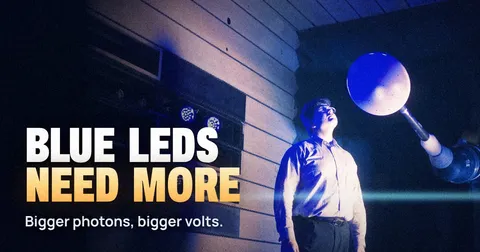
Why Do Blue LEDs Need More Voltage Than Red?
Blue photons carry 0.8 eV more than red ones, yet blue LEDs need 1.45 V more. Datasheets show where the extra voltage goes and why white LEDs match blue.
Blue photons carry 0.8 eV more than red ones, yet blue LEDs need 1.45 V more. Datasheets show where the extra voltage goes and why white LEDs match blue.
A 1 cm Ant-Man who keeps his 86 kg is as dense as a white dwarf. Why you can't squeeze out the space in atoms, and the one trick that really shrinks them.
Scale an animal to Godzilla's 81,650 tonnes and its bones carry 3,000 MPa, ten times what bone survives. Heat is the weaker argument. Here is the math.
2.45 GHz is not water's resonant frequency. We plot water's dielectric loss, compute penetration depth, show why ice won't heat and why WiFi is harmless.
Could an Iron Man arc reactor work? 3 GW in a palm-sized core is 240,000 times a fission core's power density. The fusion, neutron and heat math.
A tumbling penny tops out at 11 m/s and lands with 0.15 J, about 100 times too little to crack a skull. Here is the drag math, and what would be dangerous.
One gram of mass is 9 × 10¹³ J, about 21 kilotons of TNT. Why bombs convert under 0.1% of their fuel, plotted from a fitted binding-energy curve.
Is warp drive possible? Alcubierre's 1994 metric is valid relativity, but it needs negative energy. We compute how much and check the newer claims.
LIGO times laser light in two 4 km arms. GW150914 shifted their difference by 4×10⁻¹⁸ m, 1/420 of a proton. Optics, chirp and the stretched-light puzzle.
At 1.7 m eye height the sea horizon is 4.7 km away, about 5 km with refraction. The formula, how far you can see tall objects, and the 8 inches per mile error.
Every sunset has a green rim, but it is 4 to 8 times too thin to see. We compute the refraction and dispersion, and show why mirages make the flash visible.
Could a lightsaber exist? We compute the power to cut a blast door, why laser beams pass through each other, and why no magnet can hold a plasma blade.
Could the Dune ornithopter fly? Momentum theory says its huge wings need less hover power than a helicopter. The real problems are wing mass and flapping.
A rainbow sits 42° from the point opposite the Sun because rays leaving a raindrop pile up at a turning point. Derivation, worked numbers and computed plots.
Skylight carries more violet than blue, yet the sky looks blue. We compute the scattered spectrum and run it through human cone data to show why.
The twin paradox explained with a worked 0.8c trip: 10 years on Earth, 6 on the ship. Why acceleration is not the cause, plus Doppler counts.
A station needs about 30/√r rpm for 1 g. Why small stations feel wrong: head-to-foot gradient, Coriolis, and the radius you really need. Worked numbers.
A reproducible Python model separates water volume, kettle power and assumed efficiency to show what changes the energy used for a cup of hot water.
The station, crew and loose objects fall together. Weightlessness is about the missing support force, not gravity switching off above the atmosphere.
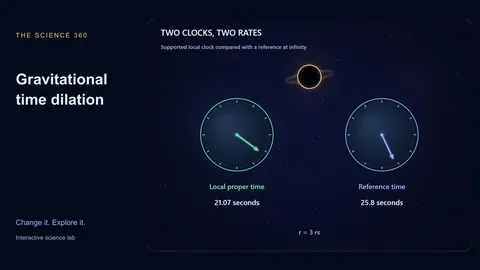
Work through supported-clock time dilation outside a nonrotating black hole, and distinguish clock rates from orbits and delayed light signals.
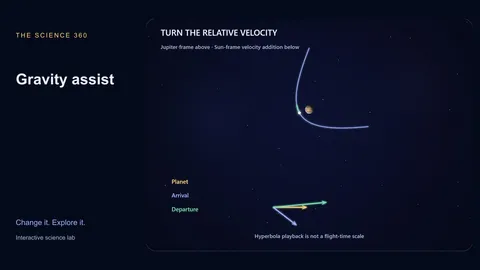
Resolve the gravity-assist puzzle by comparing planet-relative and Sun-relative velocities during a simplified Jupiter flyby.
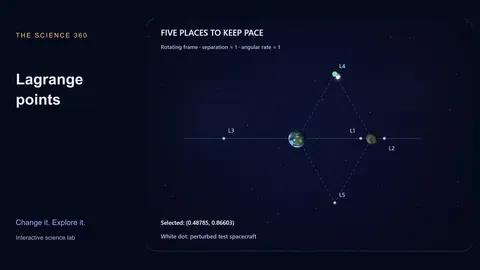
Understand the five rotating-frame equilibrium points, why L1 and L2 need station keeping, and what makes L4 and L5 different.
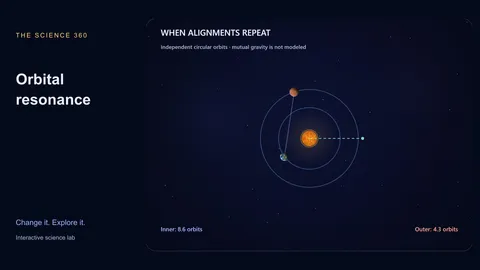
Explore 2:1 and 3:2 orbital rhythms, calculate radius ratios with Kepler’s law, and learn why a simple period match does not prove dynamical resonance.
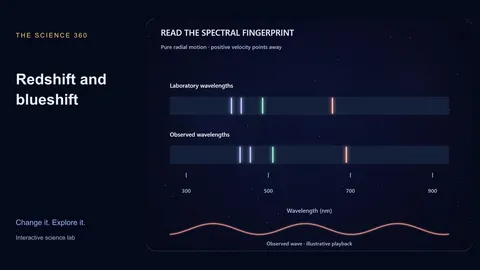
Measure a hydrogen line’s Doppler shift, distinguish fractional and absolute wavelength changes, and solve a synthetic mystery spectrum.
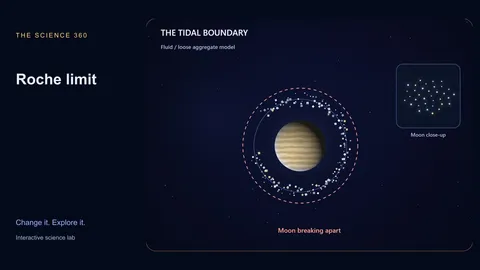
Follow a density-based worked example of the Roche limit, then test when an icy or rocky moon crosses a tidal-disruption boundary.
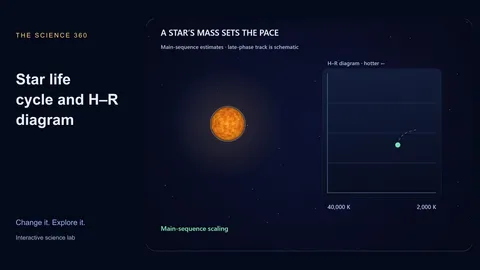
Estimate main-sequence lifetimes from mass and luminosity, read an H–R diagram, and distinguish schematic evolution paths from detailed stellar predictions.
The Arrow of Time Paradox: Exploring the Mysteries of Time's One-Way Flow. Learn about this fascinating topic and its implications for the universe.
Physics is a fascinating subject that explores the fundamental laws governing the universe. Teaching physics to kids can be a challenging task
Quantum mechanics, the branch of physics that deals with the behavior of particles at the atomic and subatomic levels...
Gravity has shaped our understanding of the universe. However, dark matter and the concept of modified gravity have challenged our...
The Manhattan Project, a secret research project initiated by the United States with the aid of Canada and the United Kingdom,...
Ever wondered why the term "black hole" was chosen to describe these fascinating cosmic phenomena? This article delves...
"Get ready to crack up and expand your knowledge with these 60 side-splitting physics jokes! From clever wordplay to scientific puns,
The universe is full of mysteries, some of which are much closer to us than we might imagine. One of these mysteries is cosmic rays,
There are super Weapons in The Star Wars Franchise. That can Release Enough energy to Blow up a Planet. But how much energy does it take?