Why Does an Ambulance Siren Change Pitch as It Passes?
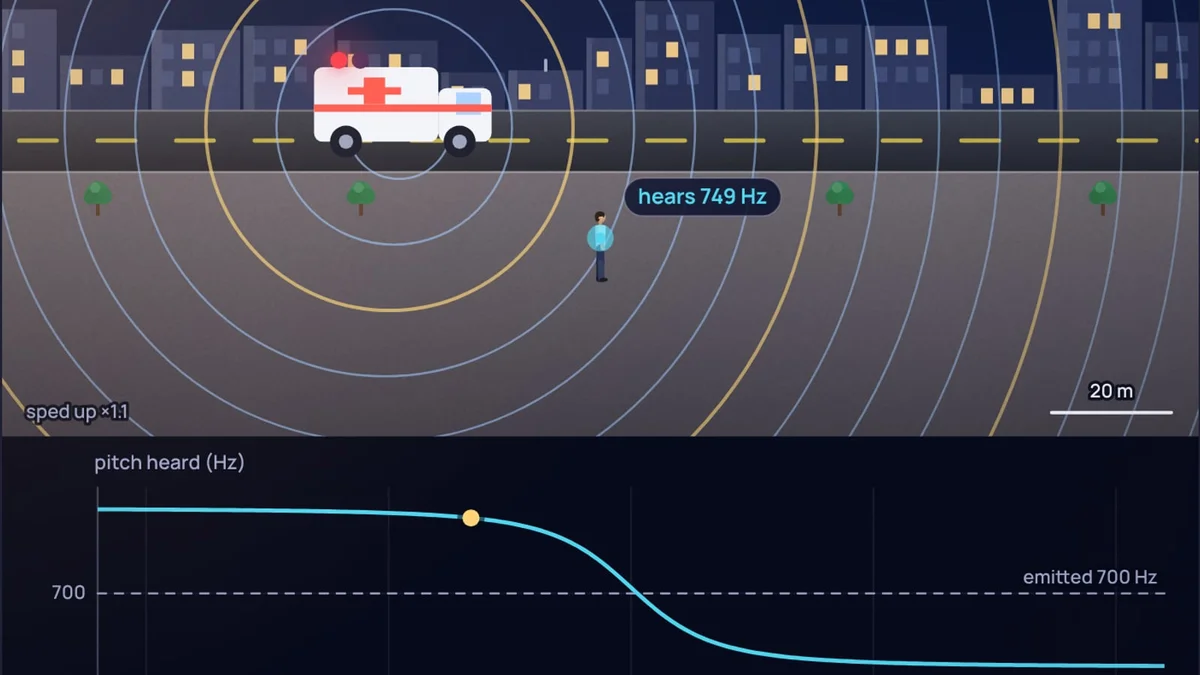
An ambulance comes up the road behind you with its siren on: a bright, insistent two-note wail. It draws level, and in about a second the whole sound sags, as if someone had turned a tuning knob down. Nothing on the ambulance changed. The driver hears the same two notes the whole time. The drop happens in the air between you, and it is big enough to measure with a phone: a 700 Hz tone on an ambulance doing 90 km/h arrives as 755 Hz and leaves as 652 Hz.
That is the Doppler effect, and you can watch it happen in our Doppler effect simulator, which draws every wavefront, plots the pitch the listener hears and, if you switch the sound on, plays it.
What is actually happening to the sound waves?
A siren pushes the air back and forth hundreds of times a second. Each push sends out a pressure crest that spreads in a sphere at the speed of sound, about 343 m/s at 20 °C. If the ambulance stood still, the crests of a 700 Hz tone would sit in neat concentric shells 49 cm apart, because .
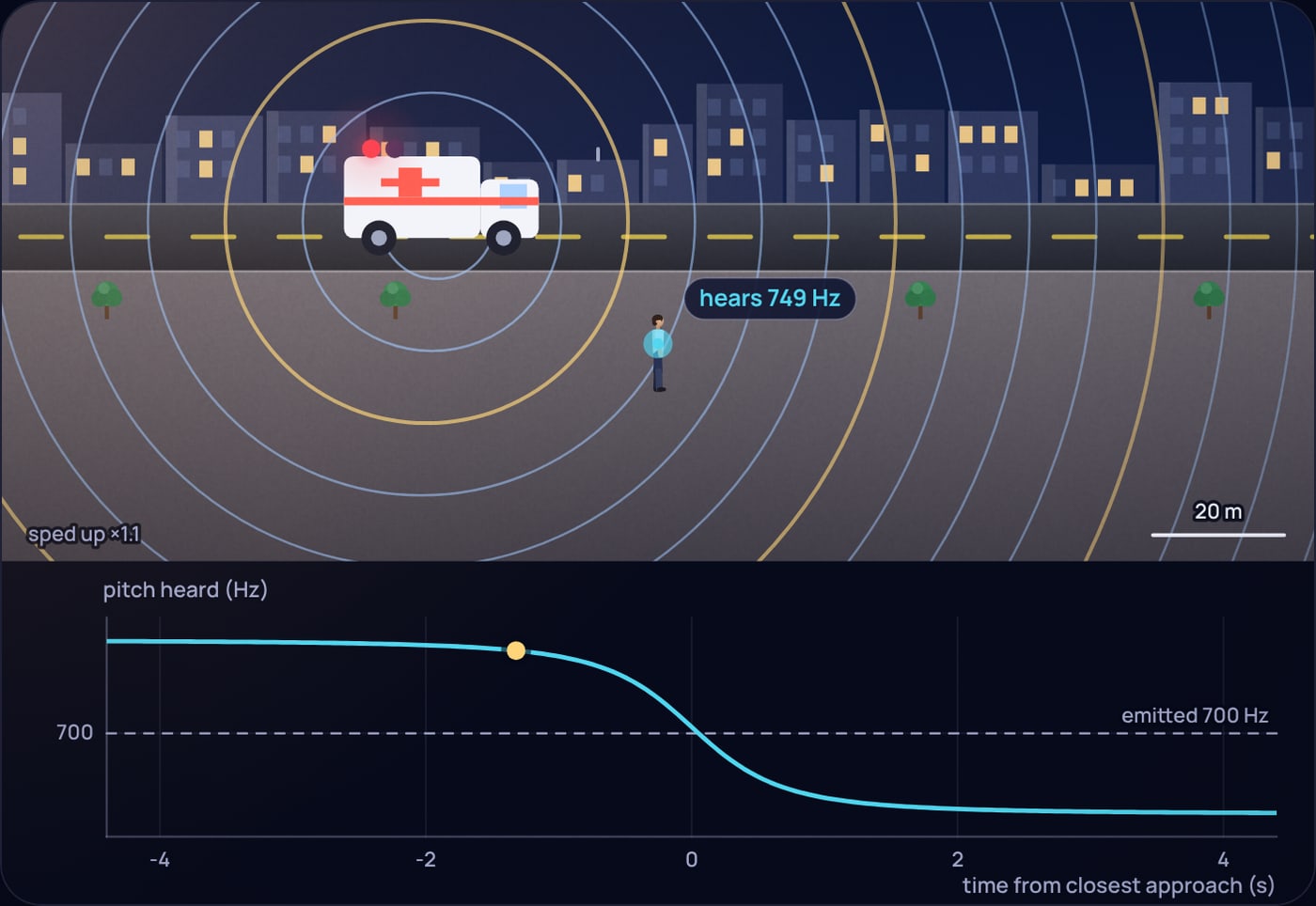
Now let it drive at 25 m/s. In the 1/700 of a second between two crests, the ambulance moves 3.6 cm forward. Every new crest starts 3.6 cm closer to the one ahead of it and 3.6 cm further from the one behind. The rings in Figure 1 are each centred on the spot where the ambulance was when it made them, which is why they look slightly off-centre.
Against 0.490 m for a parked ambulance: 7 percent shorter in front, 7 percent longer behind.
Sound in air always travels at the same speed relative to the air, whoever made it. So a shorter wavelength reaching your ear at 343 m/s means more crests per second, and that is a higher frequency. Your ear does not know or care where the source is. It just counts crests.
The Doppler effect formula
Divide the speed of sound by the squeezed wavelength and you get the frequency a still listener hears. If the listener is also moving, they run into the crests faster or slower, which adds a term on top. The general result, for motion along the line between them:
Here is the emitted frequency, the speed of sound, the source's speed and the listener's speed, both counted as positive when moving toward the other.
The ratio 755.0 / 652.5 = 1.157 is 2.53 semitones ().
Many sirens alternate two tones, often quoted as about 700 Hz and 950 Hz. Both get shifted by the same ratio, so the musical interval between them is unchanged: the whole tune just slides down by two and a half semitones as the ambulance goes by. That is why it still sounds like the same siren, only flatter.
How much does the pitch drop at different speeds?
The size of the drop depends only on the speed of the vehicle compared with the speed of sound, not on the pitch of the siren.
| Ambulance speed | Heard approaching (700 Hz siren) | Heard leaving | Drop |
|---|---|---|---|
| 30 km/h (8.3 m/s) | 717 Hz | 683 Hz | 0.8 semitones |
| 60 km/h (16.7 m/s) | 736 Hz | 668 Hz | 1.7 semitones |
| 90 km/h (25 m/s) | 755 Hz | 652 Hz | 2.5 semitones |
| 120 km/h (33.3 m/s) | 775 Hz | 638 Hz | 3.4 semitones |
A rough rule: the drop in semitones is about one for every 35 km/h. At a city crawl the shift is less than a semitone and easy to miss. On a highway it is unmistakable. A Formula 1 car at 324 km/h drops more than nine semitones, most of an octave, which is the "neeeow" everyone imitates.
Why the pitch does not keep rising as it gets closer
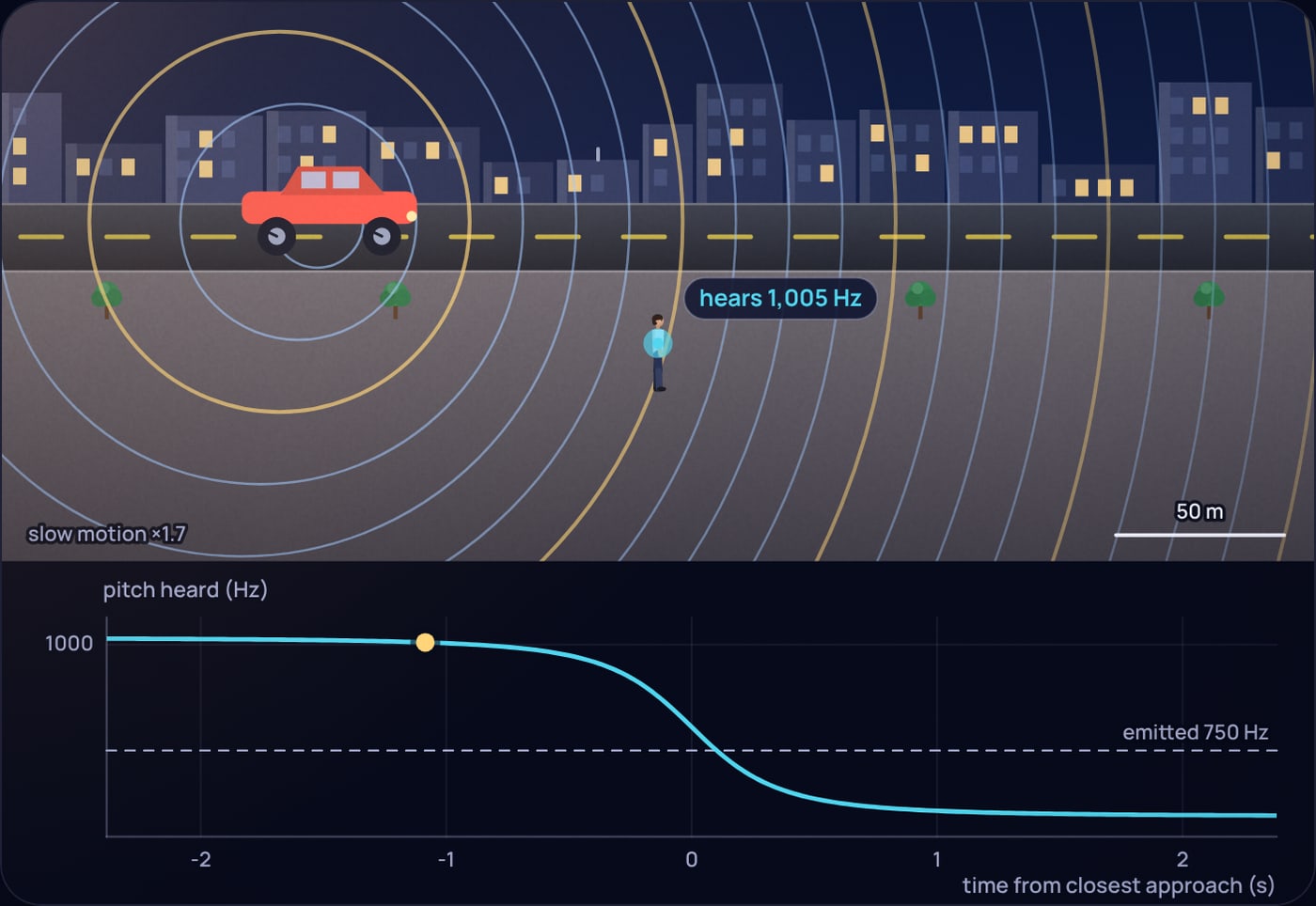
Ask people to hum an ambulance going past and many will hum a rising note, then a falling one. The physics says otherwise. While the ambulance heads straight at you, its speed toward you is constant, so the pitch is high and steady. Only the part of its velocity that points at you counts, and that part shrinks as the ambulance draws level, falls to zero at the moment of closest approach, then grows again in the other direction.
So the pitch curve is a smoothed step: flat and high, a slide down, flat and low. What rises on the approach is loudness, and our ears tend to hear loud as high. How sharp the slide is depends on how close you stand. At 90 km/h the pitch makes 80 percent of its fall in 0.3 s if you are 3 m from the lane, 1.1 s at 10 m and 3.2 s at 30 m. Standing at a bus stop you hear a sudden drop; listening from a balcony you hear a slow sag.
What if you are moving too?
Driving toward an approaching ambulance makes the shift bigger, because you run into the crests faster. At 72 km/h toward an ambulance doing 90 km/h, a 700 Hz siren is heard at 799 Hz while closing and 615 Hz after passing, a 4.5 semitone drop instead of 2.5.
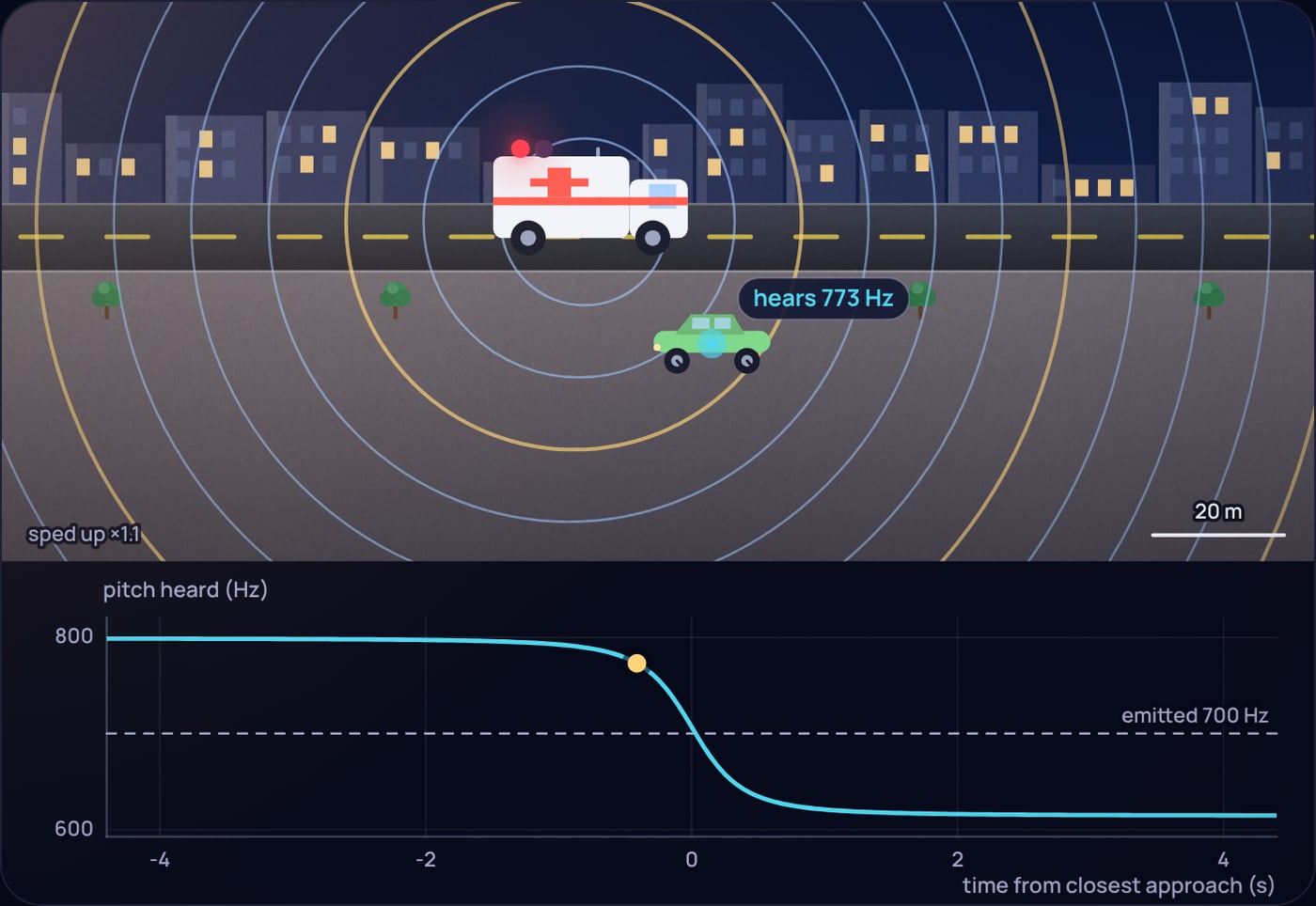
Notice that source speed and listener speed are not interchangeable for sound. A moving source changes the wavelength in the air; a moving listener only changes how fast they meet the crests. For sound, which needs air, the two give slightly different answers at the same speed. For light there is no medium, only the relative speed matters, and the formula changes. That is the version astronomers use to measure how fast galaxies recede, explained in reading starlight with redshift and blueshift and in our redshift simulator.
Can you work out the ambulance’s speed from the pitch?
Yes, and you do not need to know the siren's true frequency. Take the two pitches you hear and divide one Doppler formula by the other. The unknown cancels.
That is 90 km/h. A free spectrum app on a phone can read both pitches to a few hertz.
The same trick, with radio waves instead of sound, is how a police radar gun and a weather radar measure speed, and with ultrasound it is how a Doppler scan measures blood flow.
Does temperature change the pitch shift?
A little. The speed of sound is , which depends on the absolute temperature: 325 m/s at −10 °C, 331 m/s at 0 °C, 343 m/s at 20 °C. In colder air the ambulance is a slightly bigger fraction of the speed of sound, so the shift is slightly bigger: the approaching tone is 758 Hz on a −10 °C morning instead of 755 Hz. You would need a good ear to notice.
What happens at the speed of sound?
Push the source speed up in the simulator and the rings ahead squeeze closer and closer. At Mach 1 the source keeps pace with its own crests: they all touch at the nose and the pressure piles up into a wall, the original sound barrier. The formula's denominator goes to zero.
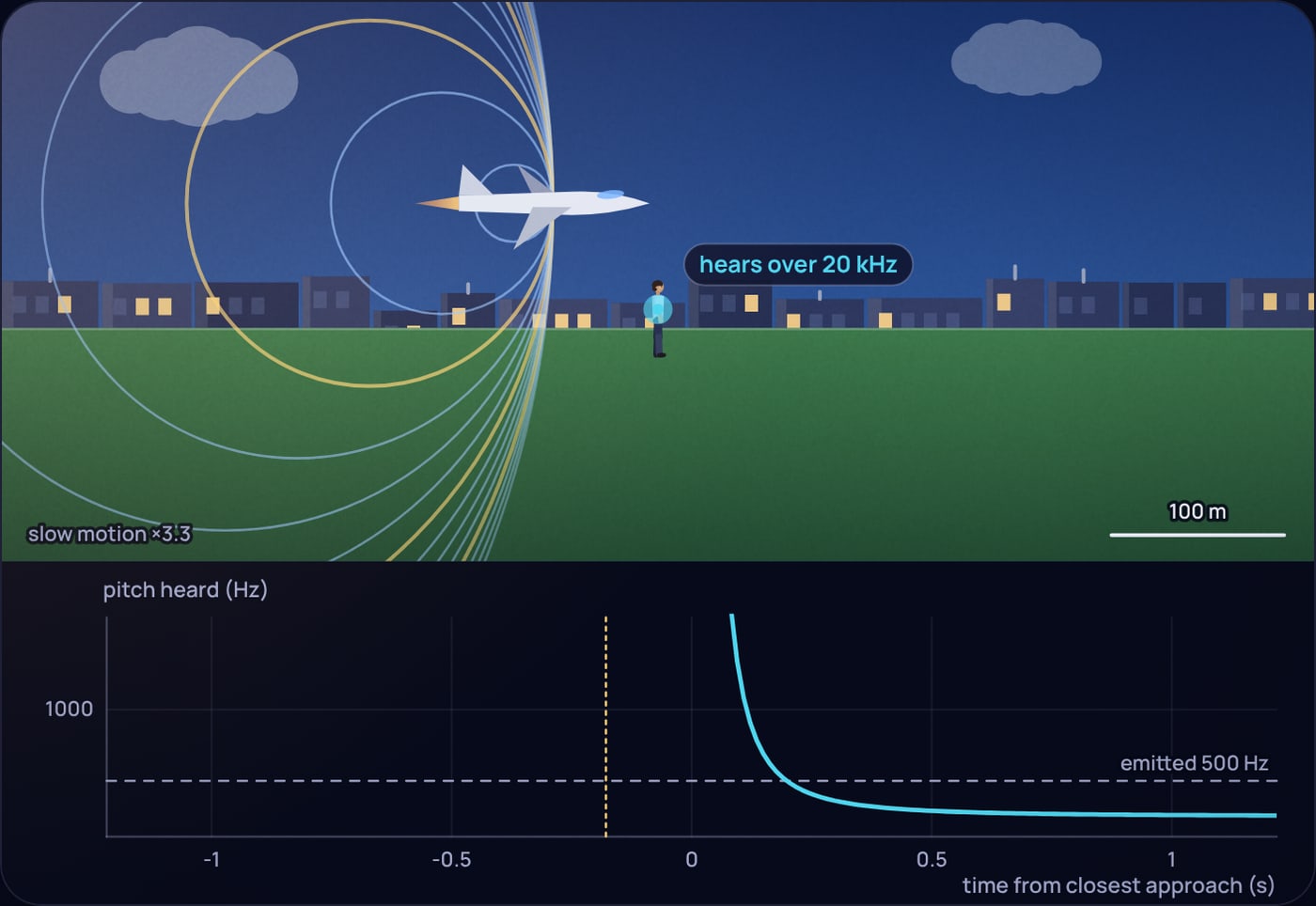
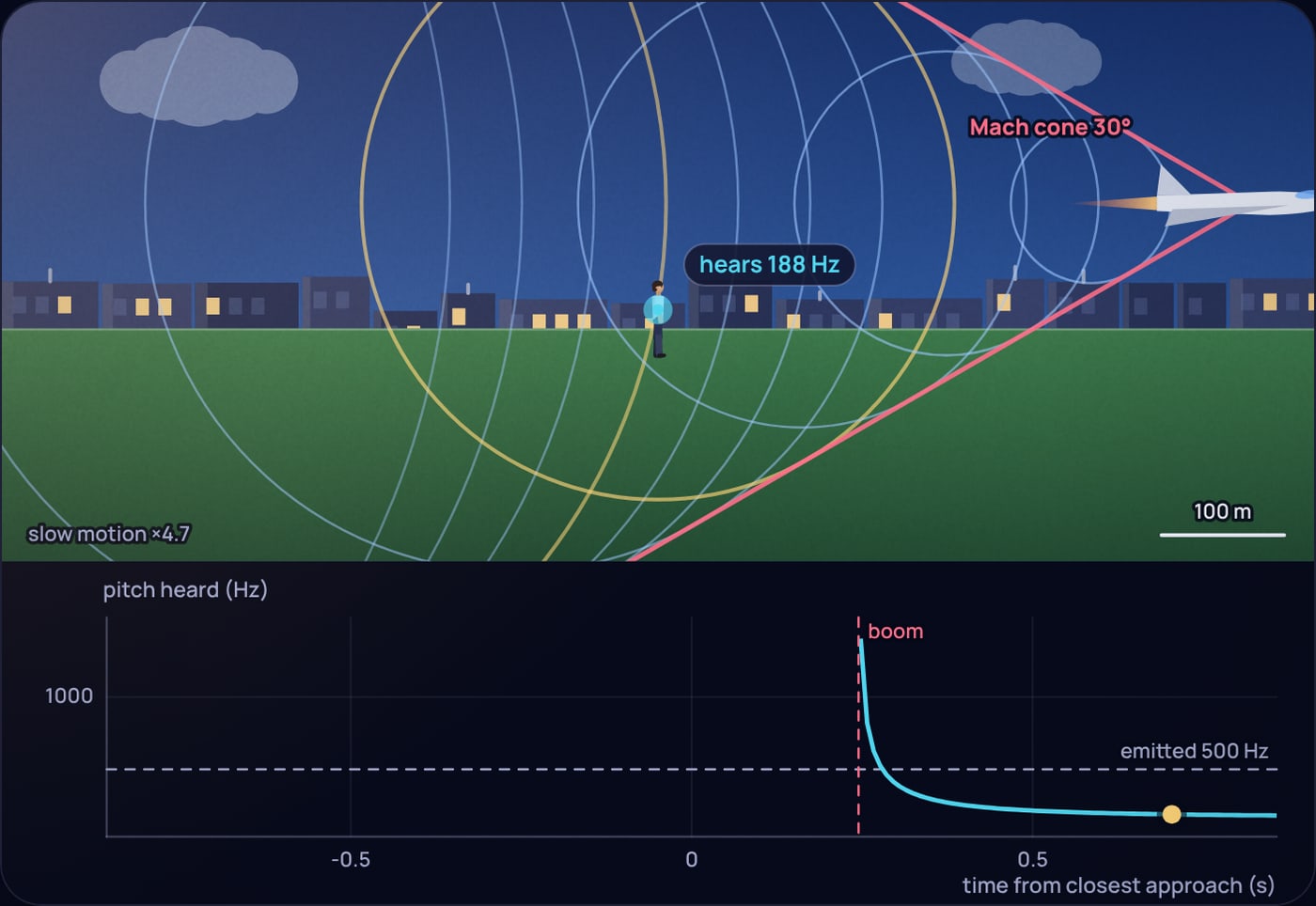
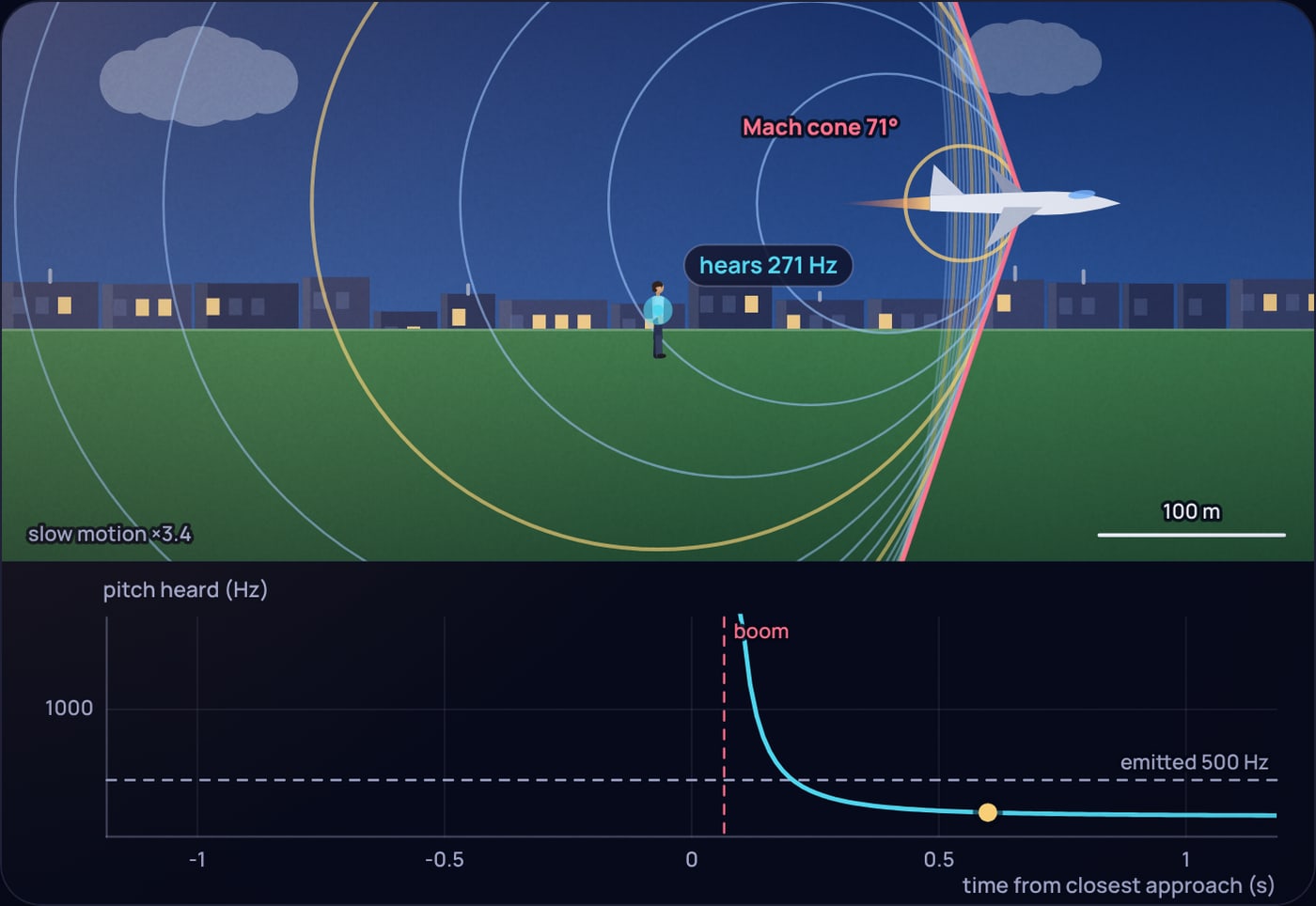
Faster still, the source outruns its sound. The rings overlap on a cone that trails behind it with a half-angle given by , which is 30 degrees at Mach 2. A listener hears nothing at all until that cone sweeps over them, then all the pressure arrives at once: the sonic boom. It is not a one-off "breaking" of the barrier; the cone is dragged along for as long as the aircraft flies supersonic.
Try it yourself
Load the ambulance setup, press the sound button and let a couple of passes go by, then drag the source speed slider to 50 m/s and listen to the drop grow. If you want to hear why noise-cancelling headphones struggle with exactly this kind of shifting tone, see how noise-cancelling headphones work.
Sources
- NASA Glenn Research Center: Speed of sound (c = √(γRT))
- Morris et al., Doppler Ambulance, Journal of Physics Special Topics, University of Leicester (700 Hz and 950 Hz siren tones)
- Wikipedia: Sonic boom
Frequently asked questions
Why does an ambulance siren sound higher when it comes toward you?
Because the ambulance moves forward while it emits each sound wave, so the crests ahead of it are squeezed closer together. They reach you more often, and your ear hears a higher frequency. At 90 km/h a 700 Hz tone arrives as 755 Hz.
Does the siren pitch keep rising as the ambulance gets closer?
No. While it drives straight at you the pitch is high and almost constant. It falls as the ambulance passes, and it is lower and almost constant while it drives away. What rises as it approaches is the loudness.
How much does the pitch drop when an ambulance passes?
It depends only on speed: about 0.8 semitones at 30 km/h, 1.7 at 60 km/h, 2.5 at 90 km/h and 3.4 at 120 km/h. Twelve semitones would be a full octave.
Can you tell how fast the ambulance is going from the pitch?
Yes. If you hear f1 approaching and f2 leaving, the speed is v = c (f1 minus f2) divided by (f1 plus f2). With 755 Hz and 652.5 Hz and sound at 343 m/s, that gives 25 m/s, or 90 km/h.
Does the ambulance driver hear the pitch change?
No. The driver moves with the siren, so the crests reach the driver at exactly the rate they are made. Only people the ambulance is moving toward or away from hear a shift.
 50 Hilarious Physics Jokes That Will Make You Laugh
 Could Ant-Man Really Shrink? The Physics Says No