Could Ant-Man Really Shrink? The Physics Says No
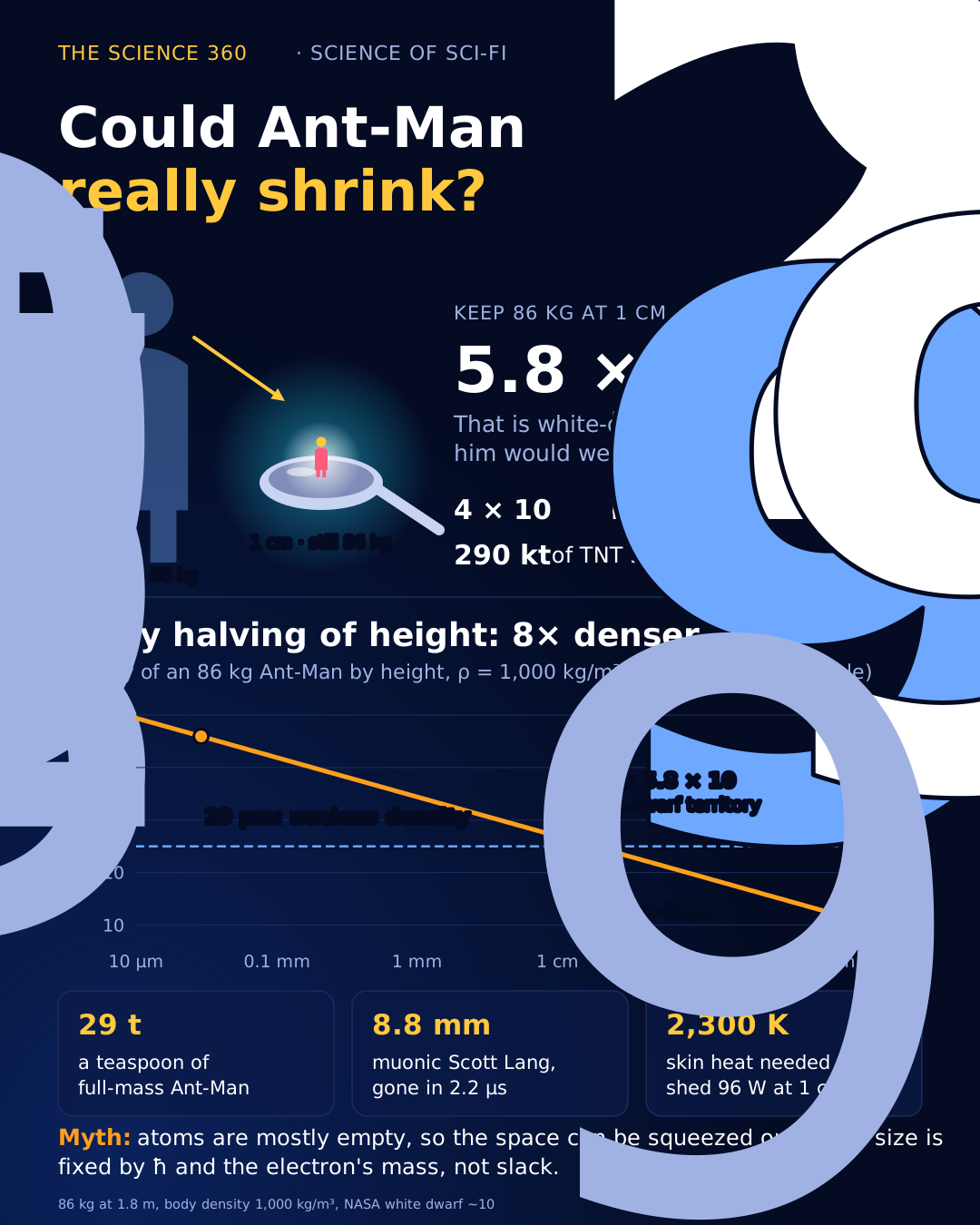
Take Scott Lang at 1.8 m and 86 kg, shrink him to 1 cm, and let him keep every gram, as the films insist he does when he punches someone at full strength. His volume drops by a factor of 180³, almost six million. His density climbs from about 1,000 kg/m³, the density of water, to 5.8 billion kg/m³. That is the average density of a white dwarf star. A teaspoon of shrunken Ant-Man weighs about 29 tonnes.
Most pages that answer this question stop at "atoms can't be compressed" or quote a big density number and move on. Neither explains why. The film's own explanation, that Pym particles reduce the distance between atoms, rests on a real fact (atoms are almost entirely empty) and draws the wrong conclusion from it. The size of an atom is not slack that can be taken in. It is fixed by three constants of nature, and there is exactly one physical knob that changes it. We will turn that knob, see what happens, and then look at what goes wrong with each version of a shrinking man.
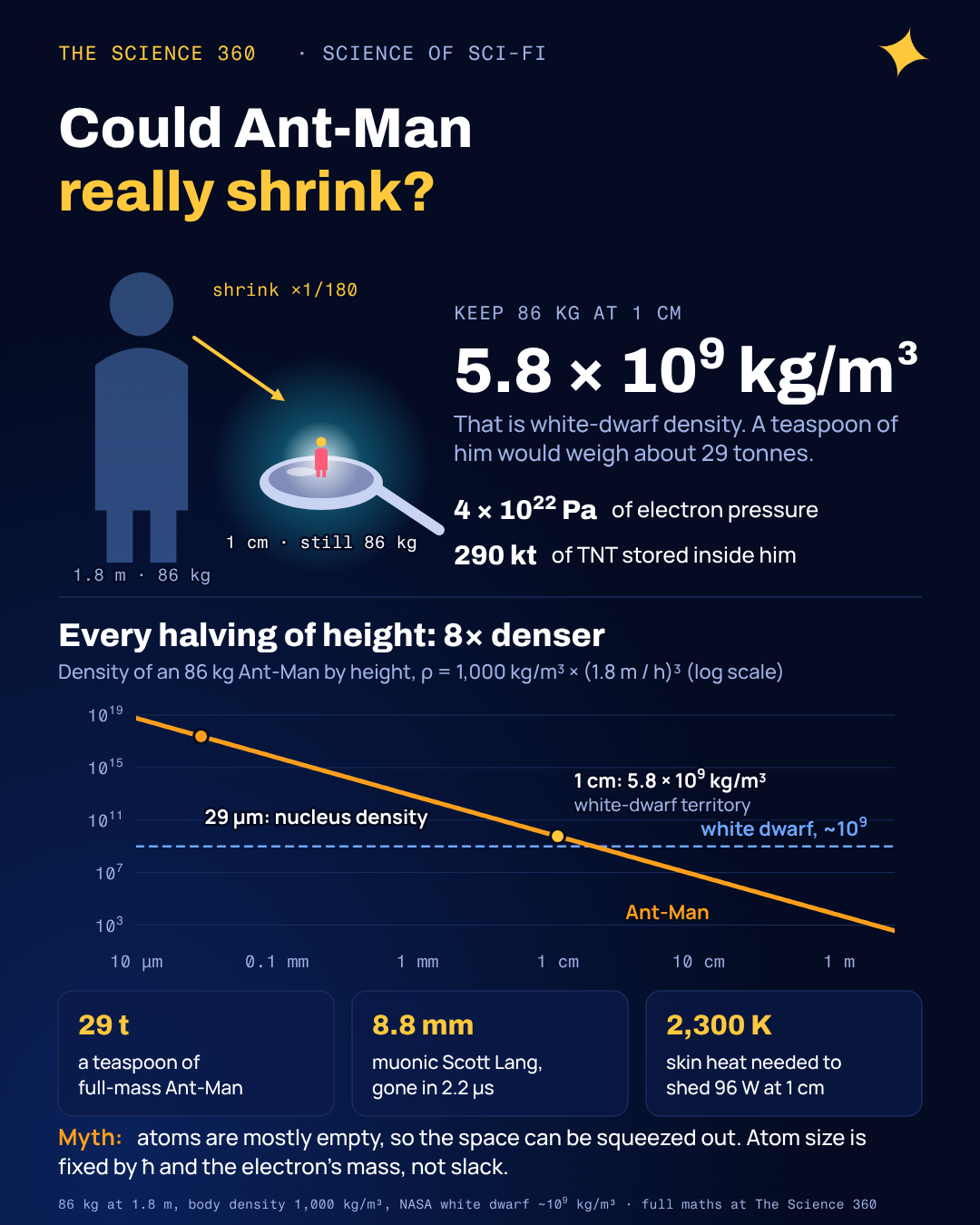
How dense would Ant-Man be if he kept his mass?
Density is mass over volume, and volume scales as the cube of height. That single cube does all the damage.
Mass-conserving Ant-Man at 1 cm
Normal: m = 86 kg and ρ ≈ 1,000 kg/m³ (people barely float), so V ≈ 0.086 m³.
The new volume is about 15 µL, a large raindrop. NASA's figure for an Earth-sized white dwarf is about 1 × 10⁹ kg/m³.
A University of Leicester student paper in the Journal of Physics Special Topics (Savage and colleagues, 2020) ran the same numbers for a half-inch Ant-Man, 0.71% of full height, and got 3.64 × 10⁹ kg/m³. Our curve gives 2.8 × 10⁹ at that size; the difference is that they assumed a body volume of 0.066 m³, which makes an 86 kg person 30% denser than water. Same order of magnitude either way. (Watch out for the paper's abstract, which drops the exponent and says 3.649 kg m−3. The body text has it right.)
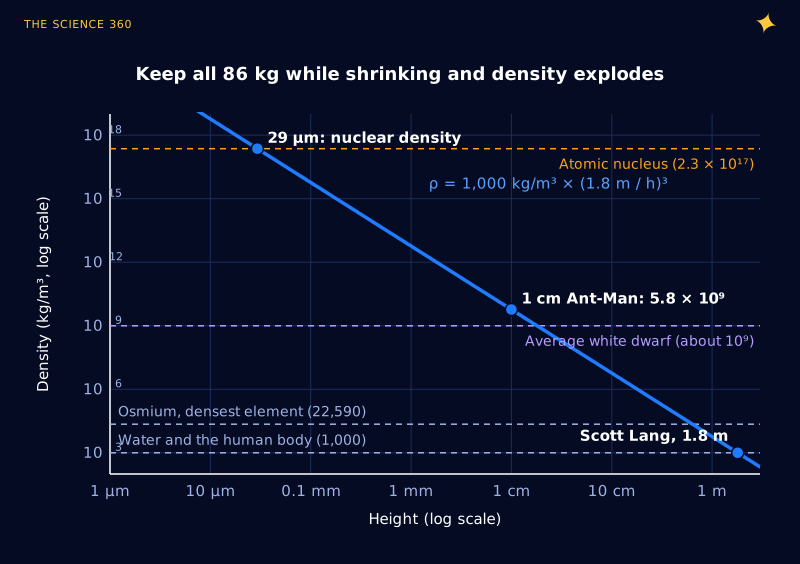
The pressure under his feet follows the same logic, with a square instead of a cube. The Leicester paper estimates 8.4 × 10⁸ Pa at half an inch. At 1 cm, with the 0.02 m² of foot scaled by 1/180², we get 1.4 × 10⁹ Pa. Structural steel yields at a few hundred megapascals. He would sink through floorboards like a hot needle through butter, and riding an ant, as he does in the first film, would mean putting 840 N on its back.
Can you shrink the space between atoms?
Here is the misconception. It is true that atoms are mostly empty. A nucleus is about 10−15 m across inside an atom about 10−10 m across, so by volume the nucleus fills roughly one part in 1014 or 1015. It is tempting to conclude that a sufficiently clever particle could just pull the electrons in. The film's explanation does exactly that, according to the Leicester paper's summary: it reduces the empty space between the nuclei and their orbiting electrons.
But the electrons do not sit at a distance like planets that chose an orbit. The size of the lowest electron state is the Bohr radius, which falls out of the balance between the electron's electric attraction to the nucleus and the uncertainty principle, which charges an energy penalty for confining it:
Why atoms are the size they are
Squeeze the electron into a smaller region and its kinetic energy rises as 1/r², faster than the attraction (1/r) can pay for it. Pauli exclusion then stops the other electrons piling into that same lowest state, so bigger atoms stay roughly the same size.
There is no "space" in that formula, only constants: Planck's constant, the electron's mass and charge, and the permittivity of the vacuum. To make atoms smaller you have to change one of them. Squeezing them from outside is possible, but it is exactly what happens inside a white dwarf, and the resistance has a name: electron degeneracy pressure. We can work out what it would be inside a 1 cm Scott Lang.
Electron pressure inside a 1 cm, 86 kg Ant-Man (own estimate, free electron gas)
Electrons per nucleon in body tissue: about 0.55 (water is 0.555).
So the electrons are already mildly relativistic. The full relativistic formula gives the degeneracy pressure:
Kinetic energy stored in those electrons:
That is about 290 kilotons of TNT.
That last line is the one Marvel should worry about. Whatever holds a compressed Scott together is holding back about a quarter of a megaton of stored energy. The day the suit glitches, the pressure is released in microseconds and the energy goes into heat and an expanding fireball. A shrunken Ant-Man is not a superhero. He is an armed device.
The opposite worry, that the dense version would collapse into a black hole, is safe to drop. The Schwarzschild radius of 86 kg is , ten billion times smaller than a proton. White-dwarf density is a long way from that; see how much a teaspoon of neutron star weighs for the next rung on the ladder.
Is there any real way to make atoms smaller?
Yes, one. Look back at the Bohr radius: it is inversely proportional to the mass of the orbiting particle. Replace every electron with a heavier particle of the same charge and every atom shrinks in proportion. Such a particle exists. The muon is a heavier cousin of the electron, 206.768 times its mass (CODATA 2022), and muonic atoms are routinely made at particle accelerators. Spyridon Michalakis, the Caltech physicist who advised on the films, pointed to exactly this idea in an interview with NBC News.
The precise shrink factor uses the reduced mass, , because a muon is heavy enough that the nucleus wobbles noticeably. For hydrogen the factor is 186; for oxygen, most of your body mass, it is 205.
Muonic Scott Lang
The height is almost exactly the size in the films. The density is white-dwarf density again, because shrinking atoms by 205 is the same thing as squeezing them. Electrons to replace, mass gained and energy to create the muons:
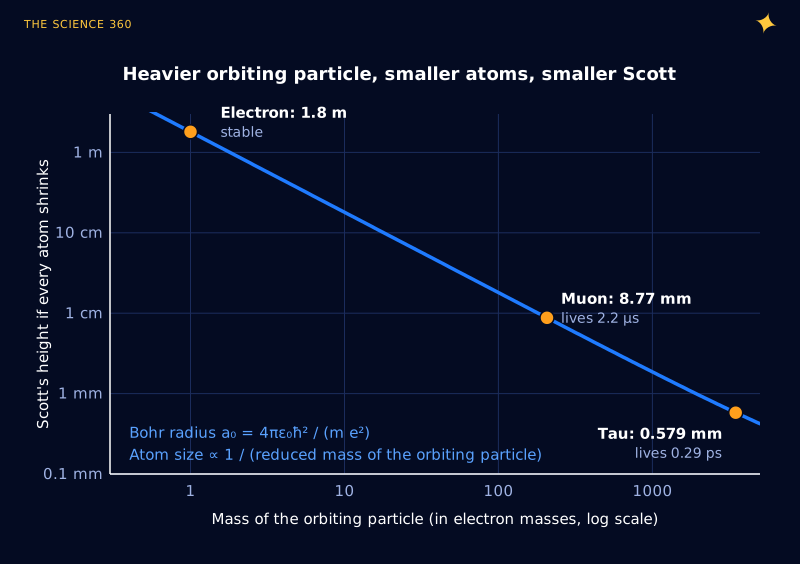
Two catches. Making 115 megatons' worth of muons means spending the output of a large power station (1 GW) for about 15 years, all at once. And the Particle Data Group's measured mean life of a free muon is 2.197 µs (shorter still when it is bound to a heavy nucleus, which can capture it). So muonic Ant-Man exists for about two millionths of a second, then all 2.85 × 1028 muons decay into electrons and neutrinos, the body re-expands to full size, and the electrons from the decay deposit a large share of that energy in the space where he used to be. If you like the bookkeeping of turning mass into energy, E = mc² for one gram puts numbers on it.
Chemistry would also go strange before it goes away. Hydrogen shrinks by 186 and oxygen by 205, so bond lengths in a muonic water molecule change by different amounts and the shapes of proteins would not simply scale. It would not be a small Scott Lang; it would be a small lump of something else.
What if Ant-Man loses mass instead?
The other way to read the films is that he sheds mass as he shrinks and stays at normal density. That fixes the floors but breaks the biology, because atoms do not shrink and neither do molecules. A smaller body built from normal-size atoms simply has fewer of them.
Normal-density Ant-Man at 1 cm
An adult body has about 7 × 1027 atoms per 70 kg, so about 8.6 × 1027 for Scott.
Fraction discarded: 99.99998%. A red blood cell (about 7.5 µm, about 270 million hemoglobin molecules) scaled to 1/180 is 42 nm wide, with room for 46 hemoglobin molecules.
You cannot build a working red blood cell from 46 hemoglobin molecules, and you cannot build a 42 nm cell at all: a single hemoglobin molecule is several nanometres across, and a cell membrane alone is several nanometres thick.
Every organ hits the same wall. Neurons, synapses and the DNA in each cell are already made from a fixed number of molecules of a fixed size. The minimum size of a working cell does not change because you want to be small. This is why ants are not tiny people: an ant's body plan is built from roughly the same size of cells as yours, just far fewer of them. And if you drop most of your neurons, the person who comes out the other side is not Scott Lang.
Why would a tiny Ant-Man freeze, and a heavy one cook?
Heat is where both versions fail again, in opposite directions. A warm body makes heat through its volume and loses it through its skin. That is the square-cube law working in reverse from the giant-monster case.
Start with the normal-density, 15 mg Ant-Man. Kleiber's law, the empirical rule for mammal metabolism, says resting power is about for a mass M in kilograms. For 86 kg that is 96 W, or 1.1 W/kg. If he keeps the same skin temperature and loses heat the same way, the loss scales with skin area.
Heat bill of a 15 mg warm-blooded human (own estimate)
Heat loss scales as area. 200 W/kg is 180 times a normal human, and 256 J a day is about 15 mg of sugar per day, his own body weight. Kleiber's law for a 15 mg mammal:
Real convection is worse at small sizes, because thinner boundary layers carry heat away faster, so 200 W/kg is a floor. The smallest warm-blooded animal by mass, the Etruscan shrew at about 1.8 g, already eats 1.5 to 2 times its body weight per day and has a heart that can hit 1,500 beats a minute. Ant-Man at 15 mg is 120 times lighter than that. Nothing warm-blooded lives at insect size; insects get away with it by not trying to stay warm.
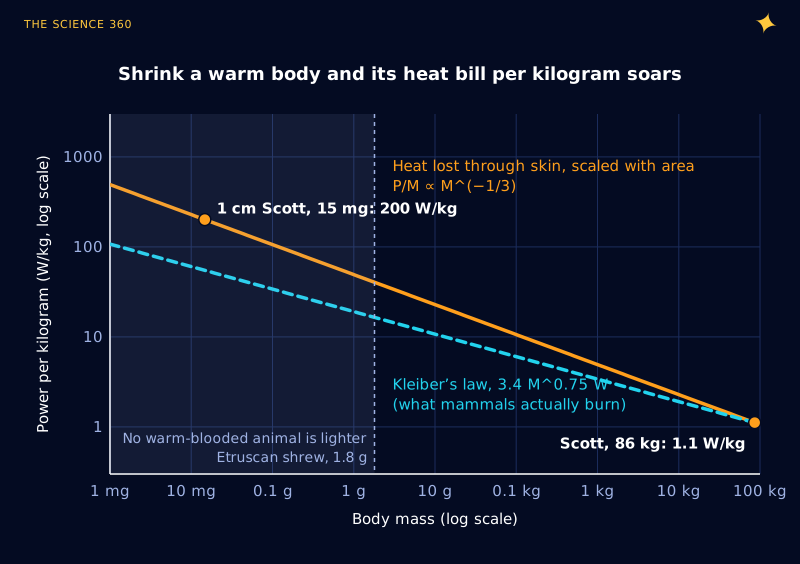
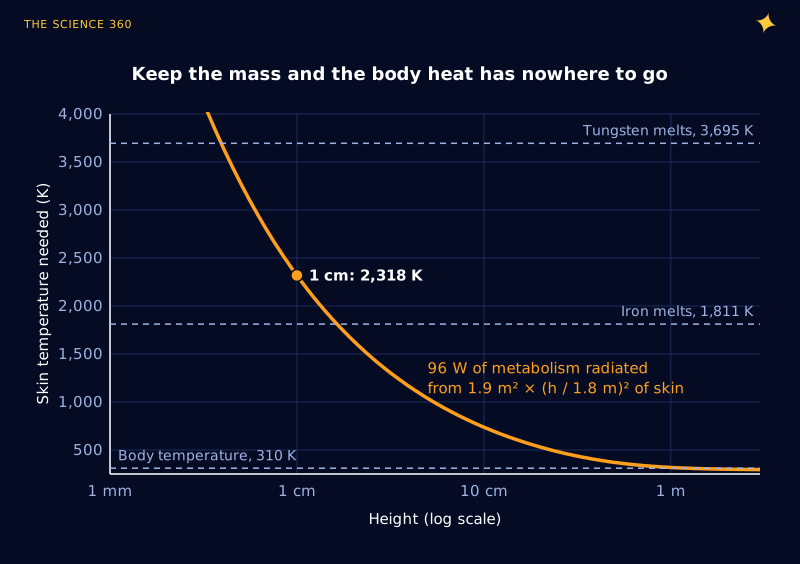
Now the mass-conserving Ant-Man. He still has 86 kg of tissue making 96 W, but his skin area has fallen from about 1.9 m² to 59 mm². If that heat has to leave by radiation, the skin temperature follows from the Stefan-Boltzmann law.
Skin temperature of an 86 kg, 1 cm Ant-Man (own estimate, radiation only)
Convection into the air would take some of that, but not enough to save him: the 1 cm body would need to shed 1.6 MW/m², about 25 times the flux from a 2 kW hob ring (our estimate: 2 kW over roughly 0.03 m²). He glows yellow-white and sets fire to the ant.
Could a tiny Ant-Man see?
One more problem the films skip. The sharpest detail an eye can resolve is set by diffraction at the pupil, . A 3 mm pupil scaled to 1/180 is 17 µm across, which gives , about 2.3°. Shrunken Scott would see the world as if through frosted glass, roughly 180 times blurrier than you do. The Leicester authors found 0.0315 rad for their slightly larger Ant-Man. This is why insects use compound eyes: many small lenses do better than one tiny one.
So could Ant-Man really shrink?
Every route ends badly. Squeeze the atoms and you are holding white-dwarf matter at 4 × 10²² Pa with a quarter of a megaton of energy waiting to escape. Swap electrons for muons and you get the right size for about two microseconds at the cost of 115 megatons. Drop the atoms and you lose the cells that make you a person, then freeze unless you eat your own weight in sugar every day. The films wave this away by sending Ant-Man into a quantum world where the rules are different, which is honest in its way: the only form of shrinking that works is one the laws of physics do not contain.
FAQ
Could Ant-Man really shrink?
Not in any way known physics allows. If he keeps his 86 kg at 1 cm tall, his density is about 6 billion kg per cubic metre, the density of a white dwarf star, held up only by enormous electron pressure. If he sheds mass instead, he has to lose 99.99998 percent of his atoms, and the copy that remains has red blood cells holding about 46 hemoglobin molecules each.
Can you shrink the space between atoms?
No. The size of an atom is not empty space waiting to be squeezed out. It is set by the electron's quantum wavefunction, which depends on Planck's constant, the electron's mass and its charge. Squeezing atoms closer means fighting electron degeneracy pressure, which is what holds up white dwarf stars, and at Ant-Man's size it would be around 4 × 10²² pascals.
How much would Ant-Man weigh when small?
The films show him keeping his full weight and strength. At about 86 kg on feet 1/180 the normal size, the pressure under his feet would be over a billion pascals, enough to punch through most floors. If he kept normal human density instead, a 1 cm Ant-Man would weigh about 15 milligrams, roughly a large ant.
Is there any real way to make atoms smaller?
Yes, in principle: replace the electrons with muons, which are 207 times heavier. Atom size scales inversely with the mass of the orbiting particle, so muonic matter is about 200 times smaller, which would make a 1.8 m man about 8.8 mm tall. Muons decay in about 2.2 microseconds, and making 3 × 1028 of them would take about 5 × 10¹⁷ joules.
Related on The Science 360
Sources
- R. Savage, R. Dev Choudhury, T. Rawlins and A. Hammerton, "The Practicality of Ant Man's Shrinking", Journal of Physics Special Topics P4_01, University of Leicester (2020): journals.le.ac.uk
- NASA Imagine the Universe, "White Dwarf Stars" (Earth-sized white dwarf density about 1 × 10⁹ kg/m³): imagine.gsfc.nasa.gov
- NIST CODATA 2022, muon-electron mass ratio 206.7682827: physics.nist.gov
- Particle Data Group, Review of Particle Physics 2024, lepton summary table (muon mean life 2.1969811 µs, tau mass 1776.93 MeV, tau mean life 290.3 fs): pdg.lbl.gov
- NBC News MACH, "'Ant-Man' science adviser explains the real-life physics behind the film" (Spyridon Michalakis on muonic matter): nbcnews.com
- Wikipedia, "Composition of the human body" (about 7 × 1027 atoms in a 70 kg adult; elemental mass fractions): en.wikipedia.org
- Wikipedia, "Red blood cell" (about 270 million hemoglobin molecules, 6.2 to 8.2 µm diameter): en.wikipedia.org
- Wikipedia, "Kleiber's law" (BMR ≈ 3.4 M0.75 W): en.wikipedia.org
- Wikipedia, "Etruscan shrew" (about 1.8 g, eats 1.5 to 2 times body weight per day, heart up to 1,511 beats per minute): en.wikipedia.org
Method note: densities, degeneracy pressure (relativistic free electron gas, 0.55 electrons per nucleon), muonic shrink factors (reduced mass with oxygen-16 nuclei), metabolic scaling and radiative skin temperatures are our own calculations from the constants and sources above. Scott Lang's 1.8 m and 86 kg follow the Leicester paper.
Header image: NASA (image iss038e029161), regraded for this article.