Could Godzilla Exist? The Square-Cube Law, With Numbers
The 2014 Godzilla stands 108.2 metres tall and weighs 81,650 tonnes, according to the film's own publicity numbers. The heaviest land animal we have good evidence for, the sauropod Argentinosaurus, comes in at around 75 tonnes on the most recent estimates. That is a gap of a factor of about 1,100. The square-cube law says that gap is not a matter of evolution not trying hard enough. It is a matter of bone.
Most articles stop at "weight grows faster than strength." That is true, but it hides the useful part: how fast, which part of the body gives up first, and which popular objections (overheating, mostly) turn out to be weak. So let us put real numbers on it.
What is the square-cube law?
Galileo worked it out in 1638, in Two New Sciences, with a drawing of two bones: a normal one and the much fatter one an animal three times larger would need. The argument fits in two lines. Make every length k times bigger. Every area (a bone's cross-section, a muscle's cross-section, the skin) grows by k². Every volume, and therefore every mass and weight, grows by k³.
Stress is force divided by area. The force on a leg bone is set by the weight it carries, so:
In terms of mass ():
Double an animal's height with the same proportions and every bone in it works twice as hard. Biewener, who measured bone strains in running animals for decades, puts the empirical version at for geometrically similar bodies, close to the ideal one third.
How much stress would Godzilla’s bones carry?
We need a starting point from a real animal. Biewener's review of mammal locomotion reports that peak bone stresses during strenuous running sit around 50 to 100 MPa from mice up to horses (about 0.04 to 300 kg), with bone's compressive fracture strength around 240 MPa. That gives a safety factor of roughly 2 to 4, and it stays roughly constant across that size range.
Take the generous end: a 300 kg animal at 50 MPa. Now scale it with unchanged proportions.
Step 1. Scale factor in mass
Godzilla 2014 against a 300 kg running mammal.
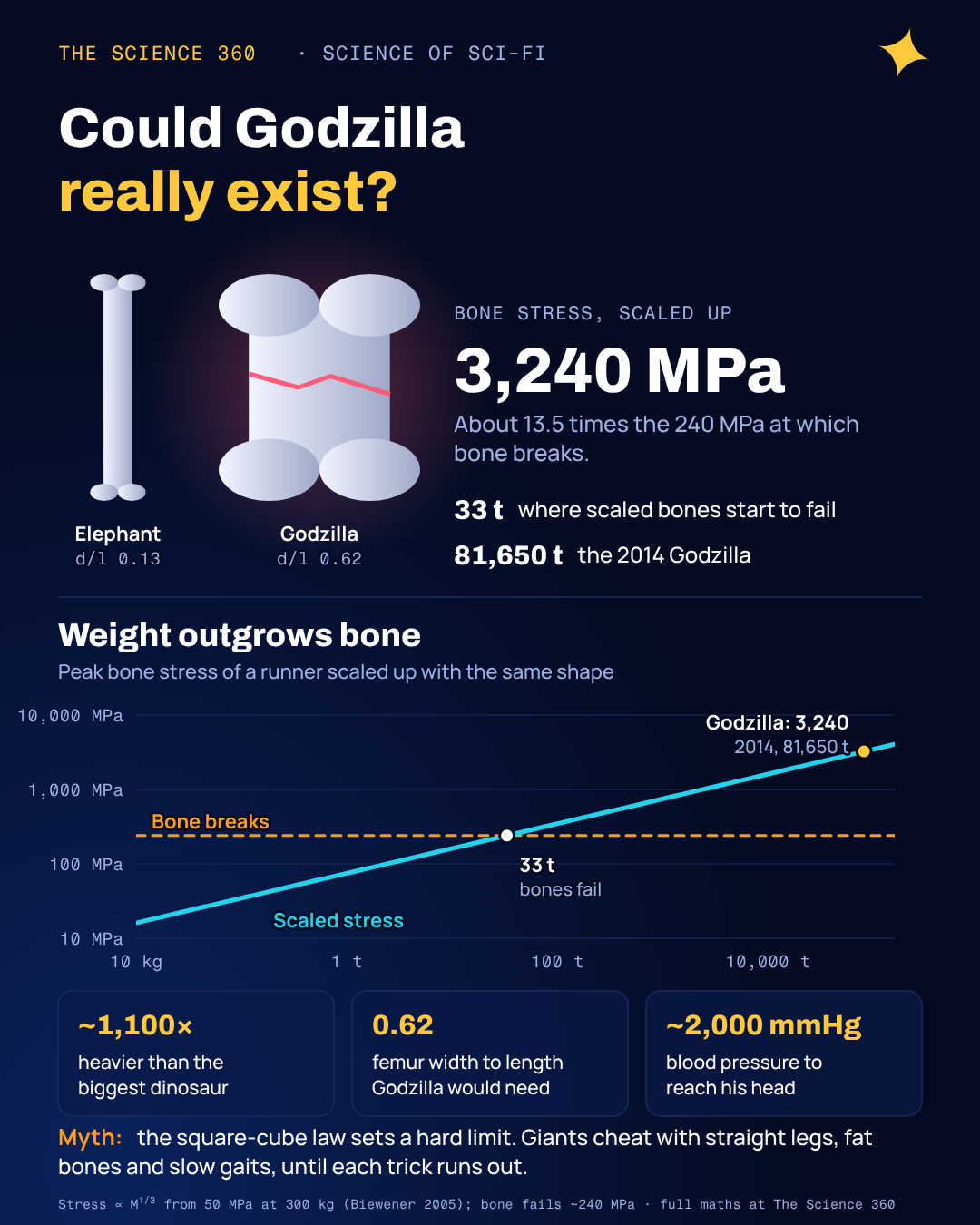
Step 2. Stress grows as M1/3
Step 3. Compare with bone
That is 13.5 times the compressive failure stress. The same line crosses 240 MPa at:
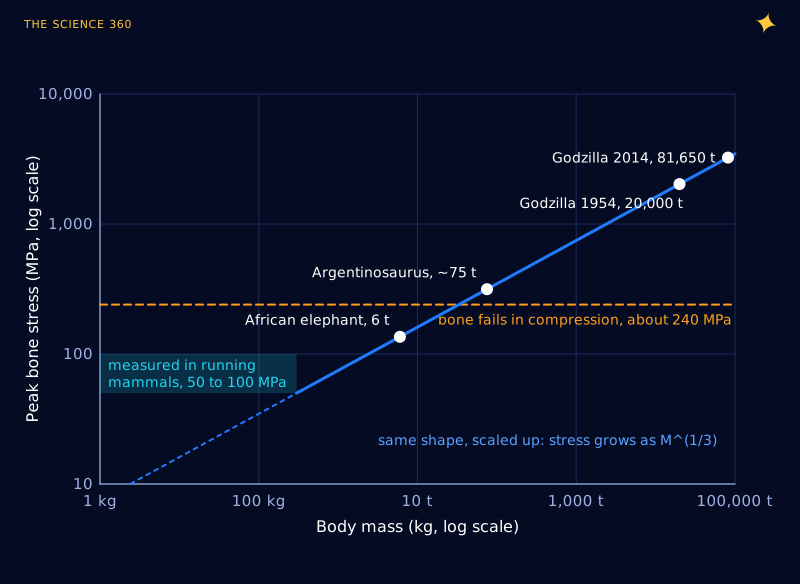
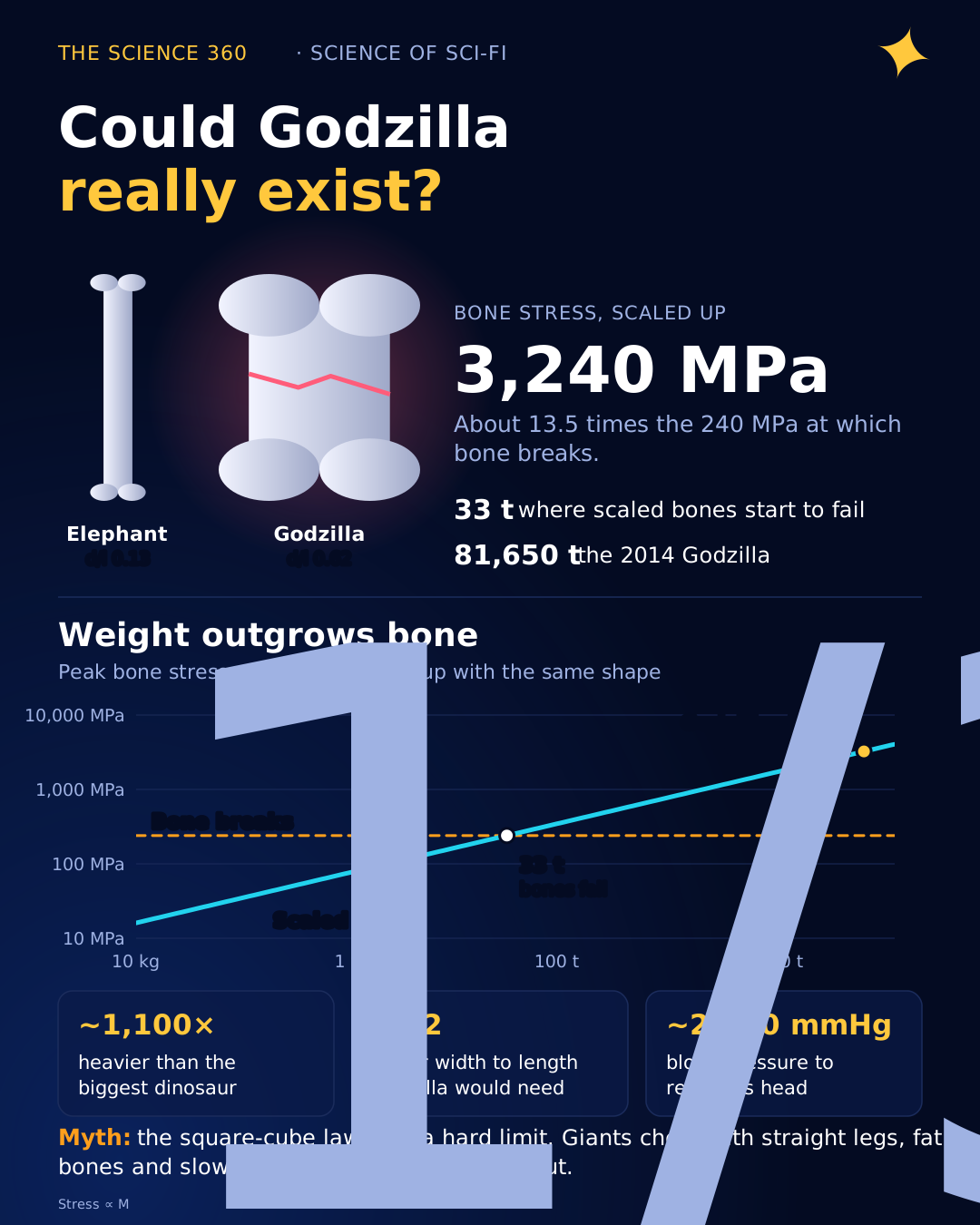
Even the original 50 m, 20,000 tonne 1954 Godzilla lands at about 2,000 MPa. And the stress line in Figure 1 crosses failure at 33 tonnes, which raises an obvious question: how did 75 tonne sauropods exist at all?
The misconception: “the square-cube law sets a hard size limit”
It does not, on its own. It sets a limit for an animal that keeps its shape. Real giants cheat, in three ways, and every one of them has a cost.
They change posture. A mouse runs crouched; a horse stands on near-vertical legs. Biewener showed that limb effective mechanical advantage (how much leverage the muscles get against the ground force) rises roughly as body weight to the 0.25 power from mice to horses. Straighter legs line the bone up with the load and cut the bending, which is what really stresses long bones. This is why measured stress stays flat in Figure 1's green band instead of climbing the blue line. The catch: once a leg is a vertical column, there is no more straightening to do. Biewener notes that the very largest mammals instead show strong positive allometry (fatter bones), which suggests the posture trick runs out.
They get fatter bones. Keep stress constant and bone area must grow in proportion to mass, so diameter grows as M1/2 while length grows only as M1/3. The ratio diameter/length grows as M1/6. An African elephant's femur has a length about 2.5 times its circumference, according to Tefera's osteometric study, which means a diameter/length ratio of about . Scale that up with constant stress:
The first is a 75 t sauropod (12.51/6 = 1.52), the second Godzilla (13,6001/6 = 4.89). d/l reaches 1, a bone as wide as it is long, at:
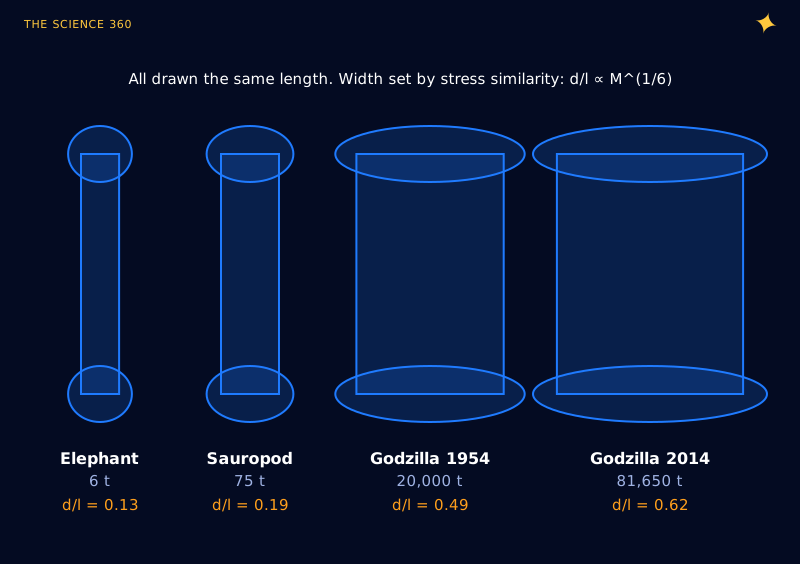
A thigh bone 62% as wide as it is long, on a body that is also broad and heavy, leaves no room for the muscle that has to move it. Muscle force grows as cross-section too, so it hits the same k² wall. Every step costs proportionally more and the muscle is proportionally weaker.
They slow down. Elephants never get all four feet off the ground. Hutchinson and colleagues filmed them in Thailand in 2003: at their top speed of around 15 mph the footfall pattern stays the same as walking, with at least one foot always down. Dropping the aerial phase caps the peak load at not much more than body weight per leg. Godzilla in the films lurches, swings a tail the length of a building, and falls over in fights. Falling is the worst load case of all.
Could Godzilla even stand still?
Let us be maximally kind. Give the 2014 Godzilla elephant-proportioned leg bones with a solid (not hollow) cross-section, and let him stand on two legs without moving. Assume the femur is 15 m long, which is my rough estimate for a 108 m creature, not a film figure.
Weight
Femur cross-section (d/l = 0.127)
Axial stress, standing still
That is already 60% of bone's compressive strength, with no walking, no bending and no fatigue. Real long bones see bending stresses several times larger than their axial stress, and Biewener's review cites compact bone failing in fatigue after a million cycles at 50 to 100 MPa amplitude. Standing still might work for an afternoon. The first stride would not.
Would Godzilla overheat? Less than you think
This is the argument popular articles reach for second, and it is much weaker than the bone one. The naive version says heat production scales with volume (k³) and heat loss with skin area (k²), so a giant cooks. But real animals do not make heat in proportion to mass. Kleiber's law, measured across mammals, gives basal metabolic rate as roughly with M in kilograms.
Heat flux through the skin, Kleiber scaling
Human, 70 kg, with about 1.9 m² of skin:
Skin area goes as M2/3 and metabolism as M3/4, so:
Same thing if metabolism scaled with mass
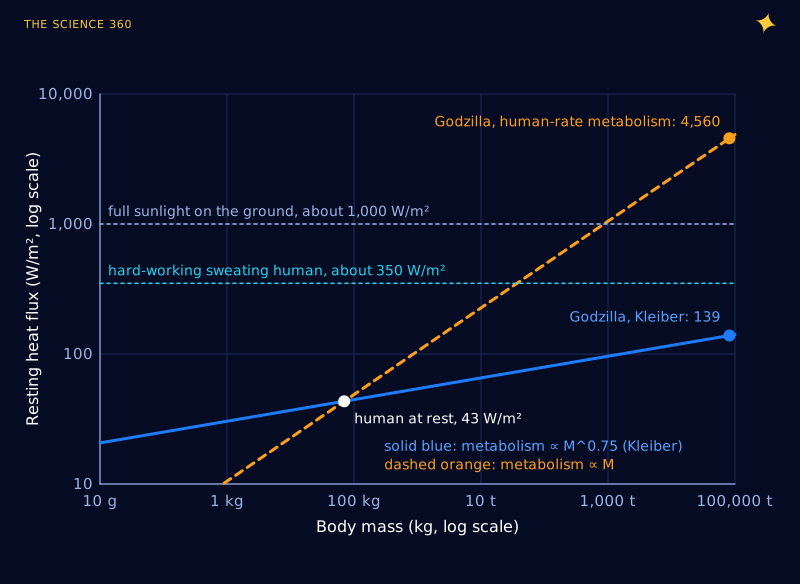
At 139 W/m² resting, Godzilla is in the same league as you jogging. Active metabolism runs several times basal, so he would need big ears, wet skin or a cool sea to retreat into, but none of that is impossible. Heat only becomes a killer argument if you assume Godzilla runs a mouse-like metabolism per kilogram, which no large animal does. Bones, not heat, set the limit.
What about blood pressure?
Here the numbers do turn ugly. Every metre of blood column needs about 77 mmHg of pressure (that is just with blood at 1,050 kg/m³: ). Giraffes, with heads about 2 m above their hearts, already run mean arterial pressures near 200 mmHg at heart level, roughly twice ours, and need tight skin on their legs to stop blood pooling.
Godzilla's head, say 25 m above the heart (my assumption):
The extra 100 mmHg is what the brain needs. That is ten times a giraffe and about twenty times a human.
Pressure like that in vessels at the feet, another 80 or so metres further down, would be enormous. Vessel walls would need to be absurdly thick. Long-necked sauropods posed the same problem on a smaller scale, and how they solved it (if they ever held their heads high) is still argued about.
Does the square-cube law work in reverse for Ant-Man?
It does, and the small end has its own physics. Shrink a 1.8 m, 80 kg person to 1.5 cm, a factor of 120.
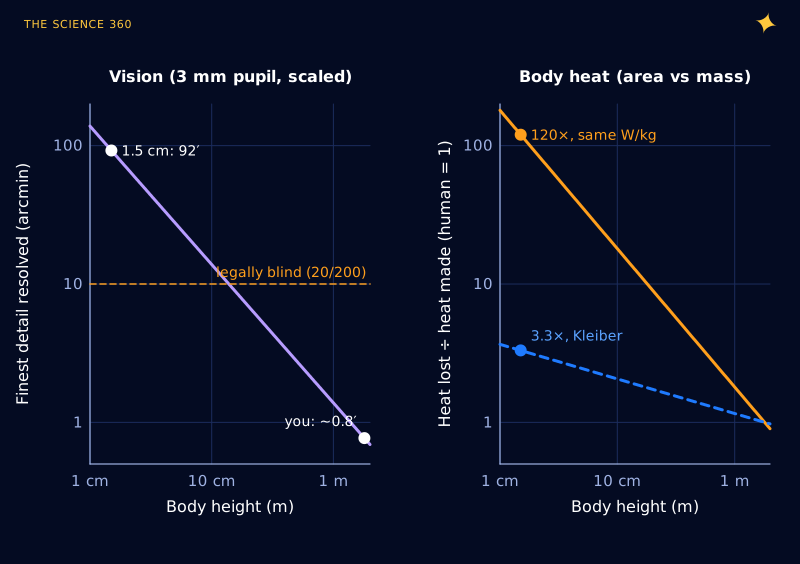
If he keeps normal tissue, his mass falls by million, to about 46 mg. His skin area falls only by . So relative to the heat he makes, he loses heat 120 times faster than you, before counting that small objects also have higher convective heat transfer coefficients. Small mammals fight this with high metabolisms: Kleiber scaling says a 46 mg mammal would burn about 36 times more energy per kilogram than you. That still leaves him losing heat 120/36 = 3.3 times faster than he makes it. No mammal comes close to being this small, and this is why.
His eyes fare worse. A pupil of about 3 mm in daylight limits you to roughly 0.8 arcminutes by diffraction ( with λ = 550 nm). Shrink the pupil 120 times to 25 μm:
Legal blindness (20/200) is about 10 arcminutes.
If he keeps his full 80 kg, which is how the comics explain his punches, the problem flips back to stress. Standing on about 0.03 m² of foot (my estimate for two adult feet), you press on the floor at about 26 kPa. Divide the area by 14,400 and the pressure becomes about 380 MPa, more than bone's compressive strength and dozens of times what floorboards will take. He would sink into the carpet on bones that were crushing themselves.
So how big could a monster really get?
On land, the record is the sauropods, with Argentinosaurus estimates mostly between 65 and 80 tonnes in recent work and older figures up to about 100. They got there with columnar legs, air-filled vertebrae that saved weight, long necks that let them feed without walking much, and slow gaits. Push past a few hundred tonnes and every one of those tricks runs out at once, because the bone, the muscle and the blood column all hit their k² or ρgh walls together.
In water the weight problem largely disappears, which is why the heaviest animals that have ever lived are whales. A 100 m Godzilla floating in the Pacific is closer to plausible than one walking up Tokyo Bay. The moment he steps ashore, he is an 81,650 tonne animal on bones that start failing at 33. The film never shows that scene, and physics explains why.
FAQ
What is the square-cube law in simple terms?
When you scale an object up by a factor k in every direction, its surface areas and cross-sections grow by k squared but its volume and weight grow by k cubed. A bone's strength depends on its cross-section, so a scaled-up animal's bones carry k times more stress than the original's.
How big can a land animal get?
The largest known land animals are sauropod dinosaurs such as Argentinosaurus, with recent mass estimates around 65 to 80 tonnes. Published estimates of the absolute ceiling vary with their assumptions, but they cluster around 100 tonnes or somewhat more, roughly a thousand times lighter than the 81,650 tonnes quoted for the 2014 Godzilla.
Would Godzilla overheat?
Less than people assume. Real animals' metabolic rate grows as mass to the 0.75 power, not in proportion to mass, so an 81,650 tonne animal resting would need to shed about 140 watts per square metre of skin, roughly three times a resting human. Its bones fail long before heat becomes the limit.
Does the square-cube law apply to Ant-Man?
Yes, in reverse. A person shrunk to 1.5 cm with normal tissue would lose body heat through the skin about 120 times faster relative to the heat they make, and their 25 micrometre pupils would limit vision to about 90 arcminutes of detail, far worse than legal blindness. If he kept his full mass, the pressure under his feet would exceed bone strength.
Could Godzilla exist in water?
Water removes most of the weight problem, which is why the heaviest animals that have ever lived are whales. A sea monster still faces feeding, oxygen supply and heat limits, but it does not need legs that can hold 81,650 tonnes. Walking out of the sea onto land is the part that breaks the physics.
Related on The Science 360
Sources
- Godzilla film heights and weights (2014: 108.2 m, 81,650 t; 1954: 50 m; 2019: 119.8 m): en.wikipedia.org/wiki/Godzilla
- IFLScience, "The cube-square law: why we'll never get a creature the size of Godzilla" (1954 Godzilla 20,000 t figure): iflscience.com
- Biewener, A. A. (2005), "Biomechanical consequences of scaling", Journal of Experimental Biology 208: 1665 to 1676 (peak bone stresses, 240 MPa compressive strength, EMA ∝ W0.25, fatigue at 50 to 100 MPa): journals.biologists.com
- Biewener, A. A. (1989), "Scaling body support in mammals: limb posture and muscle mechanics", Science 245: 45 to 48: doi.org/10.1126/science.2740914
- Argentinosaurus mass and length estimates: en.wikipedia.org/wiki/Argentinosaurus
- African bush elephant (average bull 6.0 t; largest recorded 10.4 t): en.wikipedia.org/wiki/African_bush_elephant
- Tefera, M. (2012), osteometry of African elephant limb bones (femur length to circumference ratio 2.5), Journal of Veterinary Anatomy: dx.doi.org/10.21608/jva.2012.44872
- Hutchinson, J. R. et al. (2003), "Are fast-moving elephants really running?", Nature 422: 493 to 494; summary: colorado.edu
- Kleiber's law (BMR ≈ 3.4 W × M0.75): en.wikipedia.org/wiki/Kleiber's_law
- Mitchell, G. et al. (2006), "The origin of mean arterial and jugular venous blood pressures in giraffes", Journal of Experimental Biology 209: 2515: journals.biologists.com
- Square-cube law and Galileo's Two New Sciences (1638): en.wikipedia.org/wiki/Square-cube_law
Method note: all scaling curves are computed from the power laws stated in the captions. Femur length, head height above the heart, foot area and sweat rate are my own round-number assumptions and are labelled where used.
Header image: NASA (image 6872176), regraded for this article.