Why Are Planets Round but Asteroids Aren't? The Math
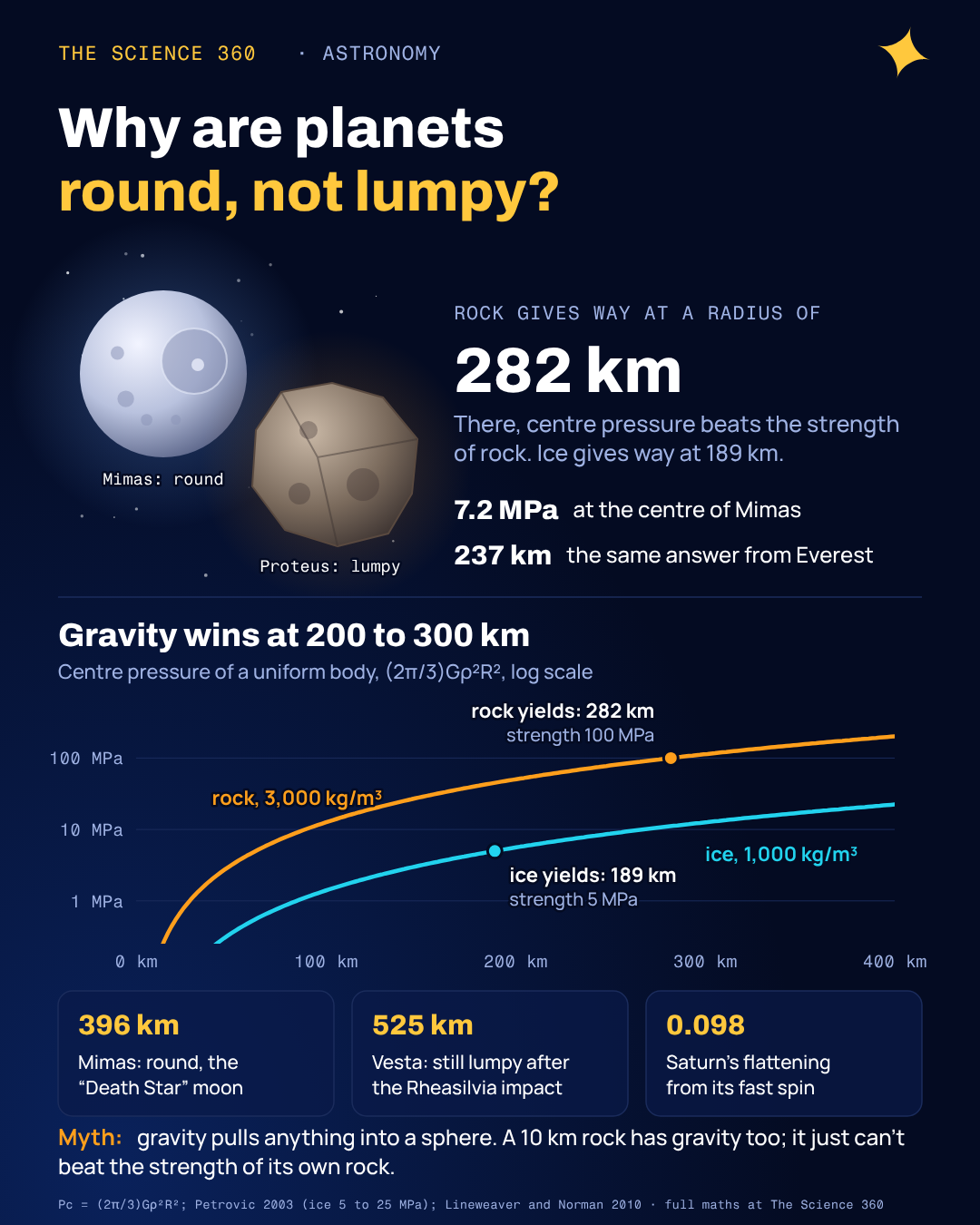
Saturn's moon Mimas is 396 km across and looks like a ball with a giant crater on it, the famous "Death Star" moon. Neptune's moon Proteus is slightly bigger, about 420 km across, and looks like a dented box. The asteroid Vesta is bigger again, 525 km across, and is distinctly lumpy. Yet the asteroid Hygiea, smaller than Vesta at about 433 km, turned out in 2019 VLT images to be nearly spherical.
So "big things are round, small things aren't" is true, but it doesn't explain any of those four cases. To do that you need the actual physics: a contest between the pressure gravity creates inside a body and the strength of the material resisting it. The nice part is that you can work out the crossover size on the back of an envelope, and it lands very close to what spacecraft have photographed.
Why are planets round? Gravity versus strength
Every piece of a planet pulls on every other piece. Add up those pulls and you get a force pointing toward the center of mass, and a pressure that grows as you go deeper. A mountain is a column of rock pressing down on its base. If the base can hold the weight, the mountain stays. If the pressure exceeds what the rock can bear, the base crushes or flows sideways, and the mountain sinks until it can be supported.
On a large body this process never stops until nothing sticks out above an equal-gravity surface. For a body that is not spinning, that surface is a sphere. Astronomers call the result "hydrostatic equilibrium," borrowing the word for fluids, because over millions of years solid rock and ice really do behave like extremely thick fluids under enough pressure.
A common misconception is that gravity "pulls everything into a sphere" for any object. Every asteroid has gravity; a 10 km rock has gravity. What it lacks is enough gravity to overcome the strength of its own material. The shape is the outcome of a contest, and small bodies lose it, or rather, their strength wins it.
How big does an object have to be to be round?
The cleanest version of the calculation compares the pressure at the center of a uniform sphere with the compressive strength of the material. For a sphere of uniform density ρ and radius R, integrating the weight of the overlying layers gives a central pressure of
The is the whole story. Double a body's size and its central pressure goes up fourfold, while the strength of rock or ice stays the same. Somewhere there has to be a crossover.
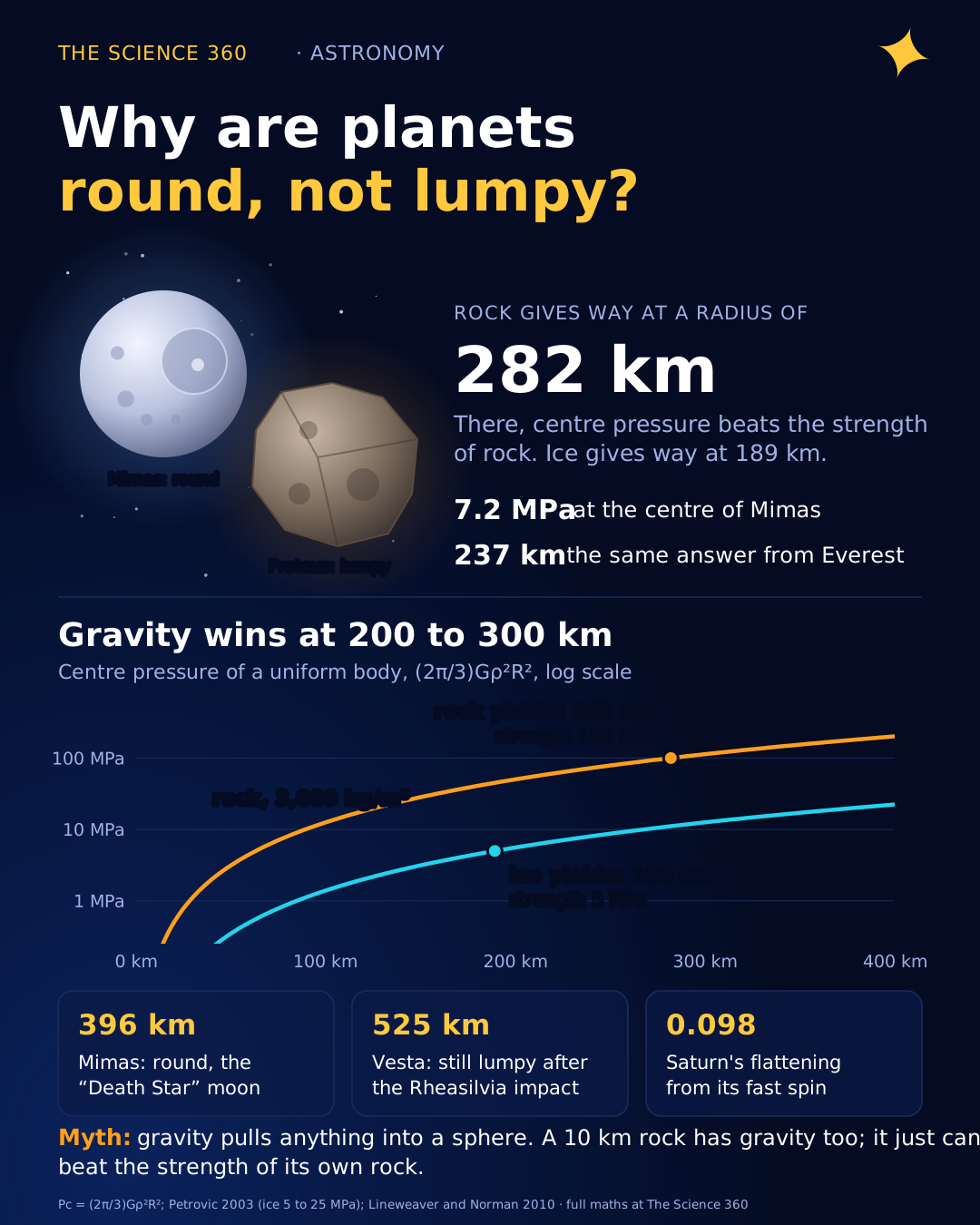
For the material side, lab measurements give us ranges. Petrovic's review of ice mechanics puts the compressive strength of ice at 5 to 25 MPa between −10 °C and −20 °C (stronger when colder). Common crustal rocks such as granite and basalt mostly fall around 100 to 250 MPa in uniaxial compression, though individual samples vary widely.
Worked calculation 1: the pressure at the center of Mimas
Mimas: mean radius , density .
Compare with ice strength of 5 to 25 MPa: Mimas sits right at the bottom of the range. It is just barely big enough.
Worked calculation 2: solving for the threshold radius
Set (the compressive strength) and solve:
Ice, , :
Rock, , :
Those two numbers, roughly 200 km for ice and 300 km for rock, match the "potato radius" that Charles Lineweaver and Marc Norman of the Australian National University derived in 2010 by looking at which real bodies are round and which aren't. Ice wins the roundness race at a smaller size even though it is less dense, because it is roughly ten times weaker than rock.
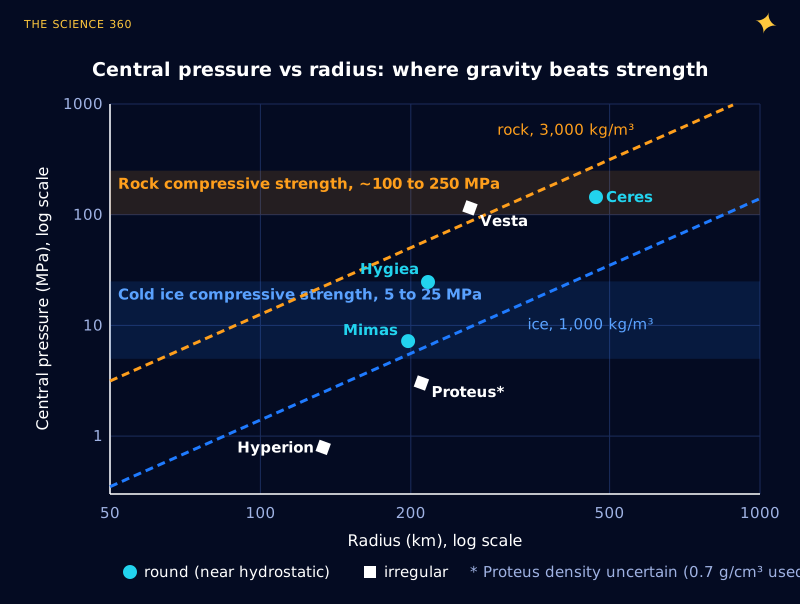
Figure 1 shows the borderline cases. Hyperion (central pressure under 1 MPa) is a sponge-like potato. Mimas reaches the ice band and is round. Vesta, at about 115 MPa, sits at the bottom of the rock band and is not quite round. Ceres, at about 144 MPa and with plenty of ice mixed into its rock, is comfortably round. Hygiea is the odd one, and we'll come back to it.
Why aren’t asteroids round? The borderline cases
Mimas versus Proteus: same size, different fate
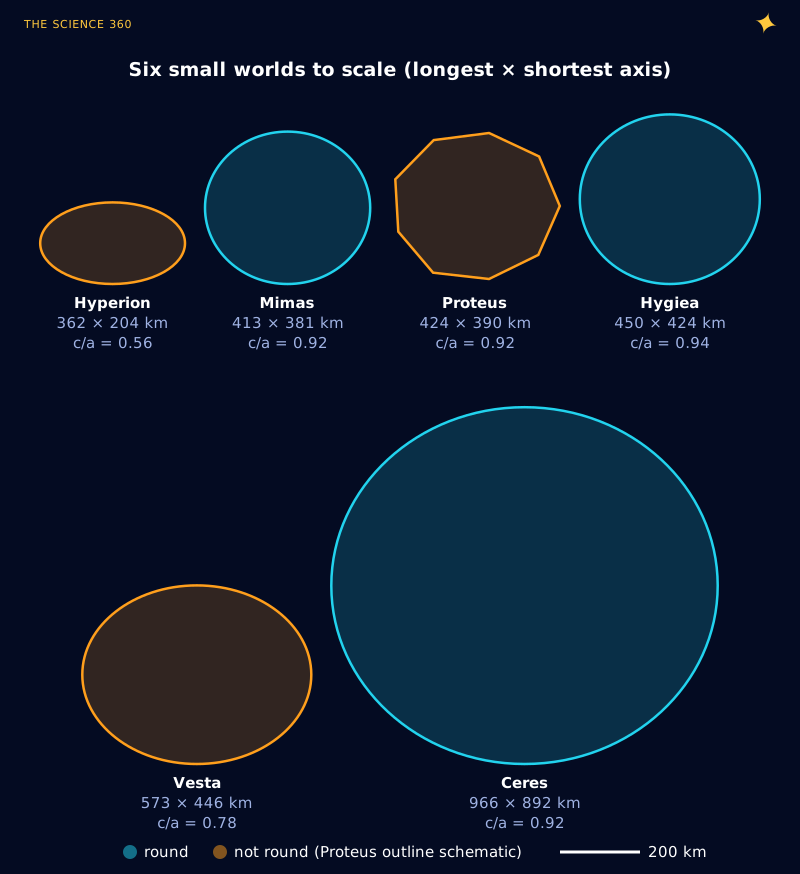
Mimas (413 × 381 km) and Proteus (424 × 390 km) are almost the same size. Mimas is not even a perfect sphere: Saturn's tides stretch it so the long axis points at the planet, and its longest axis is about 8% longer than its shortest. But that stretched shape is a smooth ellipsoid, the shape a fluid takes in a tidal field. Proteus has flat faces and up to 20 km of relief, which are thought to be old degraded impact craters that never relaxed.
The likely reasons are temperature and density. Proteus orbits Neptune at about 30 AU from the Sun, where ice is colder and therefore stronger, and its density is poorly known but probably low. Mimas is close to Saturn and has been flexed by tides. Proteus is usually described as being right at the maximum size a body of its density can reach without being pulled round. Both bodies are near the line in Figure 1, which is exactly where you'd expect history to break ties.
Vesta: big enough, but smashed
Vesta has a mean diameter of 525 km and a density of 3.46 g/cm3. NASA's Dawn mission found that Vesta is "currently not in hydrostatic equilibrium." Its shape is 573 × 557 × 446 km, and most of that short axis comes from the Rheasilvia impact basin at the south pole, a crater about 500 km across with a central peak about 22 km high. Vesta was probably closer to round once; a giant impact after it had cooled and stiffened knocked a chunk off, and its rock is now too strong to relax back.
Hygiea: round because it was destroyed
Hygiea is the surprise. At about 433 km across and 1.94 g/cm3, its central pressure works out to about 25 MPa, far below rock strength. Yet the SPHERE instrument on ESO's Very Large Telescope showed it is nearly spherical, and Pierre Vernazza's team found its shape matches a rotating fluid in equilibrium. Their explanation is that a massive impact shattered Hygiea completely, and the debris reaccumulated into a ball. A pile of gravel has essentially no strength, so it settles into an equilibrium shape the way sand does. That makes Hygiea a possible dwarf planet, and a reminder that "strength" in these calculations means the strength of the body as it actually is, cracks and all.
A second way to get the same answer: mountain heights
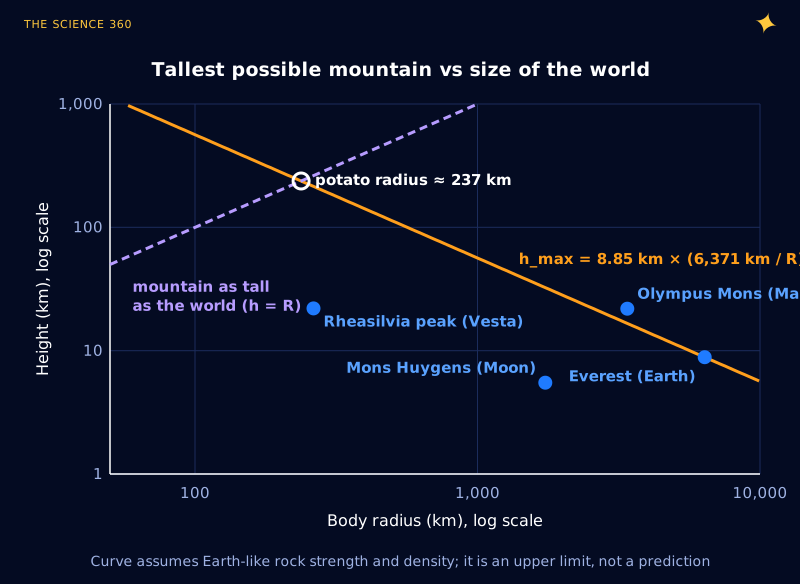
There is a lovely cross-check using mountains. The tallest mountain a world can support scales as , because the pressure at the base, , can't exceed the rock's strength. Surface gravity scales with radius for a fixed density, so scales as . Meanwhile the body itself scales as . When the tallest possible mountain is as tall as the body is wide, the body is just a mountain: a potato.
Worked calculation 3: the potato radius from Mount Everest
Take Everest as Earth's : on . For an Earth-density body of radius :
Set :
Physicist Matt Caplan published essentially this argument in 2015 and got 238 km, landing between the ice and rock estimates. It works because Everest is close to the height limit set by rock strength on Earth. Mars, with 38% of Earth's surface gravity, has Olympus Mons rising about 22 km above the Martian datum, within about 10% of the 23 km the scaling predicts.
Is “round” the IAU definition of a planet?
Partly. Resolution B5 of the International Astronomical Union's 2006 General Assembly says a planet (a) orbits the Sun, (b) "has sufficient mass for its self-gravity to overcome rigid body forces so that it assumes a hydrostatic equilibrium (nearly round) shape," and (c) has cleared the neighborhood around its orbit. A dwarf planet meets (a) and (b) but not (c), and must not be a moon.
That second criterion is precisely the strength-versus-gravity threshold we just calculated, written in committee language. It is also why the definition is fuzzy at the edges. "Nearly round" has no number attached, and as Vesta, Proteus and Hygiea show, bodies near the threshold can land on either side depending on composition, temperature and collision history. Round moons such as Mimas pass the shape test but are excluded because they orbit planets.
Planets aren’t perfectly round either: the spin bulge
Hydrostatic equilibrium does not mean a sphere if the body spins. The equal-gravity surface has to include the centrifugal effect, which is strongest at the equator, so spinning worlds bulge. Earth's equatorial radius (6,378.1 km) exceeds its polar radius (6,356.8 km) by about 21 km, a flattening of 1 part in 298. Saturn is the extreme case among the planets: 60,268 km at the equator, 54,364 km at the poles, a flattening of 0.098, almost 10%. You can see it in a backyard telescope.
How much a planet flattens depends on how fast it spins relative to how strongly it holds itself together. Physicists capture that with one number, , the ratio of centrifugal to gravitational acceleration at the equator.
Worked calculation 4: Saturn's spin parameter
Rotation period 10 h 33 m 38 s = 38,018 s (Mankovich et al. 2019, from ring seismology).
Uniform-density prediction (Maclaurin): . Observed: .
Saturn is only half as flat as a uniform ball spinning at the same rate would be. That is a measurement of its interior: most of Saturn's mass is concentrated toward the center, and a centrally concentrated planet bulges less because the dense core holds the outer layers more firmly. If all the mass were a point at the center, the flattening would drop to q/2, about 0.079. Every giant planet in Figure 4 falls between those two lines, and where it falls tells you how centrally condensed it is.
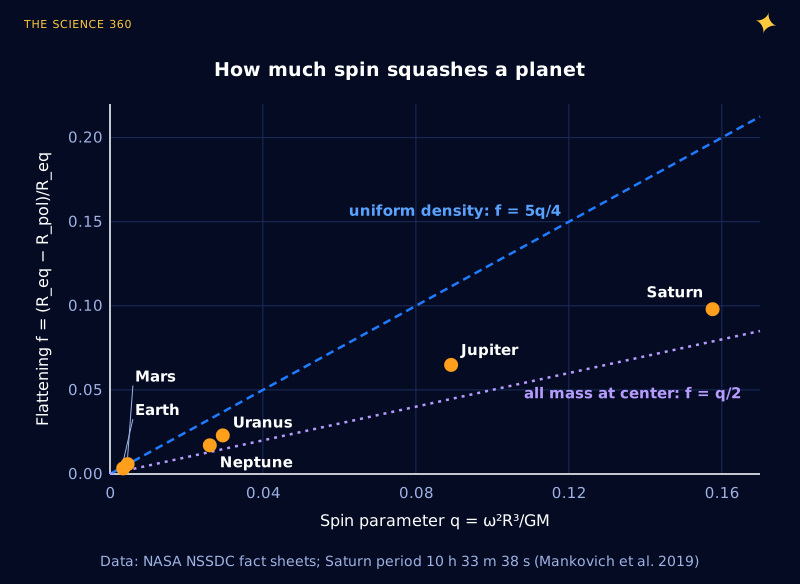
Mars is the honest outlier: its measured flattening is slightly larger than even a uniform fluid would give. Mars has a thick, strong lithosphere, and the giant Tharsis volcanic province is a load held up by rock strength rather than floating in equilibrium. Even a planet-sized body can carry a few non-hydrostatic bumps if its outer shell is cold and stiff enough.
What the numbers can and cannot tell you
The central-pressure calculation is an order-of-magnitude tool, not a sharp rule. Real bodies are not uniform, rock creeps under loads far smaller than its short-term lab strength if you wait millions of years, and warm interiors flow more easily than cold ones. That is why published thresholds wobble by tens of percent, and why Lineweaver and Norman back out effective strengths from the observed shapes rather than plugging in lab values. Still, a back-of-envelope estimate that lands within a factor of 1.5 of what spacecraft see, from nothing but G, density and lab strength, is a good day for physics.
If you like this kind of small-body physics, the same eccentricity and energy reasoning that sorts bound from unbound orbits is in our piece on how we know 3I/ATLAS is interstellar, and tides, the force that stretches Mimas, are also why we only see one side of the Moon.
Frequently asked questions
Why are planets round?
A planet's own gravity squeezes its interior. Once the pressure at the center exceeds the strength of the rock or ice it is made of, the material slowly flows, and anything sticking out gets pulled down until the surface is an equal-gravity surface, which for a non-spinning body is a sphere.
Why aren’t asteroids round?
Most asteroids are too small. Their central pressure is lower than the compressive strength of rock, so they keep whatever lumpy shape collisions gave them. The crossover is roughly 300 km in radius for rocky bodies and 200 km for icy ones.
How big does an object have to be to become round?
Roughly 200 km in radius (400 km across) for icy bodies and 300 km in radius for rocky ones, according to the potato radius analysis of Lineweaver and Norman. The exact size depends on density, temperature and history, so bodies near the line, like Proteus and Vesta, can go either way.
Is Earth perfectly round?
No. Earth's spin flattens it by about 1 part in 300: the equatorial radius (6,378 km) is about 21 km larger than the polar radius (6,357 km). Saturn, which spins fast and has low density, is flattened by almost 10%.
Is a round asteroid a dwarf planet?
Under the 2006 IAU definition, a dwarf planet orbits the Sun, is massive enough to reach a hydrostatic equilibrium (nearly round) shape, has not cleared its orbital neighborhood, and is not a moon. Ceres qualifies. Hygiea looks round in 2019 VLT images and may qualify, but the IAU has not formally reclassified it. Round moons like Mimas are not dwarf planets because they orbit a planet.
Related on The Science 360
Sources
- Lineweaver, C. H. and Norman, M. (2010), The Potato Radius: a Lower Minimum Size for Dwarf Planets: arXiv:1004.1091
- Caplan, M. E. (2015), Calculating the potato radius of asteroids using the height of Mount Everest: arXiv:1511.04297
- Petrovic, J. J. (2003), Mechanical properties of ice and snow, Journal of Materials Science 38, 1 to 6 (compressive strength 5 to 25 MPa)
- Mimas: dimensions 413.2 × 391.5 × 380.9 km, density 1.150 g/cm3: Wikipedia, Mimas (moon) (values from Cassini shape models)
- Proteus: 424 × 390 × 396 km, near the size limit for hydrostatic shape: Wikipedia, Proteus (moon)
- Vesta: 572.6 × 557.2 × 446.4 km, density 3.456 g/cm3, Dawn finding of non-hydrostatic shape: Wikipedia, 4 Vesta
- ESO press release eso1918, ESO telescope reveals what could be the smallest dwarf planet yet in the Solar System (Hygiea): eso.org/public/news/eso1918
- Hygiea dimensions and density: Wikipedia, 10 Hygiea; Hyperion: Wikipedia, Hyperion (moon); Ceres: Wikipedia, Ceres
- IAU 2006 Resolution B5, Definition of a Planet in the Solar System: IAU definition of planet and NASA, What is a planet?
- NASA NSSDC planetary fact sheets: Saturn, Jupiter, Uranus, Neptune
- UC Santa Cruz (2019), Saturn's rings reveal how fast the planet rotates (10 h 33 m 38 s): news.ucsc.edu
Header image: NASA/JPL/Space Science Institute (image PIA07742), regraded for this article.