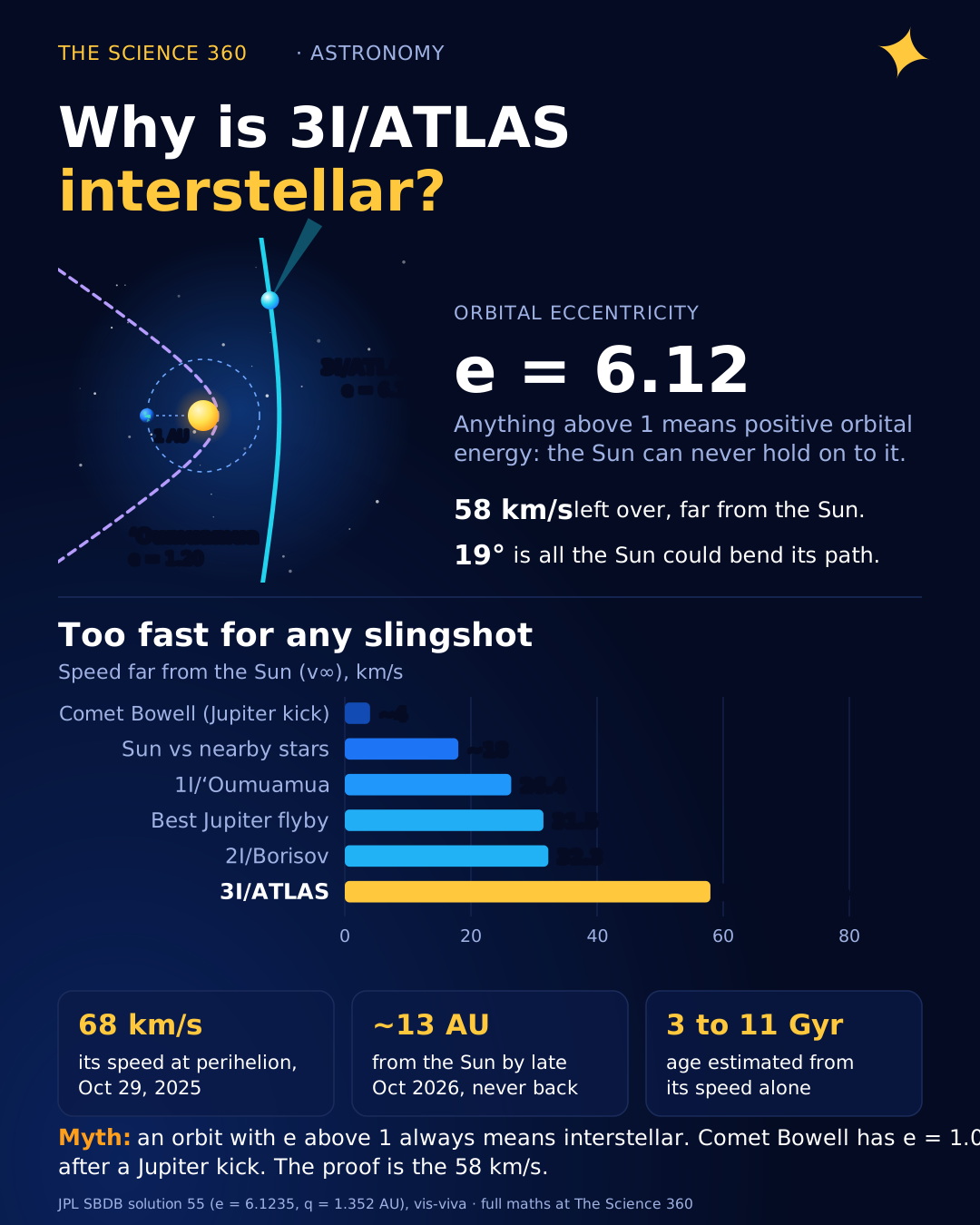
How We Know 3I/ATLAS Is Interstellar: Orbit Math

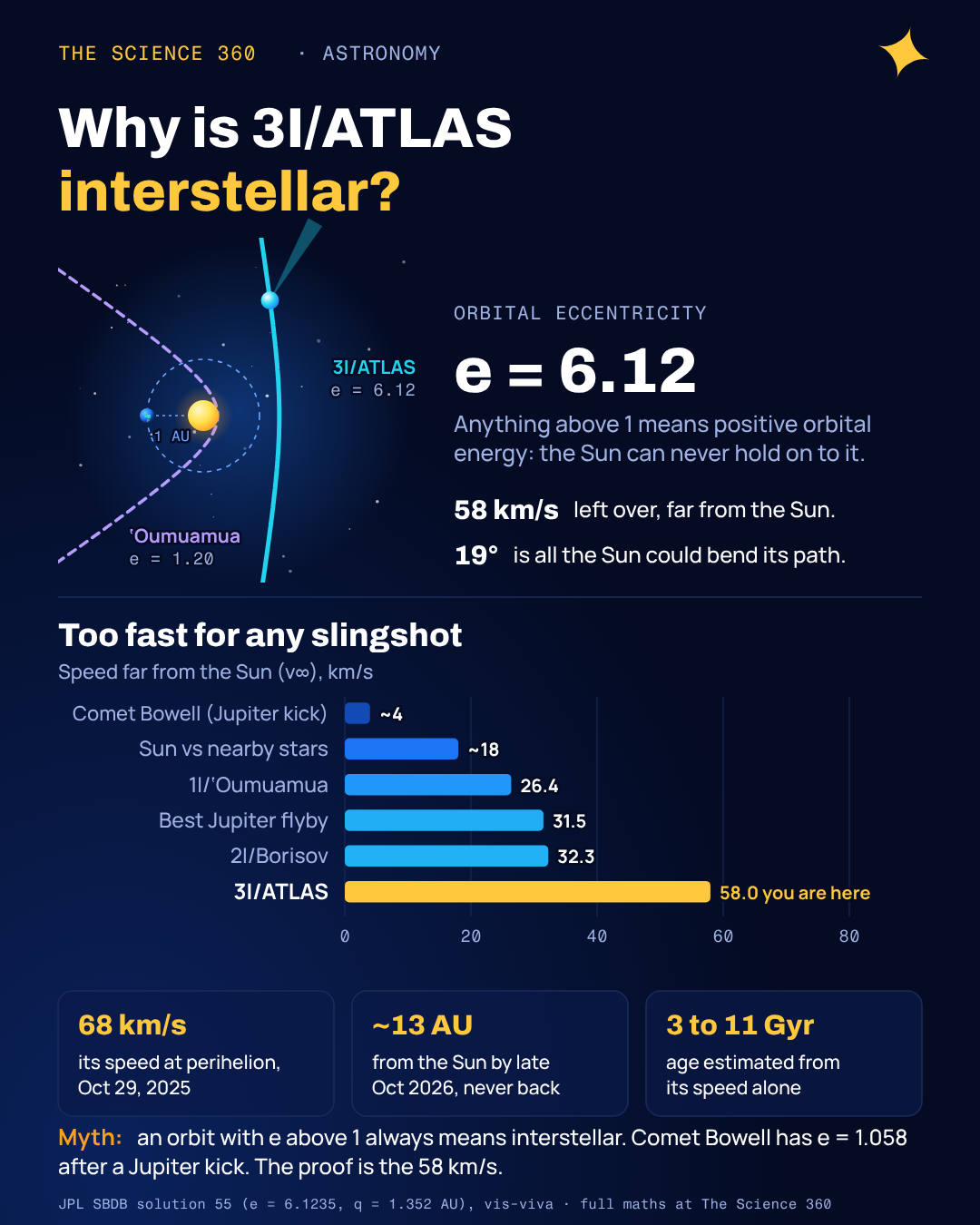
On July 1, 2025, the ATLAS survey telescope at Río Hurtado in Chile picked up a faint smudge 4.5 AU from the Sun, inside Jupiter's orbit. Within about a day, the Minor Planet Center had enough positions to fit an orbit, and the number that came out was absurd for a comet: an eccentricity above 6. Ordinary comets that fall in from the Oort cloud have eccentricities of 0.99-something, or at most a whisker above 1. This one was moving at about 61 km/s and was going to keep going.
It became the third confirmed interstellar object, after 1I/ʻOumuamua in 2017 and 2I/Borisov in 2019. The news stories say "its hyperbolic orbit proves it's interstellar" and move on. This post does the part they skip: what the eccentricity actually measures, how you get the 58 km/s from the 68 km/s, why a planet couldn't have produced it, and how the speed lets astronomers guess the object's age.
What does an eccentricity above 1 mean?
Every orbit around the Sun, ignoring the planets, is a conic section: a circle, an ellipse, a parabola or a hyperbola. The eccentricity e says which. A circle has , an ellipse has , a parabola has exactly , and a hyperbola has .
The shape is a stand-in for energy. Take the specific orbital energy, the kinetic plus potential energy per kilogram:
This number stays constant along the whole orbit (it is just energy conservation). If is negative, the object can never climb out of the Sun's gravity well; it is bound, and the orbit is an ellipse. If is exactly zero, it escapes with nothing to spare: a parabola. If is positive, it escapes with speed left over, and that leftover speed, far from the Sun, is called the hyperbolic excess speed, , with . The orbit is a hyperbola. An eccentricity above 1 is the geometric signature of positive energy, and for a body passing the Sun at perihelion distance q, the two are linked by a tidy formula:
So does not mean the comet is "six times as fast" as something. It means is five times : the object came in with so much kinetic energy that the Sun's gravity barely bent it.
How fast is 3I/ATLAS? Getting 58 km/s from 68 km/s
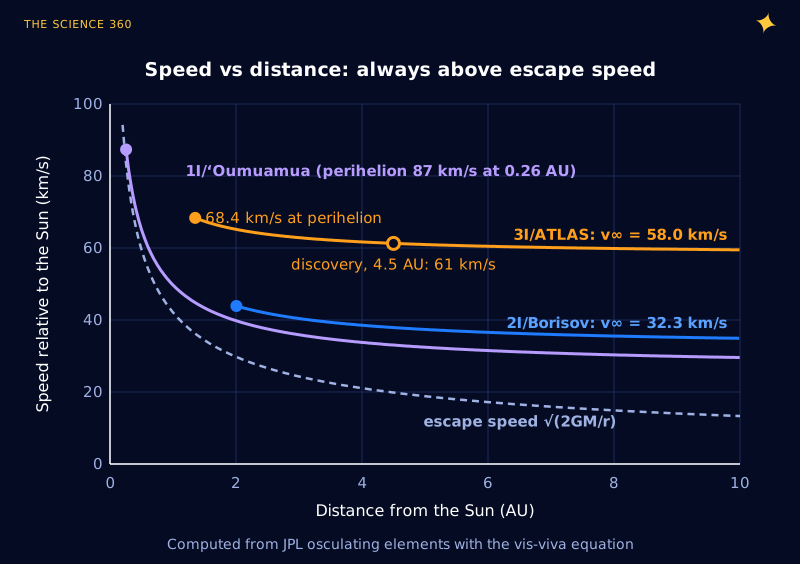
News coverage quotes two speeds for 3I/ATLAS, about 58 km/s and about 68 km/s, and sometimes mixes them up. Both are right. The 68 km/s is how fast it was moving at perihelion, its closest point to the Sun, on October 29, 2025. NASA gives it as about 246,000 km/h. The 58 km/s is , the speed it has far from the Sun, before falling in and after climbing back out. You can get one from the other with nothing but energy conservation.
Worked calculation 1: from perihelion speed to and eccentricity
Inputs: perihelion speed = 246,000 km/h ÷ 3,600 = 68.3 km/s (NASA); perihelion distance = 1.352 AU (JPL solution 55). Handy constant:
1. Escape speed at perihelion:
2. 3I is moving at 68.3 km/s, nearly twice the escape speed. Energy conservation gives .
3. Speed far from the Sun:
4. Orbital energy, positive, so unbound:
5. Eccentricity (JPL: 6.12):
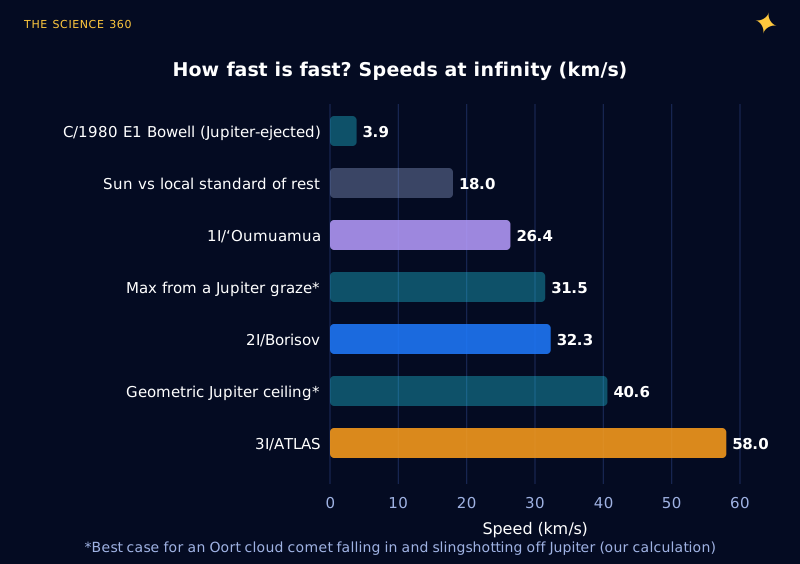
Notice how small the Sun's contribution is. Falling from interstellar space down to 1.35 AU only raised 3I's speed from 58 to 68 km/s. For ʻOumuamua, which came in more slowly and dived much closer (0.256 AU), the same fall more than tripled its speed, from 26 to 87 km/s.
Comparing 1I/ʻOumuamua, 2I/Borisov and 3I/ATLAS
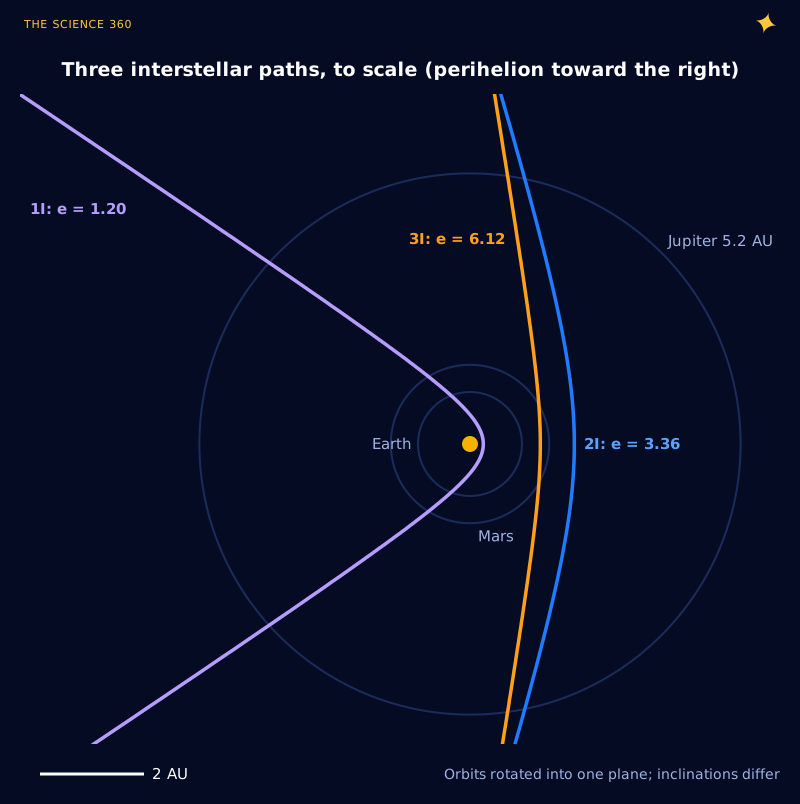
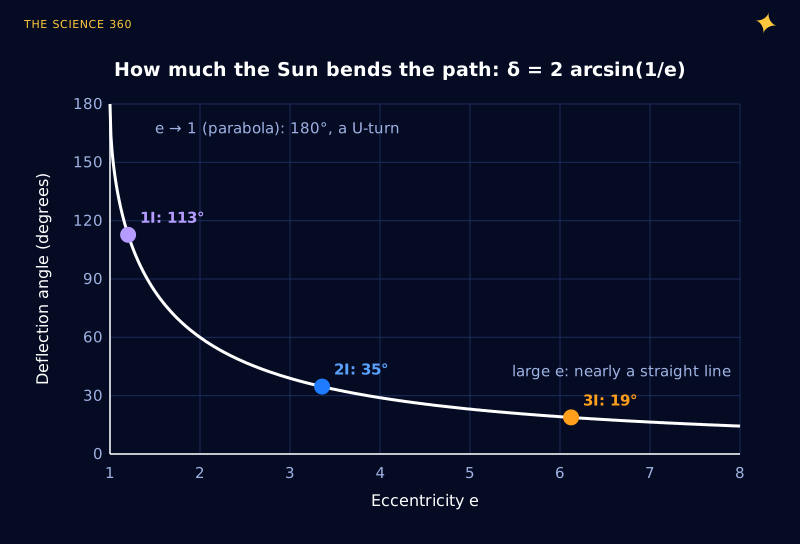
Here are the three objects side by side, from the current JPL Small-Body Database solutions. The values are computed from the semi-major axis, , and the deflection is the angle between the incoming and outgoing directions, .
| Object | Perihelion q (AU) | Eccentricity e | v∞ (km/s) | Speed at perihelion (km/s) | Path bent by |
|---|---|---|---|---|---|
| 1I/ʻOumuamua (2017) | 0.256 | 1.201 | 26.4 | 87.3 | 113° |
| 2I/Borisov (2019) | 2.007 | 3.356 | 32.3 | 43.9 | 35° |
| 3I/ATLAS (2025) | 1.352 | 6.123 | 58.0 | 68.4 | 19° |
A point that trips people up: ʻOumuamua has the smallest eccentricity of the three, yet it was just as interstellar. Its e was "only" 1.2 because it came in slowly and passed very close to the Sun, so the Sun bent its path sharply. Eccentricity mixes speed and closeness together. The number that measures how fast something arrived from interstellar space is , and 3I/ATLAS's 58 km/s is more than twice ʻOumuamua's.
Doesn’t a hyperbolic orbit always mean interstellar?
No, and this is the most common misunderstanding about these objects. Plenty of comets that formed in our own Solar System have e slightly above 1. The JPL database lists comet C/1980 E1 (Bowell) with , because a pass 0.228 AU from Jupiter on December 9, 1980 gave it a kick and it is now leaving forever, at a of roughly 4 km/s. Comets also push themselves with jets of gas (the "non-gravitational" forces you see in orbit solutions), and the eccentricity you compute at one moment, the osculating value, shifts as planets tug on the comet.
So astronomers don't just ask "is e above 1?" They integrate the orbit backward, out past the planets, and ask what the orbit looked like before the comet entered the planetary region. For Solar System comets that original orbit almost always turns out bound. For 3I/ATLAS the excess is enormous, and the question becomes: could any planet have supplied 58 km/s?
Why can’t Jupiter fling a comet out at 58 km/s?
A gravitational slingshot can't create speed from nothing. In the planet's own frame of reference, a flyby only rotates the comet's velocity; its speed relative to the planet comes out the same as it went in. All the gain in the Sun's frame comes from adding the planet's orbital velocity. That puts a hard ceiling on what Jupiter can do.
Worked calculation 2: the best Jupiter could possibly do
A comet falling from the Oort cloud is on a nearly parabolic orbit. At Jupiter's distance (5.20 AU) its speed is
Jupiter's orbital speed is 13.1 km/s.
1. Largest possible speed relative to Jupiter (head-on): 18.5 + 13.1 = 31.6 km/s.
2. The flyby can at most reverse that relative velocity, so the heliocentric speed is at most 31.6 + 13.1 = 44.7 km/s.
3. Climbing out from 5.2 AU:
4. A full reversal would need the comet to pass through Jupiter. Limiting the turn to a pass skimming Jupiter's cloud tops (radius 71,492 km) and searching all approach directions numerically gives about 31.5 km/s.
5. 3I/ATLAS: 58 km/s. Even the impossible ceiling falls short by almost 20 km/s.
Real ejections are far gentler than that idealized graze. Bowell's comet, one of the best-documented cases of a comet thrown out of the Solar System by Jupiter, leaves at about 4 km/s. And 3I/ATLAS's path did not come anywhere near a planet before discovery anyway. The speed came with it.
How old is 3I/ATLAS? Reading age from speed
Here is where the speed tells a story. Stars in the Milky Way's disk are born from gas clouds moving in neat circular orbits, so young stars move almost together. Over billions of years, encounters with giant molecular clouds, spiral arms and the galactic bar stir them up, so their random velocities grow. Astronomers call this the age-velocity dispersion relation, and it is one of the better-established trends in galactic astronomy.
For scale, the Sun, at 4.6 billion years old, moves about 18 km/s relative to the average motion of nearby stars (the "local standard of rest"; Schönrich, Binney and Dehnen measured components of 11.1, 12.24 and 7.25 km/s). Interstellar comets are thought to be flung out of young planetary systems and then drift with the same galactic motion as their parent stars, picking up the same stirring over time. A relative speed of 58 km/s is high for a thin-disk object, which points to an old parent population.
Two groups turned this into numbers within weeks of discovery. Aster Taylor and Darryl Seligman, assuming interstellar objects follow the same age-velocity relation as stars, estimated that 3I/ATLAS is likely about 3 to 11 billion years old. Matthew Hopkins and colleagues at Oxford, using their Ōtautahi-Oxford population model built on Gaia data, concluded that its velocity predicts an age of over 7.6 billion years (published in ApJ Letters 990, L30). Early press coverage said it came from the galaxy's thick disk; that label depends on which definition of thick disk you use, and should be treated as tentative.
Be honest about what this is: a statistical inference from one velocity, not a measurement. A young object could have an unusually high speed by chance. But both studies agree there is a good chance, by Oxford's estimate about two in three, that 3I/ATLAS is older than our Solar System. If so, it is a sample of planet formation from a time before the Sun existed.
What the latest orbit solutions show
JPL keeps refining the orbit as observations accumulate. The solution I used here (JPL #55, computed October 21, 2026) gives and , slightly different from the = 6.137 to 6.141 and quoted in 2025. Two things cause that drift. The elements are "osculating," meaning they describe the conic the comet would follow if all other forces vanished at a given epoch, and the newer solution uses an epoch after the comet left the inner Solar System. The fit also includes non-gravitational acceleration terms, because 3I/ATLAS, like any active comet, is pushed slightly by its own outgassing. None of this changes the conclusion: every solution has above 6 and near 58 km/s.
The outgassing itself has been one of the most interesting results. JWST observed the comet on August 6, 2025, at 3.32 AU from the Sun, and found a coma dominated by carbon dioxide, with a CO2 to water ratio of about 8 (Cordiner and colleagues), one of the highest ever measured in a comet. Most Solar System comets are water-dominated. Whether this reflects where the comet formed in its parent disk, or billions of years of cosmic-ray processing of its surface during the long trip, is an open question.
By the vis-viva and Kepler equations, the comet passed Jupiter's distance from the Sun around March 2026 and is now (late October 2026) about 13 AU out, beyond Saturn's orbit, still moving at close to 59 km/s and never coming back.
The short version
An eccentricity above 1 means positive energy, and positive energy means unbound. But the strong proof is the size of the excess: 58 km/s, nearly twice what even an impossible grazing flyby of Jupiter could give a comet that started in our own Oort cloud. Small icy bodies like this one are the leftovers of planet formation; how big they have to be before gravity rounds them is a separate story, told in why planets are round but asteroids aren't.
Frequently asked questions
How do we know 3I/ATLAS is interstellar?
Its orbit has an eccentricity of about 6.1, far above 1, which means its total orbital energy is positive: it moves faster than the Sun's escape speed everywhere along its path. Far from the Sun it travels at about 58 km/s. No planetary encounter can give an Oort cloud comet that much excess speed, so it must have arrived from interstellar space.
How fast is 3I/ATLAS moving?
About 58 km/s relative to the Sun when far away (its hyperbolic excess speed), about 61 km/s when discovered at 4.5 AU on July 1, 2025, and about 68 km/s at perihelion on October 29, 2025, according to JPL orbit solutions and NASA.
Will 3I/ATLAS come back?
No. A hyperbolic orbit is open. 3I/ATLAS has more than enough energy to escape the Sun and is heading back into interstellar space. By late October 2026 it was roughly 13 AU from the Sun, beyond Saturn's distance.
How old is 3I/ATLAS?
Nobody knows its exact age, but its high speed suggests it comes from an old stellar population. Taylor and Seligman estimate about 3 to 11 billion years; Hopkins and colleagues estimate over 7.6 billion years. Either way it is probably older than the 4.6 billion year old Solar System.
Is 3I/ATLAS an alien spacecraft?
The evidence says it is a comet. It has a coma of gas and dust, JWST detected carbon dioxide, water, carbon monoxide and other molecules, and its small non-gravitational acceleration is the kind produced by outgassing, which orbit solutions for ordinary comets also include.
Related on The Science 360
Sources
- JPL Small-Body Database, C/2025 N1 (ATLAS) = 3I, solution 55 (2026-10-21), plus 1I/ʻOumuamua (solution 16), 2I/Borisov (solution 54) and C/1980 E1 (Bowell): ssd.jpl.nasa.gov SBDB lookup (queried via the SBDB API)
- NASA Science, 3I/ATLAS facts and FAQs (discovery, perihelion speed 246,000 km/h, Earth distance): science.nasa.gov
- Bolin, B. T. et al. (2025), Interstellar comet 3I/ATLAS: discovery and physical description, MNRAS Letters: arXiv:2507.05252
- Taylor, A. G. and Seligman, D. Z. (2025), The Kinematic Age of 3I/ATLAS and its Implications for Early Planet Formation (v∞ = 58 km/s, age about 3 to 11 Gyr): arXiv:2507.08111
- Hopkins, M. J. et al. (2025), From a Different Star: 3I/ATLAS in the context of the Ōtautahi-Oxford interstellar object population model, ApJL 990, L30: arXiv:2507.05318
- Royal Astronomical Society, Newly discovered interstellar object may be oldest comet ever seen: ras.ac.uk
- Cordiner, M. A. et al. (2025), JWST detection of a carbon dioxide dominated gas coma surrounding interstellar object 3I/ATLAS: arXiv:2508.18209
- Schönrich, R., Binney, J. and Dehnen, W. (2010), Local kinematics and the local standard of rest, MNRAS 403, 1829: arXiv:0912.3693
- University of Hawaii Institute for Astronomy, Interstellar Comet 3I/ATLAS (early e = 6.137): about.ifa.hawaii.edu/research/3i
- C/1980 E1 (Bowell) Jupiter encounter: arXiv:2410.01975
- IAWN 3I/ATLAS observing campaign, orbit page: iawn.net
Header image: NASA/ESA/STScI (image PIA22357), regraded for this article.