Space 01
How Do We Know How Far Away Stars Are? Parallax Math
Proxima Centauri shifts 0.768 arcsec a year, which puts it 4.2465 light-years away. Here is the parallax math, what Gaia changed and the distance ladder.
Proxima Centauri shifts 0.768 arcsec a year, which puts it 4.2465 light-years away. Here is the parallax math, what Gaia changed and the distance ladder.
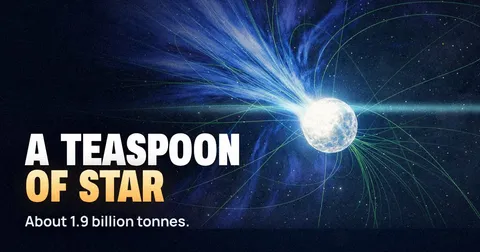
A 5 mL teaspoon of average neutron star weighs about 1.9 billion tonnes, not the 10 million often quoted. The density math, and what it would do on Earth.
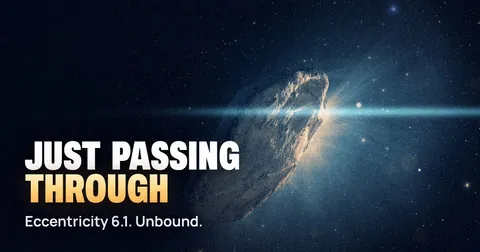
3I/ATLAS has eccentricity 6.1 and leaves at 58 km/s. We compute its orbital energy, compare 'Oumuamua and Borisov, and show why no planet could fling it.
Webb orbits L2, 1.5 million km out, so Sun, Earth and Moon stay on one side. L2 isn't where gravity cancels, and sitting at it means an endless eclipse.
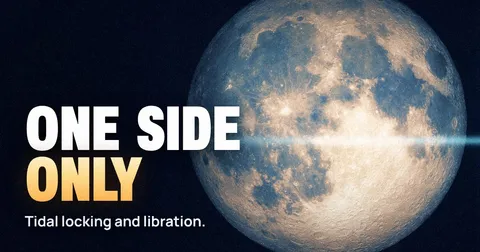
The Moon is tidally locked, spinning once per 27.3-day orbit. The torque that locked it, why we see 59% of it, and why it drifts 3.8 cm a year.
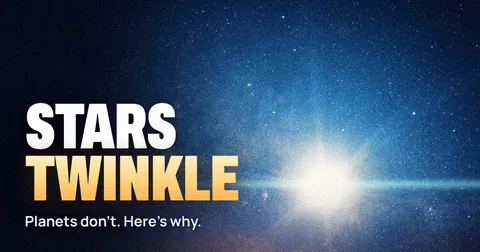
Stars twinkle because they are points that cross one 7 cm air patch at a time. Planets span hundreds of patches. Here is the arcsecond math, with figures.
In an infinite, eternal universe every sightline ends on a star and the sky would blaze like the Sun. The math of Olbers' paradox and the real answer.
Venus turns once every 243 days, backwards, giving a 116.75-day solar day. Why atmospheric tides, not a giant impact, are the leading explanation.
The horizon Moon looks huge, yet it's 1.7% narrower and 16% shorter than overhead. We measure it, then weigh the theories for why your brain inflates it.
Earth spins at up to 465 m/s, orbits at 29.8 km/s and moves at 370 km/s relative to the CMB. How each speed is measured, and why they don't add.
The 2 August 2027 eclipse gives 6 min 23 s of totality near Luxor. We compute why: a near-perigee Moon, a far Sun, and a shadow slowed by Earth's spin.
Deep space glows at 2.7 K, yet a sunlit plate near Earth hits 120 °C and ISS-height gas tops 700 K. What "the temperature of space" really means.
At a stellar black hole's horizon the stretch is 21 million g. At Sgr A* it is 0.0001 g. Tidal math, your clock and what outsiders see, worked out.
Betelgeuse's supernova should peak near magnitude -10 to -11: about 250 times Venus and a seventh of the full Moon. The magnitude math, step by step.
Compare Arizona’s astronomy survey, Edinburgh’s AstroTech and free MIT problem sets by learning goal, access costs and what each route leaves out.
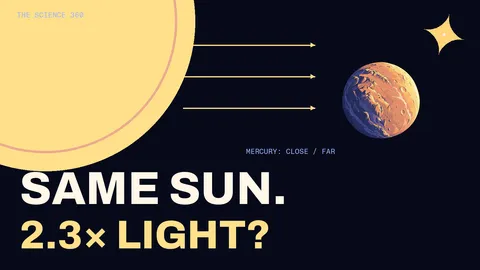
The same inverse-square calculation gives Earth about a 7% close-to-far sunlight increase and Mercury about 130%. Reproduce all eight comparisons.
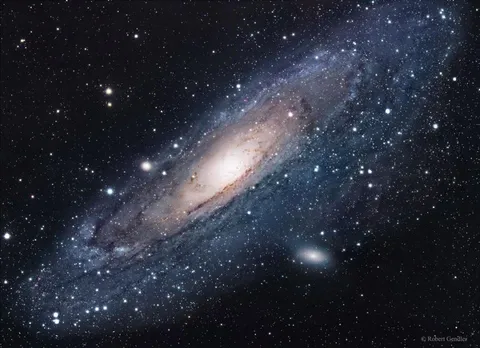
The universe is a vast and beautiful place, filled with cosmic objects that leave us in awe. In this blog, we'll explore ten of the most stunning and
Recently a fact on the viral that woods are more valuable than diamonds but why is it? I mean, if you go to a jewellery shop and a wood shop will find that diamonds are more valuable than woods. Even the raw diamonds are more beautiful than so why the question?...