Why Does Venus Spin Backwards? The Tidal Explanation
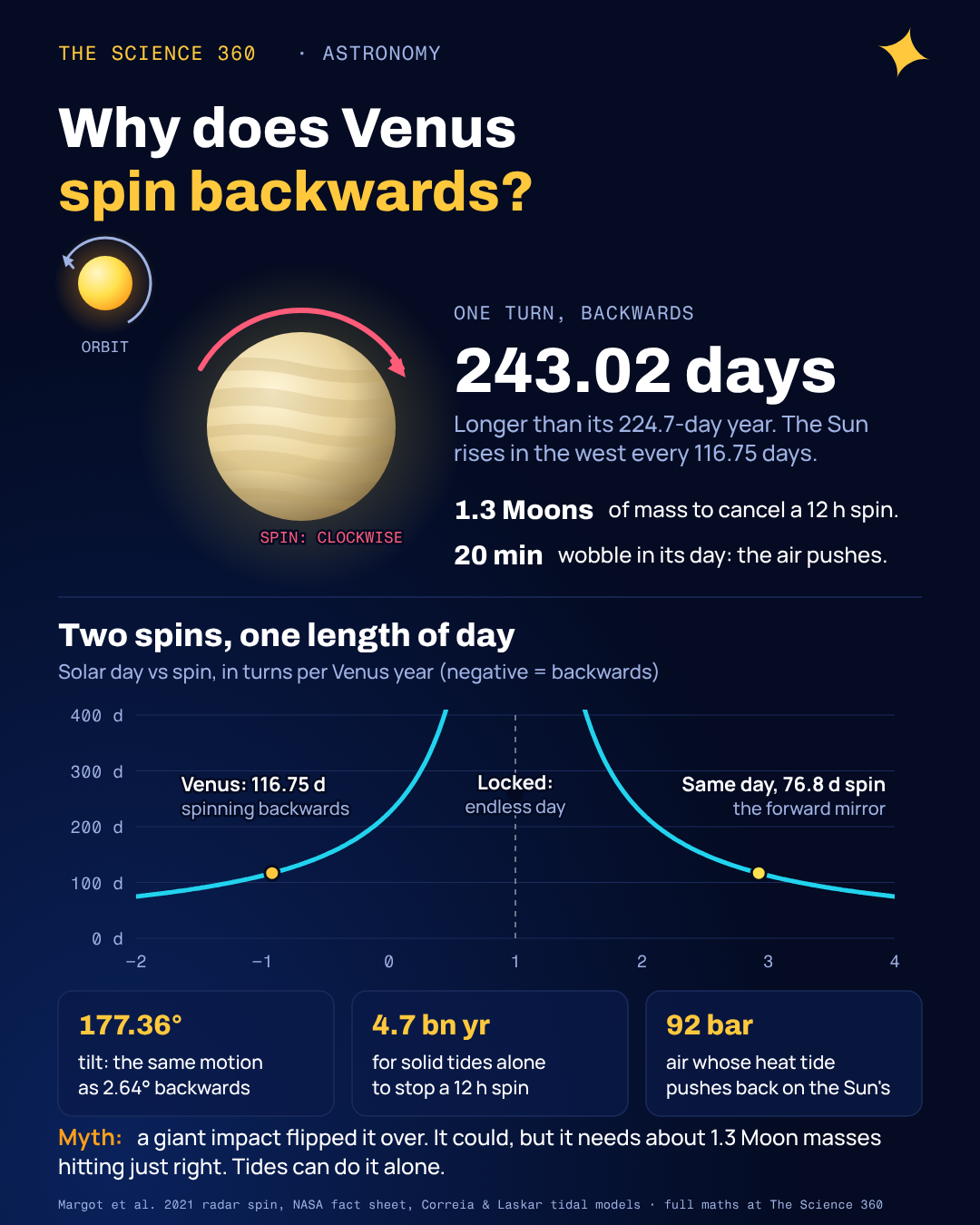
Between 2006 and 2020, a team led by Jean-Luc Margot bounced radar off Venus from Goldstone and Green Bank and timed the echoes of its surface speckle. They found that Venus turns once every 243.0226 days, backwards, and that its day is not even constant: it wobbles by about 61 parts per million, roughly 20 minutes, from one measurement to the next. Something is pushing on the solid planet. The best candidate is its atmosphere, and the same atmosphere is the leading suspect in the bigger mystery of why Venus spins backwards at all.
What does “spinning backwards” actually mean?
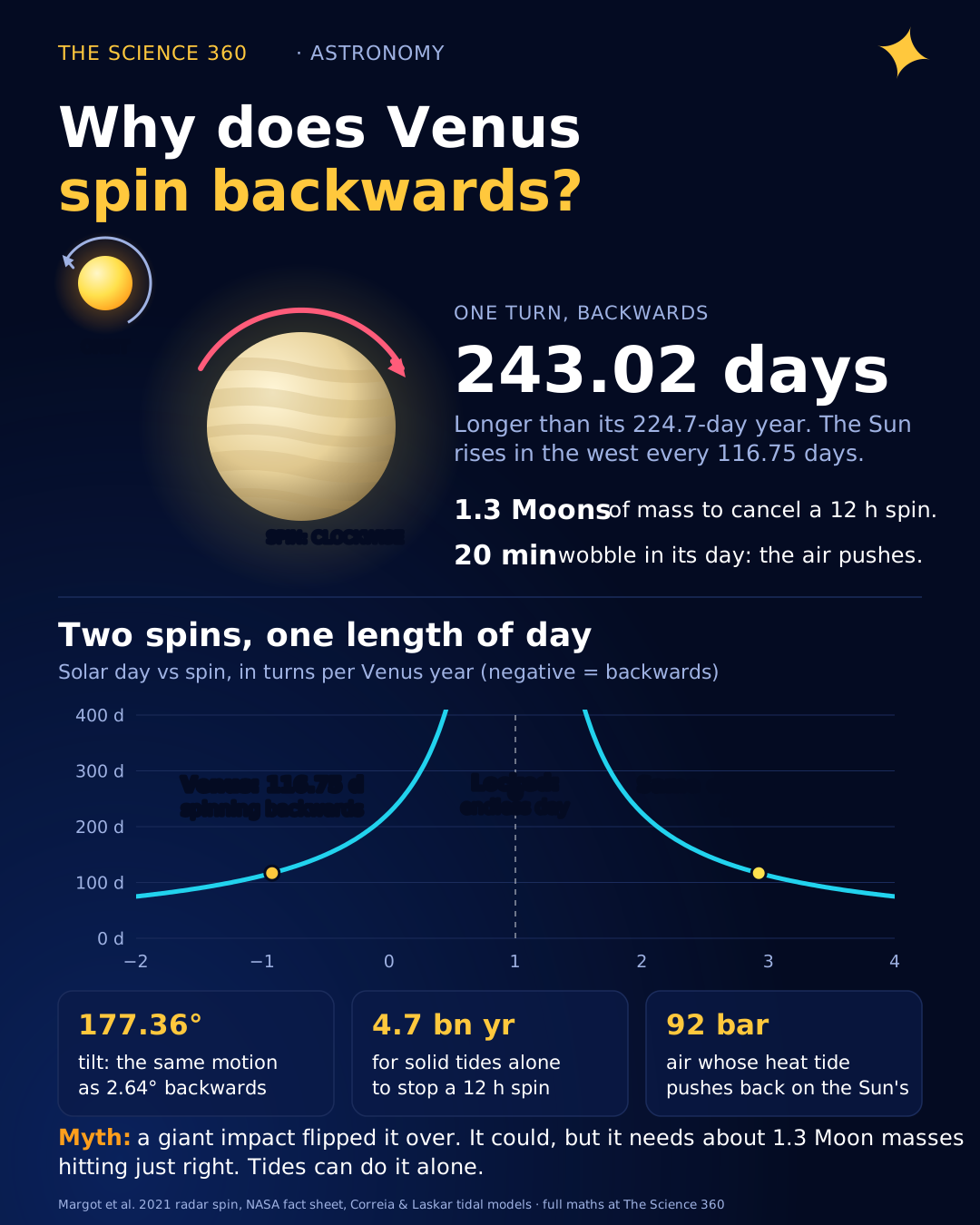
Seen from above the Sun's north pole, every planet orbits counterclockwise, and most also spin counterclockwise. Venus spins clockwise. Its 243-day rotation is the slowest of any planet and longer than its 224.7-day year.
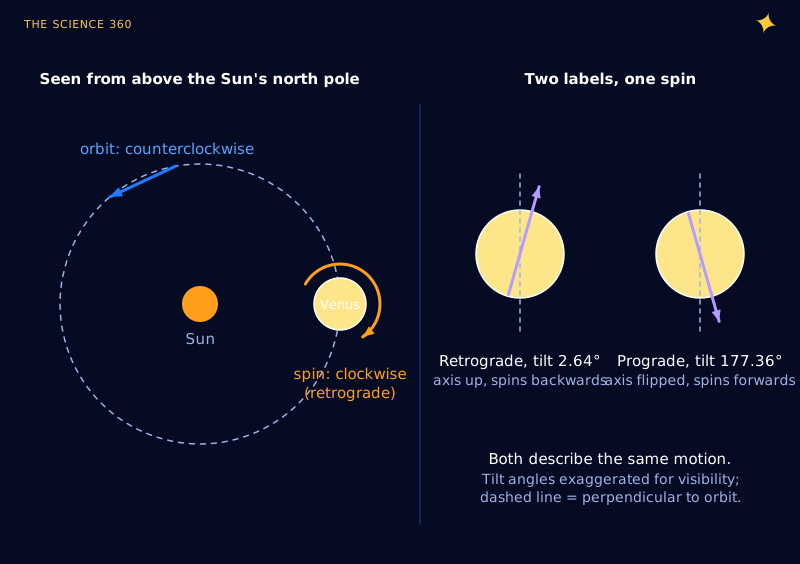
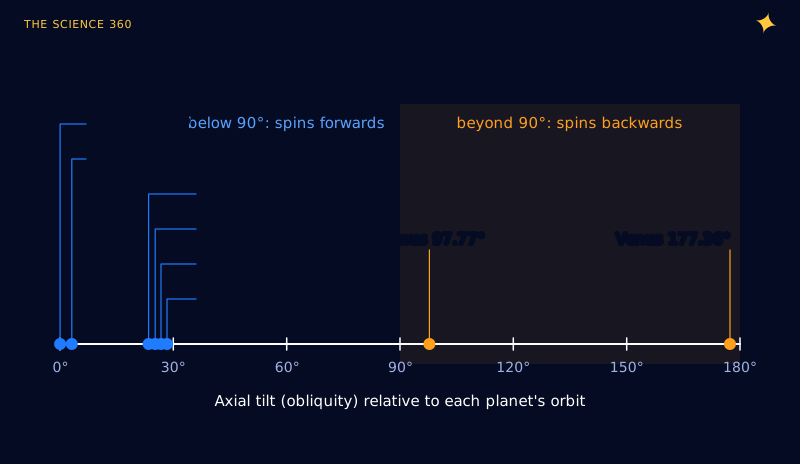
There is a subtlety that trips up a lot of explanations. NASA's fact sheet lists Venus's obliquity, its axial tilt, as 177.36°. That number means the spin axis is turned almost completely upside down relative to the orbit, and the planet spins forwards about that flipped axis. Margot's team quotes the same geometry as a tilt of 2.64° with backwards spin. These are not competing measurements. They are one motion described two ways, and the 177° convention is the one astronomers use because it keeps "rotation" positive by definition.
That matters for the history, because a planet can arrive at this state by two different routes: by having its axis tip over until it is upside down, or by having its spin slow, stop and reverse with the axis staying put. The present state does not tell us which happened.
How long is a day on Venus?
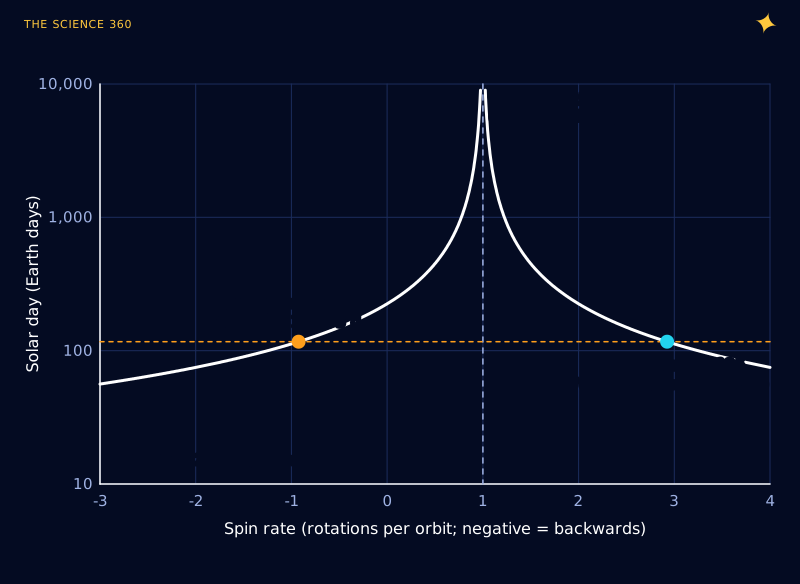
The 243 days is the sidereal day: one turn relative to the distant stars. The day you would live by is the solar day, the time from one noon to the next. On Earth the two differ by four minutes. On Venus they differ by a factor of two, and because Venus spins against its orbit the two effects add rather than subtract:
Solar day for retrograde spin
Sunrise to sunset ≈ 116.75 / 2 ≈ 58 Earth days, and the Sun rises in the west.
So a Venus year holds solar days. Figure 3 shows how the solar day depends on spin for a planet on Venus's orbit, and it holds a surprise that will matter later: the same 116.75-day solar day is also produced by a forward spin of 76.8 days.
The misconception: “a giant impact flipped it over”
The explanation you will read most often is that a huge collision knocked Venus over or reversed its spin. Impacts certainly happened, and the idea cannot be ruled out. But it is less attractive than it sounds once you put numbers on it.
The problem is angular momentum. Young rocky planets are thought to have spun fast, with days of hours rather than months, though Venus's original spin is unknown. Take a 12-hour day as an example and ask what impactor could cancel it.
Step 1. Venus's spin angular momentum at a 12-hour day
Step 2. Today's spin, for comparison
That is 0.2% of the 12-hour value.
Step 3. Best-case impactor
A grazing hit at the equator delivers at most . At (a bit above Venus's 10.4 km/s escape speed):
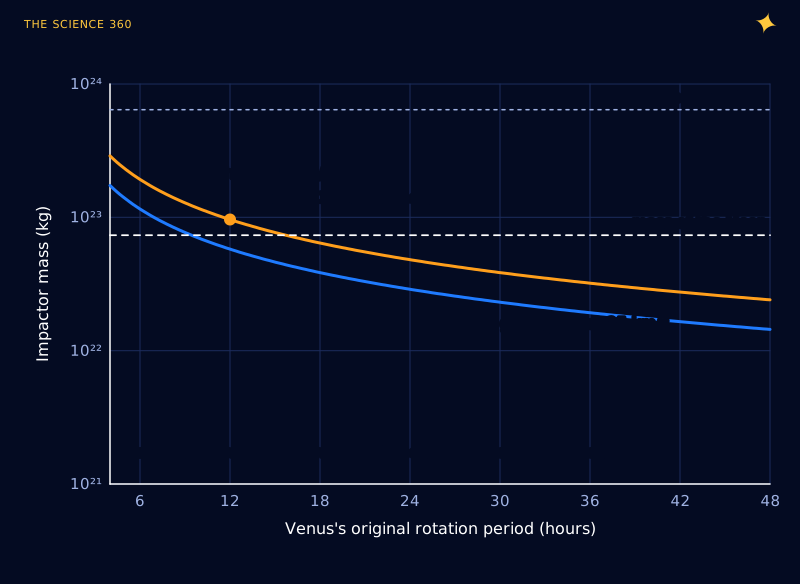
That is a best case, with every kilogram-metre-per-second of the impactor's angular momentum delivered tangentially at the equator and kept. Real collisions waste most of it. You need something the size of a small planet, which is the same class of event that is thought to have made Earth's Moon, and you need it to hit at exactly the right angle in the right direction. It is possible. It is not the only option, and many dynamicists no longer think it is the likeliest one.
Could tides alone slow Venus down?
The Sun raises tides in Venus's rock just as the Moon raises them in Earth's oceans and crust. Because rock is not perfectly elastic, the tidal bulge lags behind the Sun's direction, and the Sun's pull on that lagging bulge slows the spin. Left alone, solid-body tides would drive Venus toward tidal locking, one face always to the Sun, with a 224.7-day rotation. That is exactly what astronomers expected before radar measured the real value in the 1960s.
How fast does this work? The standard constant-Q estimate of the tidal torque is:
(measured from Magellan and Pioneer Venus tracking). With :
Time to remove a 12-hour spin:
With , 47 billion years.
The tidal quality factor Q of a planet is poorly known and changes with frequency and temperature, so treat these numbers as an order of magnitude. Even so, the result is telling: solar tides on the solid planet alone are at best marginal for slowing a fast early Venus to a crawl within 4.5 billion years. Real models add friction between the liquid core and the mantle, and a second tide that turns out to be decisive.
How can an atmosphere change a planet’s spin?
Venus's atmosphere has a mass of about 4.8×10²⁰ kg and presses down at 92 bar. Sunlight heats it most strongly on the day side, and the warm air expands and redistributes mass, producing a "thermal tide": a bulge of atmospheric mass tied to the Sun's heating rather than to its gravity. Because the heating peaks in the afternoon, after the Sun has passed overhead, the bulge sits on the opposite side of the Sun line from the solid-body tide. The Sun's gravity on that bulge produces a torque in the opposite direction, pushing the planet away from tidal locking. The atmosphere then passes that torque to the ground through friction with the surface.
Thomas Gold and Steven Soter proposed this balance in 1969, and Correia and Laskar developed the full picture in 2001. The key feature is that the two torques depend differently on how fast the planet turns relative to the Sun. Near locking, the atmospheric tide wins and pushes the spin away. Far from locking, the solid tide wins and pulls it back. Where they cross, the spin is stable.
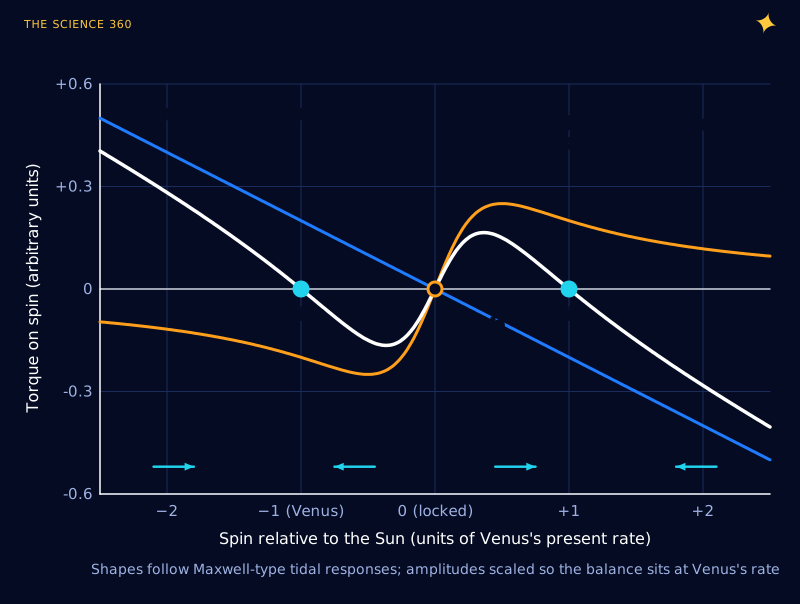
Two consequences fall out of Figure 5. First, tidal locking is unstable for Venus: the atmosphere will not let it settle there. Second, there are two stable states at the same distance from locking, one on each side. One of them is Venus as it is, 243.0 days retrograde. The other is the 76.8-day prograde spin from Figure 3. Laskar's group counts four final states in all, because each spin direction can be reached with the axis upright or upside down, and the two retrograde ones are observationally identical to what we see.
So which way did Venus get there?
Correia and Laskar's simulations followed Venus from many plausible starting spins and tilts. They found two main paths to the present state:
- Spin reversal. The tilt shrinks toward 0° while tides and core friction slow the spin. It passes through zero and settles into the retrograde equilibrium.
- Axis flip. Gravitational nudges from the other planets drive the tilt chaotically, in the example on Laskar's page beyond 70°, until dissipation carries the axis over to near 180°. The planet then spins "forwards" about an upside-down axis, which we see as backwards.
The chaos is important. Venus has no large moon to steady its axis, and Laskar notes that Earth would be in the same chaotic regime without ours. Chaos lets a wide range of starting conditions end up in one of the four final states, and the retrograde ones come out as the most likely. Laskar's group calls retrograde rotation "the most probable result of a natural evolution." No collision is needed, though one is not ruled out either.
What remains uncertain is quantitative. The strength of the thermal tide depends on how much sunlight is absorbed at the ground versus in the clouds, and on how the atmosphere's mass responds, which is why papers still disagree about the details. Leconte and colleagues showed in 2015 that even an Earth-like 1 bar atmosphere can hold a planet out of tidal locking around Sun-like stars, so this is not a Venus curiosity; it changes what we expect for rocky exoplanets.
Is there evidence the atmosphere really pushes on the planet?
Yes, and it comes back to that 20-minute wobble in the length of day. Margot's team concluded that changes of at least about 4% in the atmosphere's angular momentum are being handed to the solid planet. We can check that this is plausible:
Change in the solid planet's spin angular momentum
If that is 4% of the atmosphere's angular momentum
That is about 0.15% of the solid planet's.
The mean wind that implies
For a thin shell:
A mass-weighted mean wind of about 14 m/s is reasonable for Venus, whose cloud tops race around the planet at about 100 m/s but whose dense lower atmosphere, where most of the mass sits, moves slowly; NASA lists surface winds of 0.3 to 1 m/s. The atmosphere really does carry enough angular momentum to nudge the planet measurably, and over billions of years the tidal version of that nudge can set its spin.
Does Venus show Earth the same face?
One more coincidence fed the early theories. Venus and Earth line up (inferior conjunction) every 583.92 days. Divide by the solar day: . So at nearly every close approach Venus turns almost the same face toward Earth. Gold and Soter originally thought Earth's tides might have locked Venus into this resonance.
Earth's tidal torque on Venus relative to the Sun's, at closest approach (0.277 AU):
Earth's tidal grip is billions of times weaker than the Sun's, and even its pull on any permanent lopsidedness of Venus is about 5×10⁻⁵ of the Sun's. With a period that is 0.03% off an exact 5:1 lock and a spin that wobbles by 20 minutes, most researchers now treat the near-match as a coincidence.
FAQ
Why does Venus spin backwards?
Nobody knows for certain, but the leading explanation is a tug of war between two kinds of solar tide. Tides raised in the solid planet slow Venus toward always facing the Sun, while tides in its massive, Sun-heated atmosphere push it away from that state. Models show the balance can end with slow retrograde spin, with or without a giant impact.
How long is a day on Venus?
Venus rotates once relative to the stars every 243.02 Earth days, backwards. Because it orbits the Sun in 224.70 days in the opposite sense, the Sun returns to the same place in the sky every 116.75 Earth days. That solar day is the one a person on the surface would experience.
Does the Sun rise in the west on Venus?
Yes. Because Venus spins in the opposite direction to its orbit, the Sun rises in the west and sets in the east, about 58 Earth days after rising. You would not see it through the clouds, but the sky would slowly brighten and dim on that schedule.
Is Venus upside down?
It depends on the label. Astronomers usually give Venus an axial tilt of 177.4 degrees, meaning its spin axis is flipped and it spins forwards. That is physically identical to saying it is tilted 2.6 degrees and spins backwards. Both describe the same motion.
Did an impact make Venus spin backwards?
It is possible but not required. Reversing a fast-spinning young Venus would take an impactor of roughly a Moon's mass hitting at a grazing angle, which is a lot. Tidal models by Correia and Laskar show retrograde rotation can arise naturally, and they describe it as the most probable outcome of Venus's evolution.
Related on The Science 360
Sources
- Margot et al. (2021), "Spin state and moment of inertia of Venus", Nature Astronomy (243.0226 ± 0.0013 d; 61 ppm length-of-day variations; at least about 4% of atmospheric angular momentum transferred; tilt 2.6392°; moment of inertia 0.337): research.astro.cornell.edu/news/spin-state-and-moment-inertia-venus and ntrs.nasa.gov/citations/20220003058
- NASA NSSDC, Venus Fact Sheet (orbit 224.701 d; synodic period 583.92 d; length of day 2,802 h; obliquity 177.36°; atmosphere mass 4.8×10²⁰ kg; surface pressure 92 bar; surface winds 0.3 to 1.0 m/s): nssdc.gsfc.nasa.gov/planetary/factsheet/venusfact.html
- Jacques Laskar (IMCCE), "The retrograde rotation of Venus" (four final states, 76.8 d prograde equivalent, chaotic obliquity, "most probable result of a natural evolution"): perso.imcce.fr/jacques-laskar/en/general-audience/venus-spins-backward/
- Scientific American (2001), "Why Venus Spins the Wrong Way", on Correia and Laskar's Nature paper: scientificamerican.com/article/why-venus-spins-the-wrong/
- Leconte et al. (2015), "Asynchronous rotation of Earth-mass planets in the habitable zone of lower-mass stars", Science: arxiv.org/abs/1502.01952
- Auclair-Desrotour et al., "Atmospheric tides and their consequences on the rotational dynamics of terrestrial planets" (review of the Gold and Soter balance): arxiv.org/abs/1709.09478
- Konopliv and Yoder (1996), "Venusian k2 tidal Love number from Magellan and PVO tracking data", Geophysical Research Letters (k2 = 0.295 ± 0.066): ntrs.nasa.gov/citations/19970037571
- NASA NSSDC, Uranus and Mercury fact sheets (obliquities used in Figure 2): nssdc.gsfc.nasa.gov/planetary/factsheet/
Header image: NASA/JPL-Caltech (image PIA23791), regraded for this article.