Why We Only See One Side of the Moon (and It's 59%)
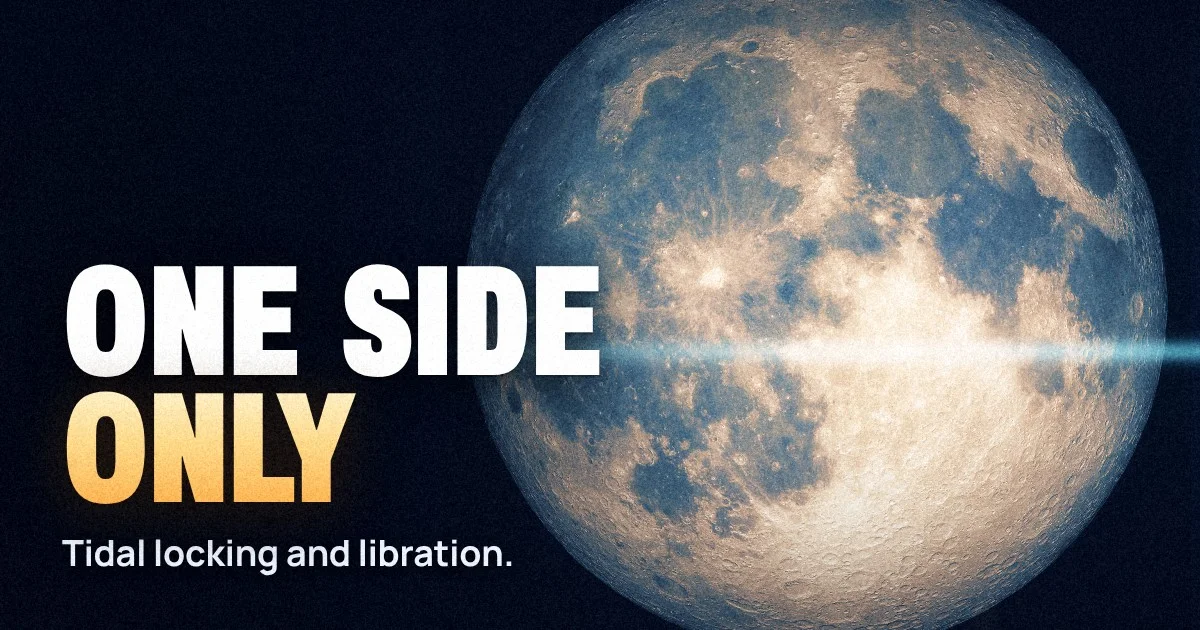
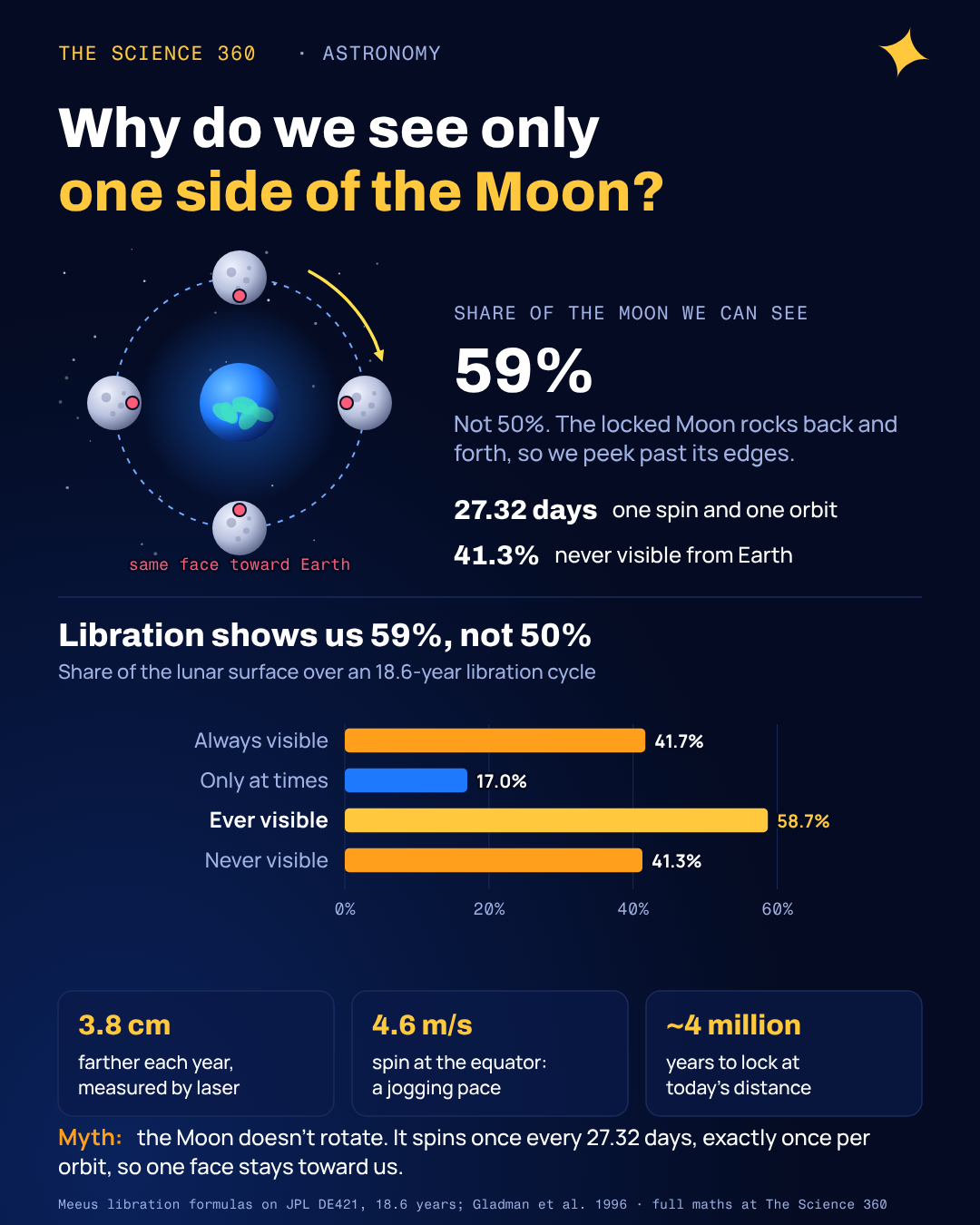
Every human who has ever looked up has seen the same Man in the Moon, the same dark patch of Mare Imbrium at roughly the same angle. Nobody saw the far side until October 1959, when the Soviet probe Luna 3 photographed it from behind. That's a strange fact when you think about it. A ball spinning in space, and it never turns its back to us.
The short explanation is "tidal locking," and most pages stop there, sometimes after adding the claim that the Moon doesn't rotate. That claim is wrong, and the full story is better. Below I'll show the torque that did the locking, why it took a geological blink, how we actually see 59% of the Moon rather than 50%, and how the same physics is still lengthening your day and pushing the Moon away by 3.8 cm a year. I've run the numbers for each piece so you can check them.
Does the Moon rotate?
Yes. This is the most common misconception about the Moon, and it's worth getting right first because everything else depends on it.
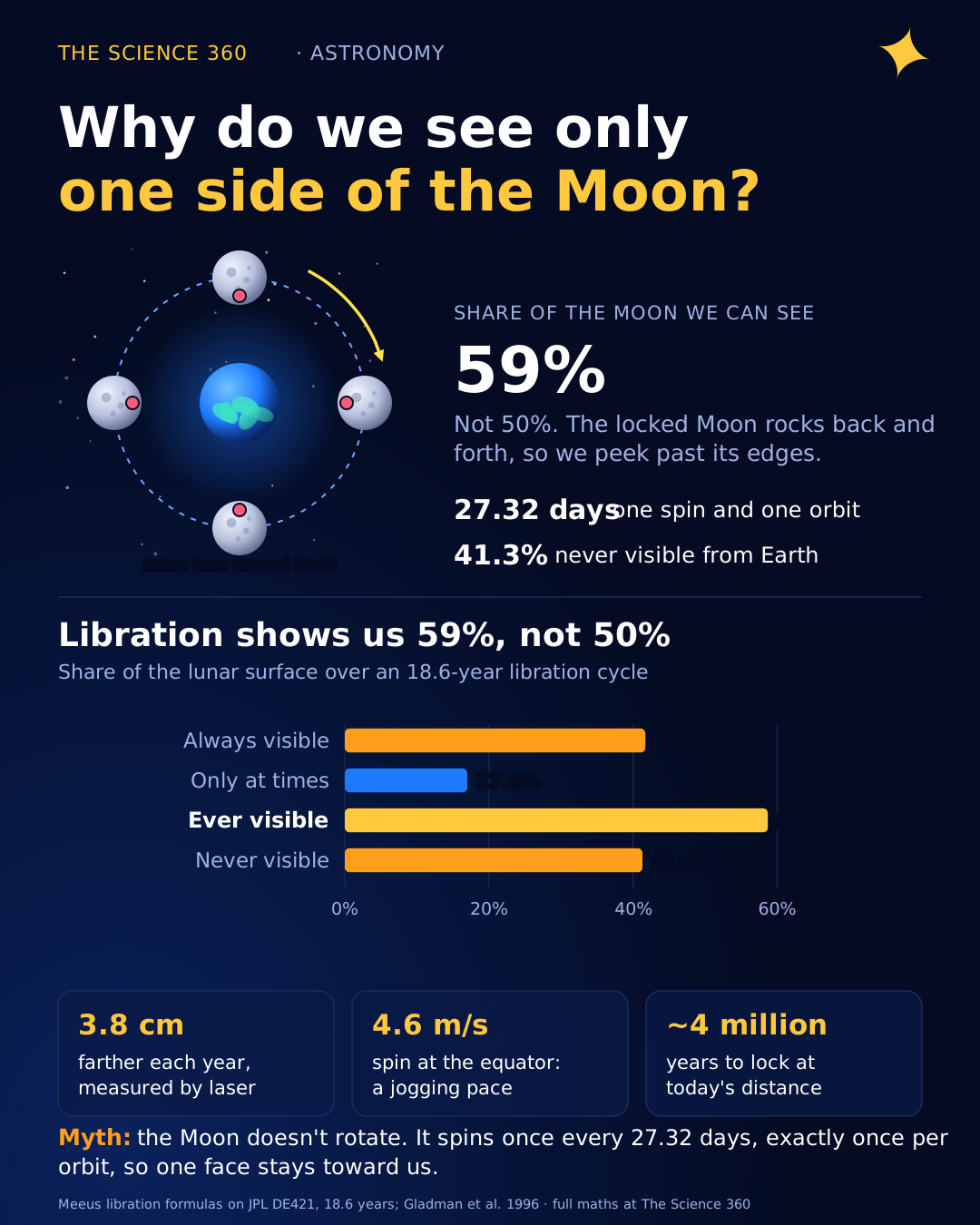
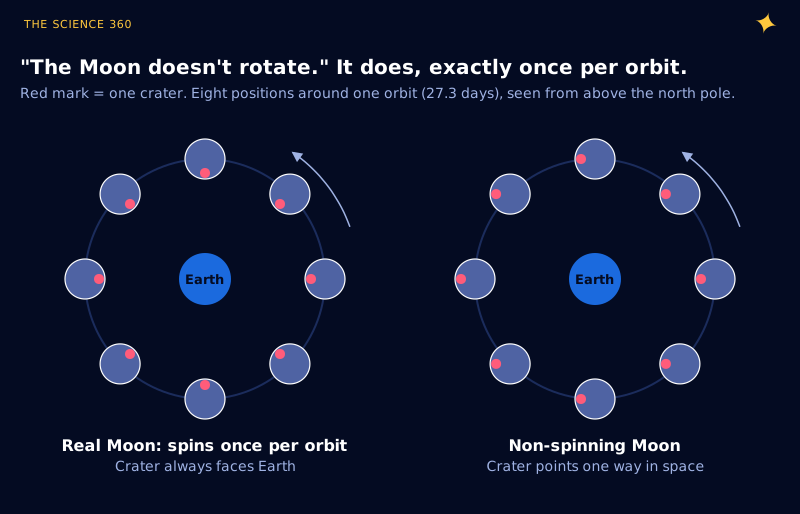
The Moon turns once on its axis every 27.32 days, relative to the stars. It also goes around Earth once every 27.32 days. Because those two periods are equal, the same hemisphere stays facing us. Astronomers call this synchronous rotation.
Try it with a chair. Walk a circle around it while keeping your face toward it. By the time you're back where you started, you've faced every wall in the room. You turned all the way around once, even though the chair only ever saw your face. If instead you kept facing the same wall while circling, the chair would see your front, then your side, then your back.
Worked calculation 1: how fast does the Moon spin?
Earth's equator, for comparison: 465 m/s. A person on the lunar equator moves at a jogging pace. Slow, but definitely not zero.
What is tidal locking, and how did it happen?
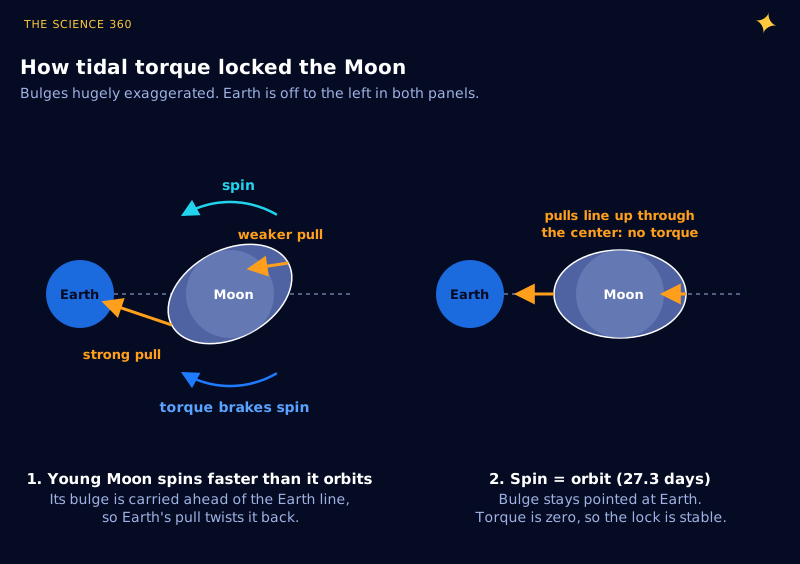
Gravity weakens with distance. Earth pulls harder on the near side of the Moon than on its center, and harder on the center than on the far side. The difference stretches the Moon along the Earth-Moon line, raising two bulges: one facing Earth, one facing away. Rock flexes under this stress, not much, but enough.
Now suppose the young Moon spun faster than it orbited, which it almost certainly did after forming from the debris of a giant impact. Rock can't reshape itself instantly. Internal friction makes the bulge lag, so the spinning Moon carries it ahead of the Earth-Moon line. Earth's gravity then pulls on a bulge that is no longer pointing straight at it.
The near bulge is closer to Earth, so it feels a stronger pull than the far bulge. That pull has a sideways component, and it points against the direction of spin. The result is a torque that brakes the rotation. The braking continues as long as the spin and the orbit are out of step. Once the spin period equals the orbital period, the bulge points straight at Earth, the pull runs through the Moon's center, and the torque vanishes. Any small wobble away from alignment produces a restoring torque, so the lock is stable.
Today the Moon also has a frozen-in shape. Its mass distribution is slightly elongated, with the long axis pointing roughly at Earth, and that permanent asymmetry keeps it locked even without a flexing bulge. The Moon's center of mass also sits about 2 km closer to Earth than its geometric center, partly because the far-side crust is thicker. How the two hemispheres ended up so different is still an open research question, but it's a reminder that the near and far sides are genuinely different worlds.
How long did it take the Moon to become tidally locked?
Not long. Gladman and colleagues (1996) give an approximate formula for the time to despin a satellite. Its most dramatic feature is that it scales with distance to the sixth power. Halve the distance and locking happens 64 times faster.
Worked calculation 2: the locking timescale
In SI units, with and an initial spin of about 12 h:
(today's distance), , (rigidity of rock), (Moon), (Earth).
That is at today's distance. At 30 Earth radii, where the young Moon spent its early history:
so about 60,000 years.
The formula is honest about being rough: Q and rigidity for the young, hot Moon are uncertain by large factors, so treat these as order-of-magnitude numbers. Even so, the conclusion is robust. Against a 4.5-billion-year history, the Moon locked almost immediately.
Tidal locking is common, by the way. Most large moons in the solar system are locked to their planets, and Pluto and its moon Charon are locked to each other, each permanently showing the other the same face.
How much of the Moon can we see from Earth?
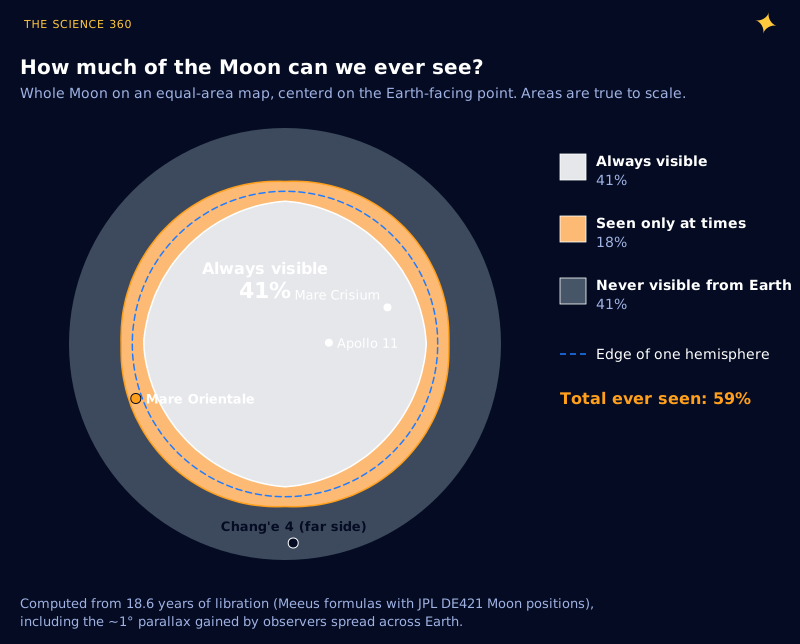
If the lock were perfect, the answer would be a hair under 50%. From a finite distance you see slightly less than a hemisphere (my calculation gives 49.8% at average distance). The real answer is about 59%, because the Moon rocks back and forth. That rocking is called libration, from the Latin for a balance scale.
Libration in longitude: the shake
The Moon's spin is steady, but its orbit is not a circle. Its eccentricity is 0.055, and Kepler's second law says it moves fastest near perigee and slowest near apogee. The rotation can't keep step with that changing speed. Near perigee the orbit runs ahead of the spin and we see a little way around one edge; near apogee the spin gets ahead and we see around the other.
Worked calculation 3: size of the east-west shake
For a small eccentricity , the true anomaly runs ahead of the mean anomaly by up to radians.
Solar perturbations stretch the eccentricity month to month, so the measured maximum reaches 7°54′, about 7.9°. My own 18.6-year run (Meeus's formulas on JPL ephemeris positions) peaks at 8.1°.
Libration in latitude: the nod
The Moon's equator is tilted about 6.7° to the plane of its orbit. Over each month we look first slightly over its north pole, then slightly under its south pole, by up to 6°50′.
Diurnal libration: the parallax bonus
Earth is 12,742 km wide. An observer at moonrise looks at the Moon from a point about one Earth radius to the side of an observer at moonset, which shifts the view by up to about 1°. Combine all three effects and the visible region grows past the hemisphere's edge.
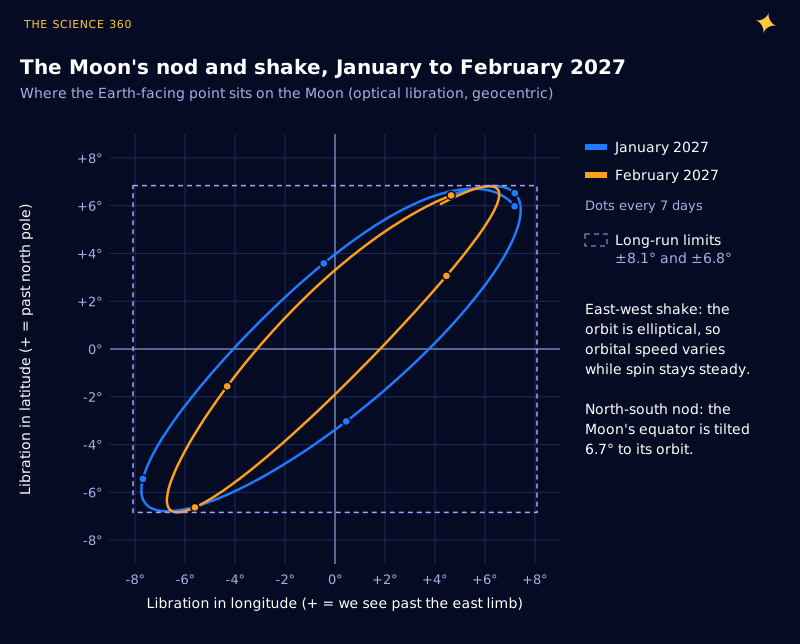
To turn these wobbles into a single number, I ran 18.6 years of libration (a full cycle of the Moon's nodes) from the ephemeris, every six hours, and asked of each point on a 40,000-point grid on the lunar sphere whether it was ever visible, always visible or never visible. The result:
| Region | Share of the Moon's surface |
|---|---|
| Always visible from Earth | 41.7% |
| Visible only at favorable libration | 17.0% |
| Never visible from Earth | 41.3% |
| Ever visible | 58.7% |
That matches NASA's "about 59%" nicely. The libration zones are viewed nearly edge-on, so you see them foreshortened, but on a good night with a small telescope you can see Mare Orientale, a 930 km bullseye basin, peeking over the western limb.
Is the far side of the Moon dark?
No. This is the second big misconception, and Pink Floyd has a lot to answer for. The far side gets exactly as much sunlight as the near side. At new Moon, when the side facing us is unlit, the far side is in full daylight. "Dark side" only ever meant "unknown."
And the far side really is different. It has almost none of the dark lava plains (maria) that make the familiar face, a thicker crust, and the largest impact basin on the Moon, the South Pole-Aitken basin. Because the Moon itself blocks radio noise from Earth, the far side is the quietest radio site in the inner solar system. That's why China's Chang'e 4 needed a relay satellite to land there in January 2019, the first soft landing on the far side, and why radio astronomers keep proposing far-side telescopes.
Is the Moon moving away from Earth?
Yes, and it's the same tidal physics running in the other direction. The Moon raises tides on Earth too, in the oceans and in the solid rock. Earth spins once a day while the Moon takes 27.3 days to go around, so Earth drags its tidal bulge ahead of the Earth-Moon line. The bulge's gravity tugs the Moon forward along its orbit, which lifts it into a higher orbit. In return, the Moon pulls back on the bulge, which brakes Earth's spin.
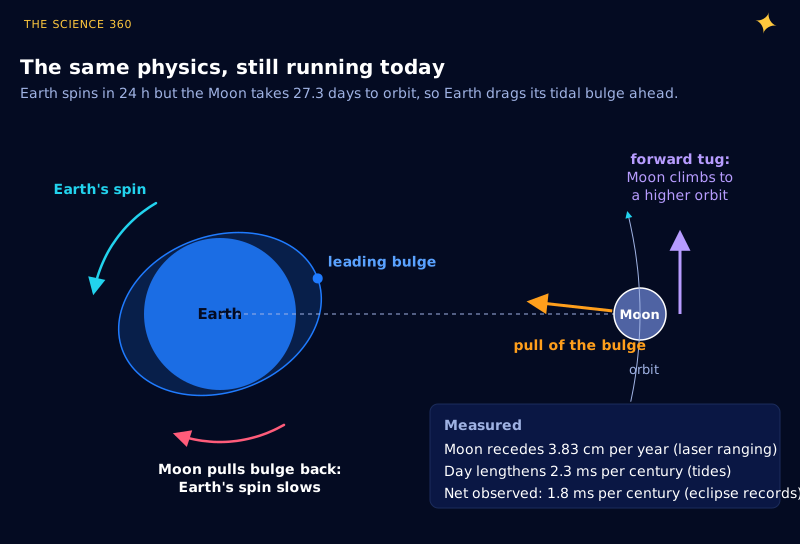
Both sides of this exchange are measured. Lasers fired from observatories at retroreflectors left by Apollo 11, 14 and 15 and the Soviet Lunokhod rovers time the round trip to millimeter precision. The fit by Williams and Boggs (2016) to 45 years of these ranges gives a recession of 38.30 ± 0.08 mm per year. On Earth's side, tidal friction should lengthen the day by about 2.3 to 2.4 ms per century.
Those two numbers are linked by conservation of angular momentum, so we can check one against the other. This is my favorite calculation in the post because it ties a clock on Earth to a ruler on the Moon.
Worked calculation 4: from a longer day to a receding Moon
Earth's moment of inertia , spin . Day lengthening: 2.395 ms per century = 7.59×10⁻¹³ s per second.
Moon's orbital angular momentum, with reduced mass , and :
The Sun's tides do about 13% of the braking, and that share does not reach the Moon:
Laser ranging measures 3.83 cm per year. The day-length model and the laser agree within 1%.
Why the observed day lengthening is only 1.8 ms per century
Here's a wrinkle the usual "2.3 ms" quote hides. When Stephenson, Morrison and Hohenkerk (2016) reconstructed Earth's rotation from ancient eclipse records going back to 720 BC, they found the day has actually lengthened by 1.8 ms per century on average, not 2.3. The tides are doing their 2.3, but something else is speeding Earth up by 0.5. The main suspect is post-glacial rebound: since the ice sheets melted, the land under them has been rising, making Earth less flattened and letting it spin a bit faster, like a skater pulling in their arms.
Today's tidal rate is also unusually fast by geological standards. Tidal rhythmites (layered sediments that record daily and monthly tides) from South Australia show a 21.9-hour day 620 million years ago. At today's rate the day would have been about 20 hours then, so the average rate since has been slower. The likely reason is that today's ocean basins happen to resonate well with the tides, which makes them unusually efficient brakes.
Will Earth become tidally locked to the Moon?
In principle. If nothing else intervened, Earth's day would keep lengthening and the Moon keep receding until Earth's spin matched the Moon's orbit, at roughly 47 present-day days. Then each would show the other the same face, like Pluto and Charon. Earth's tidal locking would take tens of billions of years. The Sun will become a red giant in about five billion, so it never gets the chance.
The recession has a nearer consequence too: every year the Moon's disk shrinks a tiny bit, and total solar eclipses, which need the Moon to cover the Sun completely, will eventually give way to annular ones only. That makes long totalities like the one in Egypt in 2027 a feature of our particular slice of history.
FAQ
Why do we only see one side of the Moon?
The Moon is tidally locked. Earth's gravity pulled on the young Moon's tidal bulge and braked its spin until one rotation took exactly as long as one orbit, 27.3 days. Since then the same face has pointed at Earth.
Does the Moon rotate?
Yes, once every 27.3 days, exactly once per orbit. A Moon that didn't rotate would show us every side over a month.
How much of the Moon can we see from Earth?
About 59% over time, thanks to libration. Roughly 41% is always visible, 18% only some of the time and 41% never.
Is the far side of the Moon dark?
No. It gets the same sunlight as the near side and is fully lit at new Moon. It's only "dark" in the sense of unseen from Earth.
Will Earth become tidally locked to the Moon?
Not in practice. It would take far longer than the roughly five billion years before the Sun becomes a red giant.
Related on The Science 360
Sources
- NASA Scientific Visualization Studio, Moon Wobble (59% of the surface visible): svs.gsfc.nasa.gov/10836
- Wikipedia, Libration (7°54′ in longitude, 6°50′ in latitude, diurnal under 1°, 6.7° axial tilt): en.wikipedia.org/wiki/Libration
- Wikipedia, Tidal locking (Gladman et al. 1996 timescale formula, Pluto-Charon, Earth-Moon future): en.wikipedia.org/wiki/Tidal_locking
- Williams, J. G. and Boggs, D. H. (2016), Secular tidal changes in lunar orbit and Earth rotation, Celestial Mechanics and Dynamical Astronomy 126, 89 (da/dt = 38.30 mm/yr): link.springer.com/content/pdf/10.1007/s10569-016-9702-3.pdf
- Stephenson, F. R., Morrison, L. V. and Hohenkerk, C. Y. (2016), Measurement of the Earth's rotation: 720 BC to AD 2015, Proc. R. Soc. A 472, 20160404: royalsocietypublishing.org/doi/10.1098/rspa.2016.0404
- Williams, G. E. (2000), Geological constraints on the Precambrian history of Earth's rotation and the Moon's orbit, Reviews of Geophysics 38, 37 (21.9 h day at 620 Ma): eoas.ubc.ca (PDF)
- Geodesy and Geodynamics (2019), oceanic lunar and solar tidal torques (4.462 and 0.676 × 10¹⁶ N m): doaj.org/article/e2b20957a03c4ae78b56864cfa0b0be1
- NASA Technical Reports, lunar center of mass offset from center of figure (about 2 km toward Earth): ntrs.nasa.gov/citations/19850005425
- Meeus, J., Astronomical Algorithms, 2nd ed. (1998), chapter 53, optical libration formulas used for Figures 3 and 4, with JPL DE421 Moon positions: ssd.jpl.nasa.gov/planets/eph_export.html
Header image: NASA Goddard Space Flight Center (image GSFC_20171208_Archive_e001861), regraded for this article.