Why No Stars in Moon Landing Photos? The Exposure Math
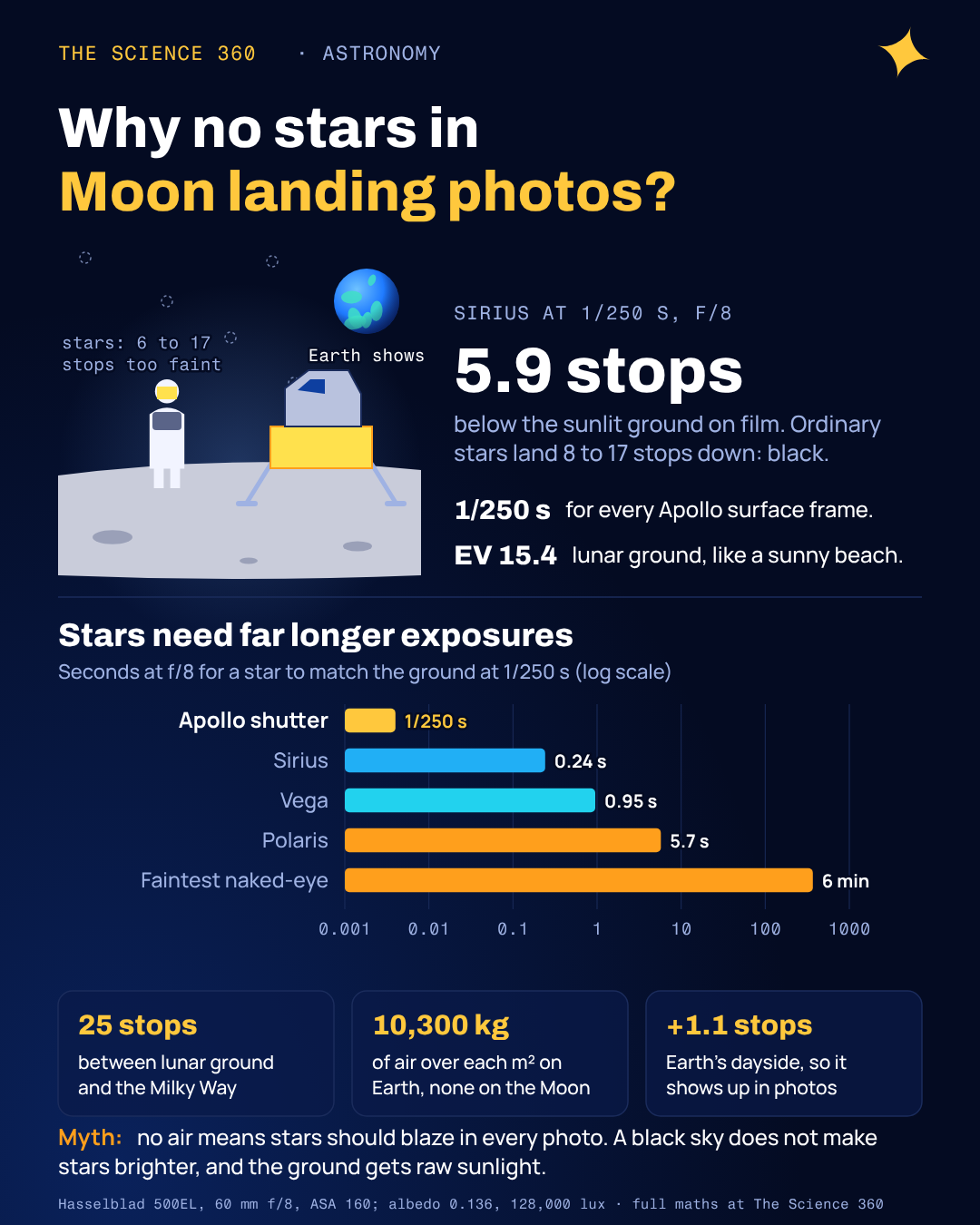
Every photograph the Apollo moonwalkers took outside the lunar module was exposed for 1/250 of a second, at f/5.6, f/8 or f/11. That fact, recorded in the Apollo Lunar Surface Journal, is most of the answer to one of the most repeated questions about the Moon landings. Those are bright-daylight settings. They are roughly what you would use on a beach at noon, and nobody expects stars in a beach photo.
"Exposure" is the explanation everyone gives and almost nobody quantifies. So let's put actual numbers on it: how bright the lunar ground is, how faint the stars are by comparison, how long the shutter would have had to stay open, and which Apollo frames do in fact contain a point of light from the sky.
What camera settings did the Apollo astronauts use?
The surface camera was a modified Hasselblad 500EL Data Camera, silver-finished to handle the swing between full Sun and full shadow, fitted with a Zeiss Biogon 60 mm f/5.6 lens designed for NASA and a glass reseau plate that printed a grid of small crosses onto every frame for measurements. It used 70 mm Kodak film on a thin base, about 160 color frames per magazine.
The color film on all the landings was Kodak SO-168 Ektachrome EF, a high-speed color reversal (slide) film rated ASA 160. Black-and-white films included Panatomic-X at ASA 80 on Apollo 11 and Plus-XX on later missions. Shutter speed stayed at 1/250 s except for some polarization shots at 1/125 s.
How bright is the lunar surface?
The Moon's surface reflects only about 13.6% of the light falling on it, which puts it close to asphalt. That sounds dark, but it sits in unfiltered sunlight. Above any atmosphere, the Sun delivers about 128,000 lux, compared with roughly 100,000 lux at sea level on a clear day.
Worked example: the exposure value of the lunar ground
Photographers measure scene brightness in exposure values: , where is the f-number and the shutter time. Each step of 1 EV is a factor of two in light, the same as one "stop". A typical sunny day on Earth is EV 15 at ISO 100. Let's see where the Moon lands.
Surface luminance, treating regolith as a matte reflector:
A reflected-light meter (calibration constant ) gives:
Apollo settings, ASA 160 film, 1/250 s:
Converting with .
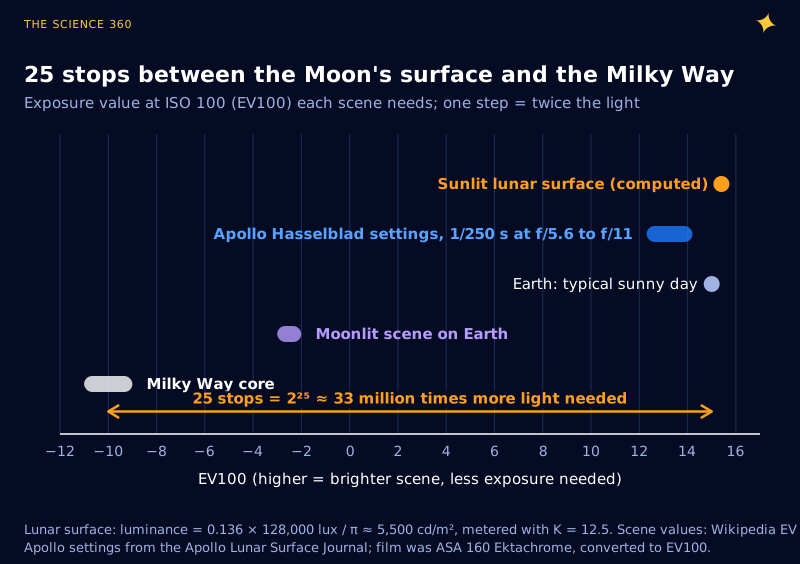
The lunar ground needs about EV 15, the same as a sunny day on Earth, and the crews shot one to three stops more generously than a meter would suggest, which makes sense for a gray, low-contrast surface full of shadows and for white spacesuits that must not burn out. Now compare the opposite end of the scale. A photograph of the Milky Way's core needs about EV −11 to −9.
Why are there no stars in the Moon landing photos?
The EV comparison is persuasive, but stars are points, not extended scenes, so it is fairer to ask how much light one star's image puts onto the film compared with the sunlit ground beside it. Here is that calculation for Sirius, the brightest star in the sky.
Worked example: Sirius on Apollo film
Star illuminance from magnitude (anchored at magnitude −14.2 = 1 lux):
Sirius, :
Light collected at f/8 by the 60 mm lens (aperture ):
Spread over a 20 µm blur spot (): about 1.1 lux on the film.
Sunlit ground imaged at f/8:
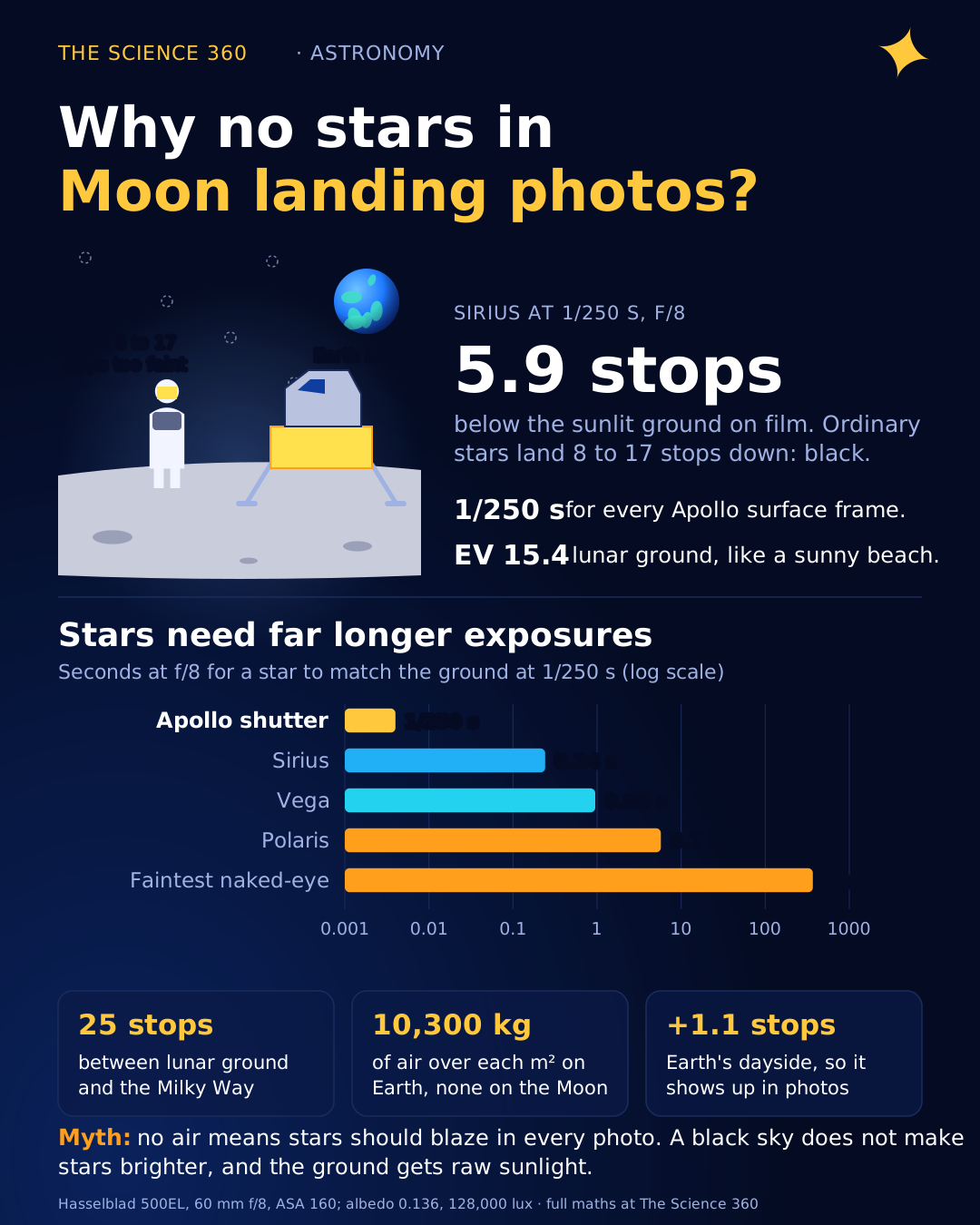
The biggest uncertainty is the size of the star's image. Lens blur and film grain spread a point into a spot of very roughly 10 to 20 µm; a 10 µm spot would make every star 2 stops brighter. That does not change the picture: each step of one magnitude costs another 1.33 stops, so Vega lands about 8 stops down, Polaris about 10.5, and the faintest naked-eye stars more than 16.
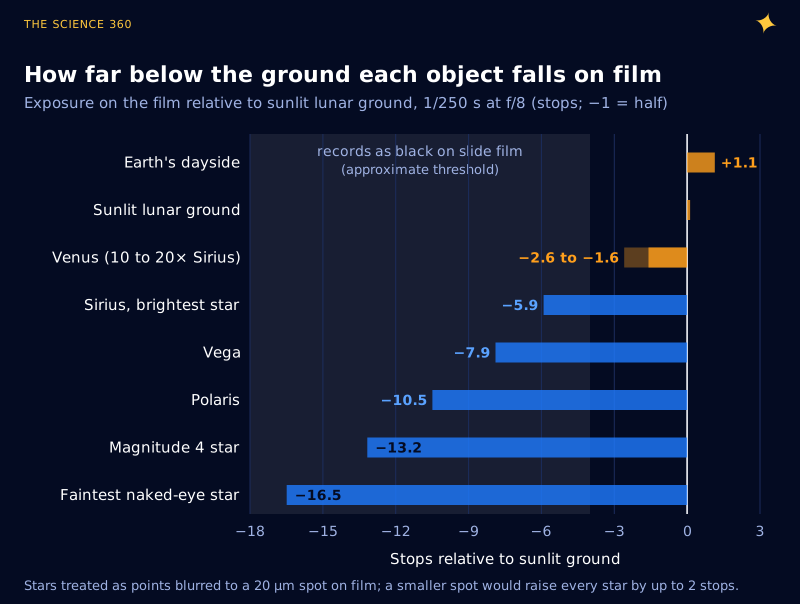
Color slide film has a narrow range between clear and black; it is commonly quoted at only about five to six stops in total. Ground exposed one or two stops above the middle leaves only a few stops before shadows become solid black, so Sirius sits right at the edge and everything fainter is gone. Sky and Telescope editor Dennis di Cicco made the same point in the Apollo Lunar Surface Journal: Sirius might just register on the original film, but the images would be "impossibly small", and a print made to show the foreground properly would never show them.
How long would the shutter have to stay open?
Turn the problem around. If an astronaut wanted a star to reach the same density on film as the ground gets at 1/250 s, how long would the exposure need to be?
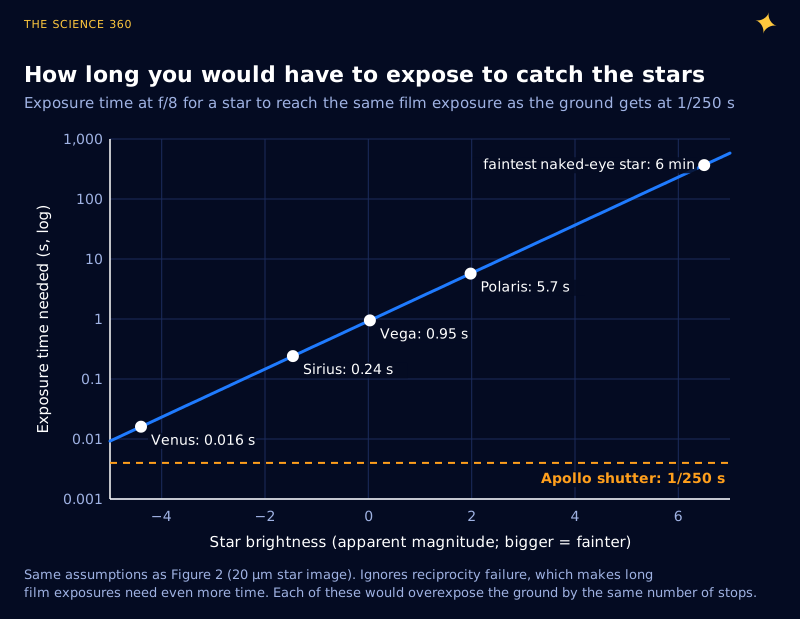
A quarter of a second for Sirius, a few seconds for the stars of familiar constellations, minutes for faint ones. Each of those exposures would overexpose the ground by the same 6 to 16 stops. You can see exactly this effect on Earth. In 1979 science writer James Oberg stood under a bright streetlight and took two photos: about 1/4 second captured him, and a 30-second exposure revealed the stars that had been behind him all along.
Why is the sky black on the Moon?
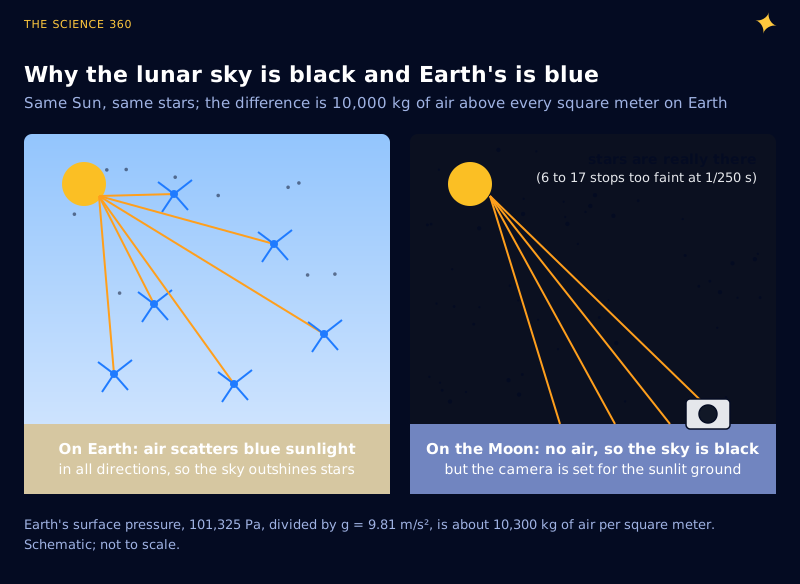
On Earth, the daytime sky is bright because air molecules scatter sunlight, much more strongly at short (blue) wavelengths. There is a lot of air doing it: sea-level pressure of 101,325 Pa divided by g = 9.81 m/s2 means about 10,300 kg of air above every square meter. That glowing blue sheet is far brighter than any star except the Sun, which is why you cannot see stars at noon on Earth with any camera setting.
The Moon has essentially no atmosphere. Sunlight passes straight down to the ground, and the sky in every direction away from the Sun is black, even at lunar noon. So the Moon gives you a black sky and a brilliantly lit surface at the same time, a combination that never happens on Earth.
Could the astronauts see stars on the Moon?
This is the second common misconception. At the Apollo 11 post-flight press conference, the crew said they did not remember seeing stars during the moonwalk, and that remark is often quoted as evidence of fakery. It was about naked-eye viewing on the sunlit surface, with eyes adapted to bright ground and a reflective visor in front of them. The same crews sighted stars routinely through the spacecraft's navigation optics to align the guidance platform, and stars could be seen by eye from shadow. Your own eyes do the same thing: step from a floodlit car park toward a dark field and it takes a while for the stars to appear.
Are there Apollo photos that show stars or planets?
Yes, and they are the best evidence that the exposure explanation is right, because they appear exactly where the numbers say they should.
- Earth. Earth's sunlit side reflects about 30% of sunlight, against the Moon's 13.6%, so it is about one stop brighter than the ground (Figure 2). It shows up properly exposed in several surface photos, including Apollo 17 shots with Earth above the flag.
- Venus. After the Sun and Earth, Venus is the brightest object in the lunar sky, about 10 to 20 times brighter than Sirius depending on the geometry. That puts it 1.6 to 2.6 stops below the ground, within the film's reach. Journal contributors found Venus in a sequence of nine Apollo 14 photographs taken by Alan Shepard, and in three frames of Charlie Duke's Apollo 16 Station 10 panorama. It was identified by appearing at the correct position in several overlapping frames.
- Stars, in ultraviolet. Apollo 16 carried George Carruthers's Far Ultraviolet Camera/Spectrograph, a small telescope the astronauts set up in the shadow of the lunar module and aimed by hand. It recorded 178 frames of 11 targets, including Earth's glowing outer atmosphere (the geocorona), nebulae, star clusters and the Large Magellanic Cloud. Its star positions match ultraviolet observations of the same fields.
One caution for anyone hunting stars in high-resolution scans: white specks can be dust on the film or scanner. The Journal shows a "star" in frame AS11-40-5850 that does not appear in another frame of the same patch of sky, which rules it out as a real object.
Why the missing stars are evidence, not a flaw
If someone had faked the photos in a studio, adding a starfield would have been trivial, and it would have been wrong. The physics predicts a black sky with no visible stars at daylight exposures, the occasional faint Venus, and a well-exposed Earth. That is exactly what the archive contains. The missing stars are what correctly exposed film of a sunlit surface under an airless sky must look like.
If the Moon itself interests you, the companion posts explain why we only see one side of the Moon and why the Moon looks bigger on the horizon.
Frequently asked questions
Why are there no stars in the Moon landing photos?
The astronauts photographed a sunlit scene at 1/250 s and f/5.6 to f/11 on ASA 160 film, settings suited to a scene as bright as a sunny day on Earth. Even Sirius lands about 6 stops below the ground on film, and most stars 8 to 17 stops below, which is black.
Could the astronauts see stars from the Moon?
Not easily on the sunlit surface, because their eyes were adapted to bright ground. They saw stars routinely through the navigation optics, and by eye from shadow.
Why is the sky black on the Moon?
There is essentially no atmosphere to scatter sunlight. On Earth, about 10,300 kg of air above each square meter scatters blue light across the sky and hides the stars.
Are there any Apollo photos that show stars or planets?
Yes. Venus appears in Apollo 14 and Apollo 16 surface photos, Earth appears in many, and the Apollo 16 Far Ultraviolet Camera recorded stars, nebulae and the Large Magellanic Cloud from the lunar surface.
What camera did Apollo astronauts use on the Moon?
A modified Hasselblad 500EL Data Camera with a Zeiss Biogon 60 mm f/5.6 lens and a reseau plate, loaded with 70 mm Kodak film.
Related on The Science 360
More science of sci-fi:
Sources
- Apollo Lunar Surface Journal, "Photographing Stars" (exposure settings, films, Venus in Apollo 14 and 16 frames, di Cicco and Oberg): apollojournals.org
- Apollo Lunar Surface Journal, "Apollo-11 Hasselblad Cameras" by Phill Parker (500EL Data Camera, Biogon 60 mm f/5.6, reseau plate, 70 mm film): apollojournals.org
- Exposure value definition, EV table (sunny day EV 15, Milky Way core EV −11 to −9), ISO conversion: Wikipedia
- Apparent magnitude (magnitude −14.2 ≈ 1 lux, Sirius −1.46, faintest naked-eye stars about +6.5): Wikipedia
- Sunlight (solar illuminance constant 128,000 lux; about 100,000 lux at the surface): Wikipedia
- Moon (albedo 0.136, comparable to asphalt): Wikipedia
- Far Ultraviolet Camera/Spectrograph (Carruthers, Apollo 16, 178 frames of 11 targets): Wikipedia
- Moon landing conspiracy theories, section on stars (Apollo 11 press conference context, navigation optics): Wikipedia
Header image: NASA (image as11-40-5903), regraded for this article.