Best Solar Panel Angle in India for Every Month
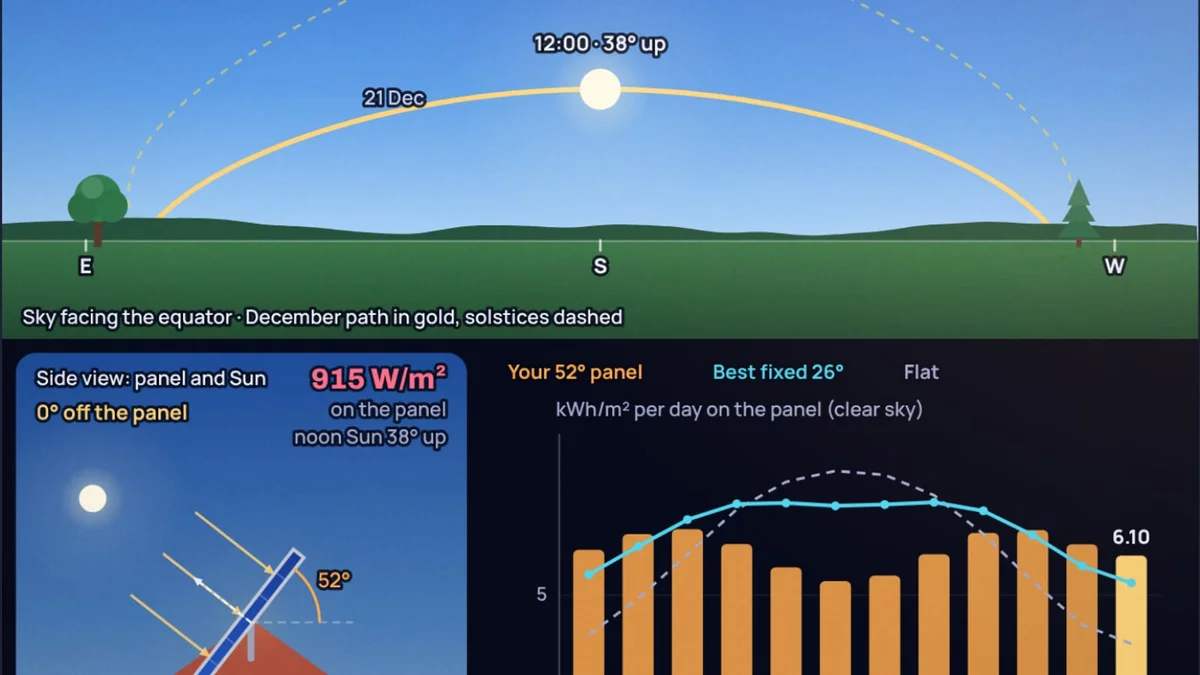
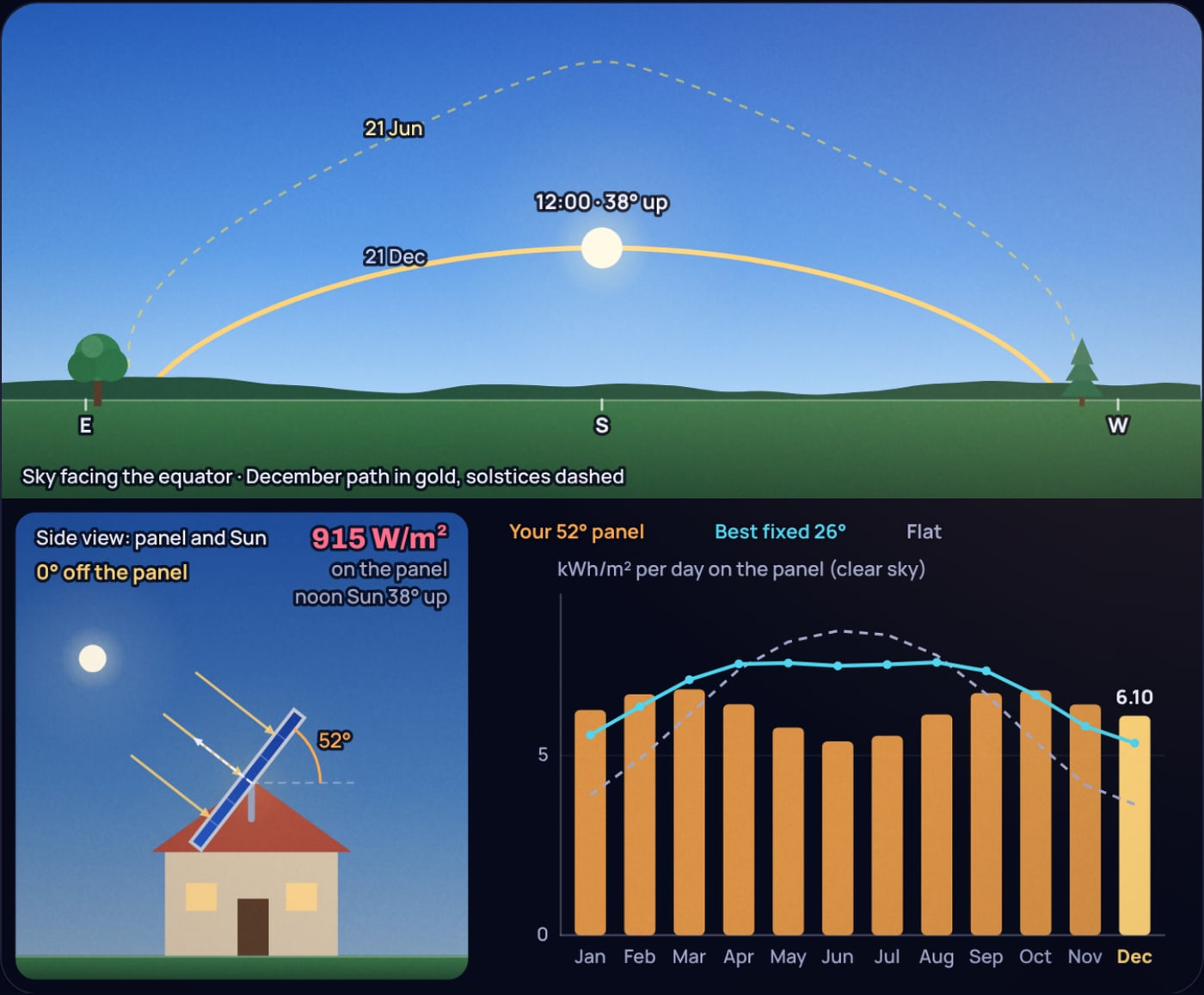
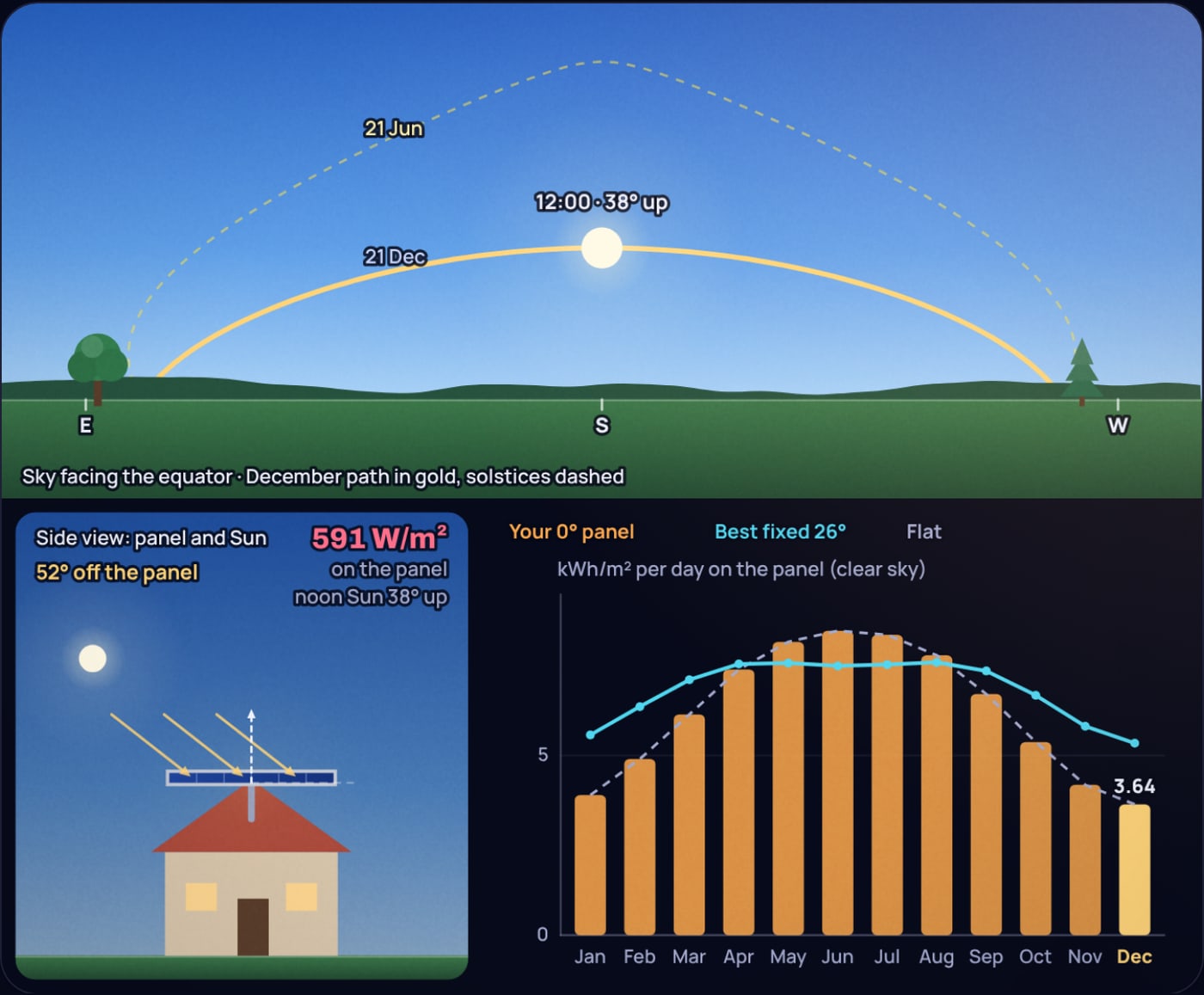
On 15 December the Sun at solar noon over Delhi climbs to only 38 degrees above the horizon. A solar panel lying flat on a roof catches its rays at a slant of 52 degrees and receives about 591 watts per square metre on a clear day. Tilt that same panel up to 52 degrees and it faces the Sun square-on: 915 watts per square metre. Same Sun, same roof, 55 percent more power, just from the angle.
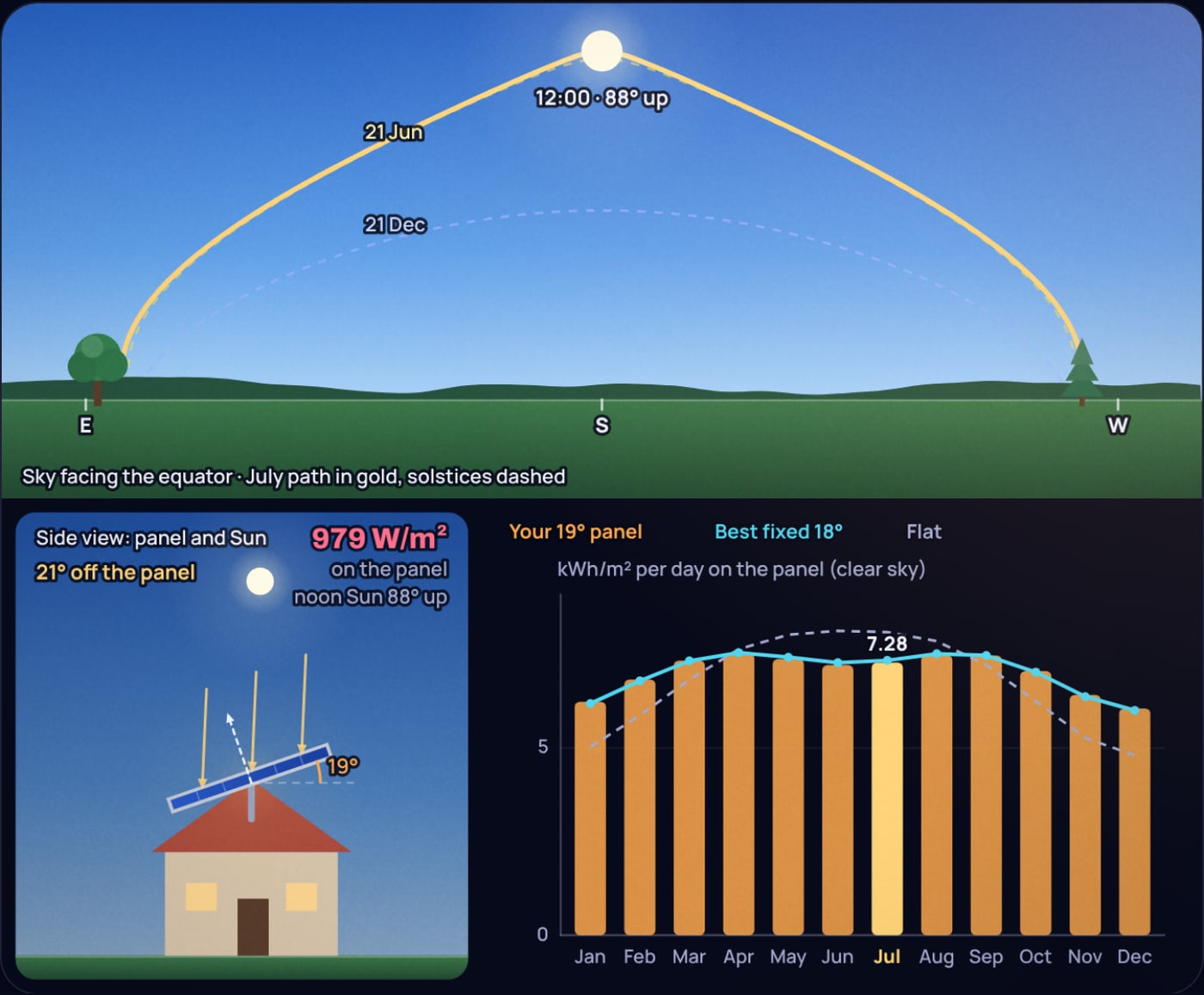
Six months later the picture flips. In June the noon Sun over Delhi is 85 degrees up, almost overhead, and the flat panel wins. So what is the best solar panel angle in India? It depends on the month, on your city, and, more than most guides admit, on the monsoon. I worked through it with our solar panel tilt angle calculator, which draws the Sun's path for any latitude and month and adds up the energy hour by hour, and then checked the answers against PVGIS, the European Commission's solar database, which uses real weather records.
Why does the best solar panel angle change every month?
Because the Sun's noon height changes by 47 degrees over the year. Earth's axis is tilted 23.45 degrees, so the latitude where the Sun is directly overhead at noon, called the declination, swings from 23.45 degrees north on 21 June to 23.45 degrees south on 21 December. For any place, the Sun's height at solar noon is
where is your latitude and is the declination. A panel catches the most direct sunlight when its face is perpendicular to the rays, which at noon means a tilt of . In June, Delhi (28.61 degrees north) has , so the noon Sun wants a tilt of just 5 degrees. In December and the noon Sun wants 52 degrees.
The full-day optimum is a little different from the noon one. Morning and evening sunlight comes in lower and from the east and west, and in winter the steeper panel also suits those hours. That is why the simulation's best December angle for Delhi is 57 degrees, not 52.
Declination on 15 December:
Noon Sun height:
Air mass:
Direct beam (Meinel clear-sky fit):
Flat panel:
52 degree panel, rays square-on:
The tilted panel gets about 55 percent more at this moment. The simulation, with a slightly more exact air mass, shows 591 and 915.
What is the best solar panel angle for each month in Indian cities?
The table gives the tilt that collects the most clear-sky energy on the 15th of each month, facing due south. It comes straight from the simulation: Sun position every 10 minutes, the Meinel clear-sky beam, diffuse light at 10 percent of the beam and ground reflection at 20 percent. Bengaluru and Chennai sit at almost the same latitude (12.97 and 13.08 degrees north), so they share a column.
| Month | Srinagar 34.1° N | Delhi 28.6° N | Jaipur 26.9° N | Kolkata 22.6° N | Mumbai 19.1° N | Bengaluru and Chennai 13° N |
|---|---|---|---|---|---|---|
| January | 60° | 55° | 54° | 50° | 47° | 41° |
| February | 52° | 47° | 45° | 41° | 38° | 32° |
| March | 39° | 34° | 32° | 27° | 24° | 18° |
| April | 22° | 16° | 14° | 10° | 6° | 0° |
| May | 7° | 2° | 0° | 0° | 0° | 0° |
| June | 0° | 0° | 0° | 0° | 0° | 0° |
| July | 2° | 0° | 0° | 0° | 0° | 0° |
| August | 15° | 9° | 7° | 3° | 0° | 0° |
| September | 32° | 26° | 25° | 20° | 17° | 10° |
| October | 47° | 42° | 40° | 36° | 33° | 27° |
| November | 58° | 53° | 51° | 47° | 44° | 39° |
| December | 62° | 57° | 56° | 52° | 49° | 44° |
Two patterns stand out. First, every city follows the same shape, shifted by its latitude: steep in December, flat in June. Second, from late April to July the answer is "flat" everywhere south of Delhi, because the Sun passes north of the zenith at noon in parts of that period. In Mumbai on 15 June the declination is 23.3 degrees and the city is at 19.1 degrees, so the noon Sun is actually slightly in the northern sky. A south-facing tilt would point the panel away from it.
What is the best fixed angle if you never adjust the panels?
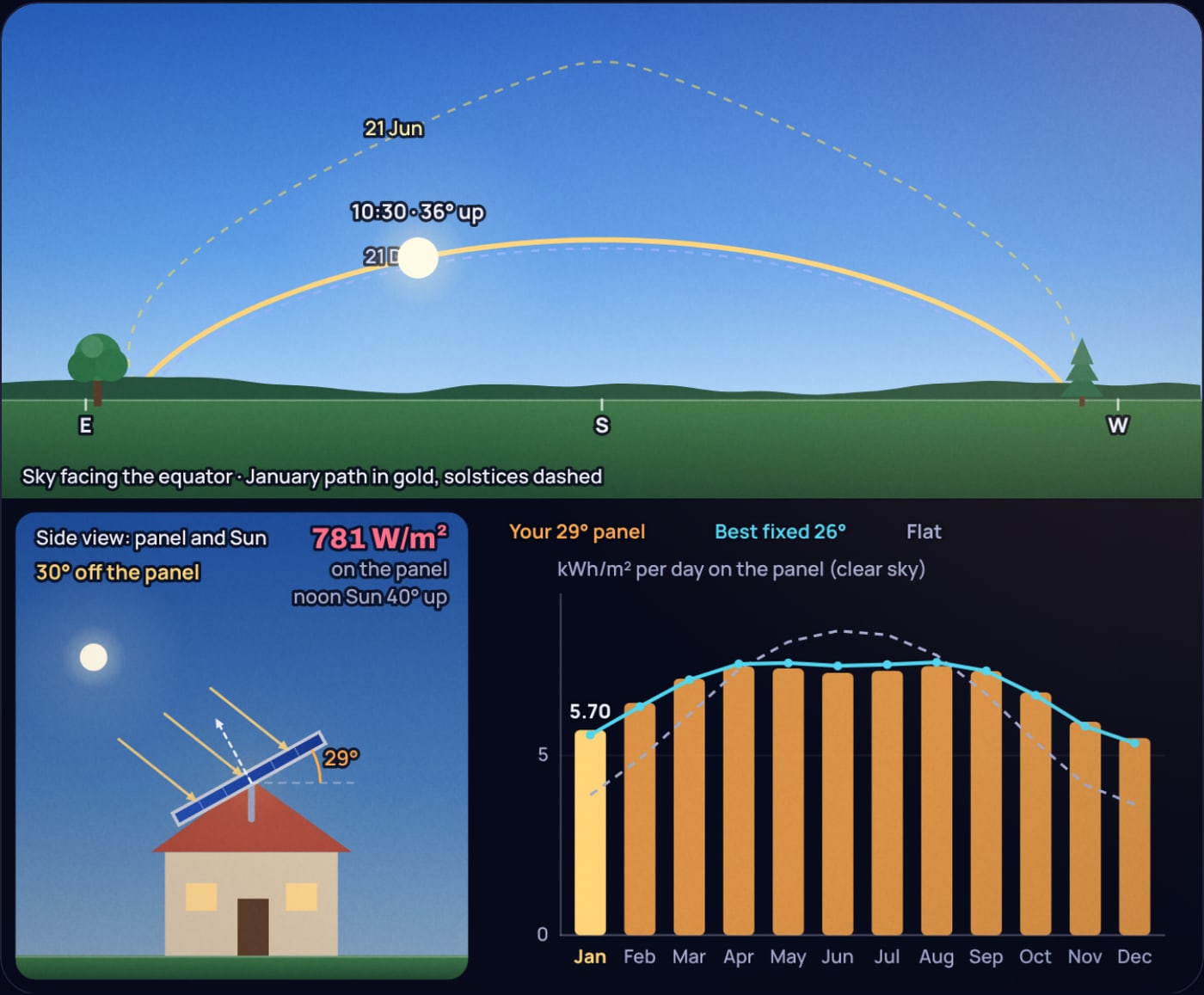
Most rooftop systems in India are fixed, so this is the number that matters. The geometry answer is simple: tilt at about the latitude, facing south. A panel at the latitude has the same relationship with the Sun's rays as a flat panel at the equator, so it sits in the middle of the yearly swing. In the clear-sky model, Delhi's best fixed tilt is 26 degrees, and 29 degrees (the latitude) collects within 0.1 percent of it.
Real weather changes this, and in India it changes it in a direction many guides miss. I queried PVGIS, the free solar tool from the European Commission's Joint Research Centre, for the optimum fixed angle in eight Indian cities. In every one, the real-weather optimum came out steeper than both the clear-sky value and the latitude.
| City | Latitude | Clear-sky best | PVGIS best (real weather) | PVGIS yield at best, kWh per kWp a year |
|---|---|---|---|---|
| Srinagar | 34.1° N | 31° | 36° | 1638 |
| Delhi | 28.6° N | 26° | 32° | 1635 |
| Jaipur | 26.9° N | 25° | 31° | 1648 |
| Ahmedabad | 23.0° N | 21° | 28° | 1585 |
| Kolkata | 22.6° N | 21° | 28° | 1425 |
| Mumbai | 19.1° N | 18° | 25° | 1560 |
| Bengaluru | 13.0° N | 12° | 17° | 1517 |
| Chennai | 13.1° N | 12° | 15° | 1477 |
The reason is the monsoon. PVGIS's own monthly figures for Mumbai show a south-facing panel at its optimum getting 7.18 kWh per square metre per day in February but only 3.24 in July. The months that would reward a flat panel are the cloudy ones, so they barely count. The clear winter months reward a steep panel, and they decide the answer. The optimum slides up by 3 to 7 degrees.
This is the opposite of what NREL found for much of the United States. Craig Christensen and Greg Barker's study of 239 US weather stations found that optimal tilts there are usually less than the latitude, most of all in places with cloudy winters. London behaves the same way: the clear-sky optimum is 44 degrees, PVGIS says 40. India has the reverse climate pattern (wet summers, dry winters), so its correction runs the other way.
PVGIS, 14 percent system losses, panels facing south.
At 32 degrees (optimum):
At 29 degrees (latitude): , a difference of 6 kWh
Flat: , which is 609 kWh (12.4 percent) less
At an assumed tariff of ₹7 per unit, laying the panels flat throws away about ₹4,300 a year. Getting within a few degrees of the optimum is worth almost nothing extra.
Is it worth adjusting the angle twice a year?
If your mounting frame has two positions, it is a cheap gain. The simulation finds the best pair of tilts for a summer half (April to September) and a winter half (October to March):
| City | Summer tilt | Winter tilt | Gain over best fixed (clear sky) |
|---|---|---|---|
| Srinagar | 12° | 52° | 5.3% |
| Delhi | 7° | 48° | 5.5% |
| Jaipur | 5° | 46° | 5.5% |
| Kolkata | 1° | 42° | 5.6% |
| Mumbai | 0° | 39° | 5.7% |
| Bengaluru and Chennai | 0° | 33° | 5.3% to 5.4% |
Changing every month adds only about 1 percentage point more (6.8 percent in Delhi). In real weather the summer half matters less, so the true gain is smaller than these clear-sky numbers. The familiar rule of "latitude minus 15 in summer, latitude plus 15 in winter" (14 and 44 degrees in Delhi) gets 5.0 percent, nearly as good as the computed pair. For a rooftop you climb twice a year, set it to the winter angle around the start of October and the summer angle in early April, and keep the summer angle at 10 degrees or more for rain washing.
Which direction should solar panels face in India?
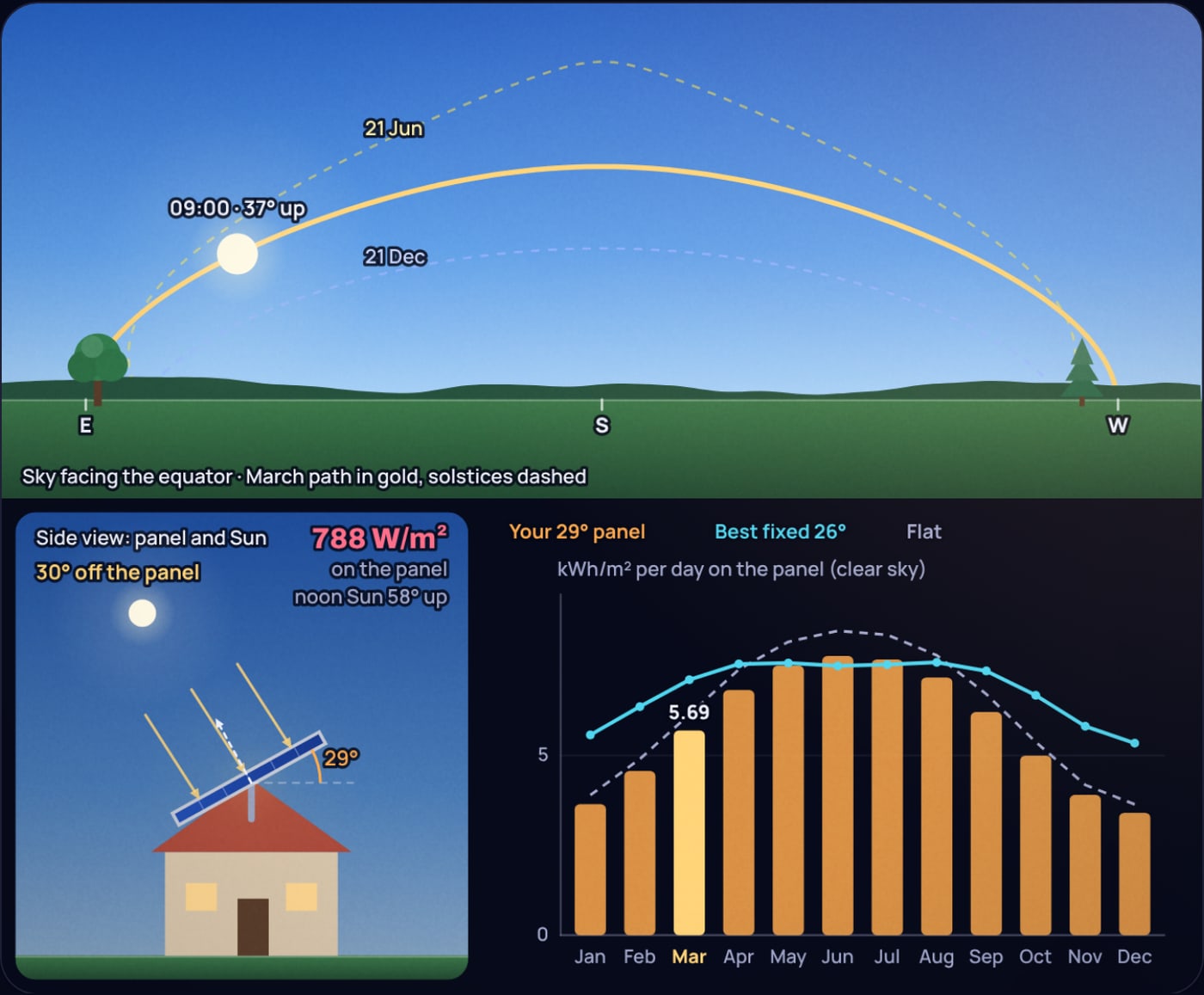
Due south, with some slack. In the clear-sky model a Delhi panel at 29 degrees facing south-east collects 4.4 percent less a year than the best south-facing panel, and facing due east it collects 15.3 percent less. East-facing panels do collect well in the morning (788 W per square metre at 9 am in March, as Figure 5 shows) but lose the afternoon entirely. Facing north at the same tilt costs 35 percent.
If your roof slope points east or west, lay the panels flatter. At 10 degrees the direction matters much less, because a nearly flat panel sees the whole sky. Magnetic north in India is within about 1 to 2 degrees of true north, so a phone compass is accurate enough here.
What does the calculator leave out?
The simulation is a clear-sky model on purpose: it isolates the geometry so you can see why the angle matters. It does not include clouds, haze, dust, shading from water tanks or neighbouring buildings, or the 0.3 to 0.5 percent of output a hot panel loses per degree above 25 °C. Those change how much energy you get far more than they change the best angle. For a yield estimate at your exact address, PVGIS and NREL's PVWatts both take weather records into account and are free.
The time slider in the simulation is solar time, so 12:00 is when the Sun is highest. In India that can differ from clock time by up to an hour, because the whole country runs on one time zone set at 82.5 degrees east. Kolkata, at 88.4 degrees east, reaches solar noon about 23 minutes before 12:00 IST on average; Ahmedabad, at 72.6 degrees east, about 40 minutes after. The equation of time shifts both by up to about 16 minutes through the year.
How do I find the angle for my own roof?
Open the solar panel tilt angle calculator and pick your city, or drag the latitude slider to your own value. The gold "Best fixed tilt" readout gives the clear-sky optimum, and for the preset cities the note below it gives the PVGIS real-weather optimum. Then try the December setup at 52 degrees and slide the month to June to see the panel lose its advantage. If you are sizing a whole system, our post on calculating an electricity bill in Python shows how to turn units into rupees, and what colour the Sun really is explains the spectrum your panels are catching. For why sunlight changes across a planet's year in general, see how orbital eccentricity changes sunlight.
Sources
- PVGIS 5.2 PVcalc API, EU Joint Research Centre (optimum angles and yields for each city, queried 12 November 2026)
- PVGIS tools, EU Joint Research Centre
- PVEducation: Declination angle
- PVEducation: Air mass, with the Meinel clear-sky formula
- PVEducation: Solar radiation on a tilted surface
- Christensen and Barker, NREL: Effects of tilt and azimuth on annual incident solar radiation for United States locations (Solar Forum 2001)
Frequently asked questions
What is the best angle for solar panels in India?
For a fixed panel, face due south and tilt it by about your latitude or a few degrees more. PVGIS, which uses real weather data, gives about 32 degrees for Delhi, 31 for Jaipur, 28 for Kolkata and Ahmedabad, 25 for Mumbai, 17 for Bengaluru and 15 for Chennai.
What angle should solar panels be in winter in India?
Steeper than the year-round angle: roughly latitude plus 20 to 28 degrees in December and January. In Delhi the clear-sky best tilt is 55 degrees in January and 57 degrees in December, because the noon Sun is only about 38 to 40 degrees above the horizon.
What angle should solar panels be in summer in India?
Close to flat. From May to July the noon Sun is almost overhead across most of India, so the clear-sky best tilt is 0 to 2 degrees. Keep at least 10 degrees anyway so rain can wash dust off, since a flat panel holds water and dirt.
Is it worth changing the solar panel angle every month?
Only if it is easy. Re-angling every month adds about 6 to 7 percent in clear-sky terms. Two settings a year, about 48 degrees from October to March and 7 degrees from April to September in Delhi, captures about 5.5 percent of that. A fixed panel at the right angle is the sensible default for rooftops.
Why is the best tilt in India steeper than the latitude?
Because of the monsoon. The summer months, when the Sun is high and a flat panel would do best, are cloudy, while the winter months, when a steep panel does best, are clear. The year is won in winter, so the real optimum moves up by 3 to 7 degrees above the clear-sky value.