How Long Will a 150Ah Battery Last With Fans, TV and a Fridge?
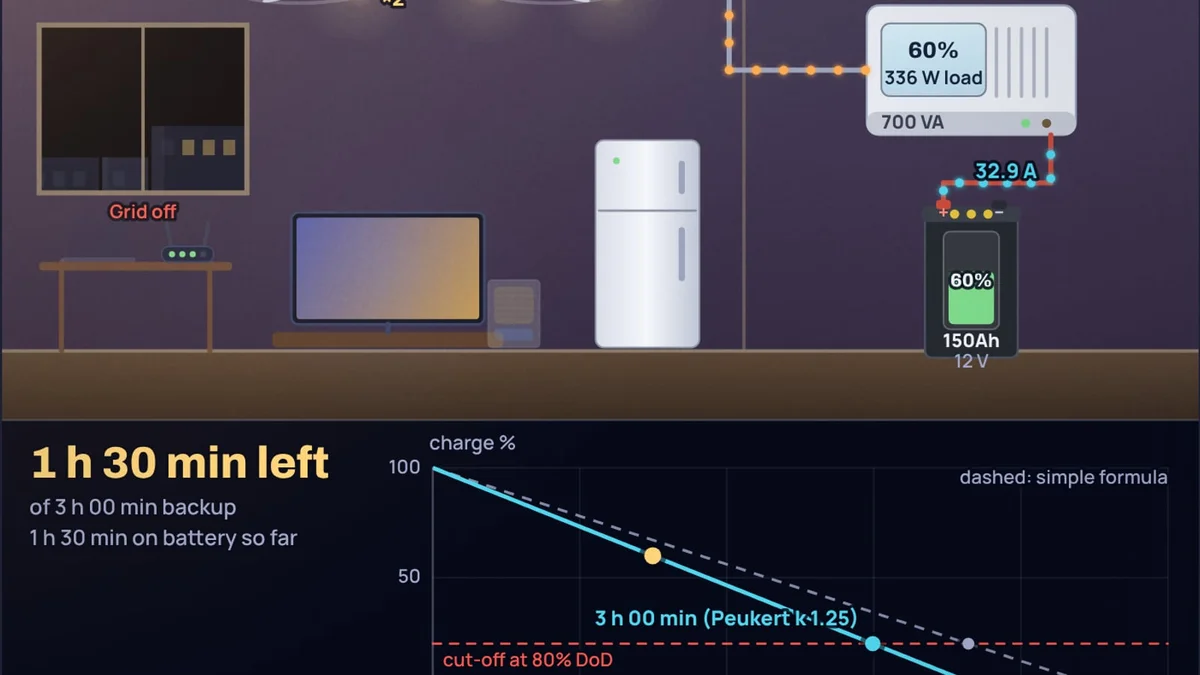
The power went at 9:40 on a June night in Lucknow, and the question in my aunt's house was the usual one: will the inverter last till it comes back? Two fans, four bulbs, the TV and the fridge, on a 150Ah tubular battery that the shop had promised was good for "four, five hours". It lasted a little over three.
The shop was not lying, exactly. It was using the brochure formula, which assumes the battery gives its full rated capacity no matter how fast you drain it. Lead acid batteries do not. The inverter battery backup calculator runs both models side by side, and every number below comes from it.
How much power do fans, a TV and a fridge actually draw?
Start with the load, because it sets everything else. A regular 1200 mm ceiling fan at full speed draws about 75 W. A 9 W LED bulb is 9 W. A 43 inch LED TV is around 80 W, a Wi-Fi router 10 W. The fridge is the interesting one: a 240 litre frost-free model's compressor draws about 150 W while running, but it runs roughly 40 percent of the time, so its average is about 60 W. That matches its BEE label of around 250 kWh a year.
| Load | Count | Watts each | Average watts |
|---|---|---|---|
| Ceiling fan | 2 | 75 | 150 |
| LED bulb | 4 | 9 | 36 |
| TV, 43 inch | 1 | 80 | 80 |
| Wi-Fi router | 1 | 10 | 10 |
| Fridge, 240 L | 1 | 150 running | 60 |
| Total | 426 peak | 336 |
The two fans are 45 percent of the load. The four bulbs are 11 percent. People switch off lights to save backup; switching off a fan does four times as much.
What does the simple backup formula say?
The formula every inverter shop uses is stored energy times the share you can use, times inverter efficiency, divided by the load:
Worked example: the brochure answer for 336 W
80 percent depth of discharge is roughly where a home inverter cuts off a 12 V lead acid battery, near 10.5 V. 85 percent is a typical sine wave home inverter efficiency.
That is not a bad first estimate. It is just optimistic, and the error grows exactly when you need the backup most, with a heavy load.
Why does a 150Ah battery give less than 150Ah?
Look at the small print on an Indian inverter battery and you will find "C10" next to the Ah figure. Luminous, for example, rates its 150Ah tall tubular batteries at C10: the battery delivers 150 Ah if you draw it over 10 hours, which is 15 A. Draw it faster and the chemistry cannot keep up. Acid has to diffuse into the plates, and at high current the voltage sags to the cut-off before all the active material has reacted.
Peukert's law captures this with a single exponent :
where is the rated Ah at the hour rate (10 for C10), is the actual current and the time to empty. With it collapses to the simple formula. Victron, whose battery monitors use this law, sets as the default for lead acid. LiFePO4 lithium cells sit much closer to 1; the calculator uses 1.05.
Worked example: Peukert for the same 336 W
At 32.9 A the battery delivers about 123 Ah in total instead of 150 Ah. That missing 27 Ah is 39 minutes of backup.
Three hours is what my aunt got. The calculator draws both curves on its chart: the dashed straight line is the brochure, the solid one is Peukert, and the gap opens as the load rises.
How long does a 150Ah battery last at different loads?
| Load | Inverter | Battery current | Tubular, Peukert | Simple formula | LiFePO4 150Ah |
|---|---|---|---|---|---|
| 100 W | 600 VA | 9.8 A | 13 h 37 min | 12 h 14 min | 15 h 59 min |
| 200 W | 600 VA | 19.6 A | 5 h 43 min | 6 h 07 min | 7 h 43 min |
| 300 W | 600 VA | 29.4 A | 3 h 27 min | 4 h 05 min | 5 h 03 min |
| 400 W | 700 VA | 39.2 A | 2 h 24 min | 3 h 04 min | 3 h 44 min |
| 500 W | 900 VA | 49.0 A | 1 h 49 min | 2 h 27 min | 2 h 57 min |
| 600 W | 1100 VA | 58.8 A | 1 h 27 min | 2 h 02 min | 2 h 26 min |
| 800 W | 1450 VA | 78.4 A | 1 h 01 min | 1 h 32 min | 1 h 48 min |
One 12 V battery, 85 percent inverter efficiency, 80 percent depth of discharge for tubular; the lithium column uses 12.8 V, 90 percent efficiency and 90 percent depth of discharge. Notice the 100 W row: below the C10 current the tubular battery gives more than the simple rule, because it is being drained more gently than its rating assumes. At 800 W it gives a third less.
What size inverter do you need, in VA?
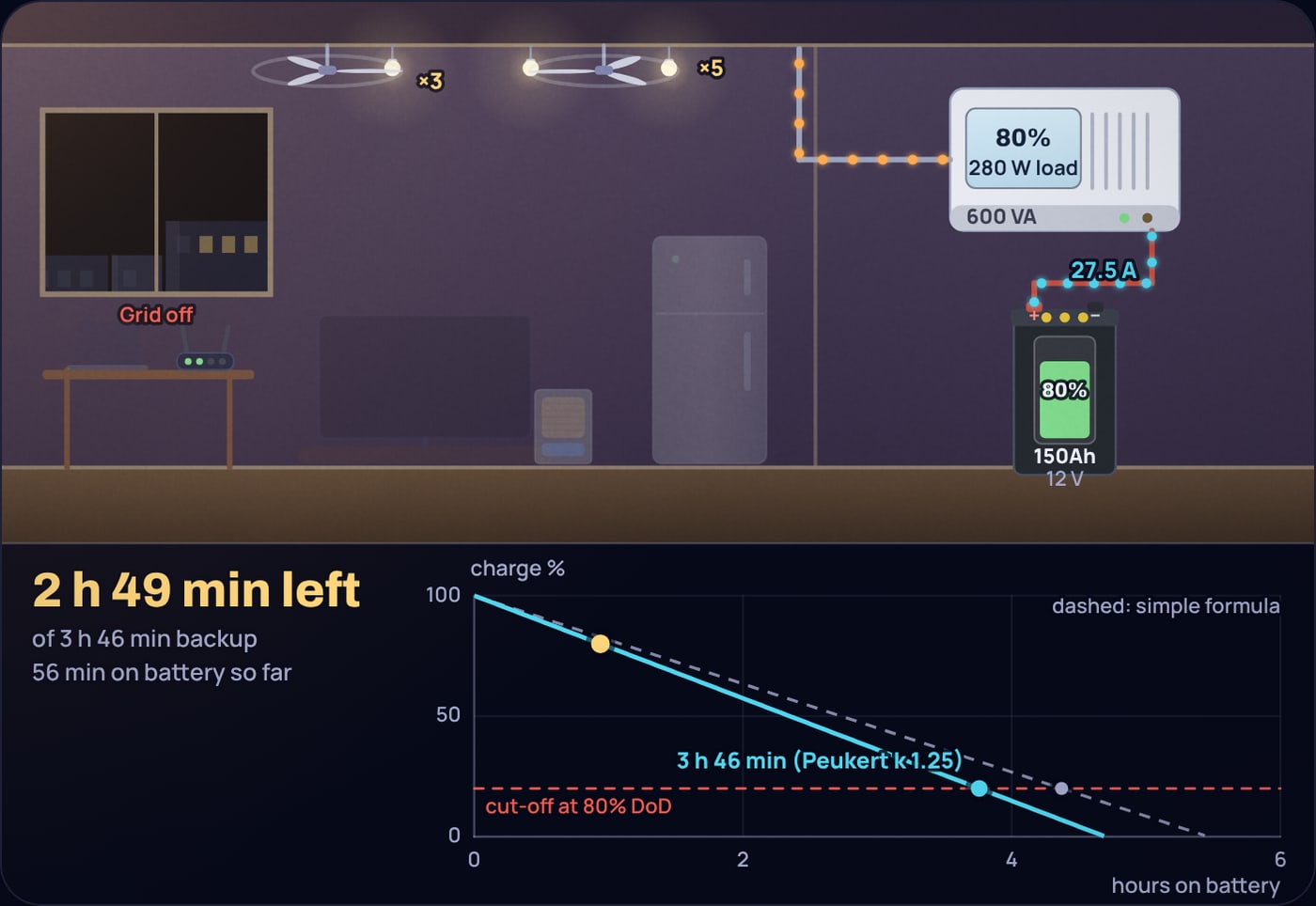
Inverters are sold in VA, not watts. Home units assume a power factor of about 0.8, so a 700 VA inverter supplies about 560 W. For the fans, TV and fridge setup the running load is 426 W when the compressor is on, which is 533 VA. Add 25 percent headroom and the next standard size is 700 VA.
The fridge is the trap. When its compressor starts it can pull three to five times its running current for a fraction of a second. With everything else on, that start can ask for around 1,100 VA. Most home inverters tolerate a short surge above their rating, but a cheap 600 VA unit with a weak surge spec will trip every time the fridge kicks in. A common belief is that a bigger inverter means more backup. It does not: the inverter limits what you can connect, the battery decides how long it runs.
What gets you more hours from the same battery?
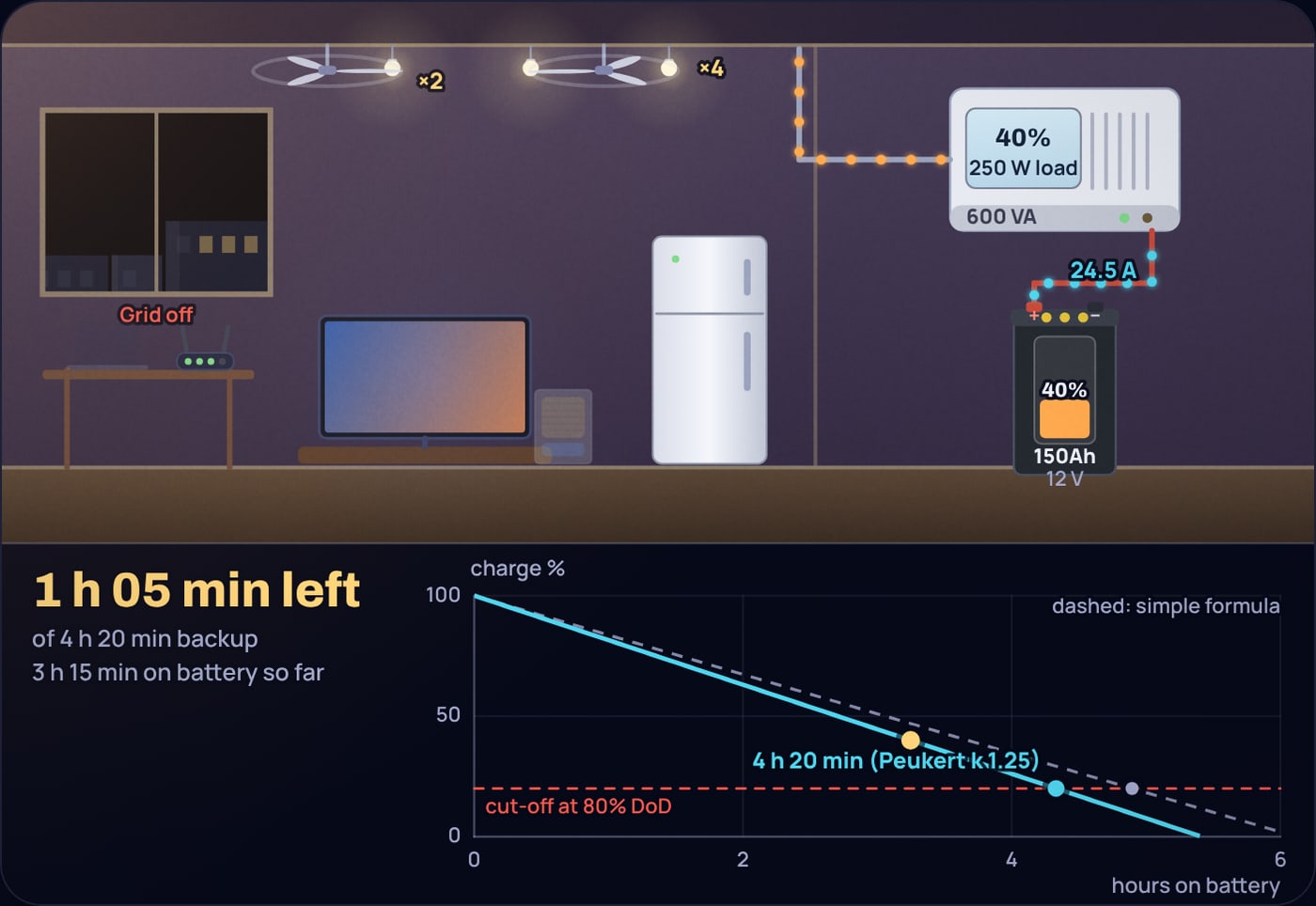
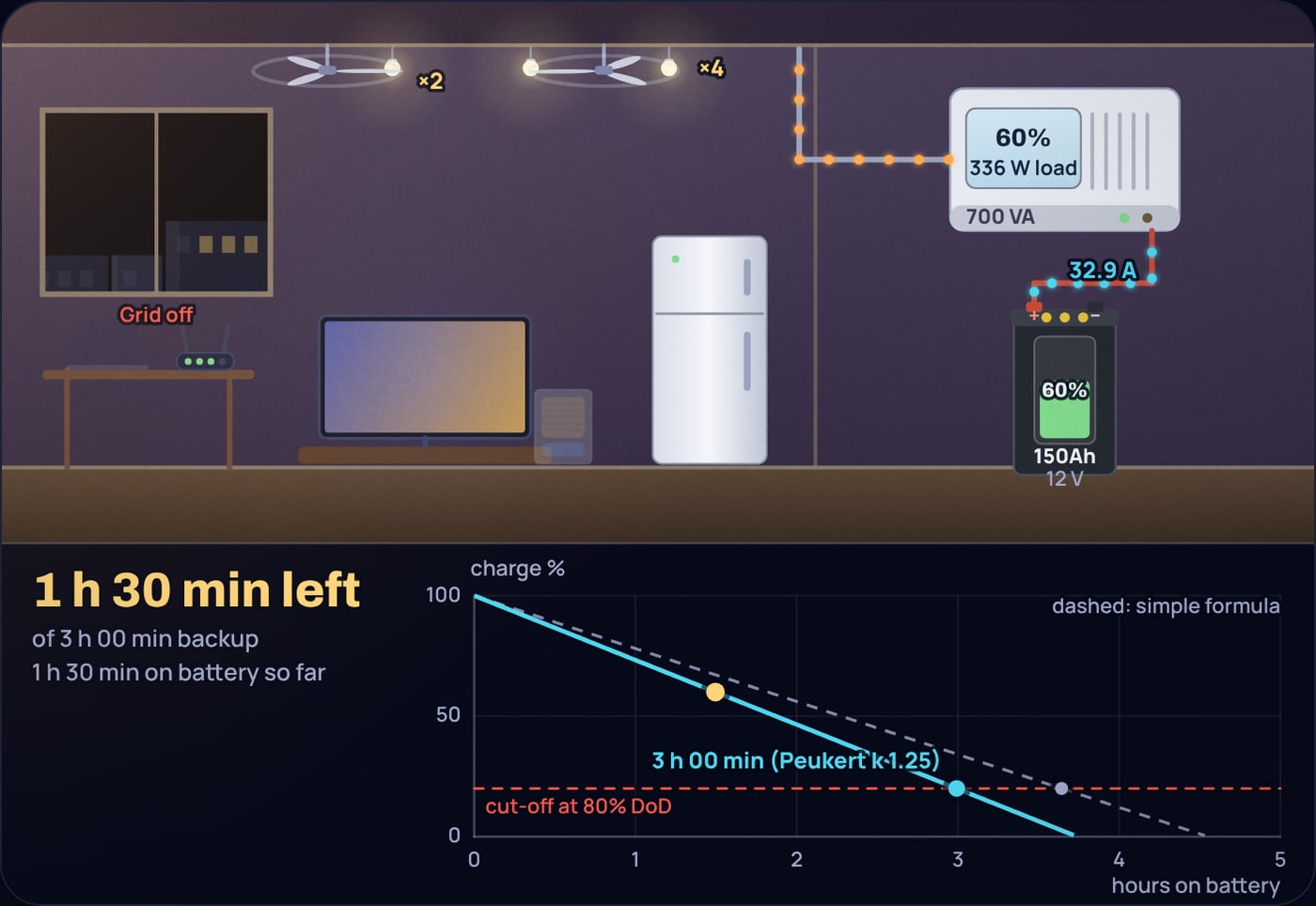
BLDC fans. A BEE 5 star BLDC fan draws about 32 W against 75 W for a regular one. In the fans, TV and fridge house that drops the load from 336 W to 250 W and the backup from 3 hours to 4 hours 20 minutes. Peukert rewards you twice: fewer watt-hours needed, and the battery gives more of its capacity at the lower current.
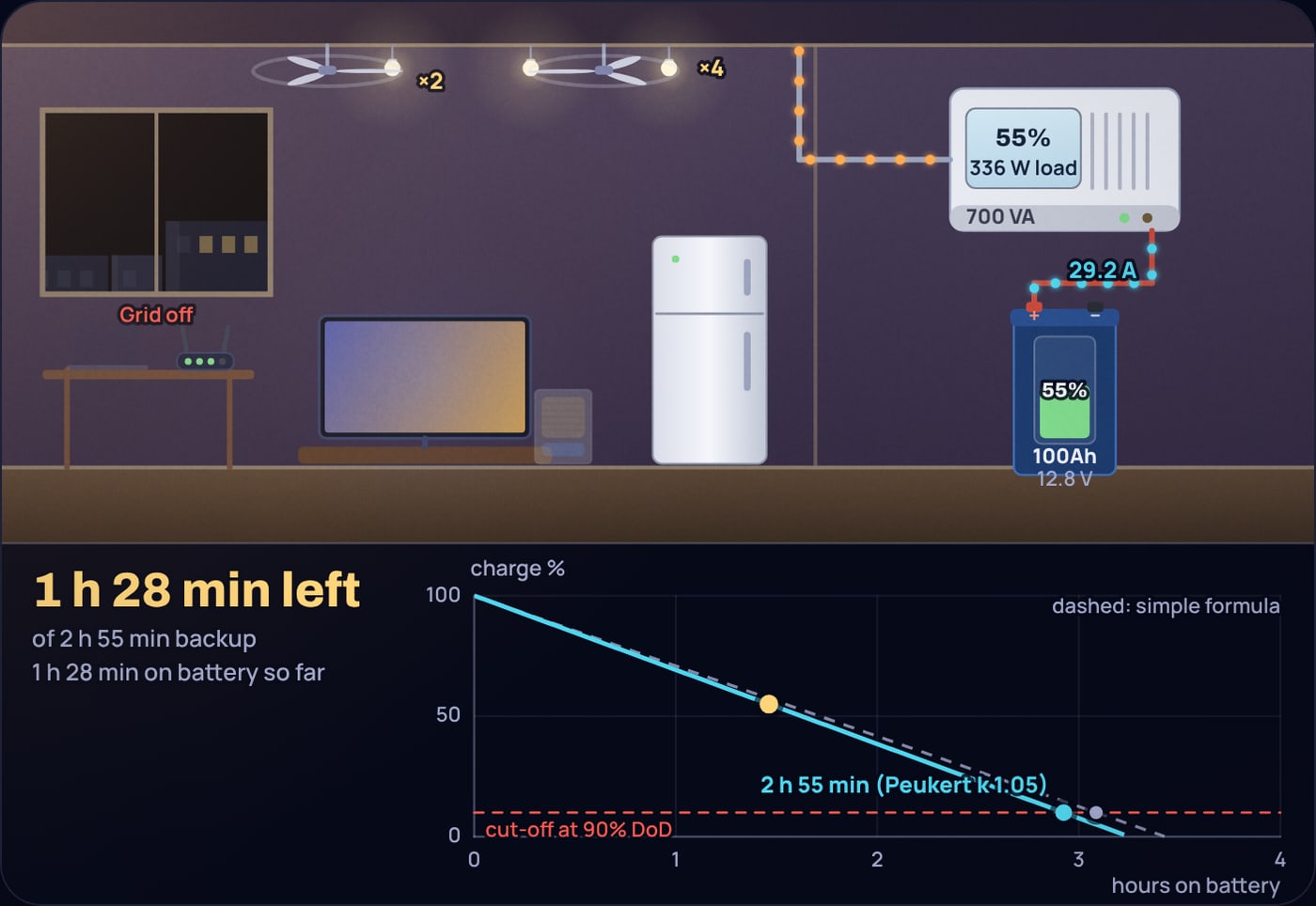
A lithium battery. A 100Ah 12.8 V LiFePO4 battery stores only 1,280 Wh, yet runs the same 336 W load for 2 hours 55 minutes, almost matching the 150Ah tubular. It can be used to 90 percent, barely suffers from the Peukert effect, and lasts thousands of cycles. The LiPo C rating post explains why lithium chemistry shrugs off high current.
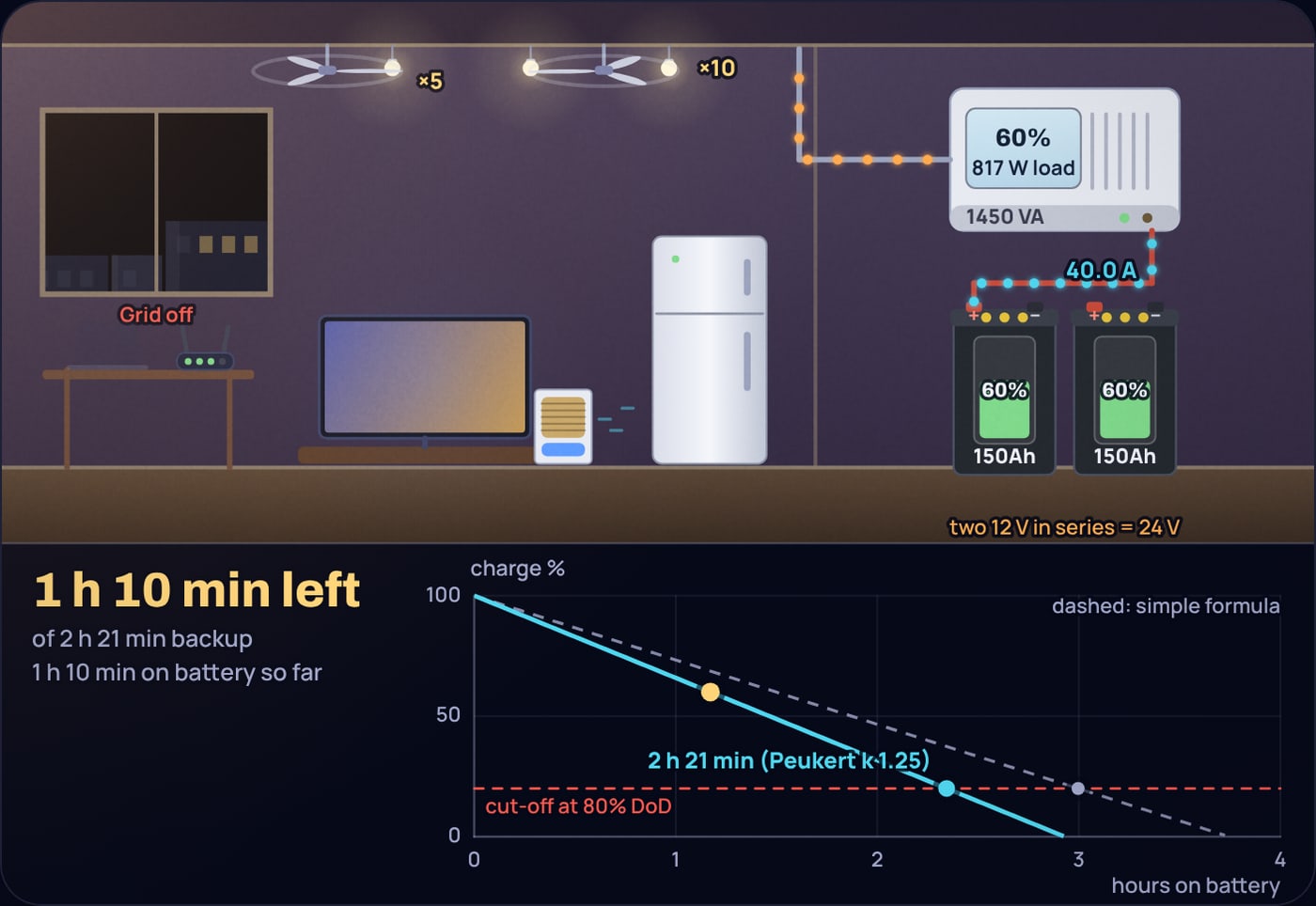
24 V with two batteries. Two 150Ah batteries in series make a 24 V, 3,600 Wh bank. The same watts need half the current, so each battery works closer to its C10 rate. For a bigger home running five fans, ten lights, a TV, the fridge and a cooler (817 W), this setup gives 2 hours 21 minutes on a 1,450 VA inverter. Thick, short battery cables matter at these currents; the 12 V wire gauge post shows why.
Do not drain lead acid to zero. Pushing a tubular battery past 80 percent depth of discharge buys a few minutes tonight and costs months of battery life. Luminous quotes up to 1,500 cycles at 80 percent depth of discharge for its 150Ah solar tubular battery; deeper cycles wear the plates faster.
What the numbers leave out
Real batteries age: a three year old tubular battery may hold 70 to 80 percent of its new capacity, so scale the Ah down. Inverters draw 10 to 30 W just being on, which matters most at light loads. Loads change through the night as fans slow and the TV goes off. The calculator uses a steady average, which is the right starting point for planning.
Try the setup that matches your own house: open the 150Ah fans, TV and fridge preset, set your own counts, and watch where the solid curve crosses the cut-off line. For what those same appliances cost when the grid is on, the units per day post does the bill.
Sources
- Victron Energy: battery capacity and Peukert exponent (default 1.25 for lead acid)
- Luminous LPTT 12150L 150Ah tubular battery: C10 rating, 1,500 cycles at 80% DoD
- Bajaj Finserv: 5 star BLDC fan vs regular fan power consumption
- Onida: 2026 BEE AC and appliance star rating bands
Frequently asked questions
How long will a 150Ah battery last with 2 fans and a TV?
Two 75 W fans, a 80 W TV, four LED bulbs and a router draw about 276 W. On a 12 V 150Ah tubular battery with an 85 percent efficient inverter, stopping at 80 percent depth of discharge, that is roughly 3 hours 50 minutes. Add a fridge and it drops to about 3 hours.
Can a 150Ah inverter battery run a fridge?
Yes. A 240 litre frost-free fridge averages about 60 W because its compressor cycles, so it costs well under an hour of backup. The catch is the start: the compressor can briefly draw three to five times its 150 W running power, so the inverter needs a surge rating that covers it.
What is the formula for inverter battery backup time?
Backup hours equal battery volts times Ah times depth of discharge times inverter efficiency, divided by load watts. For 12 V, 150 Ah, 80 percent and 85 percent at 300 W that gives 4.1 hours. Lead acid batteries deliver less at high current, so the real figure is closer to 3.5 hours.
Is 150Ah enough for a 1 BHK or 2 BHK?
For fans, lights, a TV and a router in a 1 or 2 BHK, a 150Ah battery gives about 3 to 4 hours, which covers most Indian power cuts. If you want to add a cooler or many fans, or need 6 hours or more, move to a 24 V system with two batteries or switch to BLDC fans.
Does a bigger inverter give more backup?
No. The inverter’s VA rating only limits how much load you can connect. Backup time comes from the battery’s stored energy and how fast you draw it. A larger inverter on the same battery gives the same or slightly less backup because of its higher idle draw.
- Battery Life Calculator: mAh to Hours Pick a battery and a load and watch it drain. Steady current or an ESP32 that sleeps and wakes, a derating factor, and a power bank mode that shows why 10000 mAh gives about 6000 at 5 V.
- Inverter Battery Backup Calculator (VA, Ah, Hours) Run fans, lights, TV and a fridge through a power cut and watch a 150Ah battery drain: backup hours with the Peukert effect, inverter VA and battery current.
 Best Solar Panel Angle in India for Every Month
 Charging a Capacitor: Where Half the Energy Goes