How Many Units Do an AC, Fridge and Geyser Use Per Day?
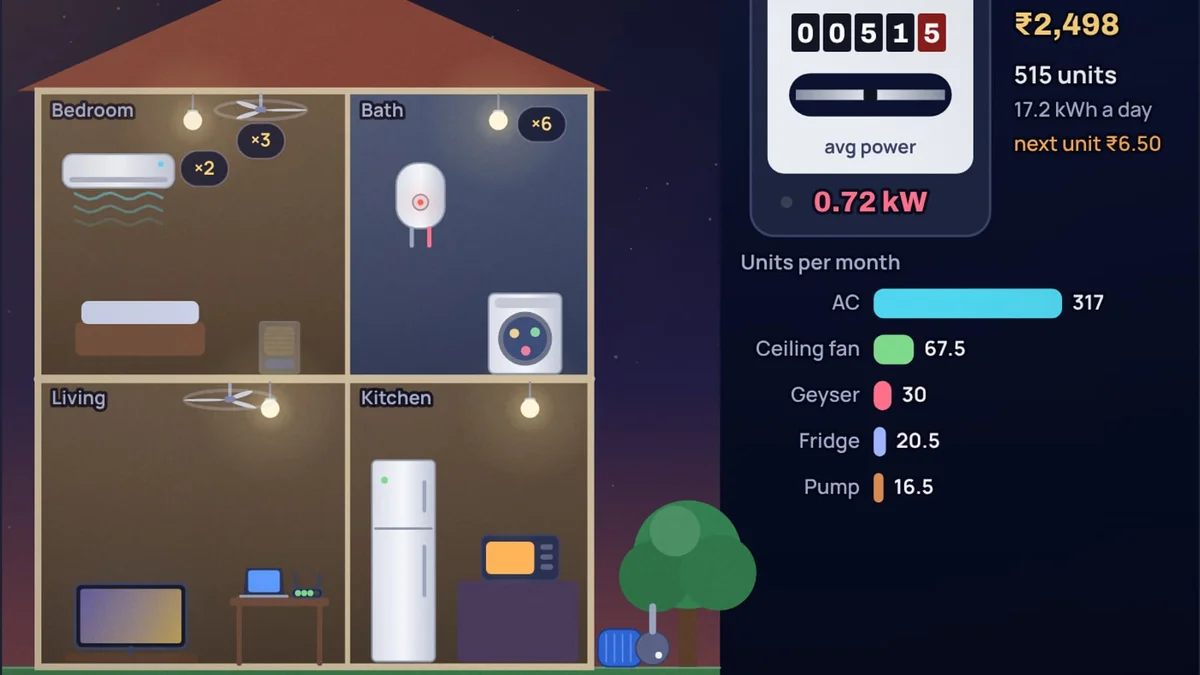
Last May a friend in Dwarka sent me a photo of his bill: 515 units, ₹2,498, and a question mark. He had added a second AC to the kids' room and wanted to know which machine had done it. The answer took one line of arithmetic per appliance, and it is the same arithmetic for every home, in rupees, dollars or pounds.
You can follow along in the electricity cost calculator, which draws the house, puts each appliance in its room and spins a meter at the power you are using. Every number in this post comes from it.
What is one unit of electricity?
A unit on an Indian bill is a kilowatt-hour, the energy a 1,000 watt load uses in one hour. Power (watts) is a rate. Energy (units) is that rate multiplied by time. So the whole calculation for any appliance is:
where is how many you have, the power in watts and the hours per day. Multiply by the days in the billing cycle and you have units per month. A 9 W LED bulb needs 111 hours to use one unit. A 2,000 W geyser needs 30 minutes. That ratio, more than anything, explains why bills look the way they do.
The catch is that some appliances do not draw their nameplate power the whole time they are on. A fridge compressor switches itself on and off. An inverter AC slows down once the room is cool. For those two the honest number comes from the BEE star label, not the nameplate, and that is what the calculator uses.
How many units does a 1.5 ton AC use per hour?
A ton of cooling is 12,000 BTU per hour, or 3.517 kW of heat pumped out of the room. A 1.5 ton AC therefore has a rated capacity of about 5.3 kW. It does not burn 5.3 kW of electricity: an AC is a heat pump, and it moves several units of heat for each unit of electricity. The label figure for that is ISEER, the Indian Seasonal Energy Efficiency Ratio.
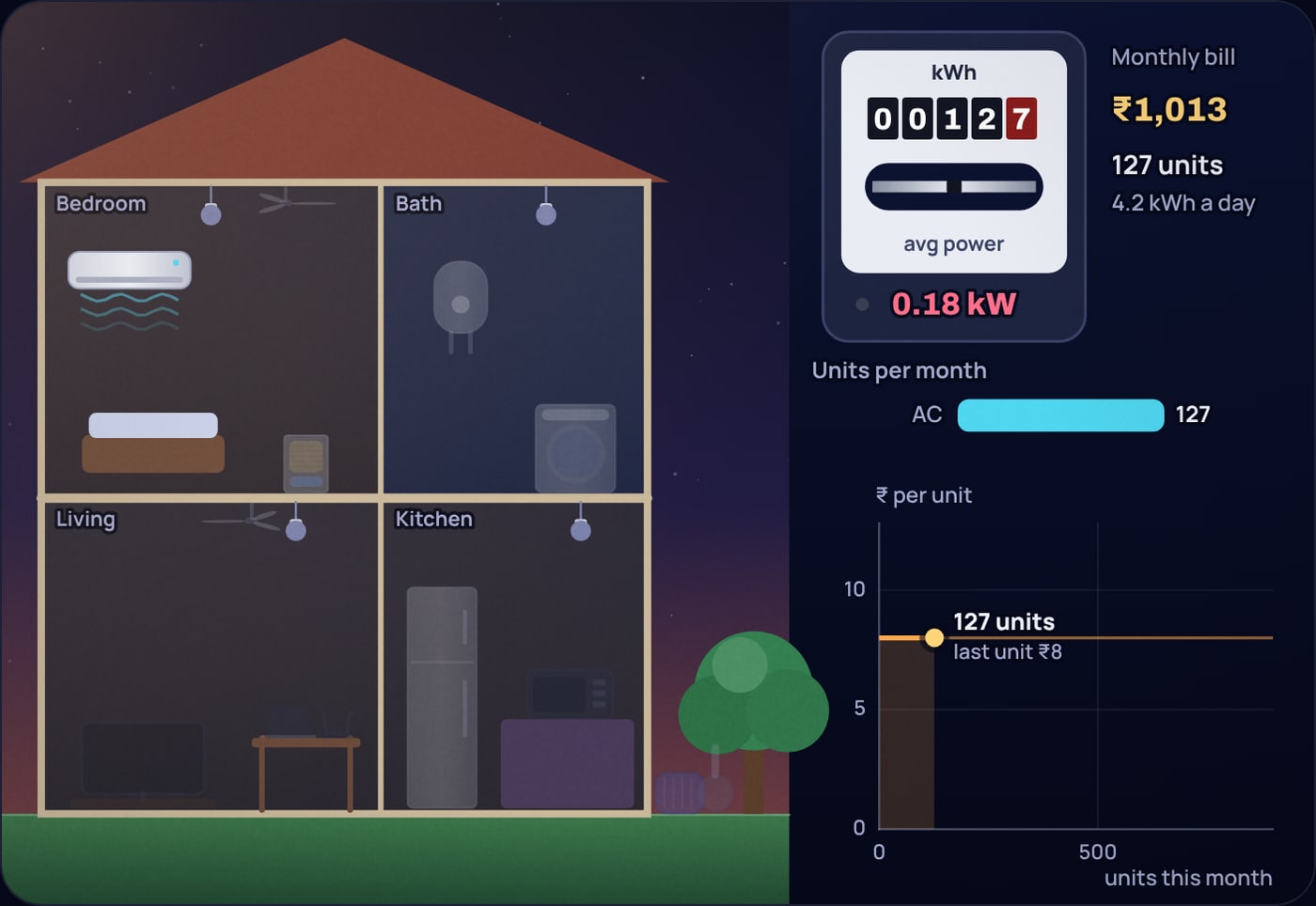
Over a typical Indian cooling season the room needs only part of the AC's full capacity on average. BEE's labels assume 1,600 hours of use a year, and if you take a real 2026 label (a 1.5 ton unit with ISEER 5.6, labelled 663 kWh a year) you find the average cooling load is about 45 percent of capacity. With that, the average electrical draw is:
Worked example: 1.5 ton 3 star inverter AC, 8 hours a day
The 4.5 is a typical ISEER for a 3 star split AC under the 2026 BEE bands (3 star runs from 4.3 to 4.99).
Swap in a 5 star unit (ISEER about 5.8) and the average draw falls to 409 W, or 3.3 units for the same 8 hours. An old fixed-speed AC with an efficiency near 2.9 averages 819 W, 6.6 units. Same tonnage, same room, double the electricity between the best and the worst.
Two warnings. First, in a 45 °C heatwave the AC runs near full load, about 1,600 W for a 1.5 ton 3 star model, so afternoons in May can use 50 to 100 percent more than this typical day figure. Second, the 1,600 W number is what your wiring and any inverter backup must handle, even if the monthly average is much lower.
A common belief is that setting the AC to 16 °C cools the room faster. It does not: the compressor already runs at full speed when the room is hot, and a lower set point only makes it run longer. The Ministry of Power puts the saving at about 6 percent for each degree you go up, which is why new Indian ACs ship with a 24 °C default.
How many units does a fridge use per day?
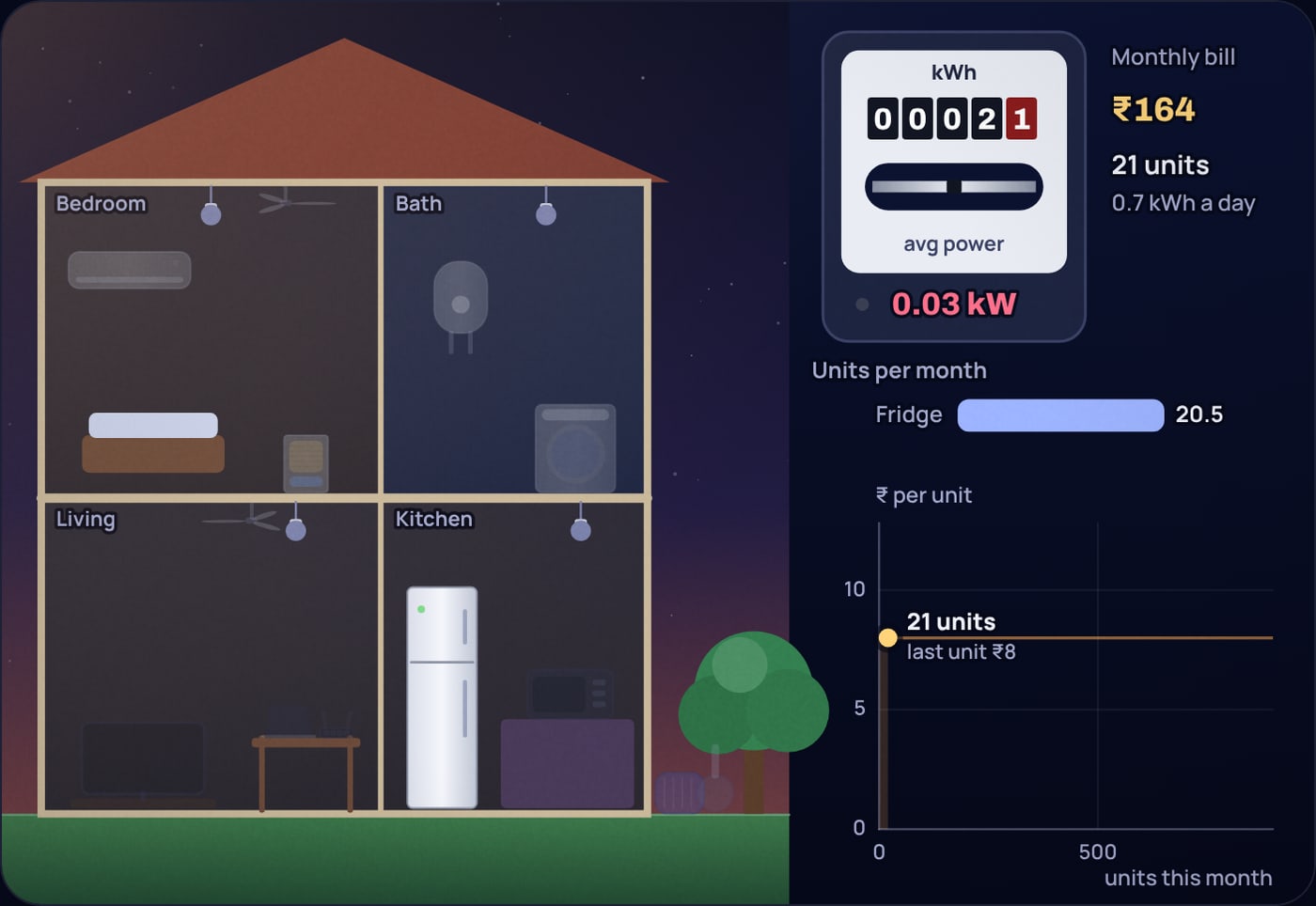
The fridge is the appliance people most often overestimate. It is plugged in 24 hours, so it feels like it must dominate. A typical 240 litre frost-free double door 3 star model is labelled at about 250 kWh a year. Divide by 365 and it is 0.68 units a day, 21 units a month. Its compressor draws around 150 W while running, but it runs only part of each hour.
Put that next to the AC: one day of the fridge uses less electricity than 1.3 hours of a 1.5 ton AC. "Always on" and "high power" are different things. What does push a fridge up is a hot kitchen (the label is tested at a fixed room temperature), a door seal that no longer grips a sheet of paper, or an old model from before star labels.
How many units does a geyser use?
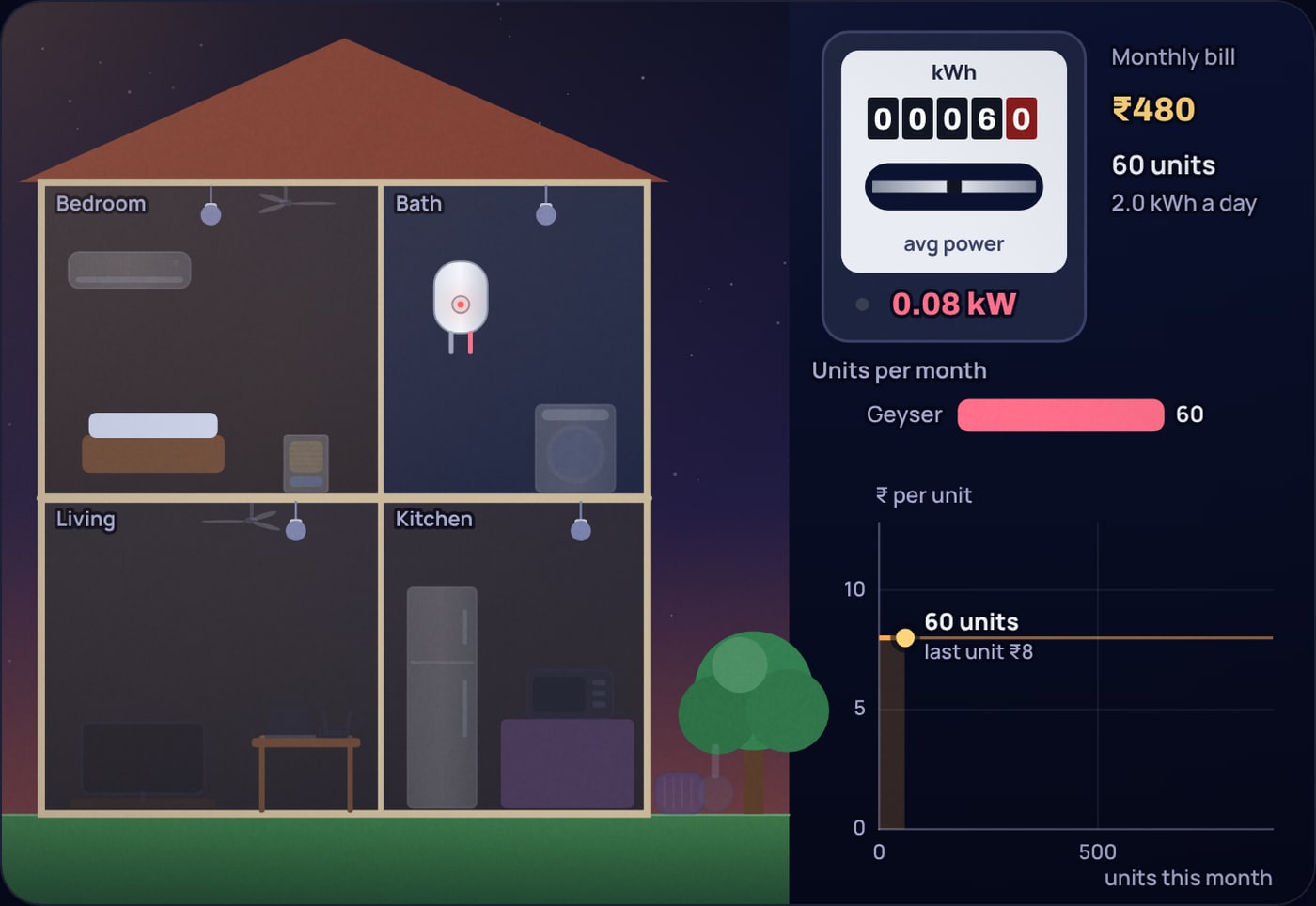
The geyser is the opposite of the fridge: enormous power, short time. Most 15 litre storage geysers sold in India are rated at 2,000 W. While the element is on it uses 2 units an hour, more than three times a 1.5 ton AC's average. The question is how long it is actually on, and that is set by how much water you heat.
Worked example: heating one 15 litre tank
Heating from 20 °C to 45 °C. Standing losses through the tank insulation add a little on top.
A family that reheats the tank twice in a winter morning uses close to 1 unit a day, 30 a month. Leave it switched on all day and the thermostat keeps topping up heat lost through the insulation, which is why BEE star ratings for geysers are about standing loss. The kettle energy post does the same heat calculation for boiling water.
What does a whole Indian home add up to?
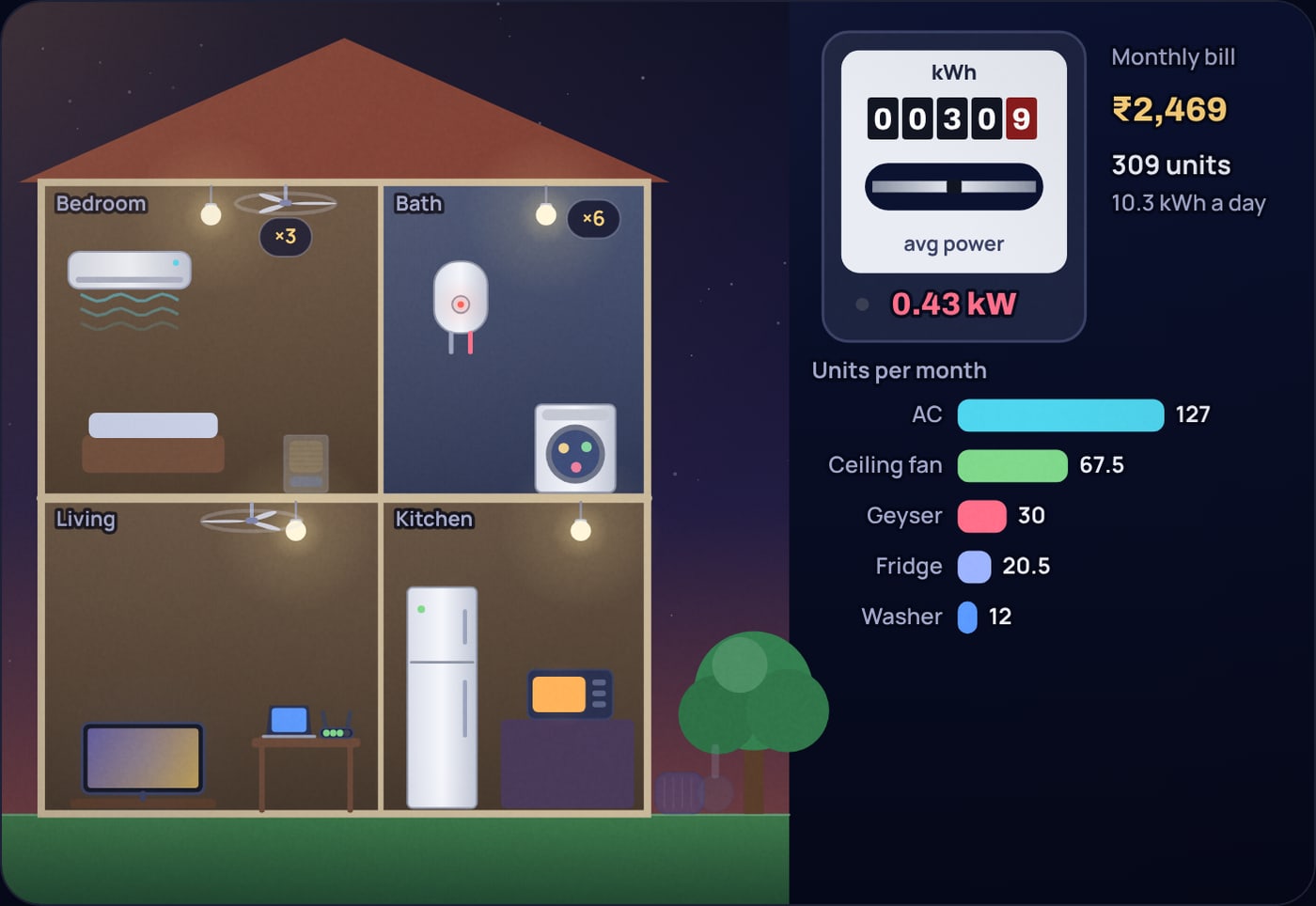
Here is a typical two bedroom flat in summer, with the hours I would actually expect. The AC is the largest line by a wide margin. Fans come second, which surprises people until they multiply 75 W by three fans by ten hours.
| Appliance | Power | Hours a day | Units a day | Units a month | At ₹8 a unit |
|---|---|---|---|---|---|
| AC, 1.5 ton 3 star | 528 W average | 8 | 4.22 | 127 | ₹1,013 |
| 3 ceiling fans | 75 W each | 10 | 2.25 | 68 | ₹540 |
| Geyser | 2,000 W | 0.5 | 1.00 | 30 | ₹240 |
| Fridge, 240 L | 250 kWh a year | 24 | 0.68 | 21 | ₹164 |
| Washing machine | 400 W | 1 | 0.40 | 12 | ₹96 |
| 6 LED bulbs | 9 W each | 6 | 0.32 | 9.7 | ₹78 |
| TV, 43 inch | 80 W | 4 | 0.32 | 9.6 | ₹77 |
| Laptop, router, microwave, iron | 10 to 1,200 W | various | 1.09 | 33 | ₹262 |
| Total | 10.29 | 309 | ₹2,469 |
The AC is 41 percent of the total. The six LED bulbs, which people switch off obsessively, are 3 percent. If you want to cut a bill, start at the top of that table.
How do slab tariffs change the bill?
Most Indian states do not charge one price per unit. Delhi's domestic tariff, set by the Delhi Electricity Regulatory Commission, is telescopic: units 1 to 200 cost ₹3.00 each, 201 to 400 cost ₹4.50, 401 to 800 cost ₹6.50, 801 to 1,200 cost ₹7.00 and anything above that ₹8.00. A fixed charge is added per kW of sanctioned load: ₹20 per kW up to 2 kW, ₹50 per kW from 2 to 5 kW. Those energy rates are unchanged in the DERC schedules since the FY 2019-20 tariff schedule.
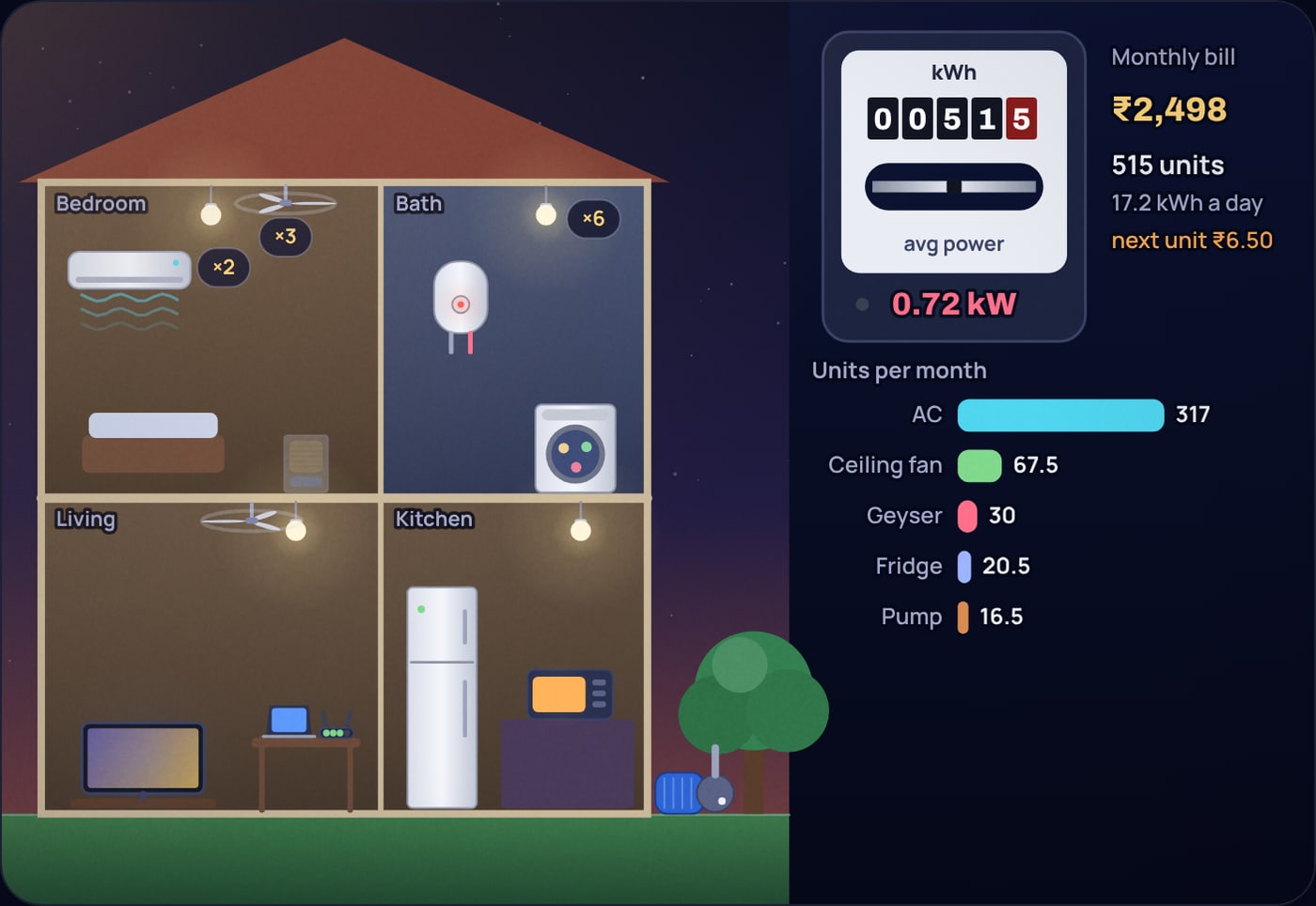
My friend's flat had two 1.5 ton 3 star ACs running 10 hours each, plus the rest of the house above and a half HP pump for an hour. That is 17.2 units a day and 515 units for the month.
Worked example: 515 units on the Delhi slabs, 5 kW load
Before the power purchase adjustment surcharge (about 16 percent in 2026), pension trust surcharge and electricity tax.
The average works out to about ₹4.85 per unit, but that average is the wrong number for decisions. Every extra unit this month costs ₹6.50, and every unit you save is worth ₹6.50. Slab tariffs reward cutting the top of the bill much more than the average rate suggests.
What does switching to a 5 star AC actually save?
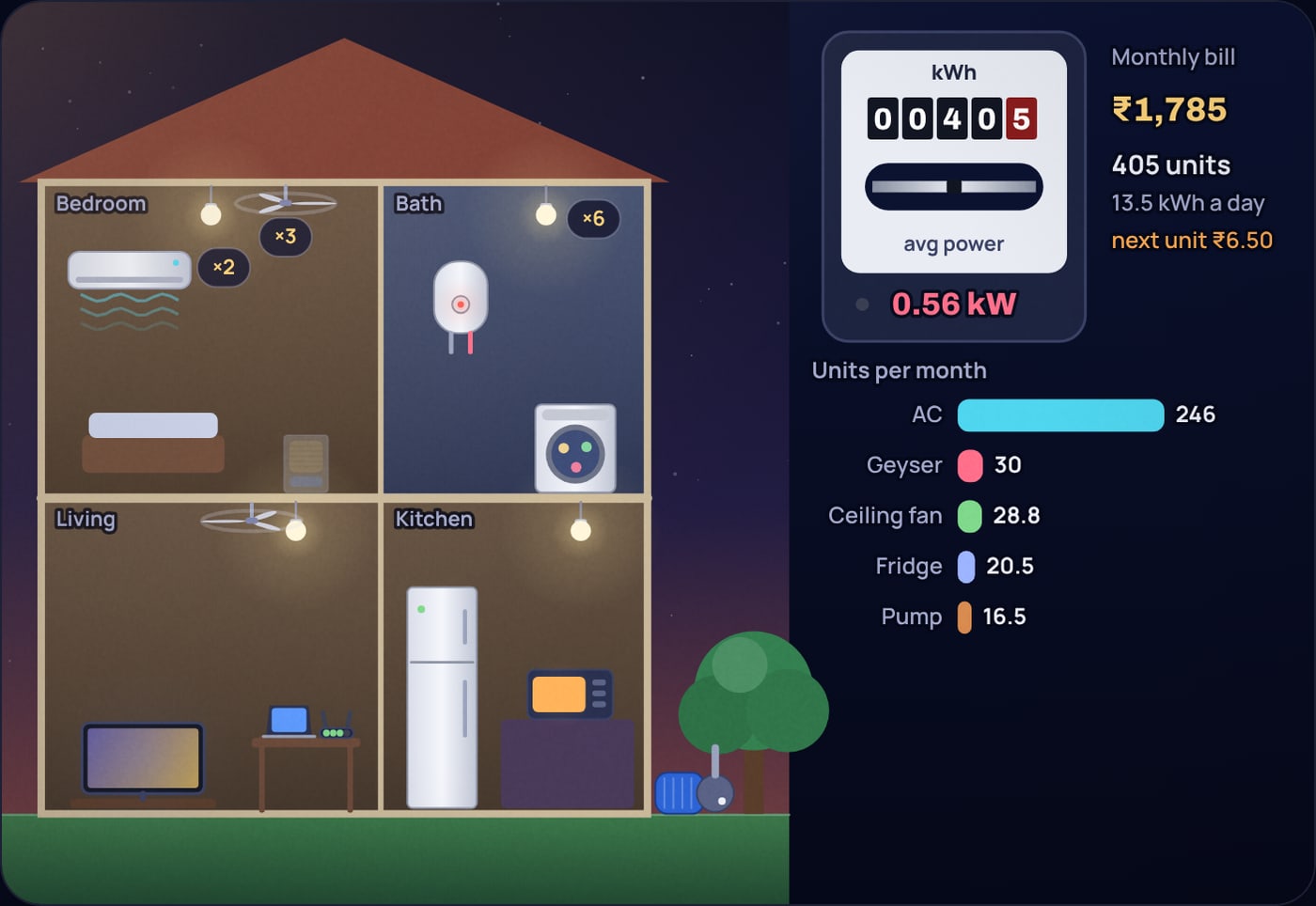
Keep everything the same and swap the two ACs for 5 star inverter models and the three fans for BLDC fans (about 32 W instead of 75 W). The month drops to 405 units and the bill to ₹1,785. That is 110 fewer units but ₹713 less, because almost all of those units were coming out of the ₹6.50 slab. Over a four month summer the saving is around ₹2,850, a real part of the price gap between a 3 star and a 5 star AC.
The same reasoning works anywhere. On the US average of 18.2 cents per kWh (EIA's November 2026 outlook), 110 kWh is about $20 a month. On the UK price cap for October to December 2026, 26.32p per kWh, it is about £29. The calculator has flat rate options in rupees, dollars, pounds and euros if your tariff is a single price.
How to estimate your own bill in five minutes
Take last month's bill and divide the amount by the units: that is your effective rate. Then list every appliance with its watts (from the label or nameplate) and honest hours. Put them into the calculator, or into a few lines of code like the Python electricity bill program. If your total comes out well below the bill, look for things you forgot: a second fridge, a water pump, a heater, or standby loads that add 10 to 30 units a month. If it comes out far above, your AC hours are probably generous.
Large homes with several ACs also run into sanctioned load limits, since everything starting at once can draw 7 to 9 kW. That is a wiring question as much as a billing one, and it is one reason bigger loads in India move to three phase supply, which the three phase power post explains.
Try it with the setup that most surprised me: load the Delhi summer house, then change only the AC star rating from 3 to 5 and watch the slab marker slide back toward the 400 unit line.
Sources
- DERC Electricity Tariff Schedule FY 2019-20 for BRPL, BYPL, TPDDL and NDMC (domestic slabs and fixed charges)
- DERC addendum dated 17 June 2026 on TPDDL FPPAS for April 2026
- Ofgem: changes to the energy price cap, 1 October to 31 December 2026
- EIA Short-Term Energy Outlook, electricity section
- Onida: 2026 BEE AC star rating bands and 1,600 hour label basis
- Midea MAI18SR5R36W0 1.5 ton 5 star listing with label ISEER and annual kWh
- HVACR News: India makes 24 °C the AC default, quoting the Ministry of Power on 6 percent per degree
- Bajaj Finserv: 5 star BLDC fan vs regular fan power consumption
Frequently asked questions
How many units does a 1.5 ton AC use per day?
A 1.5 ton 3 star inverter AC averages about 528 W once the room has cooled, so 8 hours a day is about 4.2 units and 127 units a month. A 5 star model uses about 3.3 units in the same 8 hours, and an old non-inverter AC about 6.6 units.
How many units does a refrigerator use per day?
A 240 litre frost-free 3 star fridge is labelled at about 250 kWh a year, which is 0.68 units a day or about 21 units a month. Smaller single door fridges use less, and an old fridge with a tired door seal can use twice as much.
How many units does a geyser use in 1 hour?
A 2,000 W geyser uses 2 units for every hour its heating element is on. Heating a 15 litre tank from 20 to 45 degrees Celsius takes about 0.44 units, roughly 13 minutes. Half an hour of heating a day is about 30 units a month.
Why is my electricity bill higher than the units times the rate?
Most Indian bills add a fixed charge based on sanctioned load, a fuel or power purchase adjustment surcharge and electricity duty or tax. On a slab tariff your later units are also billed at higher rates than your first ones, so the average price per unit rises as you use more.
Does setting the AC to 24 degrees save electricity?
Yes. The compressor works less when the gap between indoor and outdoor temperature is smaller. India’s Ministry of Power estimates about 6 percent saving for each degree you raise the set point, which is why 24 degrees is now the default on new ACs.
- Electricity Cost Calculator: Appliance Units and Bill Switch on an AC, fridge, geyser and fans in a cut-away house, watch the meter spin, and get units per month and the bill on a flat rate or Delhi's slab tariff.
- EV Charging Time Calculator: Home and Fast Charging Plug a Nexon EV, Windsor, BE 6, Ioniq 5 or Leaf into a 3.3 kW socket or a 150 kW DC charger and watch the battery fill: charging time, the slowdown after 80 percent, cost and cost per km against petrol.
- Inverter Battery Backup Calculator (VA, Ah, Hours) Run fans, lights, TV and a fridge through a power cut and watch a 150Ah battery drain: backup hours with the Peukert effect, inverter VA and battery current.
 Best Solar Panel Angle in India for Every Month
 Charging a Capacitor: Where Half the Energy Goes