How long does an electric car take to charge?
A Tata Nexon.ev 45 takes about 40 min from 10 to 80 percent on a 60 kW DC fast charger and about 5 h 44 min from 20 to 100 percent on a 7.4 kW home wallbox. The rough rule is battery kWh to add ÷ charger kW, but it fails at both ends: on AC the car's own on-board charger sets the limit, and on DC the car cuts its power as the battery fills, so the last 20 percent can take almost as long as the first 70.
Pick a car or type in any battery size, choose a charger from a 3.3 kW wall socket to a 150 kW DC pillar, and set where you start and stop. The battery fills in a time-lapse at the real pace of the session, and the chart below shows the power going into the battery at every percent. For what the charging costs against the rest of your home bill, see the electricity cost calculator.
Key results from the calculator
- Home charging is set by the car, not the wallbox: the Nexon.ev's on-board charger takes 7.2 kW of AC, so 7.4 kW, 11 kW and 22 kW wallboxes all give the same 4 h 52 min from 10 to 80 percent.
- Fast charging slows after 80 percent: an Ioniq 5 on a 150 kW charger goes from 10 to 80 percent in 25 min but needs another 16 min for the last 20 percent, at under half the power.
- Cost per km is the big win at home: at ₹8 per unit a Nexon.ev costs about ₹1.14 per km, against ₹6.81 per km for a 15 km/L petrol car at ₹102.12 a litre. At a ₹20 public fast charger it is about ₹2.70 per km, still well under petrol.
- A bigger charger only helps a car that can use it: the Nexon.ev accepts about 54 kW at most in this model, so it charges 10 to 80 percent in 40 min on 60 kW and 40 min on 150 kW. A Mahindra BE 6 drops from 58 min to 25 min.
Six charging sessions people actually do
Each section is a preset in the calculator with the numbers it shows. The button loads it so you can change one thing at a time.
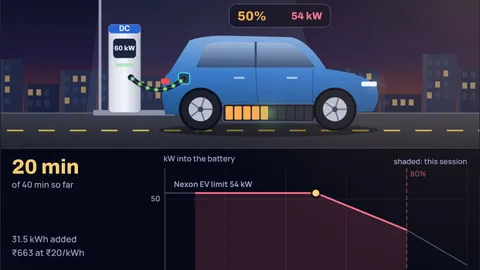
Nexon.ev 45 on a 60 kW charger, 10 to 80%: 40 min
31.5 kWh added · ₹663 at ₹20 per unitTata quotes 40 minutes for 10 to 80 percent on a 60 kW charger, and the model is fitted to that. The charger can push about 57 kW into a battery, but the Nexon.ev accepts only about 54 kW, so the car sets the pace from the start. Above about 50 percent it starts to ease off, and by 80 percent it is down to about 30 kW.
The session adds 31.5 kWh (70 percent of 45 kWh) at an average of 47.3 kW. Billed at ₹20 per kWh with about 5 percent lost on the way, it costs ₹663 and gives roughly 246 km.
Nexon.ev 45 on a 7.4 kW home wallbox, 20 to 100%: 5 h 44 min
7.2 kW on-board charger · ₹1.14 per kmAC charging goes through a charger inside the car, and the Nexon.ev's is rated 7.2 kW. After about 10 percent loss in that charger and the cable, the battery receives about 6.5 kW. Adding 36 kWh takes 4 h 10 min to reach 80 percent and 1 h 34 min more for the last 20, because the battery management system slows the final few percent while it balances the cells.
The car draws 40.0 units from the meter. At ₹8 per unit that is ₹320 for about 281 km, ₹1.14 per km. Plugged in at 11 pm, it is full before 5 am.
The 15 A wall socket, 20 to 100%: 12 h 31 min
3.3 kW portable charger · overnight and then someMost Indian EVs come with a portable charger for an ordinary 15 A socket. At 230 V and 15 A that is at most 3.45 kW; we use 3.3 kW. The battery gets about 3.0 kW, so 36 kWh takes 12 h 31 min.
That still covers daily driving: a night of 10 hours adds about 30 kWh, roughly 232 km. Use a dedicated 16 A circuit with a proper earth; a long run on an old shared socket is the usual cause of melted plugs.
MG Windsor EV on 50 kW, 10 to 100%: 1 h 23 min
47 min to 80% · 36 min for the restMG quotes 55 minutes from 0 to 80 percent at up to 45 kW for the 38 kWh Windsor. The model gives 47 min from 10 to 80 percent. Carrying on to 100 percent adds 36 min, almost as long again, for 20 percent of the battery.
That is the case for unplugging at 80 percent on a trip: the next 197 km of range came in 47 min, and the last 56 km would cost another 36 min at the pillar.
Mahindra BE 6 on a 150 kW charger, 20 to 80%: 22 min
47.4 kWh at an average 131 kWMahindra quotes 20 minutes from 20 to 80 percent on a 175 kW charger for the 79 kWh BE 6. On a 150 kW charger the model gives 22 min: the charger caps the flat part at about 143 kW, and from about 56 percent the car's own taper drops below that and takes over.
Adding 47.4 kWh at ₹22 per unit costs ₹1,098, about ₹3.51 per km for roughly 313 km.
Hyundai Ioniq 5 on 150 kW, 10 to 100%: 40 min
the last 20% takes 38% of the timeThe 84 kWh Ioniq 5 runs at 800 volts and Hyundai quotes about 18 minutes from 10 to 80 percent on a 350 kW charger. A 150 kW charger holds it at about 143 kW until about 75 percent, and it reaches 80 percent in 25 min.
The last 20 percent takes 16 min, and the power falls from about 127 kW to 28 kW. As a check on the model: Hyundai quotes 76 minutes for 10 to 80 percent on a 50 kW charger, and the model gives 1 h 14 min.
Time from 10 to 80 percent by car and charger
| Car | 3.3 kW | 7.4 kW | 11 kW | 22 kW | 60 kW DC | 150 kW DC |
|---|---|---|---|---|---|---|
| Tata Nexon.ev 45 (45 kWh) | 10 h 36 min | 4 h 52 min | 4 h 52 min | 4 h 52 min | 40 min | 40 min |
| MG Windsor EV 38 (38 kWh) | 8 h 57 min | 4 h 00 min | 4 h 00 min | 4 h 00 min | 47 min | 47 min |
| Mahindra BE 6 79 kWh (79 kWh) | 18 h 37 min | 8 h 18 min | 5 h 35 min | 5 h 29 min | 58 min | 25 min |
| Hyundai Ioniq 5 84 kWh (84 kWh) | 19 h 48 min | 8 h 50 min | 6 h 13 min | 6 h 13 min | 1 h 02 min | 25 min |
| Nissan Leaf 40 kWh (40 kWh) | 9 h 26 min | 4 h 43 min | 4 h 43 min | 4 h 43 min | 41 min | 41 min |
AC: the smaller of the charger and the car's on-board charger, 90 percent efficient. DC: the smaller of the charger × 0.95 and the car's charge curve, fitted to each maker's published fast-charge time. Leaf: the 40 kWh model has a 6.6 kW on-board charger and CHAdeMO DC at about 46 kW peak.
How the calculator works
On AC the power into the battery is the smaller of the wallbox rating and the car's on-board charger, times 0.9 for the losses in that charger and the cable. Above 95 percent it tapers while the battery management system balances the cells.
On DC the charger feeds the battery directly. The power is the smaller of the charger's rating × 0.95 and the car's own limit at that state of charge. The car's limit is a simple stated model of measured curves: flat at the car's peak up to a knee, a straight fall to 55 percent of peak at 80 percent charge, then a straight fall to 12 percent of peak at 100 percent. The knee for each car is set so the model reproduces the maker's own fast-charge figure.
Time is the battery energy for each 0.1 percent step divided by the power at that step, added up from the start charge to the end charge. Energy from the grid is the energy added divided by the efficiency, cost is that times your price per kWh, and range is the energy added times the car's typical km per kWh. Petrol cost per km is the litre price divided by the mileage.
The time-lapse plays the whole session in 8 seconds at its real pace, so the battery visibly slows once it passes the knee. The gold dot rides along the charge curve.
What the model leaves out
- Battery temperature: a cold battery accepts much less power until it warms up, and a hot one after a fast motorway run may be held back. Many cars precondition the battery on the way to a fast charger; the model assumes it is already at a good temperature.
- Shared and derated chargers: many Indian 60 kW units split their power between two guns, and a 50 kW pillar may deliver 30 to 40 kW. Pick a lower charger power to match what the screen shows.
- Usable vs gross capacity: makers quote different figures. We use the capacity each maker states; the usable part may be a few percent less.
- Real curves are lumpy: measured curves have steps and plateaus, not straight lines. The model matches the maker times; the exact minute-by-minute power differs from car to car and from software version to version.
- Charger idle and session fees: some public networks add a per-session or parking fee, and GST is included in most posted prices. Put the all-in price per kWh into the price slider.
Common misconceptions
“A 22 kW wallbox charges any car four times faster than a 7 kW one.” Only if the car has a 22 kW on-board charger. Most Indian EVs take 7.2 to 11 kW of AC, so the extra wallbox power goes unused.
“Fast charging to 100 percent is just as quick per percent.” No. Above about 80 percent the car cuts the current to protect the cells, so the last 20 percent takes about as long as the 70 before it.
“A 150 kW charger always delivers 150 kW.” The car decides how much it accepts. A Nexon.ev on a 150 kW charger draws only about 54 kW at best, the same as on a 60 kW charger.
Frequently asked questions
How long does an EV take to charge at home?
On a 7.2 to 7.4 kW home wallbox, a 45 kWh car like the Nexon.ev takes about 5 h 44 min from 20 to 100 percent. On the 15 A portable charger (about 3.3 kW) the same top-up takes about 12 h 31 min. Divide the kWh you need by about 6.5 for a 7 kW wallbox, or by about 3 for a 15 A socket, to get hours.
Why does EV charging slow down after 80 percent?
As a lithium-ion cell fills, its voltage rises towards the safe limit and lithium has fewer free places to go in the graphite anode. Pushing high current near full risks lithium plating and heat, so the car cuts the current, first gradually from a knee and then steeply above about 80 percent.
How much does it cost to charge an EV in India?
At home on a ₹8 per unit tariff, adding 36 kWh to a Nexon.ev costs about ₹320, roughly ₹1.14 per km. At public DC chargers priced around ₹18 to ₹25 per kWh a 10 to 80 percent session costs ₹600 to ₹800, about ₹2.70 per km at ₹20. A 15 km/L petrol car costs about ₹6.81 per km at ₹102.12 a litre.
Does a bigger charger charge my car faster?
Only up to what the car accepts. On AC the limit is the car's on-board charger (7.2 kW for the Nexon.ev, 11.2 kW for the BE 6). On DC it is the car's peak power and its taper: the Nexon.ev takes 40 min from 10 to 80 percent on 60 kW and 40 min on 150 kW, while the BE 6 drops from 58 min to 25 min.
Is it bad to fast charge an EV every day?
Frequent DC fast charging, especially to 100 percent and in hot weather, wears a battery somewhat faster than slow AC charging. Makers design for regular fast charging, but the gentlest routine is AC at home to 80 or 90 percent for daily use, with DC on trips.
Keep learning
Why EVs Charge Slowly After 80 Percent (the Charging Curve Explained)
A Nexon.ev goes from 10 to 80 percent in 40 minutes on a 60 kW charger, then needs about 35 more for the last 20. Here is the charging curve, the chemistry behind it, and what it means for time and cost.

Why Phone Charging Slows After 80%: The CC-CV Curve
Fast charging fills a phone from 0 to 70% at full current, then a fixed voltage limit makes the current taper. The physics, the plating risk and the math.
How Many Units Do an AC, Fridge and Geyser Use Per Day?
A 1.5 ton AC uses about 4.2 units in 8 hours, a 240 L fridge 0.7 a day, a 2 kW geyser 2 an hour. The maths, a real Delhi slab bill and what to change.

LiPo C Rating Explained: Current, Sag and Real Limits
A 5000 mAh 50C LiPo is rated for 250 A, but at 3 milliohms per cell that current sags each cell by 0.75 V. What the C rating means and how to check it.