Why EVs Charge Slowly After 80 Percent (the Charging Curve Explained)
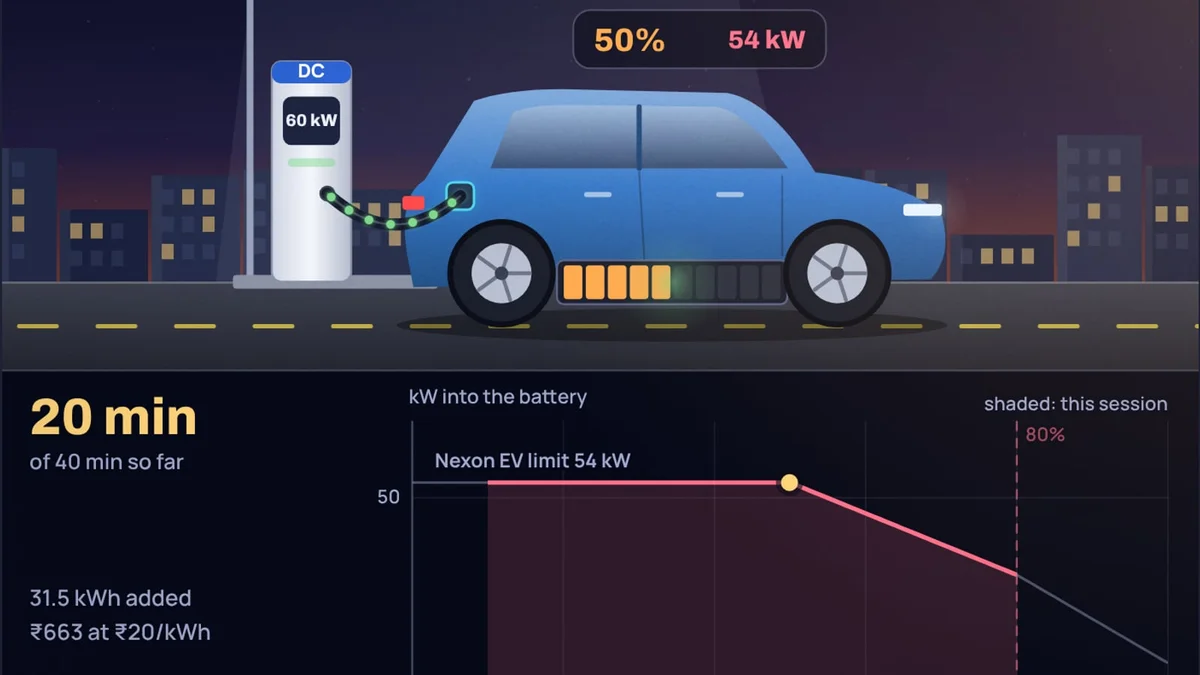
Plug a Tata Nexon.ev into a 60 kW charger at 10 percent and it reaches 80 percent in about 40 minutes. Leave it plugged in for a full battery and you will wait roughly another 35 minutes for the last 20 percent. The charger has not failed and nothing is wrong with the car. That slowdown is designed in, and it is the single biggest reason fast-charging advice says "stop at 80".
The EV charging time calculator shows it happening: a car fills on a charging bay in a time-lapse that runs at the real pace of the session, and the chart under it plots the power going into the battery at every percent. Every number in this post comes from it.
What does an EV charging curve look like?
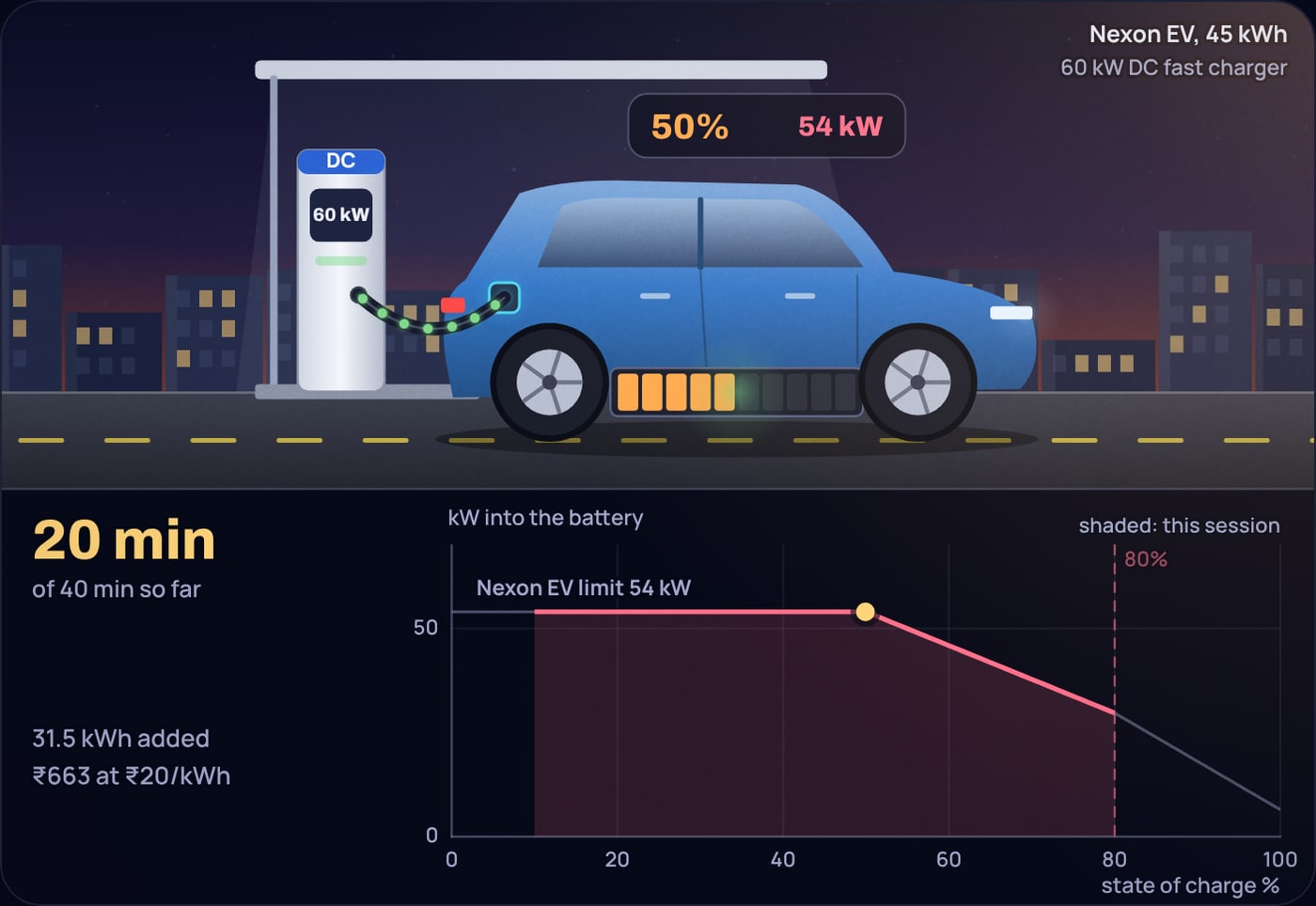
A charging curve plots the power going into the battery, in kW, against how full the battery is. Almost every modern EV draws the same shape on a DC fast charger:
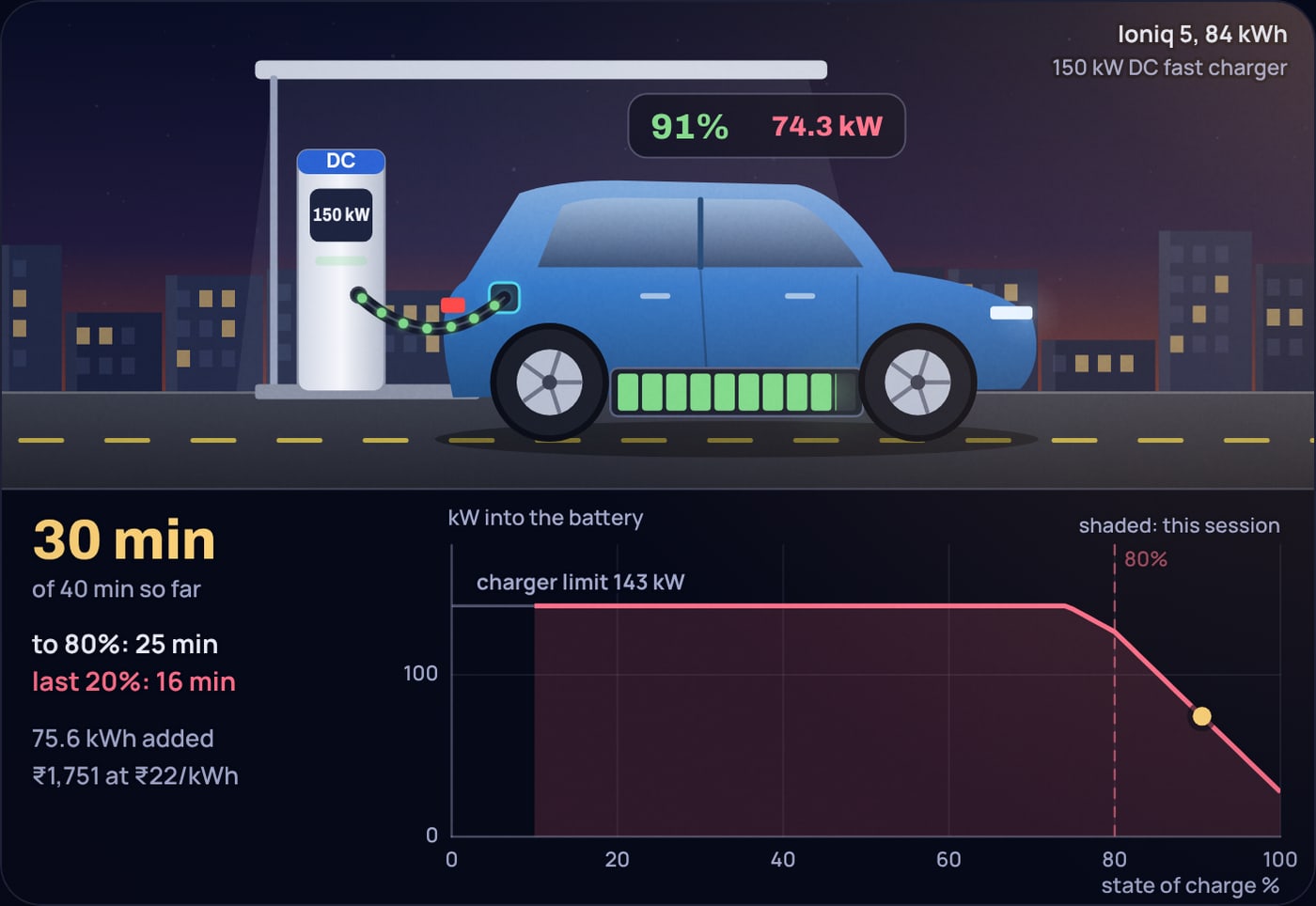
- A flat top. From low charge the car takes its peak power, or the charger's limit if that is lower. A Nexon.ev holds about 54 kW. A Hyundai Ioniq 5 on a 150 kW charger holds about 143 kW, which is all the charger can deliver.
- A knee. At some state of charge the power starts to fall. Where it falls depends on the car, the cell chemistry and the battery temperature. In the calculator the knee sits at about 50 percent for the Nexon.ev and about 43 percent for the Ioniq 5.
- A steep tail. Above about 80 percent the power keeps falling, to a small fraction of peak by 100 percent.
Real curves have steps and plateaus. The calculator uses a simple stated shape instead: flat to the knee, a straight fall to 55 percent of peak at 80 percent charge, and a straight fall to 12 percent of peak at 100. For each car the knee is set so the model reproduces the maker's own fast-charge figure, such as Tata's 40 minutes from 10 to 80 percent on 60 kW. As a check, Hyundai quotes 76 minutes for the Ioniq 5 from 10 to 80 percent on a 50 kW charger, a figure the fit never used, and the model gives 74.
Why does the car cut the power near full?
A lithium-ion battery is charged in two phases, the same way your phone is. First comes constant current: the charger pushes a steady, high current and the cell voltage climbs as lithium ions move from the cathode into the graphite anode. When the cell reaches its maximum voltage, around 4.2 V for the nickel-rich cells in cars like the Ioniq 5 and about 3.65 V for LFP cells, the chemistry in most Indian EVs, charging switches to constant voltage. The charger holds that voltage and the current falls by itself as the cell fills.
The reason for the voltage limit is what happens inside the anode. Charging means pushing lithium ions into the gaps between graphite layers. When the anode is nearly full, there are fewer free places, and at high current the ions arrive faster than they can slot in. Some deposit as metallic lithium on the surface instead. This is lithium plating: it removes lithium from use for good, so capacity drops, and in the worst case it grows needle-like dendrites that can short a cell. Cold makes it worse, because the ions move more slowly.
Heat is the second limit. The power lost inside a battery grows with the square of the current:
Near full, the cell's internal resistance and voltage are both high, so the car would be turning more of the charging power into heat exactly when the cells are most vulnerable. The battery management system watches every cell group, and the whole pack slows as soon as the highest group nears its limit. At the very top it slows further to balance the cells, so that every group ends at the same charge.
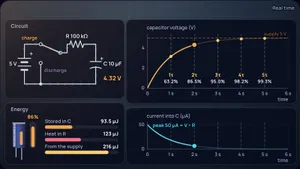
So the knee is not one hard switch. It is the car stepping the current down as voltage, temperature and cell spread close in on their limits, and the steep tail above 80 percent is mostly the constant voltage phase doing what it is meant to do. The phone charging post walks through the same two phases at 5 V scale.
How long does the last 20 percent take?
Time is energy divided by power. A full curve needs that sum taken in small steps, which the calculator does in 0.1 percent slices, but averages make the point.
Worked example: Ioniq 5 (84 kWh) on a 150 kW charger
The last 20 percent of the battery is 22 percent of the energy but 38 percent of the time. Within it, 80 to 90 percent takes about 5 minutes and 90 to 100 percent about 10.
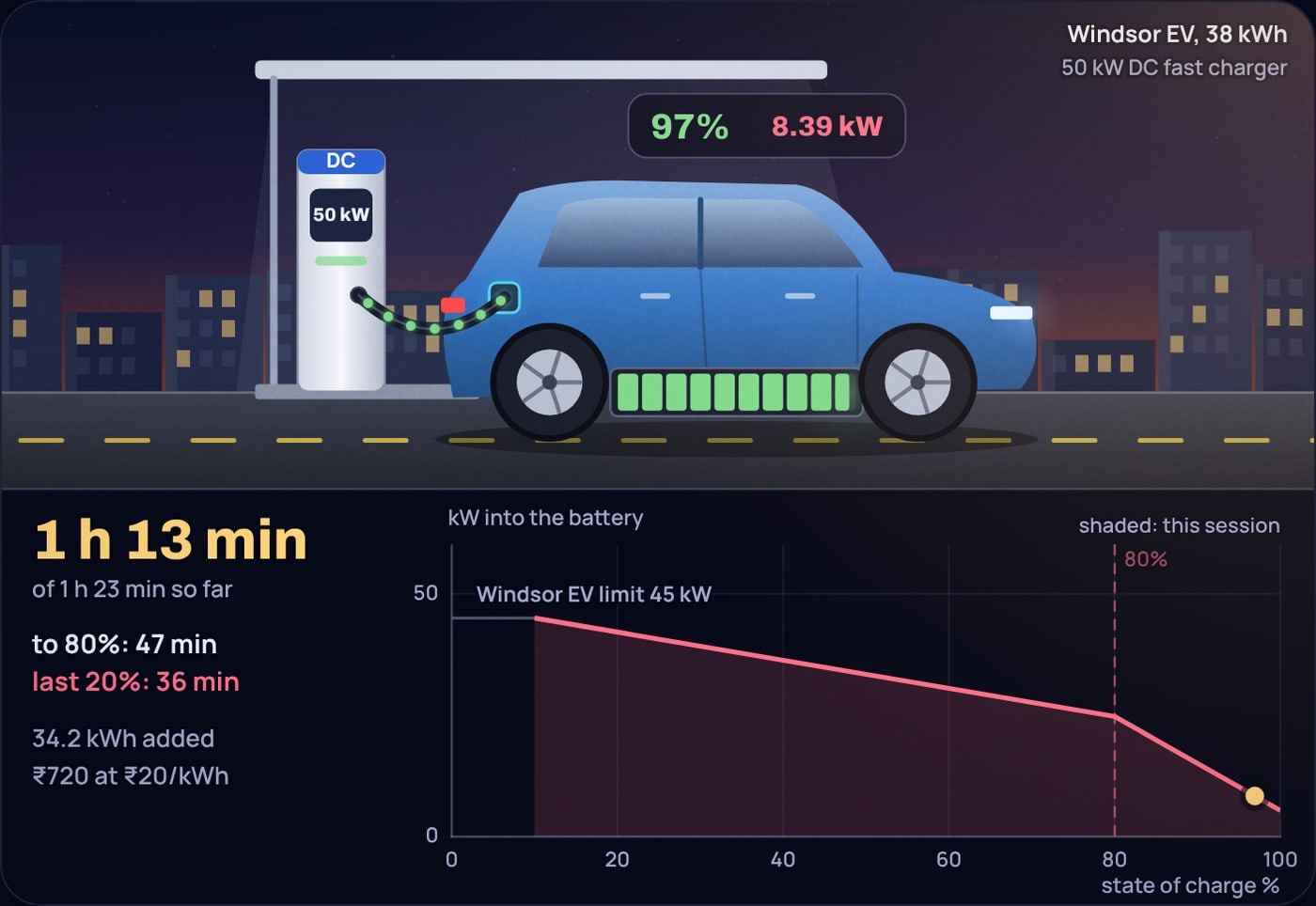
Smaller Indian EVs with lower peak power feel it more, because their curves start lower. The MG Windsor EV with its 38 kWh pack is a good example: MG quotes up to 45 kW and 55 minutes from 0 to 80 percent.
Worked example: MG Windsor EV (38 kWh) on a 50 kW charger
Thirty-six minutes for 7.6 kWh, about 56 km of range. At its 10 to 80 percent average of 34 kW, the same 36 minutes would have added about 20 kWh, more than two and a half times as much.
Why is home charging hardly affected?
On AC, the charger on your wall does not charge the battery directly. It supplies AC to a charger inside the car, the on-board charger, which converts it to DC. That on-board charger is small: 7.2 kW in the Nexon.ev, 7.4 kW in the Windsor, about 11 kW in the Mahindra BE 6 and Hyundai Ioniq 5. After about 10 percent loss in the conversion and the cable, a Nexon.ev on a 7.4 kW wallbox puts about 6.5 kW into a battery that could accept 54 kW. The battery never comes near its limits until the very top, where the battery management system slows down to balance the cells.
Worked example: Nexon.ev 45 on a 7.4 kW wallbox, 20 to 100 percent
From 20 to 95 percent the charge is a straight line. The slowdown at the end adds about 11 minutes, compared with about 25 extra minutes on the 60 kW DC charger, where a flat 54 kW would have done 80 to 100 percent in 10.
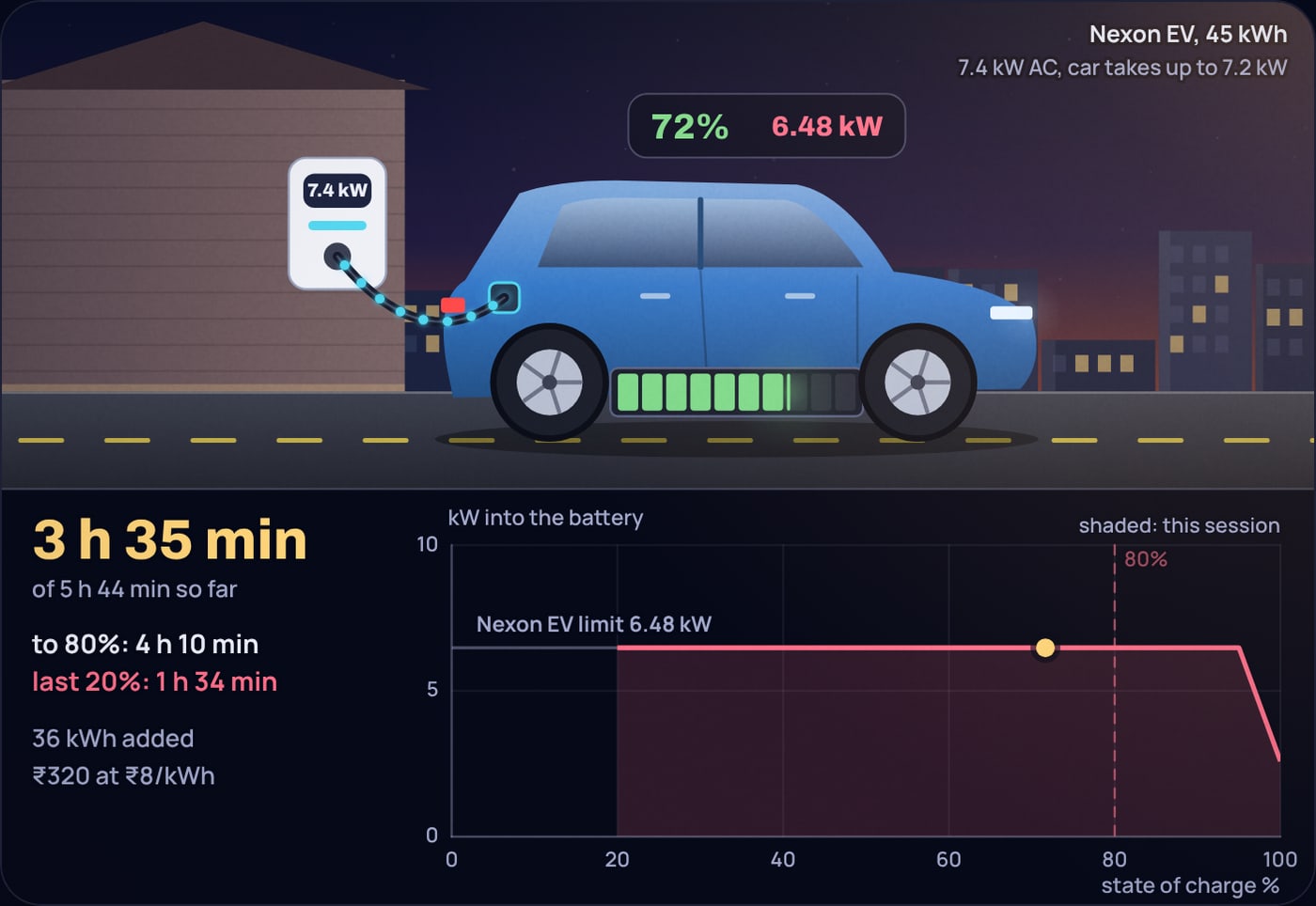
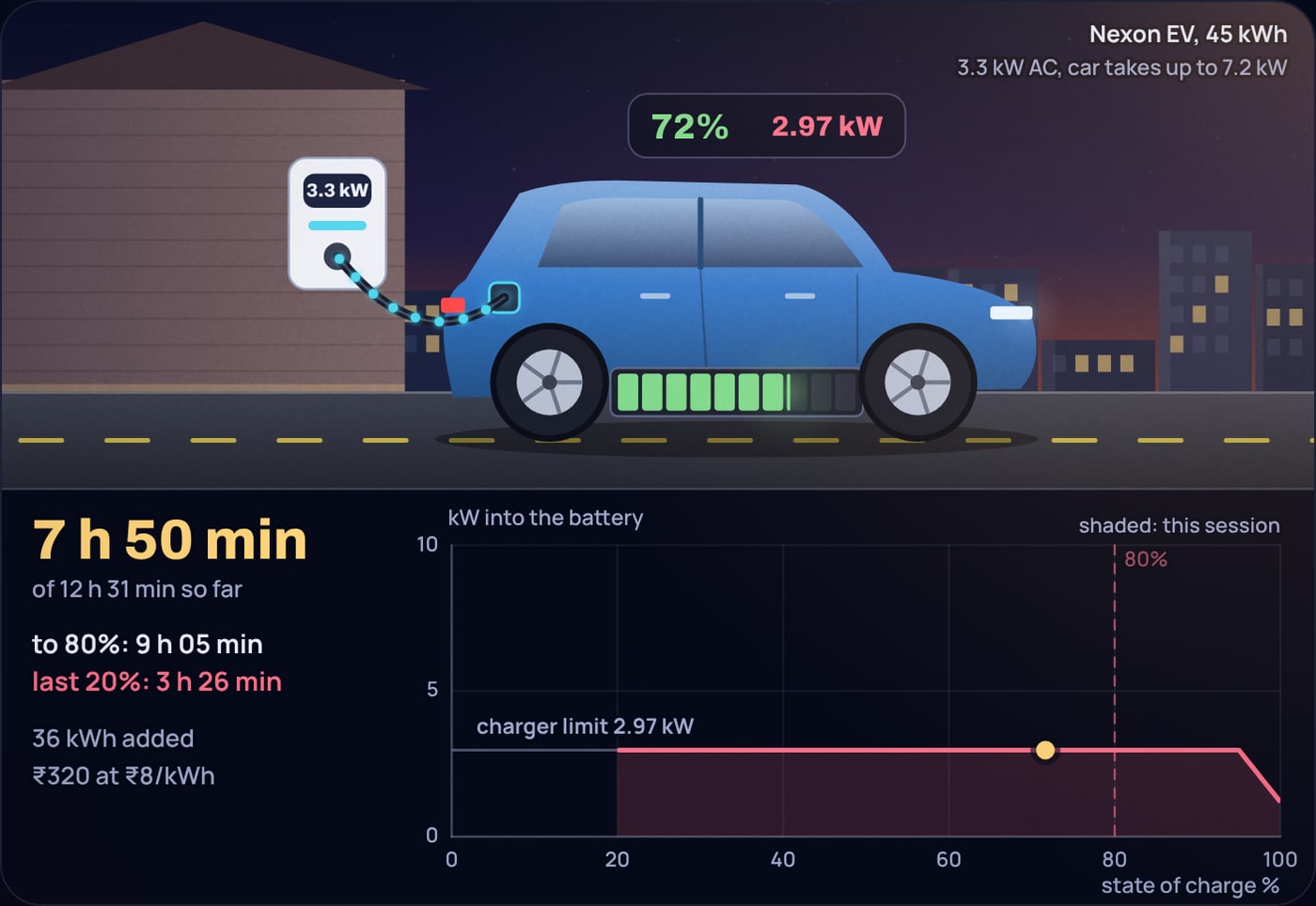
This also explains why a bigger home wallbox often changes nothing. A 22 kW three-phase wallbox charges a Nexon.ev in exactly the same time as a 7.4 kW one, because the car still takes only 7.2 kW. The portable charger for a 15 A socket, about 3.3 kW, is where home charging gets genuinely slow: 12 h 31 min from 20 to 100 percent.
Does a bigger fast charger help?
Only up to what the car accepts, and only below the knee. Here is the 10 to 80 percent time for each car in the calculator at each charger power:
| Car (battery) | 7.4 kW AC | 60 kW DC | 150 kW DC |
|---|---|---|---|
| Tata Nexon.ev 45 (45 kWh) | 4 h 52 min | 40 min | 40 min |
| MG Windsor EV (38 kWh) | 4 h 00 min | 47 min | 47 min |
| Mahindra BE 6 (79 kWh) | 8 h 18 min | 58 min | 25 min |
| Hyundai Ioniq 5 (84 kWh) | 8 h 50 min | 1 h 02 min | 25 min |
| Nissan Leaf (40 kWh) | 4 h 43 min | 41 min | 41 min |
The Nexon.ev, Windsor and Leaf gain nothing from a 150 kW charger: their peak is already below 60 kW. The BE 6 and Ioniq 5, with peaks of about 175 kW and 230 kW, more than halve their time. Mahindra quotes 20 minutes from 20 to 80 percent for the BE 6 on a 175 kW charger; on a 150 kW unit the calculator gives 22.
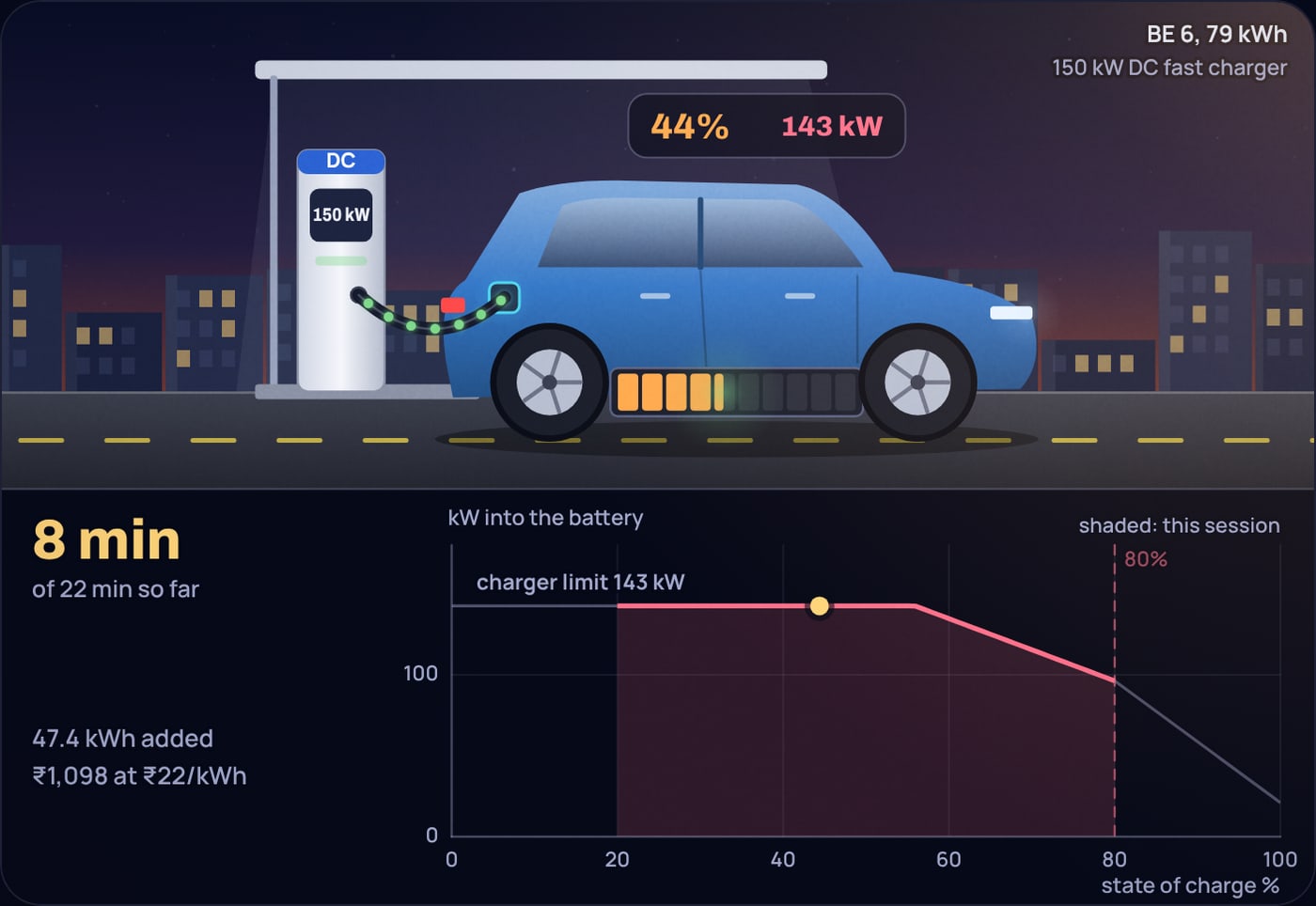
Above 80 percent the charger does not matter at all. An Ioniq 5 at 90 percent accepts about 77 kW whether it is on a 150 kW or a 350 kW unit.
What does charging cost per km against petrol?
The meter counts more than the battery stores, because the charger and cable lose some energy: about 10 percent on AC in the calculator and about 5 percent on DC. Cost per km is the grid units times the price, divided by the distance those units drive.
Worked example: Nexon.ev at home vs a petrol car
At a public DC charger priced at ₹20 per kWh the same Nexon.ev costs about ₹2.70 per km, still well under half the petrol figure.
The 7.8 km per kWh is a typical real-world figure for city and highway driving, not the certified range. Change it, the unit price and the petrol price in the calculator to match your own car and city. If the EV will share a meter with an air conditioner and a geyser, the units per day post shows how a few hundred extra units move you up the tariff slabs.
When should you stop at 80 percent?
On a trip, almost always. Charge until the curve starts to fall steeply, drive on, and charge again at the next stop: two short stops on the flat part of the curve add more range per minute than one long stop that includes the tail. Arriving at a charger with a low battery helps for the same reason, because you spend more of the session on the flat top.
At home, set the car's charge limit to 80 or 90 percent for daily driving and to 100 percent before a long trip. The time cost is small on AC, but a battery that sits at 100 percent for days ages faster than one that sits at 80. Cars with LFP batteries are the exception: makers often recommend a regular full charge so the battery management system can recalibrate its state of charge reading.
A cold battery shifts the whole curve down. On a winter morning, or straight after parking for hours in the cold, a car may take half its rated power until the pack warms up. Many EVs warm the battery on the way when you pick a fast charger as the destination in the car's maps.
What the calculator leaves out
The straight-line curve matches each maker's published time but not every step of a real curve. It assumes a warm battery, a charger that delivers its full rating (many 60 kW units split power between two guns), and no session fees.
To see the curve for your own car, open the EV charging time calculator, pick the closest car or type in the battery size, and slide the end charge from 80 to 100 percent. Watch the time jump. For the battery chemistry behind charge rates, the LiPo C rating explainer covers what C rates mean, and the 150Ah battery post shows the same physics running the other way, as a battery drains.
Sources
- Tata Motors: Nexon.ev 45 kWh launch release (battery size and 60 kW DC charging)
- Tata Motors: Nexon.ev specifications
- Autocar India: MG Windsor EV specifications (38 kWh, 45 kW DC)
- Mahindra: BE 6 brochure and specifications
- Hyundai: Ioniq 5 specification sheet (84 kWh, 10 to 80 percent times on 50 kW and 350 kW)
- EV Database: Nissan Leaf 40 kWh charging data
- Business Today: petrol prices in Indian cities
Frequently asked questions
Why does EV charging slow down after 80 percent?
As a lithium-ion cell fills, its voltage climbs towards its safe maximum and the graphite anode has fewer free places for lithium. Forcing high current at that point risks lithium plating and extra heat, so the car’s battery management system cuts the current. The power falls gradually from a knee and then steeply above about 80 percent.
How long does it take to charge an EV from 80 to 100 percent?
On a DC fast charger, roughly as long as 10 to 80 percent takes, sometimes longer. In the calculator a Nexon.ev on 60 kW needs about 35 minutes for 80 to 100 percent after 40 minutes for 10 to 80, and an MG Windsor on 50 kW needs about 36 minutes after 47. On a home AC charger the slowdown is much smaller because the power is low to begin with.
Should I charge my EV to 100 percent?
For daily driving, 80 or 90 percent on a home charger is gentler on the battery and leaves room for regenerative braking. Charge to 100 percent before a long trip, ideally on AC overnight and close to departure. On a fast charger, unplugging at 80 percent and driving on usually gets you to your destination sooner.
Does a faster charger fix the slowdown after 80 percent?
No. Above 80 percent the car, not the charger, sets the power. A Hyundai Ioniq 5 on a 150 kW charger draws about 126 kW at 80 percent and under 30 kW near 100 percent, and a 350 kW charger would deliver the same at that point.
Why does my phone also charge slowly after 80 percent?
It is the same lithium-ion chemistry and the same constant current then constant voltage method. The phone holds a high current until the cell voltage reaches its limit, then holds the voltage and lets the current fall. EVs add a second limit, heat, because they push far more power into the pack.
 Best Solar Panel Angle in India for Every Month
 Charging a Capacitor: Where Half the Energy Goes