LiPo C Rating Explained: Current, Sag and Real Limits

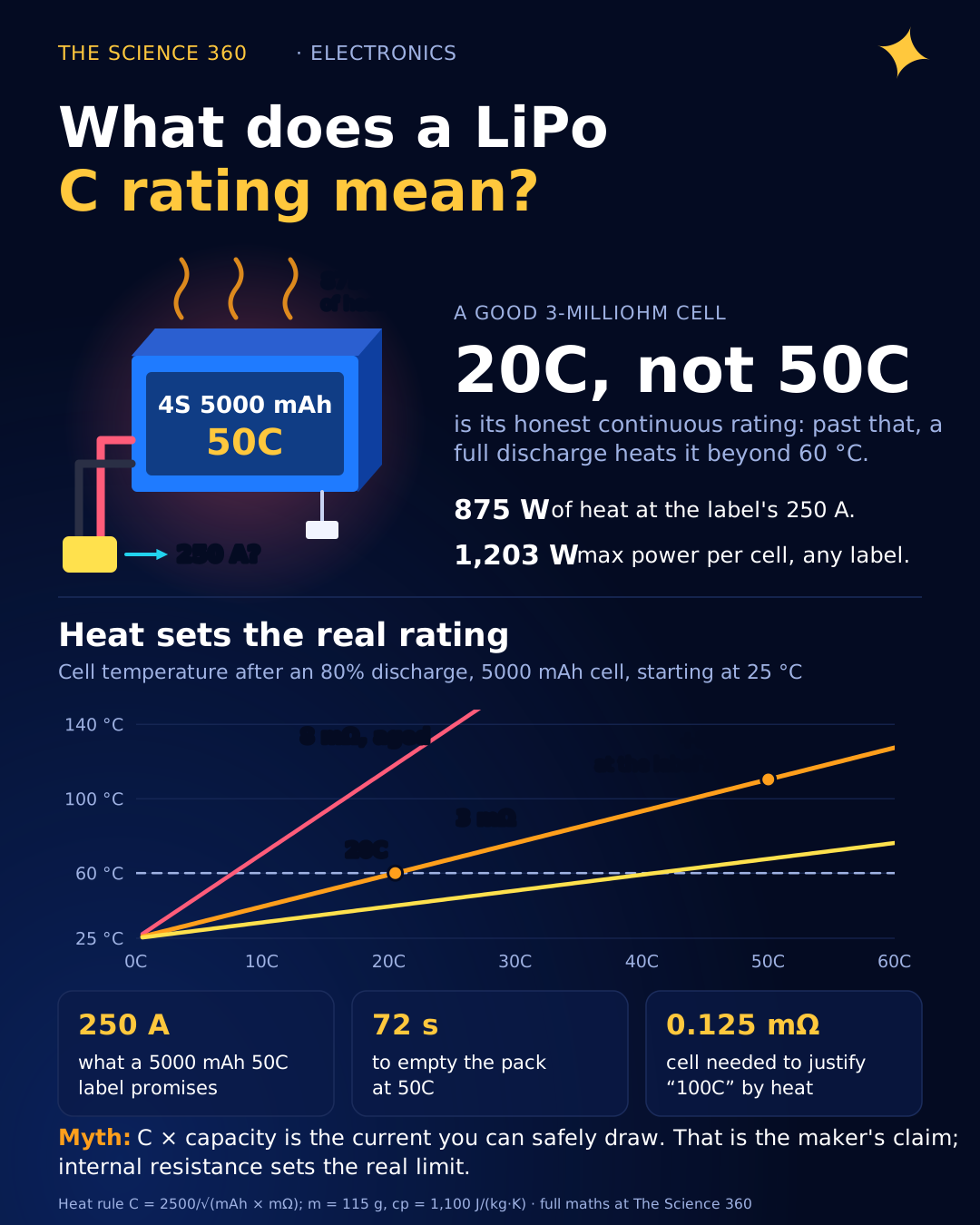
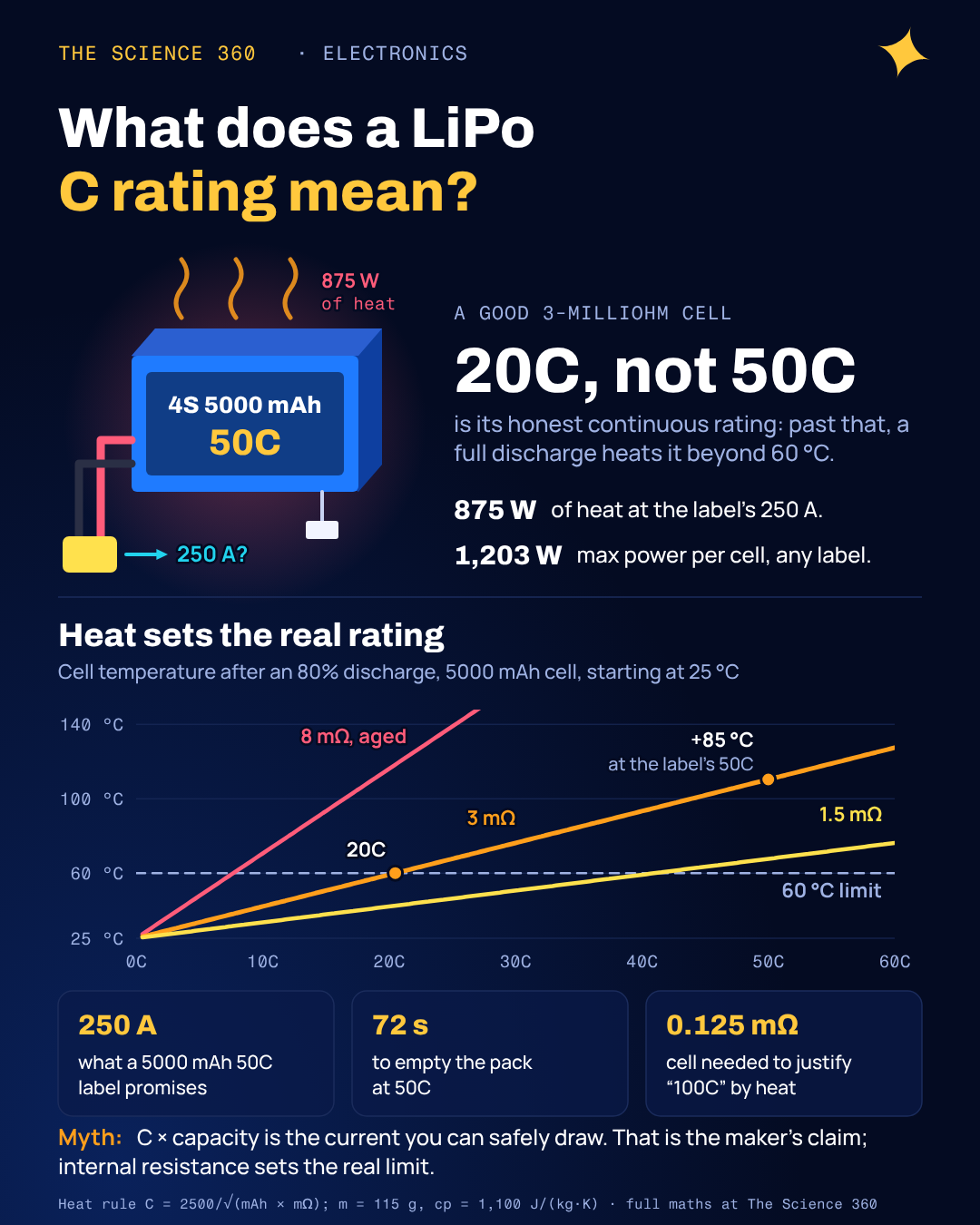
Pick up a 4S 5000 mAh LiPo with "50C" printed on the wrap. Multiply it out and the label promises 250 amps, which at 14.8 volts is 3.7 kilowatts from a brick that weighs about half a kilo. Now put a cheap internal resistance meter on one of its cells and read 3 milliohms, which is a good fresh cell. At 250 A, those 3 milliohms drop 0.75 V inside every cell and turn 188 watts per cell into heat. Run that for the 58 seconds an 80% discharge takes at 50C and the cell would warm by around 85 °C. Nobody's pack survives that, which tells you something about the number on the label.
This post explains what a C rating actually is, how it connects to internal resistance and voltage sag, and how to work out an honest rating for a pack you already own.
What does C rating mean on a LiPo battery?
"C" is borrowed from the general battery convention where 1C is the current that would empty a battery in one hour. Battery University puts it simply: a 1 Ah battery at 1C supplies 1 A for an hour, at 2C it supplies 2 A for 30 minutes, at 0.5C it supplies 500 mA for two hours. So a C number is a current expressed relative to capacity, not an independent physical property.
From label to amps
The 1300 mAh 120C pack is a common 6S FPV size.
That last line is worth pausing on. A 50C rating is a claim that the pack can be fully discharged in 72 seconds without damage. A 120C pack is claiming 30 seconds. Keep those times in mind, because the heat calculation later depends on them.
Packs often carry three C numbers:
- Continuous discharge, the headline figure, claimed for a whole discharge.
- Burst discharge, usually about double the continuous figure, claimed for a few seconds (5 or 10 s is typical on wraps).
- Charge rate, often 1C to 5C. The conventional safe default is 1C (5 A for a 5000 mAh pack), and most people charge at 1C because higher rates add heat and wear.
The catch is that, for hobby packs, no published standard tells a manufacturer how to measure any of these. Formal cell standards such as IEC 61960 rate capacity at a gentle 0.2C and say nothing about a "50C" claim. So the continuous rating is whatever the maker decided to print, and you cannot compare one brand's 50C with another's.
Why the C rating is really a statement about internal resistance
A LiPo cell behaves, to a good first approximation, like an ideal voltage source (the resting voltage, about 4.2 V full to roughly 3.7 V at half charge) in series with a small internal resistance R. Everything the C rating tries to describe follows from that resistance.
Typical numbers: RC Helicopter Fun reports 1 to 4 mΩ per cell for brand new high-capacity cells (around 5000 mAh) at room temperature, rising with age and roughly doubling in the cold. Small 150 mAh micro cells sit around 150 mΩ. Since a pack's resistance is the sum of its cells in series, a 4S pack of 3 mΩ cells is 12 mΩ before you count wires and connectors.
Figure 1 shows what that resistance does to the voltage over a discharge. The dashed black line is a commonly published resting voltage chart for a LiPo cell. Each coloured line subtracts .
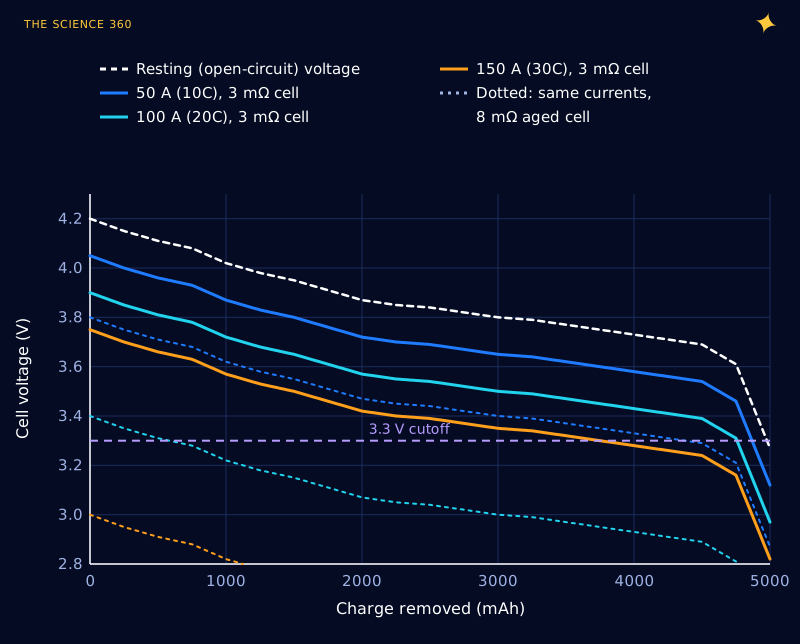
Two things jump out. First, sag steals usable capacity: the 150 A curve hits the 3.3 V cutoff after 3,775 mAh, so a quarter of the pack is stranded because the voltage collapsed, not because the charge ran out. Second, an aged pack at the same current can be unusable outright. Same label, same capacity, different resistance, completely different battery.
How much voltage sag should you expect? A worked example
Take that 4S 5000 mAh pack with 3 mΩ cells and add 2 mΩ for the main leads and connector, a reasonable allowance for 10 AWG wire and a good bullet connector.
Pack resistance
At 100 A (20C), half charged (rest 3.75 V per cell = 15.0 V)
That is 3.40 V per cell, and an efficiency of 13.6 ÷ 15.0 = 91%.
At the label's 250 A (50C)
The pack sits at 2.88 V per cell.
At its own rated current, a healthy pack would sit below 2.9 V per cell at half charge and cook itself at almost 900 W. The rating is not describing anything the pack can do for a whole discharge.
Can a high C rating give you more power? The limit is fixed by resistance
A source with internal resistance can only ever deliver so much power. The delivered power is a downward parabola, and it peaks when the load takes half the voltage, at . That is the maximum power transfer theorem, and it is the same physics that makes a solar panel's operating point matter.
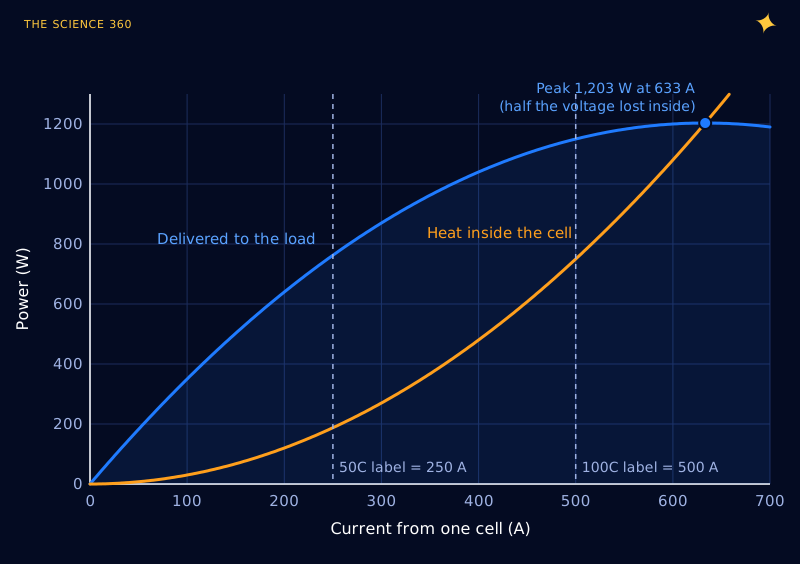
So a cell's power ceiling is , here W, no matter what the wrap says. To get more real power you need a lower , which in practice means a bigger cell, a better cell, or a warmer cell. Printing a bigger C number changes none of these.
Where an honest C rating comes from: heat
If sag were the only issue, you could tolerate it. Heat is what ends a LiPo's life. Hobby guidance commonly treats about 60 °C (140 °F) as the most a pack should reach, and a pack that comes off "hot to the touch" is losing cycle life.
Here is the clever part. RC Helicopter Fun publishes a rule of thumb, popular among helicopter pilots who measure cell resistance with chargers or dedicated ESR meters:
Their example, 5100 mAh with 1.4 mΩ cells:
About 30C, or 153 A.
The page does not explain where 2500 comes from, so I worked backwards. Square both sides and substitute :
Unpacking the rule (my derivation)
That is 6.25 W of heat per Ah of capacity, per cell.
What that heat does to a 5000 mAh cell
Cell mass ≈ 115 g (18.5 Wh at about 160 Wh/kg); specific heat ≈ 1,100 J/(kg·K).
For a 3 mΩ cell the rule gives 20C, so an 80% discharge takes s.
From 25 °C to about 60 °C.
So the rule of thumb is a heat budget in disguise. It caps the heating power at a fixed amount per amp-hour (and therefore roughly per gram of cell), chosen so that a full discharge at the allowed rate lands right around the 60 °C ceiling. That is a satisfying result, because it means the rule rests on physics rather than folklore. The specific heat value comes from calorimetry on commercial pouch cells: an Oxford group measured 541 J/K for a 489 g pouch cell (about 1,110 J/(kg·K)) and a Chalmers study reported 1,100 J/(kg·K). The 115 g cell mass is my estimate; real packs vary by maybe 20%.
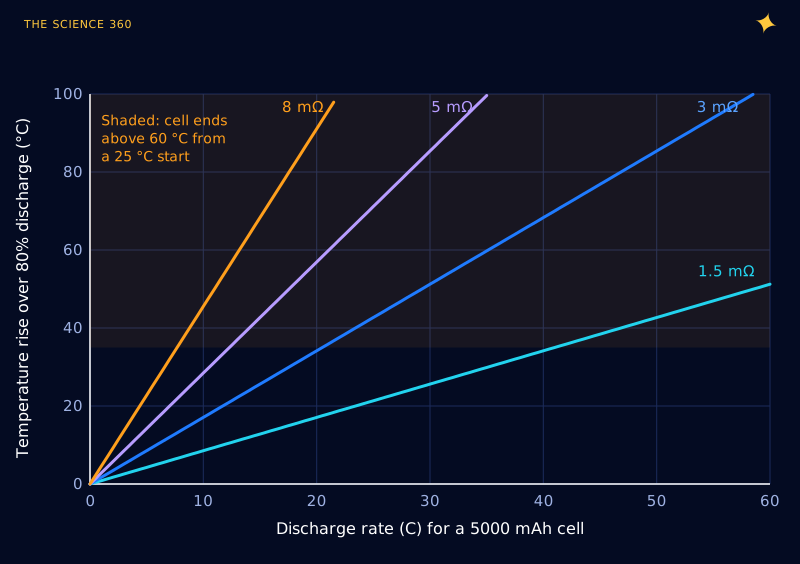
Look at the slopes in Figure 3. Even an excellent 1.5 mΩ cell passes 60 °C at about 41C. A typical 3 mΩ cell gets there at 20C. An aged 8 mΩ cell gets there below 8C. Read against those lines, "50C" or "100C" on a 5000 mAh pack is not a description of a full continuous discharge.
The misconception: “C rating × capacity is the current I can safely use”
Most top-ranking explanations stop at the multiplication, maybe with a vague warning that some brands inflate their numbers. The multiplication gives you the manufacturer's claim. The current you can actually use is set by internal resistance and by how long you hold it. Figure 4 puts the label next to two honest yardsticks: the heat rule above, and a simple sag rule that allows 0.5 V of drop per cell (enough to keep a half-charged cell above about 3.2 V).
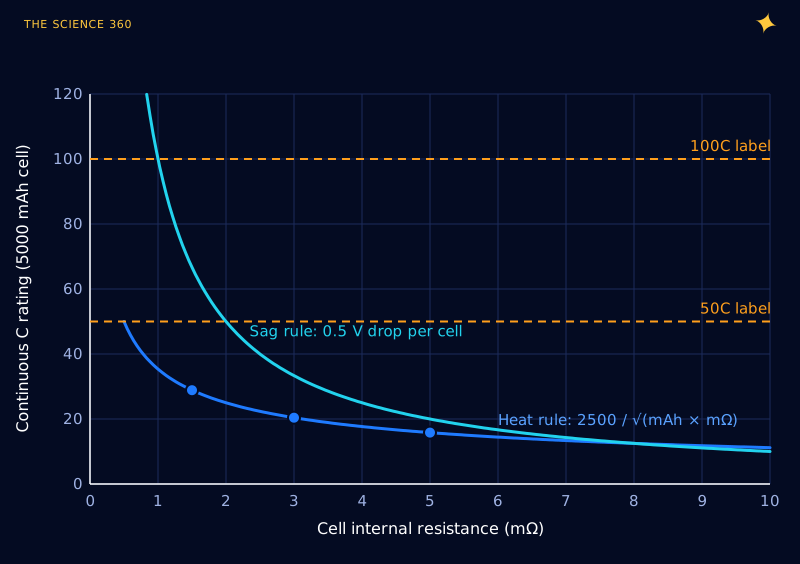
Working the label backwards makes the gap concrete:
What cell resistance would a "100C" 5000 mAh label require?
The first line uses the heat rule; the second the 0.5 V sag rule.
Typical fresh cell: 1 to 4 mΩ.
No hobby pouch cell of that size is anywhere near 0.125 mΩ. The sag rule is more forgiving, and a very good fresh cell can approach it, but only by running hot. That is why experienced pilots and drivers treat the label as a ranking within one brand at best.
There is a second, quieter misconception worth killing: that a higher C pack will "push" more current and burn out a motor or ESC. It cannot. The load decides how much current it draws. A lower-resistance pack holds its voltage higher, so the motor spins a little faster and may draw a little more, but that is the whole effect. The real risk runs the other way: a pack that is too weak for the load sags, heats, and puffs.
How to estimate the real C rating of your own pack
- Measure cell resistance at about 22 °C. Many hobby chargers report per-cell IR. Their absolute values vary with method, so compare readings from the same charger over time. Dedicated DC-load ESR meters are more consistent; the ProgressiveRC ESR Meter Mark II, for example, resolves 0.04 mΩ per cell. Use the highest cell, since the weakest cell limits the pack.
- Apply the heat rule to get a continuous C, and the sag rule if voltage matters to you (it does on a quad that needs punch at the end of a flight).
- Compare with your load. If your logger says the vehicle averages 60 A with 150 A spikes, a 5000 mAh pack needs an honest 12C continuous. Spikes of a second or two are fine above that, because the cell's heat capacity soaks them up.
- Check the temperature after a run. This is the honest test that needs no meter. Warm is fine. Uncomfortable to hold means you are over the real rating.
- Track IR over the pack's life. Resistance rises with cycles and abuse. When a pack's IR has roughly doubled, its honest C rating has fallen by about 30% (√2) by the heat rule and by half by the sag rule.
Worked example: a 6S 1300 mAh "120C" FPV pack
Label: 1.3 Ah × 120 = 156 A. Measured highest cell: 5 mΩ (plausible for a fresh 1300 mAh cell; small cells read higher).
The first is the heat rule, the second the sag at a 100 A punch.
A 3.0 V drop on a 22.2 V pack is 0.5 V per cell. Verdict: fine for the short bursts of freestyle flying, nowhere near 156 A continuous.
That last example shows why FPV pilots buy "120C" packs and are perfectly happy: their duty cycle is bursty, the pack spends most of the flight at 20 to 40 A, and a 3 minute flight never builds the full heat load. The packs work. The label just describes something else.
FAQ
Is a higher C rating LiPo better?
Only if the higher number reflects a lower internal resistance. A genuinely lower-resistance pack sags less and runs cooler at the same current. A higher number on the label alone tells you very little, because hobby C ratings are not measured to a common standard.
Will a higher C rating battery damage my motor or ESC?
No. The motor and ESC draw the current they need; the battery does not push extra current into them. A lower-resistance pack holds its voltage a little higher under load, so the motor may spin slightly faster and draw slightly more, but the C rating itself never forces current into anything.
What is the difference between continuous and burst C rating?
Continuous C is the discharge rate the maker claims the pack can sustain for a whole discharge. Burst C is a higher figure claimed for a few seconds, typically about double the continuous number. Neither has a standard test behind it, so treat both as marketing upper bounds.
How do I calculate the maximum current of a LiPo?
Multiply the capacity in amp-hours by the C rating: a 2200 mAh 30C pack is 2.2 Ah times 30, or 66 A. For a realistic figure, measure the cell internal resistance and use a heat-based estimate such as C = 2500 divided by the square root of (capacity in mAh times highest cell resistance in milliohms).
What C rating do I need for my drone or RC car?
Measure or estimate your average and peak current, divide by the pack capacity in amp-hours, and choose a pack whose honest rating covers the average with margin. A pack that comes off the vehicle much warmer than body temperature is being run too hard for its real internal resistance.
Related on The Science 360
Sources
- Battery University, BU-402 "What Is C-rate?" (definition and examples of 1C, 2C, 0.5C): batteryuniversity.com/article/bu-402-what-is-c-rate
- RC Helicopter Fun, "LiPo Internal Resistance" (1 to 4 mΩ typical for new high-capacity cells, temperature effect, C = 2500 / √(mAh × mΩ) rule with 5100 mAh example): rchelicopterfun.com/lipo-internal-resistance.html
- Lin et al., "Anisotropic thermal characterisation of large-format lithium-ion pouch cells" (heat capacity 541 J/K for a 489 g pouch cell): arxiv.org/pdf/2112.09768
- Chalmers University of Technology, "Experimental Characterization of Li-ion Battery cells for Thermal Management in Heavy Duty Hybrid Applications" (specific heat 1,100 J/(kg·K) for pouch and prismatic cells): odr.chalmers.se
- ProgressiveRC, LiPo ESR Meter Mark II (per-cell resolution 0.04 mΩ): progressiverc.com/products/lipo-esr-meter-mark-ii
- UAVModel blog, "FPV LiPo Battery C-Rating Explained" (per-cell IR ranges for new and cycled packs; values given without test data, used only for orientation): blog.uavmodel.com
- Grepow, "What is the C rating on a LiPo battery" (manufacturer's explanation of continuous, burst and charge C ratings): grepow.com/blog/what-is-the-c-rating-on-a-lipo-battery.html
Method note: all curves use a single-resistor cell model (resting voltage minus I × R) with a commonly published LiPo resting voltage chart. Real cells add polarisation effects that grow over a few seconds, so sustained sag is somewhat larger than the pure-resistance figure, and resistance falls as a cell warms. The 115 g cell mass and the 60 °C ceiling are typical values, not specifications.
Header image: NASA/JPL-Caltech (image PIA26677), regraded for this article.