Nvidia Gaming GPU Prices 2026: What It Means for Gamers
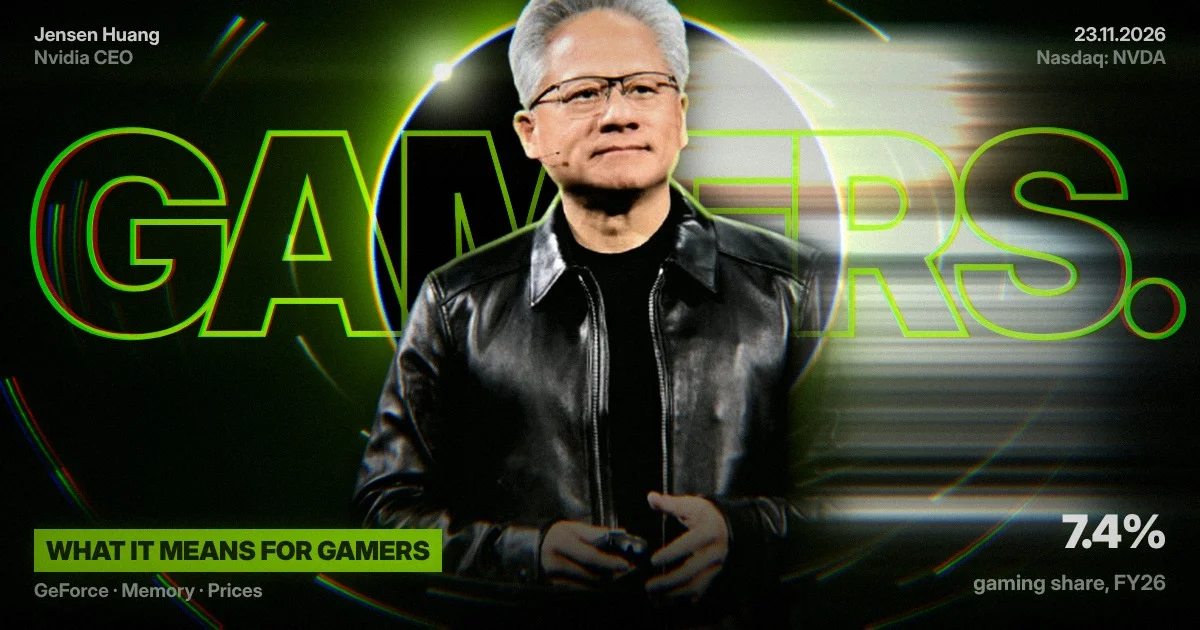
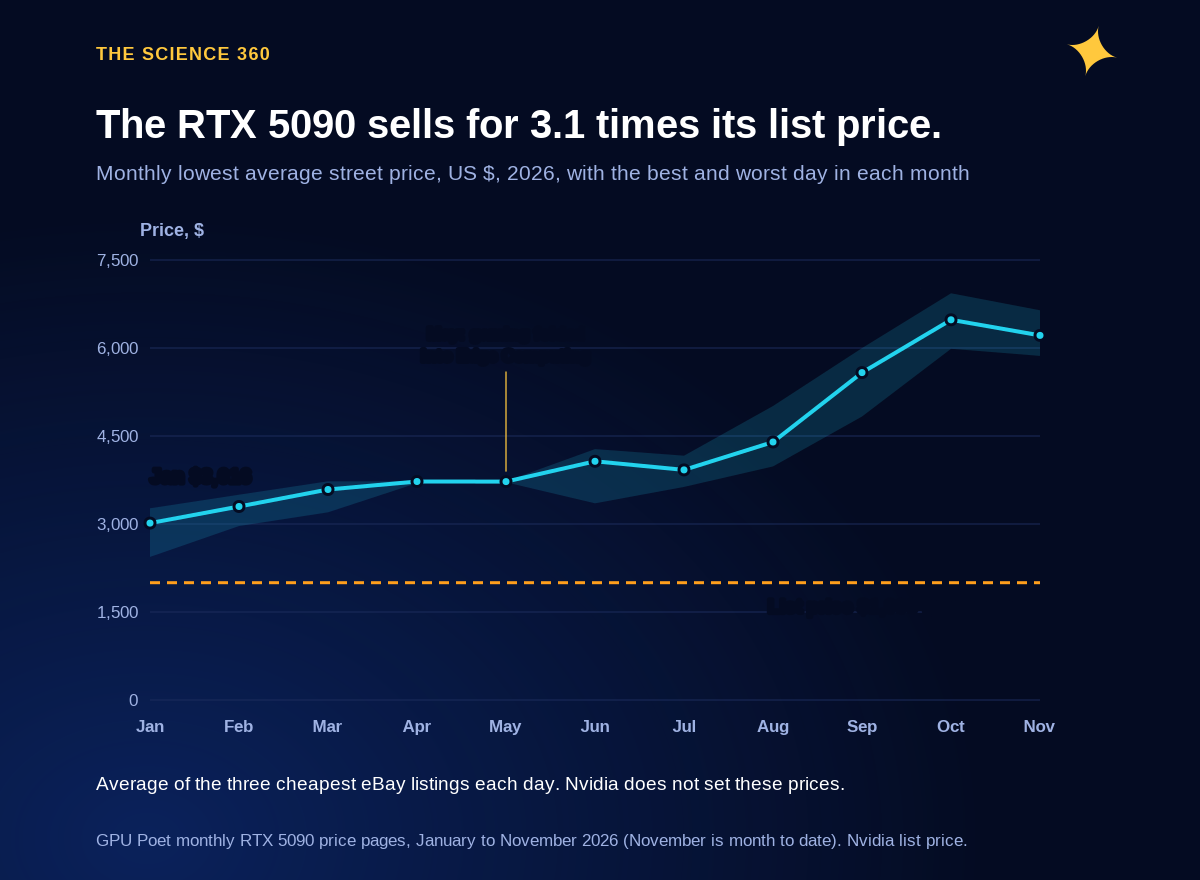
Nvidia still lists the GeForce RTX 5090 at $1,999, the same price it launched at in January 2025. In November 2026 the cheapest typical listings in the US were around $6,215, according to the price tracker GPU Poet. That is 3.1 times list for a card that is almost two years old.
The main story this month was about Jensen Huang leaving and then returning as Nvidia's CEO, and about the trillion dollars of market value that moved with him. But the quarterly report that landed in the middle of the drama says a lot about why your next graphics card costs what it does. This piece follows the numbers: how small gaming has become inside Nvidia, why memory is the real choke point, and a simple model of what one silicon wafer earns as a data centre GPU versus a gaming GPU.
How much of Nvidia’s revenue comes from gaming now?
In fiscal 2020 (the year to January 2020) gaming was $5.5 billion, half of Nvidia's $10.9 billion revenue. In fiscal 2026 it was a record $16.0 billion, up 41% on the year. Gaming nearly tripled. Its share still fell from 50.5% to 7.4%, because data centre went from $3.0 billion to $193.7 billion over the same six years.
The quarterly data shows the slide more sharply. In the quarter to May 2022, gaming was 43.7% of revenue. In the quarter to January 2026, the last time Nvidia reported it, gaming was $3.7 billion and 5.4%.
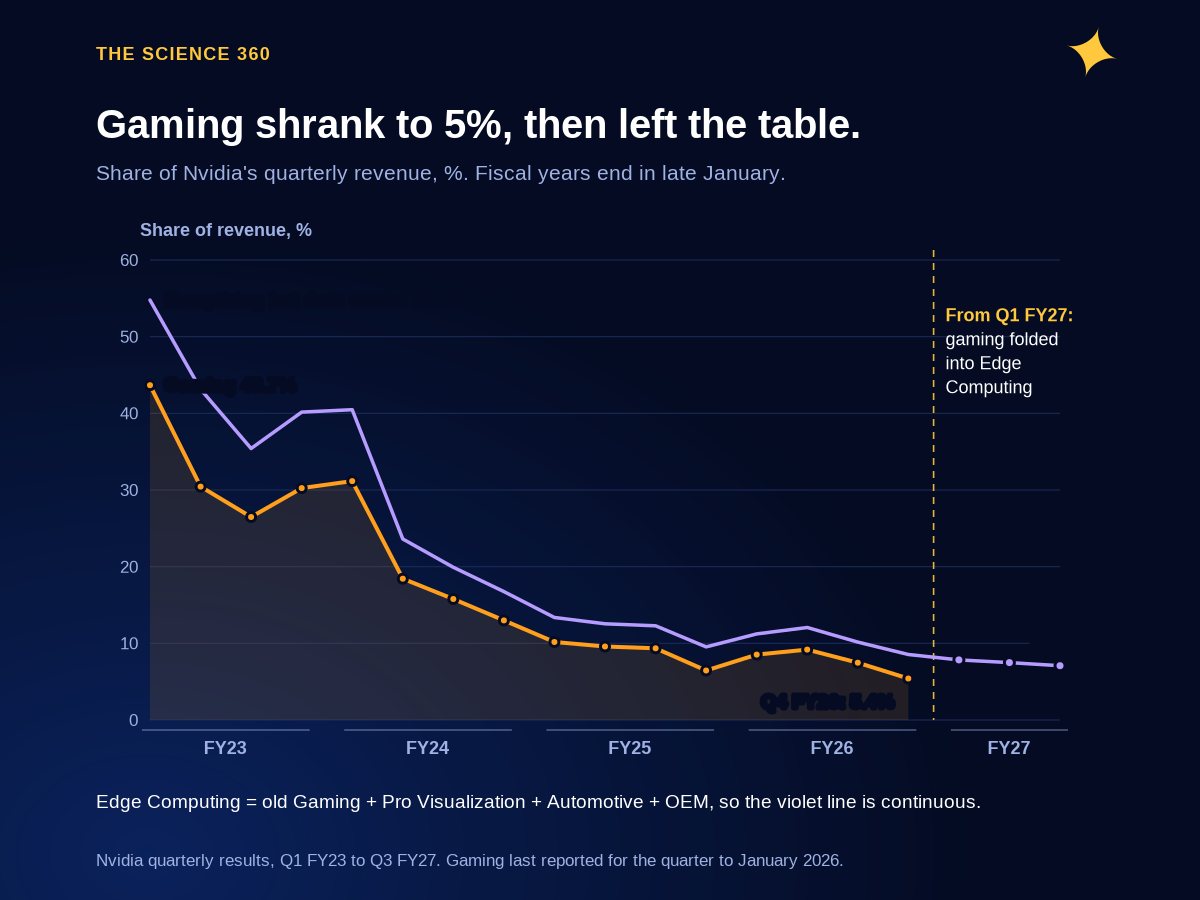
From the first quarter of fiscal 2027 (the quarter to April 2026) Nvidia reports only two segments. Data Center is one. Edge Computing is the other, which Nvidia describes as devices for "agentic and physical AI including PCs, game consoles, workstations", plus robotics, cars and AI-RAN base stations. Trade press, including Tweaktown, reported that Edge Computing equals the old Gaming, Professional Visualization, Automotive and OEM segments added together. Our check agrees: the old segments summed to $4.95 billion in Q1 fiscal 2026, and Nvidia's reported 29% growth to $6.4 billion implies a base of $4.96 billion.
So the violet line in Figure 1 is a continuous series, and it gives a hard ceiling. Even if every dollar of Edge Computing were GeForce, gaming could be no more than 7.1% of the latest quarter. A fairer guess uses the old mix:
FY26 non-data-centre revenue:
Gaming's slice of it in FY26:
Apply to Q3 FY27 Edge revenue:
Share of Q3 FY27 revenue:
That is our estimate, not an Nvidia number, and the mix has probably moved. The point stands either way. Gaming is about one dollar in twenty at Nvidia today, and investors can no longer see it.
Why is the RTX 5090 so expensive?
The common belief is that Nvidia has raised the price. It has not, at least not on paper. The list price is unchanged. The money between $1,999 and $6,215 goes to whoever holds the scarce cards: retailers, board partners pricing their own models, and resellers. Nvidia's revenue per chip does not triple when eBay prices do.
What Nvidia does control is supply, and that is where the reports get worrying for gamers. Guru3D reported alongside the Q3 results that the RTX 5090 is only available at inflated prices and that board partners cannot order new GB202 packages, the chip inside the 5090. Several outlets, including Guru3D and Tweaktown, also reported that a 24 GB version of the RTX 5080, expected around January 2027, was shelved because 3 GB GDDR7 memory chips are too expensive and too scarce.
How does the memory shortage hit graphics cards?
A graphics card is a GPU plus a ring of memory chips, and memory is where the AI boom bites hardest. On 28 October SK hynix told investors that "our DRAM and HBM volumes for the next three years through 2029 are effectively sold out", based on long-term agreements with 14 major customers. Those agreements already cover more than half of its capacity for 2027 and 2028. Nvidia's side of the same story shows up in its supply commitments, which Guru3D reported rose from $279 billion to $390 billion in one quarter.
GeForce cards do not use HBM. They use GDDR7. But both come out of the same DRAM fabs, and HBM is greedy. Micron said in 2024 that HBM3E takes about three times as much wafer supply as DDR5 to make the same number of bits, because each stack is several thinned dies joined by through-silicon vias. Every wafer a memory maker turns into HBM for a Rubin rack removes about three wafers' worth of ordinary bits from the market.
Nvidia has already said this hurts its consumer business. In the Q1 fiscal 2027 report it described "slower consumer PC demand that was tempered by elevated memory and systems prices". Gamers are not only paying more for the card. They are paying more for the RAM and the whole PC around it.
What does one wafer earn as a gaming GPU versus a data centre GPU?
Here is the economics in one model. Both chips are built by TSMC on 4 nm class processes, on the same 300 mm wafers. The question is how much revenue a wafer produces in each product.
First, how many chips fit. A standard first-order estimate for dies per wafer subtracts the partial dies lost at the round edge:
where is the wafer diameter and is the die area. Then revenue per wafer is chips times price times yield:
Our inputs, with where each comes from:
- GB202 (RTX 5090): 750 mm², 92.2 billion transistors (Nvidia via TechPowerUp). The 5090 enables 170 of 192 SMs, so partly flawed dies are still sellable.
- B200 (Blackwell data centre GPU): two reticle-limited dies with 208 billion transistors in total. Nvidia has not published the die area; reports put each die near 800 mm². That is our estimate.
- Prices: Huang told CNBC in March 2024 that a Blackwell GPU would cost $30,000 to $40,000. For the RTX 5090 we use the $1,999 list price of the whole card, which is more than Nvidia receives, because it includes the board, cooler and the partner's and retailer's margins.
- Yield: the two dies are similar in size, so we assume the same yield for both. It then cancels out of the ratio.
GB202 dies per wafer:
B200 dies per wafer:
, so 32 GPUs
Gaming wafer at list price:
Data centre wafer: to
Ratio: to
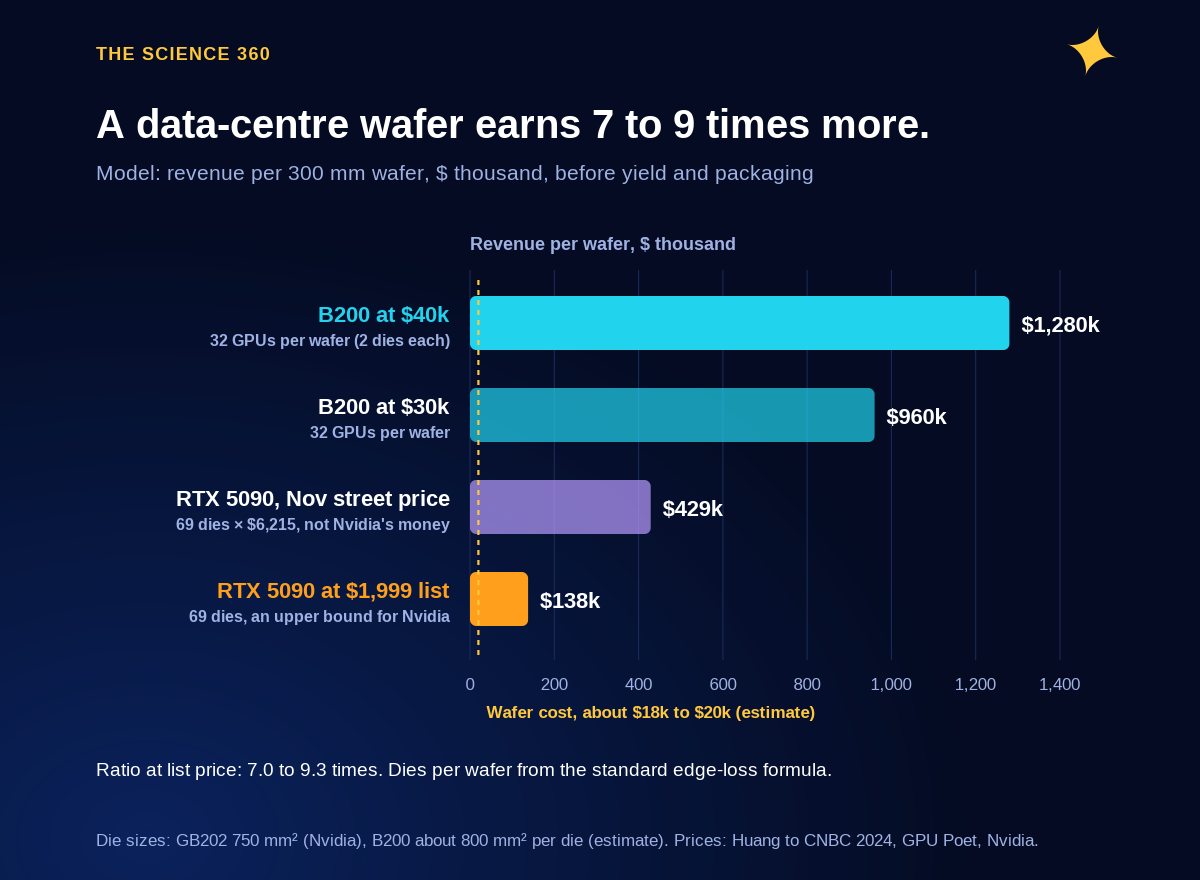
Even with the gaming side flattered by using the full retail card price, a data centre wafer earns 7 to 9 times as much. If you could somehow give Nvidia the November eBay price for every 5090, the gaming wafer would reach $429,000, still less than half the low end for B200. Morgan Stanley estimated 4 nm class wafers at about $18,000 to $20,000, so both products are very profitable per wafer. The question for Nvidia is never whether gaming makes money. It is what else the same supply could have made.
What is Nvidia still doing for gamers?
The Q3 fiscal 2027 release lists real consumer launches, so the story is not one of neglect. Edge Computing revenue was $8.2 billion, up 42% on a year earlier and 14% on the quarter. Nvidia said it:
- launched DLSS 5 in NBA 2K27 and Hogwarts Legacy, "bringing AI-powered, photorealistic lighting", with Where Winds Meet next, across GeForce RTX 50 Series cards, GeForce NOW and RTX Spark;
- began shipping RTX Spark laptops, Windows PCs from ASUS, Dell, HP, Lenovo, Microsoft Surface and MSI.
Both moves fit the economics. DLSS has always been a way to do more with the silicon you already own, by having a neural network fill in work the GPU does not render directly. Laptop GPUs generally use much smaller dies than a 750 mm² GB202, which stretches scarce wafers and memory further. For a company that earns several times more per wafer elsewhere, software features and small chips are the cheapest ways to keep gamers on its platform.
Does Huang’s return change anything for gamers?
Probably not much in the short term. Nvidia under interim CEO Colette Kress and under the reinstated Huang faces the same memory contracts, the same TSMC capacity and the same customers. The Q4 guidance of $130 billion, with no China data centre revenue assumed, came out while Huang was away. Gross margin is guided down to 71% to 72%, and with memory this tight Nvidia has little reason to divert scarce supply to its lowest-value cards.
What Huang does bring back is the founder who built GeForce, and he has long used big stage events for product news. GTC Washington, D.C. runs from 30 November to 3 December, overlapping with his congressional appearances. Any change to RTX 50 supply or a new consumer product would most likely surface there or at the start of 2027. We would not expect a price cut.
What should you do if you need a graphics card now?
Treat this as reasoning from the data, not shopping advice. The list price is the only price Nvidia controls, so watch for restocks of Founders Edition cards at $1,999 instead of paying a reseller three times that. Buy for the VRAM your games actually need, since smaller cards feel the GDDR7 squeeze less than the flagship. If you can wait, the useful signals are Nvidia's Q4 fiscal 2027 results in late February 2027, any new memory capacity announcements, and whether DRAM contract prices stop rising. Until then, the arithmetic of a wafer says gamers are bidding against data centres, and data centres pay more.
FAQ
Why is the RTX 5090 so expensive in 2026?
Supply is short and Nvidia has kept its list price at $1,999. GPU Poet's tracker put the cheapest typical US listings at $6,215 in November 2026, about 3.1 times list. Memory makers have sold their DRAM and HBM capacity for years ahead, and a wafer of data centre GPUs earns Nvidia roughly 7 to 9 times what a wafer of RTX 5090 chips could.
Does Nvidia still report gaming revenue?
No. From the first quarter of fiscal 2027, the quarter to April 2026, Nvidia reports only Data Center and Edge Computing. Edge Computing combines the old Gaming, Professional Visualization, Automotive and OEM segments. It made $8.2 billion in the quarter to October 2026, 7.1% of revenue. The last separate gaming figure was $3.7 billion for the quarter to January 2026.
Will graphics card prices come down in 2027?
The supply side gives little reason to expect it soon. SK hynix said in October 2026 that its DRAM and HBM volumes are effectively sold out through 2029, and Nvidia's own supply commitments rose to $390 billion. Prices could still ease if data centre demand cools or new memory capacity arrives faster than planned.
Is Nvidia abandoning gaming?
No. Edge Computing, which holds GeForce, grew 42% a year in the latest quarter, and Nvidia launched DLSS 5 and began shipping RTX Spark laptops. But gaming is now a small share of the company, and when chips or memory are scarce the data centre business earns several times more from the same supply.
This article explains market data and is not investment advice. Prices are as reported to 23 November 2026.
Sources
- NVIDIA, Financial Results for Third Quarter Fiscal 2027 (press release, 17 Nov 2026), SEC EDGAR
- NVIDIA, First Quarter Fiscal 2027 results (new Data Center and Edge Computing segments)
- NVIDIA, Fourth Quarter and Fiscal 2026 results
- NVIDIA, Form 10-K for fiscal 2023, SEC EDGAR
- Tweaktown, "NVIDIA's latest financial report removes Gaming as a segment, it's now called Edge Computing"
- Wccftech, Nvidia moves gaming under Edge Computing (21 May 2026)
- GPU Poet, NVIDIA GeForce RTX 5090 price, November 2026 (and the January to October 2026 monthly pages)
- Guru3D, Nvidia Q3 FY2027 report (19 Nov 2026)
- Guru3D, "Nvidia reportedly shelves the GeForce RTX 5080 24GB"
- Tweaktown, Nvidia reportedly cancels RTX 5080 24GB launch over GDDR7 costs
- Korea JoongAng Daily, "SK hynix says DRAM, HBM booked through 2029" (28 Oct 2026)
- AnandTech, "Micron Sells Out Entire HBM3E Supply for 2024, Most of 2025" (HBM3E uses about 3 times the wafer supply of DDR5)
- TechPowerUp GPU Database, GeForce RTX 5090 (GB202, 750 mm², 92.2 billion transistors)
- AnandTech, "NVIDIA Blackwell Architecture and B200/B100 Accelerators Announced"
- Tom's Hardware, Huang says Blackwell GPU to cost $30,000 to $40,000 (March 2024)
- TechPowerUp, TSMC to raise wafer prices by 10% in 2025 (Morgan Stanley 4 nm estimate)
- The Science 360, Jensen Huang returns as Nvidia CEO (parent article and its sources)
Cover: The Science 360. Charts: our calculations from the sources listed.