Jensen Huang Resignation and Return: Day-by-Day Timeline
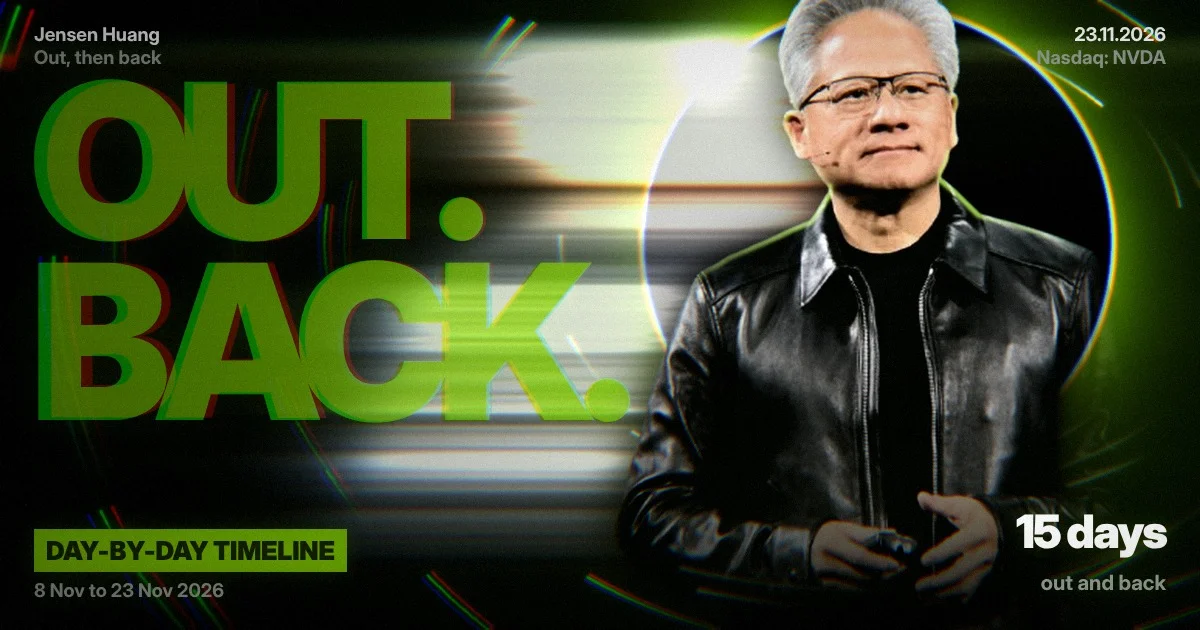
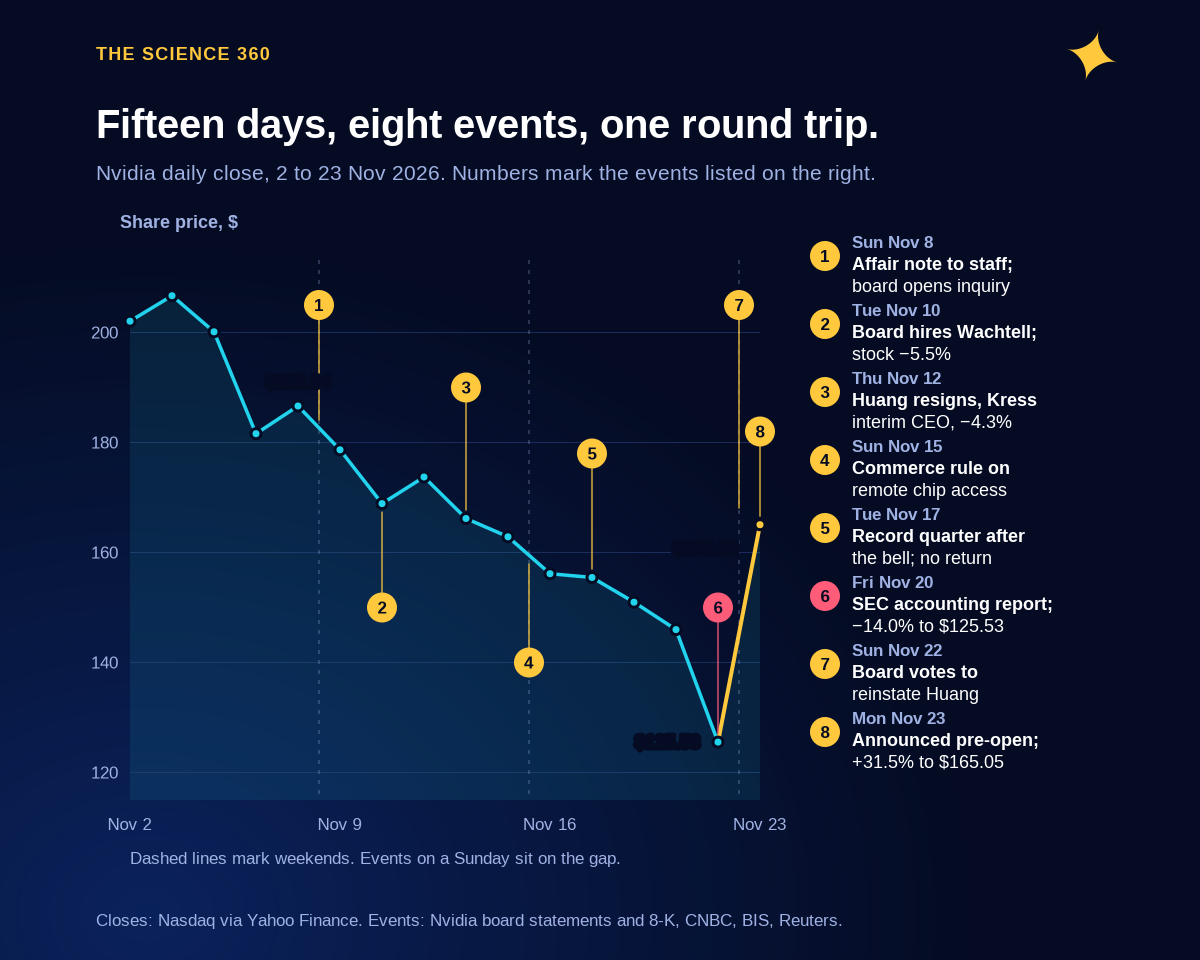
Eleven trading sessions. That is all it took for Nvidia to lose a third of its value, hand its CEO job to the finance chief, rule out the founder's return, and then reverse itself and bring him back. The main analysis of Huang's return covers the event study, the revenue and the valuation. This piece does something narrower and, we think, more useful if you want to understand how markets digest a scandal: it walks the 15 days one at a time, and next to each event it puts the close, the daily change, the move the market alone would have predicted, and what was left over.
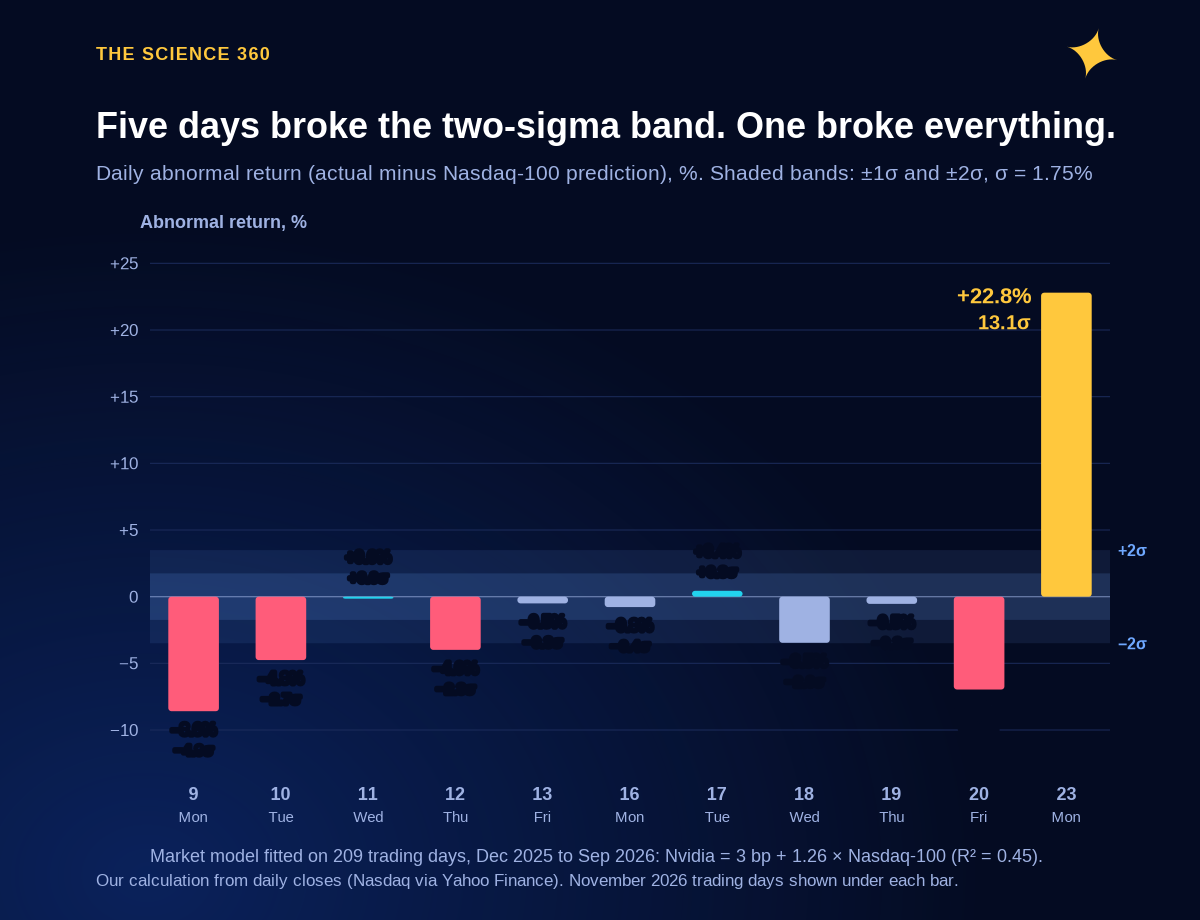
The pattern that comes out is not a smooth slide. Most of the damage landed on four or five specific days, and the biggest single Huang-specific loss was not the day he resigned.
How to read the numbers in this timeline
Each trading day gets four numbers. The close and daily change are straight from the exchange. The abnormal return strips out what the broad market did that day. We use the same market model as the parent article, fitted on 209 trading days from December 2025 to September 2026, before any of this news:
The 1.75% is the typical size of an Nvidia-only daily surprise in that calm period, so tells you how unusual a day was. Anything beyond two sigma would happen by chance roughly one day in twenty. Market value is the close times 24.19 billion diluted shares, the count implied by the third-quarter fiscal 2027 net income of $65.3 billion and diluted EPS of $2.70.
Nasdaq-100 return:
Expected Nvidia return:
Actual Nvidia return:
Abnormal return:
In standard deviations:
In dollars:
On a day when the index jumped and AMD rose 13.3%, Nvidia lost $0.19 trillion of market value in raw terms and about $0.39 trillion against where the market says it should have been. No other day in the episode took more company-specific value out of Nvidia.
The full timeline, 8 to 23 November 2026
| Date | What happened | Close | Day | Nasdaq-100 | Abnormal (σ) | Value, $ tn |
|---|---|---|---|---|---|---|
| Fri 6 Nov | Last close before the note | $186.64 | +2.78% | +1.35% | reference | 4.51 |
| Sun 8 Nov | Huang's note to staff; board opens inquiry | market closed | ||||
| Mon 9 Nov | First session after the note | $178.67 | −4.27% | +3.40% | −8.59% (−4.9) | 4.32 |
| Tue 10 Nov | Board hires Wachtell; class action filed | $168.89 | −5.47% | −0.60% | −4.75% (−2.7) | 4.09 |
| Wed 11 Nov | Chip rally on CoreWeave; NYT second-affair report after the close | $173.73 | +2.87% | +2.28% | −0.05% (0.0) | 4.20 |
| Thu 12 Nov | Huang resigns; Kress interim CEO; Jones chair | $166.19 | −4.34% | −0.30% | −3.99% (−2.3) | 4.02 |
| Fri 13 Nov | Below $4 trillion at the close | $162.85 | −2.01% | −1.22% | −0.50% (−0.3) | 3.94 |
| Mon 16 Nov | Commerce remote-access chip rule | $156.14 | −4.12% | −2.67% | −0.78% (−0.4) | 3.78 |
| Tue 17 Nov | Results after the bell; board rules out return | $155.46 | −0.44% | −0.72% | +0.44% (+0.3) | 3.76 |
| Wed 18 Nov | First session after results | $150.96 | −2.89% | +0.42% | −3.46% (−2.0) | 3.65 |
| Thu 19 Nov | Broad AI sell-off, S&P 500 −2.0% | $145.98 | −3.30% | −2.21% | −0.54% (−0.3) | 3.53 |
| Fri 20 Nov | Reuters: SEC examining accounting | $125.53 | −14.01% | −5.61% | −6.96% (−4.0) | 3.04 |
| Sun 22 Nov | Board votes to reinstate Huang | market closed | ||||
| Mon 23 Nov | Reinstatement announced before the open | $165.05 | +31.48% | +6.86% | +22.80% (+13.1) | 3.99 |
Closes are Nasdaq data via Yahoo Finance; abnormal returns and market values are our calculation.
Week one: from the note to the resignation (8 to 13 November)
Sunday 8 November. Huang wrote to employees that he had been unfaithful to his wife. The Financial Times reported the relationship was with Alice Huang (no relation), an executive at the Singapore cloud company Megaspeed, whom US officials reportedly suspect of links to Chinese intelligence; China denies she is a spy. The board's statement that day said it had "no reason to believe" national security or company secrets were compromised, and that it had confidence in Huang.
Monday 9 November. Confidence was not what the market expressed. The worked example above shows a −4.9 sigma day, and the contrast with peers is stark: AMD +13.3%, the iShares Semiconductor ETF +7.5%, Nvidia −4.3%. Money stayed in chips and left Nvidia.
Tuesday 10 November. The board said it had hired Joon Kim of Wachtell, Lipton, Rosen & Katz to run the investigation, a Rosen Law Firm class action was filed, and The Information reported Alice Huang helped at least $7.5 billion of Nvidia chips reach Chinese firms. CNBC reported the stock briefly dipped below $4 trillion intraday. It closed down 5.47%, abnormal −4.75%. Reuters put the two-day loss at about $430 billion, which matches our $0.43 trillion fall from $4.51 to $4.09 trillion.
Wednesday 11 November. A breather. CoreWeave raised its revenue outlook and chip stocks surged; Nvidia rose 2.87%, almost exactly the 2.91% the model expected. After the bell, the New York Times reported a relationship with an Nvidia executive who reported to Huang, the Wall Street Journal reported the board was preparing to force him out, and the stock fell more than 9% in after-hours trading, according to CNBC.
Thursday 12 November. Huang resigned as CEO and from the board. CFO Colette Kress became interim CEO and Harvey Jones became Nvidia's first board chair. The stock was down as much as 14% intraday and closed down 4.34%.
Friday 13 November. A quieter 2.01% fall, mostly market (the Nasdaq-100 fell 1.22%). At $162.85 the market value was about $3.94 trillion, and CNBC reported it as the first close below $4 trillion since July 2025.
Why the resignation day was not the worst day
The common reading is that the resignation was the shock. The numbers say otherwise. Thursday's abnormal return was −3.99%, a 2.3 sigma day, less than half of Monday's. Two things explain it. Much of the news arrived on Wednesday evening, after the close, so it was already in the after-hours price. And by Thursday the outcome was less of a surprise: on Tuesday Dan Ives of Yorkville Ives put the Street's odds of Huang's removal at about 15%, and Wednesday night's reports pushed that much higher. Daily data credit a move to the first session that can trade on the news, and that session is often not the one with the headline.
Week two: rules, results and a hard no (16 to 19 November)
Monday 16 November. The Commerce Department's Bureau of Industry and Security issued an interim rule to stop Chinese companies renting advanced US chips in data centres abroad, and added licence requirements for Indonesia, Malaysia, Singapore, Thailand and Brazil. CNBC called it the first US policy response to the scandal. Nvidia fell 4.12% to its lowest close since July 2025, but the Nasdaq-100 fell 2.67% too, so the abnormal part was only −0.78%.
Tuesday 17 November. The close (−0.44%) came before the news. Nvidia reported after the bell: revenue of $115.8 billion, up 103%, and a $130 billion fourth-quarter guide. Earlier that day Huang had said he would be "honored" to return. On the call Jones said the board "does not intend to reinstate" him and had hired Heidrick & Struggles. The stock rose about 5% after hours, according to NBC News.
Wednesday 18 November. The after-hours gain did not survive the session. Yahoo Finance reported an almost 4% premarket gain turning into a loss; the close was −2.89% on a day the index rose 0.42%, an abnormal −3.46%, right at the two-sigma line. This is the clearest daily evidence that the market was separating Nvidia's numbers from Nvidia's leadership: the record quarter was in the price, and the "no return" message was too.
Thursday 19 November. A broad sell-off. Reuters reported all three main US indexes fell at least 2% as a record-sized IPO failed to revive enthusiasm for AI stocks. Nvidia's 3.30% fall was nearly all market; abnormal −0.54%.
Friday 20 November: the bottom, and why half of it was the market
Reuters reported that SEC enforcement staff were examining potential accounting issues at Nvidia. The stock fell 14.01% to $125.53, its seventh straight weekly loss and the longest losing streak since 2008, per CNBC. It is tempting to read the whole 14% as the SEC story. The model disagrees.
Nasdaq-100:
Expected Nvidia:
Abnormal:
Market value lost:
Of which market-driven: ; Nvidia-specific:
It was a terrible day for the whole index, and Nvidia's high beta means it should fall about 1.26 times as far as the Nasdaq-100 anyway. The company-specific part was real and large, at four sigma, but it was half the move, not all of it. That evening Nvidia was up 3.6% after hours, according to Yahoo Finance's quote, and Reuters reported that President Trump had made the case for Huang's return at a press conference that day.
22 and 23 November: the reversal
Sunday 22 November. Nvidia's 8-K says the board reinstated Huang as president, CEO and director on 22 November. The board said it acted after "input from senior levels of the United States government". Stock Analysis reported that Trump posted on Sunday night that he hoped the board would rehire Huang.
Monday 23 November. The announcement came before the open. Nvidia closed at $165.05, up 31.48%, its biggest one-day gain since 2003, adding about $956 billion. The Nasdaq-100 rose 6.86%, so the model expected +8.69% and the abnormal return was +22.80%, a 13.1 sigma day. Stock Analysis reported that Nvidia was already up about 7.6% premarket before the announcement as AI stocks bounced, close to what the model would expect from the index alone. Huang said he would "be a better CEO the second time around".
What do the 15 days add up to?
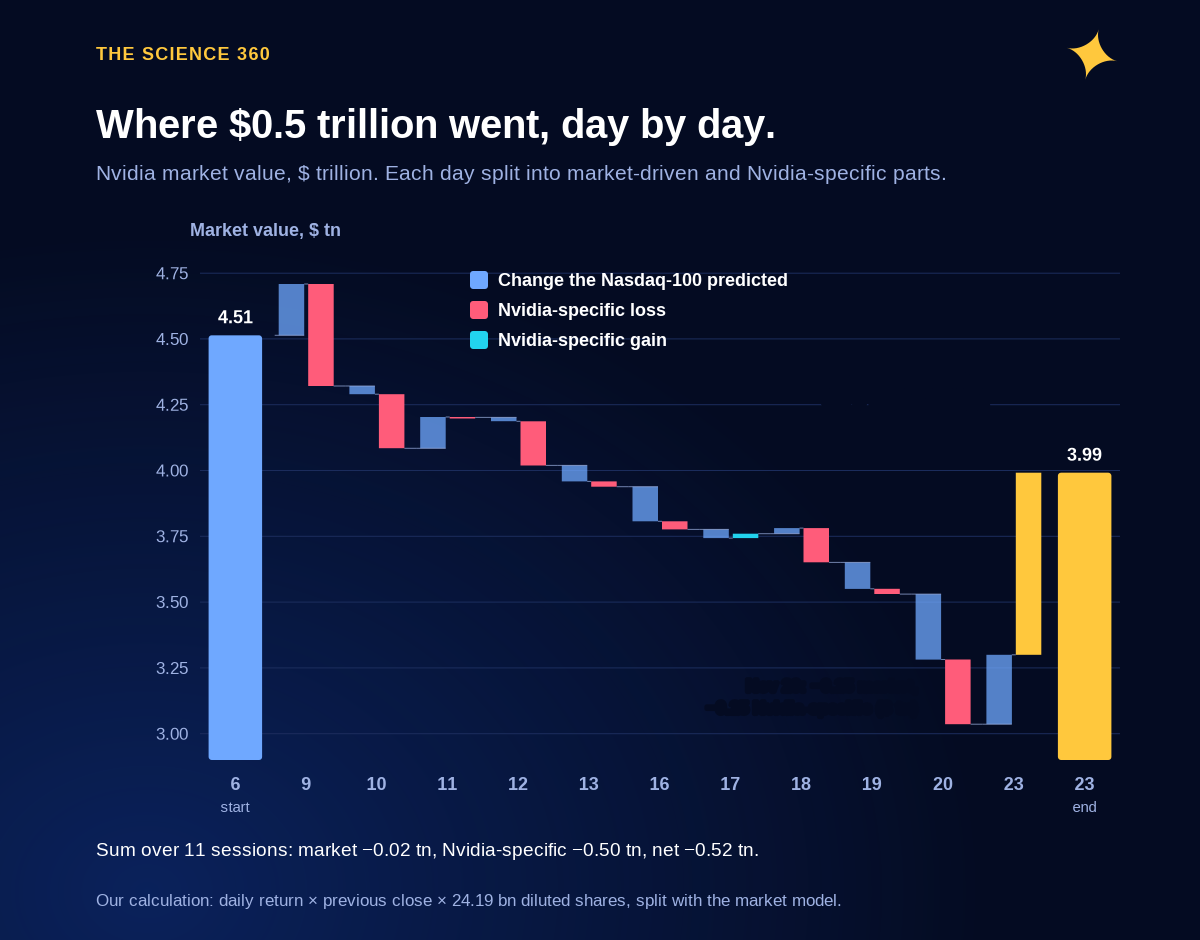
Add the bars in Figure 3 and the market-driven parts almost cancel: a 6.9% Nasdaq day on the 23rd undid the 5.6% fall on the 20th, and the rest roughly netted out. Over the 11 sessions the market component sums to about −$0.02 trillion. The Nvidia-specific component sums to −$0.50 trillion. Through 20 November it had reached −$1.19 trillion; the reinstatement day returned $0.69 trillion of that.
So the honest summary of the fortnight is this. The market did not simply panic and recover. It marked Nvidia down hardest on the days with genuinely new information about leadership (9, 10, 12 and 18 November) and about legal risk (20 November), barely reacted on days dominated by the broad market, and on 23 November restored about 58% of the lost company-specific value. The other 42% is still priced as risk: investigations, testimony and the question of what the board's inquiry finds. The close of $165.05 is about 12% below the $186.64 of 6 November.
The days ahead
| Date | Event | Why it could move the stock |
|---|---|---|
| Mon 30 Nov to Thu 3 Dec | GTC Washington, D.C. | Huang's first big stage since his return |
| Tue 1 Dec | Huang's closed-door transcribed interview with House committees | Questions on export controls and Megaspeed |
| Wed 2 Dec | General counsel Tim Teter before Congress; dividend record date ($0.25) | Disclosure and compliance questions |
| Thu 3 Dec | Public testimony to the Senate Banking Committee | Huang answers senators' questions in public |
| Wed 23 Dec | Dividend paid | None expected |
| Late Feb 2027 | Q4 fiscal 2027 results | Whether revenue lands near the $130 billion guide |
Open with no date: the board's own investigation with Wachtell, the SEC inquiry, Justice Department work and the search for Nvidia's first chief compliance officer. Investigations are not findings, and none has reported a conclusion. If you want to use the timeline method yourself, the rule is simple: compare each day with what the Nasdaq-100 did, and treat anything under two sigma as noise.
FAQ
When did Jensen Huang resign and when did he come back?
Huang told Nvidia staff about an extramarital affair on Sunday 8 November 2026 and resigned as CEO and from the board on Thursday 12 November. The board voted to reinstate him on Sunday 22 November, according to its 8-K filing, and announced it before the market opened on Monday 23 November. He was out for 11 days.
Which day was worst for Nvidia stock during the Huang crisis?
By raw price, Friday 20 November, when Nvidia fell 14.01% to $125.53 after Reuters reported an SEC accounting inquiry. Adjusted for the market, the worst day was Monday 9 November, the first session after Huang's note: Nvidia fell 4.3% while the Nasdaq-100 rose 3.4%, an abnormal return of minus 8.6%, about 4.9 standard deviations.
Did Nvidia stock recover all its losses after Huang returned?
No. Nvidia closed at $165.05 on 23 November, below the $186.64 close on 6 November before the scandal. Our market model says about $0.50 trillion of Nvidia-specific value lost since 6 November had still not come back after the 31.5% rebound.
What are the next dates to watch after Huang’s return?
Huang's closed-door House transcribed interview on 1 December, general counsel Tim Teter on 2 December, public Senate Banking testimony on 3 December, GTC Washington DC from 30 November to 3 December, the dividend record date on 2 December and fourth-quarter fiscal 2027 results in late February 2027.
This article explains market data and is not investment advice. Prices are closing prices to 23 November 2026.
Sources
- NVIDIA, "Statement From NVIDIA Board of Directors" (8 Nov 2026)
- NVIDIA, Form 8-K reporting Huang's reinstatement on 22 Nov 2026, SEC EDGAR
- NVIDIA, Financial Results for Third Quarter Fiscal 2027 (17 Nov 2026), SEC EDGAR
- CNBC, "Nvidia sells off for second day in fallout from Jensen Huang's affair with alleged spy" (10 Nov 2026)
- CNBC, "Nvidia hires law firm Wachtell Lipton to lead Jensen Huang affair probe" (10 Nov 2026)
- Reuters, "Nvidia faces deepening scrutiny over China chip ties, CEO affair" (10 Nov 2026)
- CNBC, "Nvidia shares rebound as Jensen Huang faces scrutiny ahead of earnings" (11 Nov 2026)
- CNBC, "Nvidia board meets to decide CEO Jensen Huang's fate" (11 Nov 2026)
- CNBC, "Nvidia stock closes down over 4% after CEO Jensen Huang announces resignation" (12 Nov 2026)
- CNBC, "Nvidia closes below $4T market cap for first time since July 2025" (13 Nov 2026)
- CNBC, "Nvidia fallout: Commerce targets loophole for China's data center use" (16 Nov 2026)
- CNBC, "Nvidia stock slides as investors weigh Jensen Huang resignation" (16 Nov 2026)
- BBC News, "Nvidia reports bumper results as firm says it's not reinstating Jensen Huang" (17 Nov 2026)
- NBC News, "Nvidia enters the post-Jensen Huang era with a bang" (17 Nov 2026)
- CNBC, "Nvidia sinks after earnings, dragging down neoclouds" (18 Nov 2026)
- Yahoo Finance, "Nvidia stock erases earnings pop as investors face life after Jensen Huang" (18 Nov 2026)
- Reuters via Investing.com, "Wall Street ends sharply lower" (19 Nov 2026)
- CNBC, "Nvidia stock plunges 14%, wraps up longest weekly losing streak since 2008" (20 Nov 2026)
- Reuters via Investing.com, "Trump rewrites the lame-duck rules with flex on Nvidia CEO" (23 Nov 2026)
- Stock Analysis, "NVIDIA board reinstates Jensen Huang as CEO, stock jumps 30% premarket" (23 Nov 2026)
- CNBC, "Jensen Huang reinstated as Nvidia CEO. Stock skyrockets 31%" (23 Nov 2026)
- Al Jazeera, "Nvidia board reinstates Jensen Huang as CEO" (23 Nov 2026)
- Daily closing prices for NVDA, the Nasdaq-100, the S&P 500, SOXX and AMD, Nasdaq data via Yahoo Finance, 25 Nov 2024 to 23 Nov 2026.
Cover: The Science 360. Charts: our calculations from the sources listed.