Jensen Huang Returns to Nvidia: Stock, GPUs and the Data
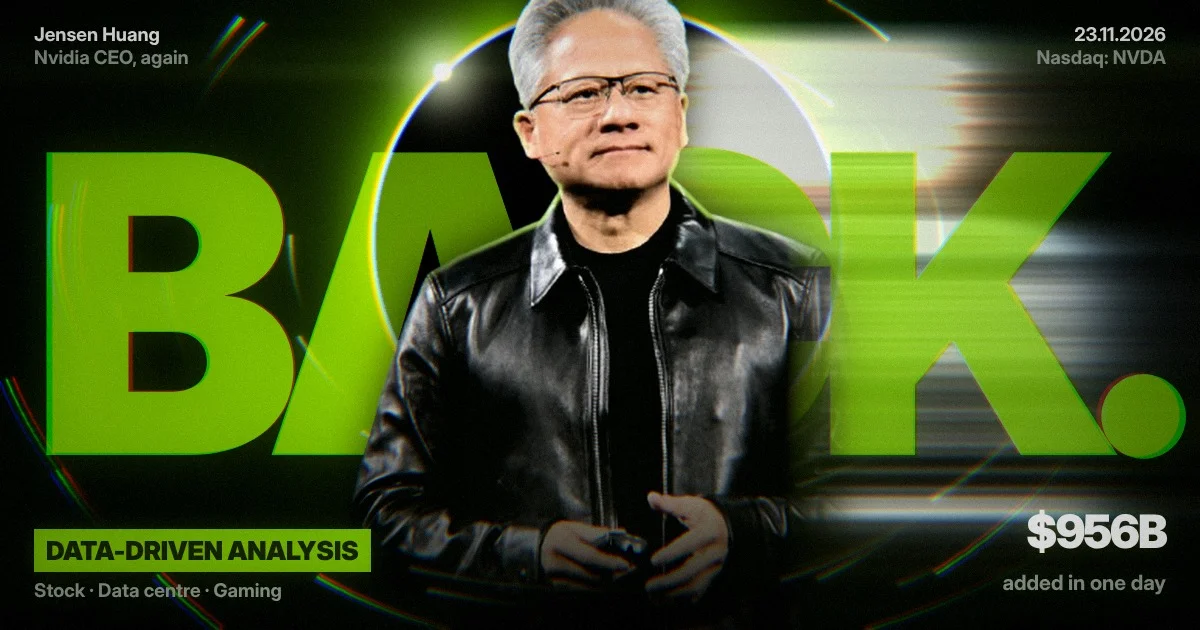
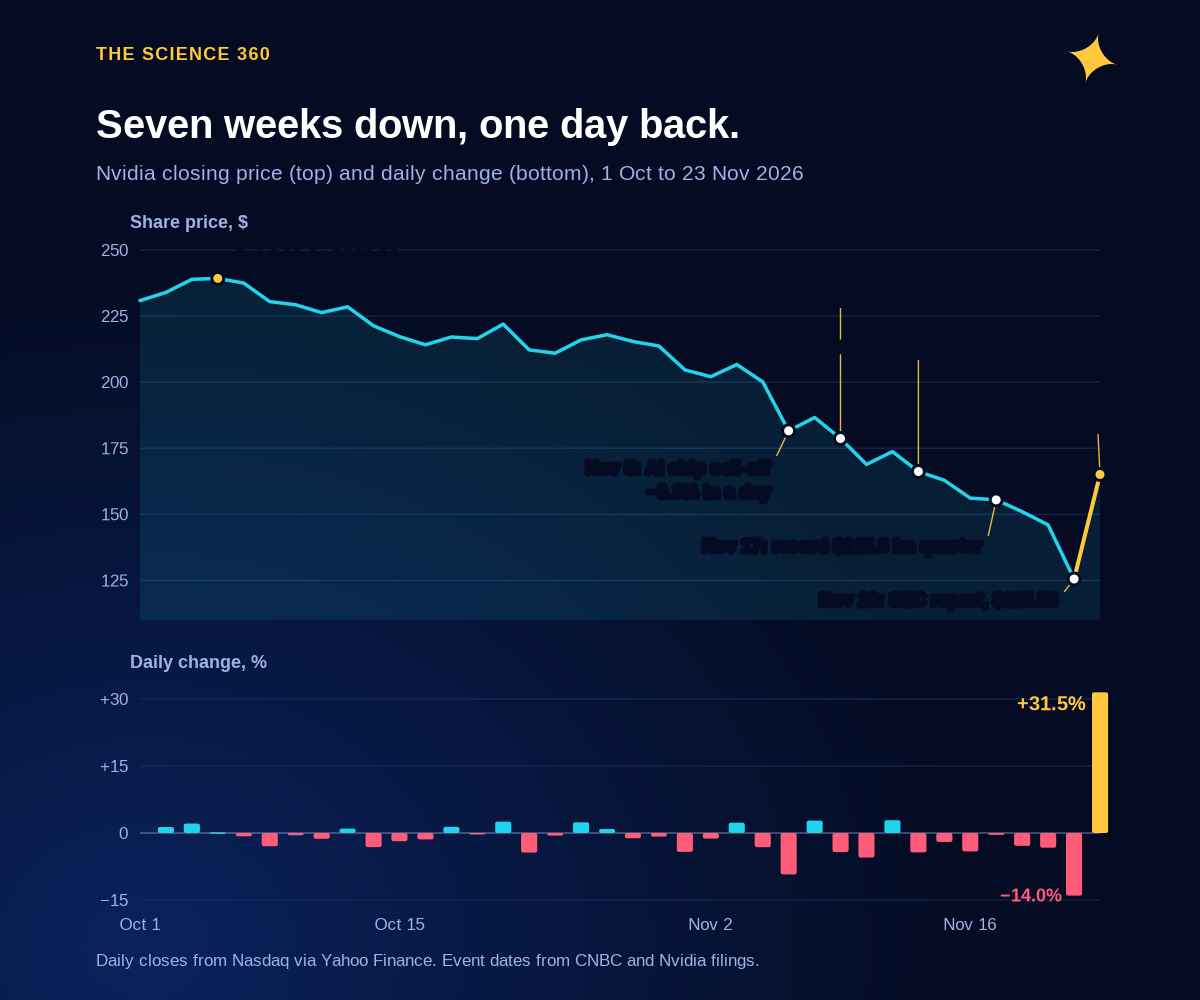
At 4 p.m. on Monday, 23 November 2026, Nvidia closed at $165.05. On Friday it had closed at $125.53. That 31.48% move, on a company that started the day worth about $3.0 trillion, is the largest one-day gain for Nvidia since 2003, when the whole company was worth less than $4 billion. The trigger was one sentence from the board: Jensen Huang, who resigned on 12 November, was reinstated as president and chief executive, effective immediately.
Most coverage stops at "stock soars". We want the numbers underneath. How much of the November crash was really about Huang, and how much was the AI trade cracking anyway? Is the business he returns to still growing, or did the stock know something the income statement does not? And what happened to the gamers who built Nvidia in the first place? Every figure below comes from Nvidia's filings, exchange closing prices or named reporting, and every model is shown so you can check it.
What happened between 8 and 23 November?
The short version, from the reporting of CNBC, Al Jazeera, Fortune and Reuters:
- Sunday 8 November. Huang told employees in a note that he had had an extramarital affair. The Financial Times reported the relationship was with Alice Huang (no relation), an executive at the Singapore cloud company Megaspeed, whom US intelligence officials reportedly believe is linked to Chinese intelligence. China has denied she is a spy. The board opened an investigation the same day.
- 11 and 12 November. The New York Times and Reuters reported further relationships with Nvidia employees. On 12 November Huang stepped down as CEO and from the board. CFO Colette Kress became interim CEO and former Synopsys CEO Harvey Jones became Nvidia's first board chair. The stock fell as much as 14% intraday and closed down 4.34%.
- 17 November. Nvidia reported a record quarter: $115.8 billion revenue, up 103%. On the call Jones said the board did not intend to reinstate Huang and had hired Heidrick & Struggles to find a permanent CEO.
- 20 November. Reuters reported that SEC enforcement staff were examining potential accounting issues. Nvidia fell 14.01% to $125.53, its seventh straight weekly loss, the longest run since 2008.
- 23 November. After what the board called "input from senior levels of the United States government", it voted unanimously to bring Huang back. President Trump said publicly that Huang "did nothing wrong". The board's own investigation, run with the law firm Wachtell, Lipton, Rosen & Katz, continues, as do inquiries by the SEC, the Justice Department and congressional committees.
How much is Jensen Huang worth to Nvidia’s stock?
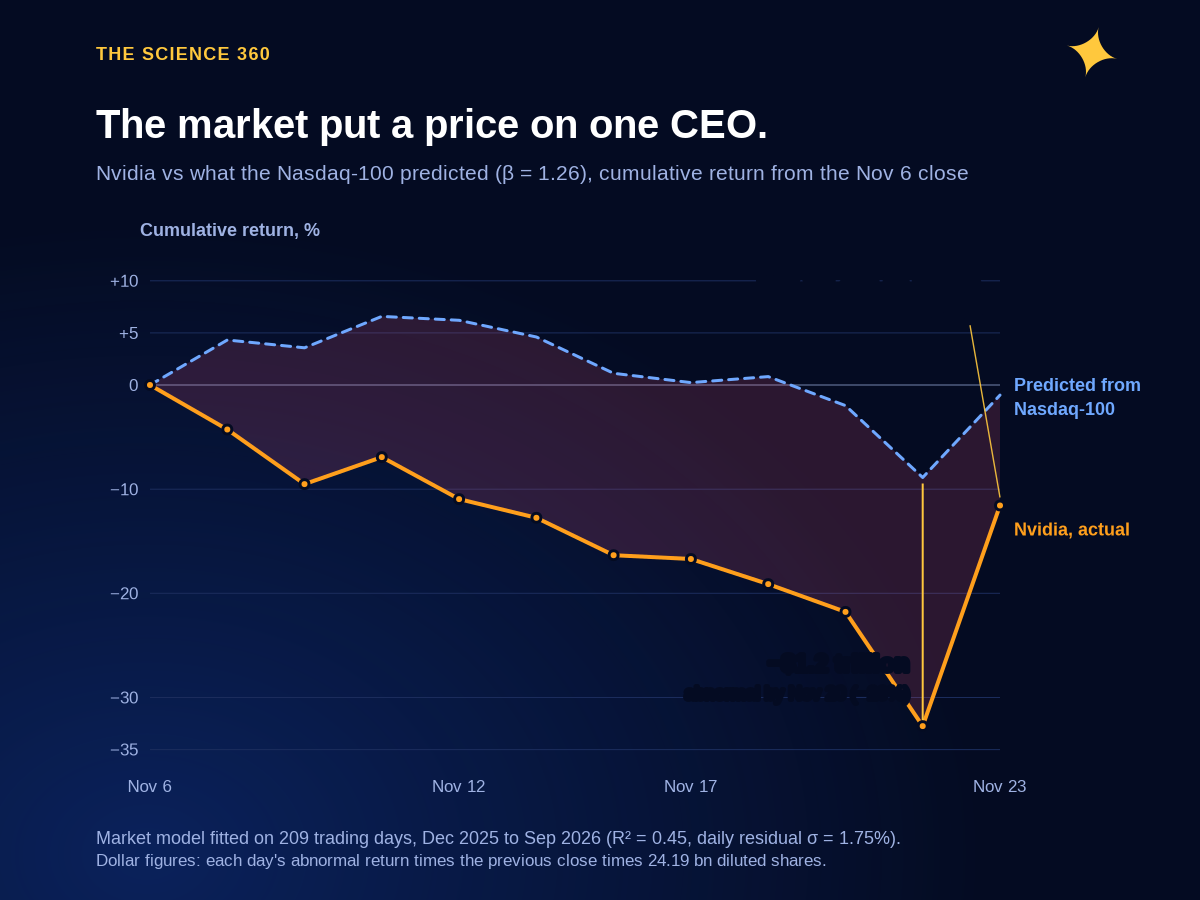
A raw price change mixes two things: news about the company and news about everything else. On 23 November the Nasdaq-100 also rose 6.86%, so not all of Nvidia's 31.5% was about Huang. The standard tool for pulling these apart is an event study, the same method finance researchers use to measure what a merger announcement or a CEO's death does to a share price.
First you learn how Nvidia normally moves with the market. We regressed Nvidia's daily return on the Nasdaq-100's daily return over 209 trading days, December 2025 to September 2026, well before any of this news:
A beta of 1.26 means that on a normal day Nvidia moves about 1.26 times as far as the index. The residual of 1.75% is the size of a typical "Nvidia-only" daily surprise. Then, for each day of the event window, the abnormal return is what actually happened minus what the market predicted, and the cumulative abnormal return (CAR) adds them up:
Nasdaq-100 return:
Predicted Nvidia return:
Actual Nvidia return:
Abnormal return:
In standard deviations:
In dollars:
A 13-sigma day is not noise. Under a normal distribution you would expect it less than once in the life of the universe, and even with the fat tails real stocks have, nothing in Nvidia's previous two years comes close. The next biggest company-specific day in the window was 9 November, the first session after Huang's note, at about 5 sigma.
Run the same arithmetic across the whole crisis and you get two numbers worth remembering:
- Going down: from the 6 November close to 20 November, the model expected Nvidia to lose 8.9% with the market. It lost 32.7%. The cumulative abnormal return was −29.2%, about $1.19 trillion of value that the market took away for Nvidia-specific reasons.
- Coming back: the single day of the reinstatement returned $0.69 trillion of abnormal value. Fortune's "$1 trillion price on Jensen Huang" uses the raw $956 billion gain, which includes about $0.27 trillion the market would have handed Nvidia anyway on a 6.9% Nasdaq day.
So a fair statement is that investors priced Jensen Huang at somewhere between $0.7 trillion and $1.2 trillion. For scale, Dan Ives of Yorkville Ives had warned before the reinstatement that Nvidia could lose as much as 30% of its value without him; the event study says the market did exactly that, then gave back about three quarters of it in one session.
Was the November crash really about Huang?
The popular story is that Nvidia lost $2.6 trillion because its CEO left. That number is real (CNBC's tally of the seven-week slide) but the cause is only partly right, and this is the most common misreading of the whole episode.
Nvidia's 52-week closing high was $239.24 on 6 October 2026. By the close on 5 November, three days before anyone outside the company knew about an affair, it was at $181.60, down 24%. Trefis attributes the 9.3% drop on 5 November to an AI chip sell-off driven by post-election fears of a data centre slowdown, after voters rejected data centre projects in ballot measures in ten states. AMD fell 17.3% that day. Nvidia was being pulled down with its whole industry.
The next week shows the separation clearly. On 9 November, the first trading day after Huang's note, the Nasdaq-100 rose 3.4% and AMD rose 13.3%. Nvidia fell 4.3%. Money did not leave AI chips; it left Nvidia, and some of it went straight to its closest rival. From 6 to 20 November, Nvidia fell 32.7% while the iShares Semiconductor ETF fell 9.6% and AMD only 5.5%.
Market value on 6 October:
Market value on 20 November:
Total fall: (CNBC, using its own share count: about $2.6 tn)
Company-specific part from 6 Nov (event study):
Everything else (sector sell-off, rates, AI spending fears):
So a little under half of the drop was about Huang and the governance mess around him. The larger half was the AI trade itself, and that half did not come back on Monday. That is the part an investor should think hardest about.
Data centre GPUs: is the business actually slowing?
Here is the strange part. While the stock lost almost half its value, the company posted the best quarter in its history. For the quarter to 25 October 2026 (Q3 of fiscal 2027), Nvidia reported:
- Revenue of $115.8 billion, up 103% year on year and 20% on the quarter, above its own $108 billion guide.
- Data Center revenue of $107.6 billion, up 110%, as Vera Rubin NVL72 racks began shipping to CoreWeave, Google Cloud, Microsoft Azure, Oracle and Nebius.
- GAAP gross margin of 74.8% and net income of $65.3 billion.
- Guidance of $130 billion ± 3% for Q4, with no data centre compute revenue from China assumed.
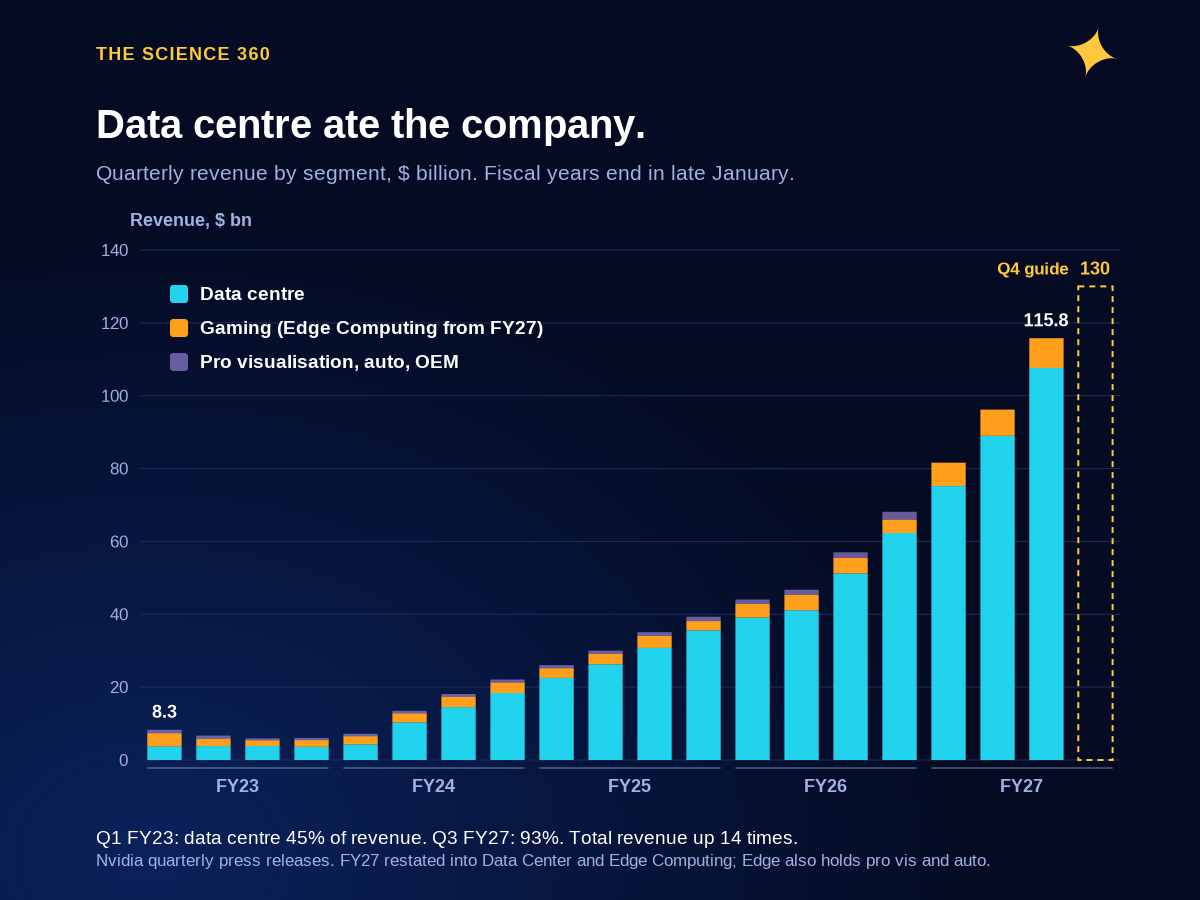
Two numbers make that scale concrete. A 13-week quarter has 91 days, so Nvidia now books more than a billion dollars a day:
In Q1 of fiscal 2023, the quarter to May 2022, total revenue was $8.29 billion, with data centre at $3.75 billion edging past gaming's $3.62 billion for the first time. Data centre was 45% of the company then. It is 93% now.
So where is the slowdown the market feared? Read the Q4 guide carefully. The $130 billion includes an extra week, because Nvidia's fiscal year has a 53rd week this time. Strip it out:
14-week guide:
13-week equivalent:
Growth on Q3:
After four quarters of 18% to 20% sequential growth, a like-for-like 4% is a real deceleration, even if part of it is conservative guiding. Gross margin is also guided down to 71% to 72%, from 74.9%. Guru3D reported that Nvidia's supply commitments jumped from $279 billion to $390 billion in one quarter, mostly expensive memory bought under long-term contracts. That is Nvidia betting very heavily that demand holds through 2027 and 2028, and paying up for HBM to make sure it can ship.
The demand side still looks strong on paper. On the August call, management said the top five hyperscalers were expected to spend nearly $800 billion on capital equipment in 2026, and interim CEO Kress projected about 75% revenue growth for fiscal 2028. The risks are concentration, the voter backlash against new data centres, custom chips from Google and others, and the "circular" deals where Nvidia invests in customers who then buy its GPUs. Kress said on the Q3 call that Nvidia would be far more selective about that kind of financing.
What happened to gaming GPUs?
If you are a PC gamer, you may have noticed that Nvidia no longer tells you how its gaming business is doing. From fiscal 2027 it reports two segments: Data Center, and Edge Computing, which bundles GeForce cards, console chips, RTX Spark laptops, workstations, robotics and cars. Edge Computing made $8.2 billion in Q3, up 42%.
The last clean gaming number is fiscal 2026: a record $16.0 billion, up 41%, on strong demand for Blackwell-generation GeForce cards. Gaming did not shrink. It just stopped mattering to the total.
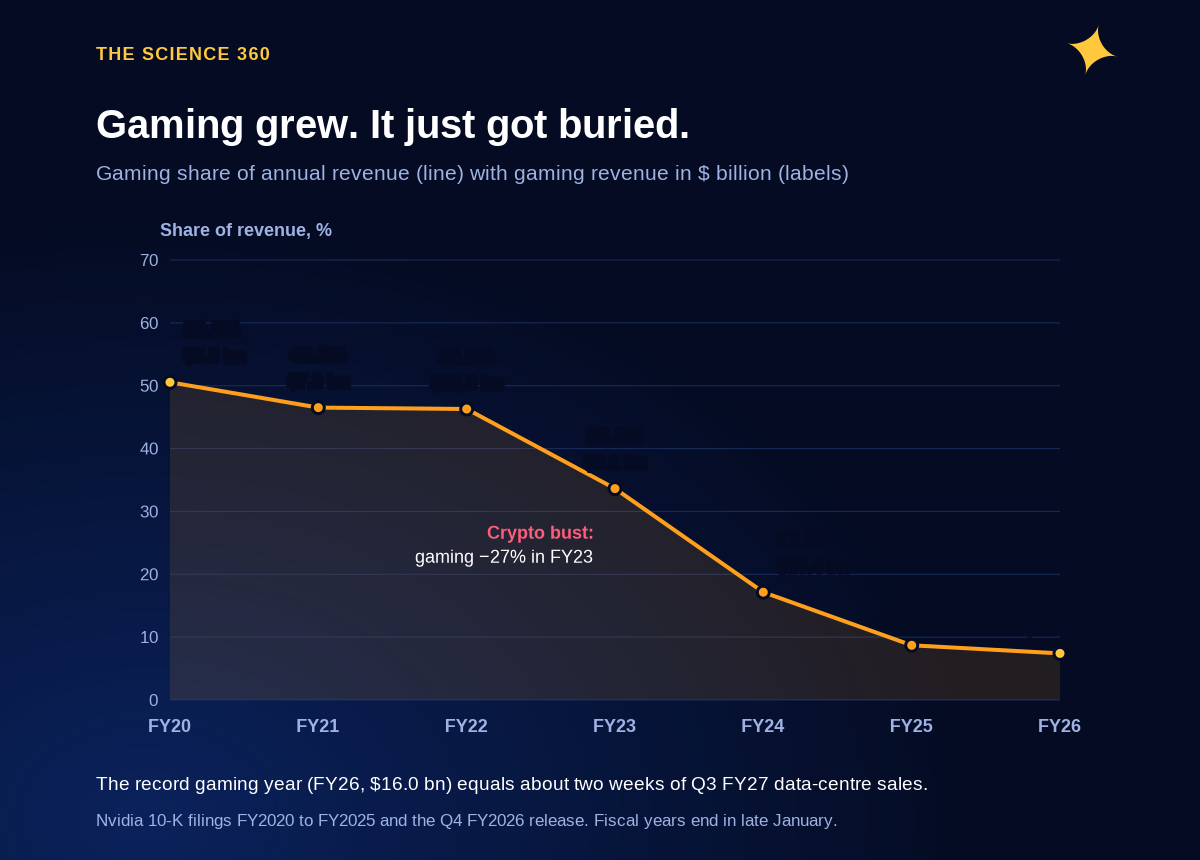
Q3 FY27 data centre revenue per week:
FY26 gaming revenue:
Equivalent:
For players, this has practical consequences. The same memory and packaging capacity that goes into a GeForce card goes into a Rubin rack that sells for far more per wafer. Guru3D reported that the RTX 5090 is still only available at inflated prices, that board partners cannot order new GB202 packages, and that a 24 GB RTX 5080 was shelved; SK hynix has said its DRAM and HBM capacity is booked into 2029. Nvidia is still investing in the software side, with DLSS 5 launching in NBA 2K27 and Hogwarts Legacy, but the economics are plain. When every wafer has a data centre buyer, gaming gets what is left.
Is Nvidia stock cheap now? A valuation model
This is where data turns into speculation, so we will keep the model simple and show every input. A company's market value is its share price times its share count, and the share price can be written as a multiple of expected earnings:
CNBC reported that at the 20 November close Nvidia traded at about 8.4 times forward earnings, while AMD traded at 29 times. Working backwards gives the forward earnings the market was using:
Q3 run rate for comparison: (non-GAAP)
Nov 23 multiple:
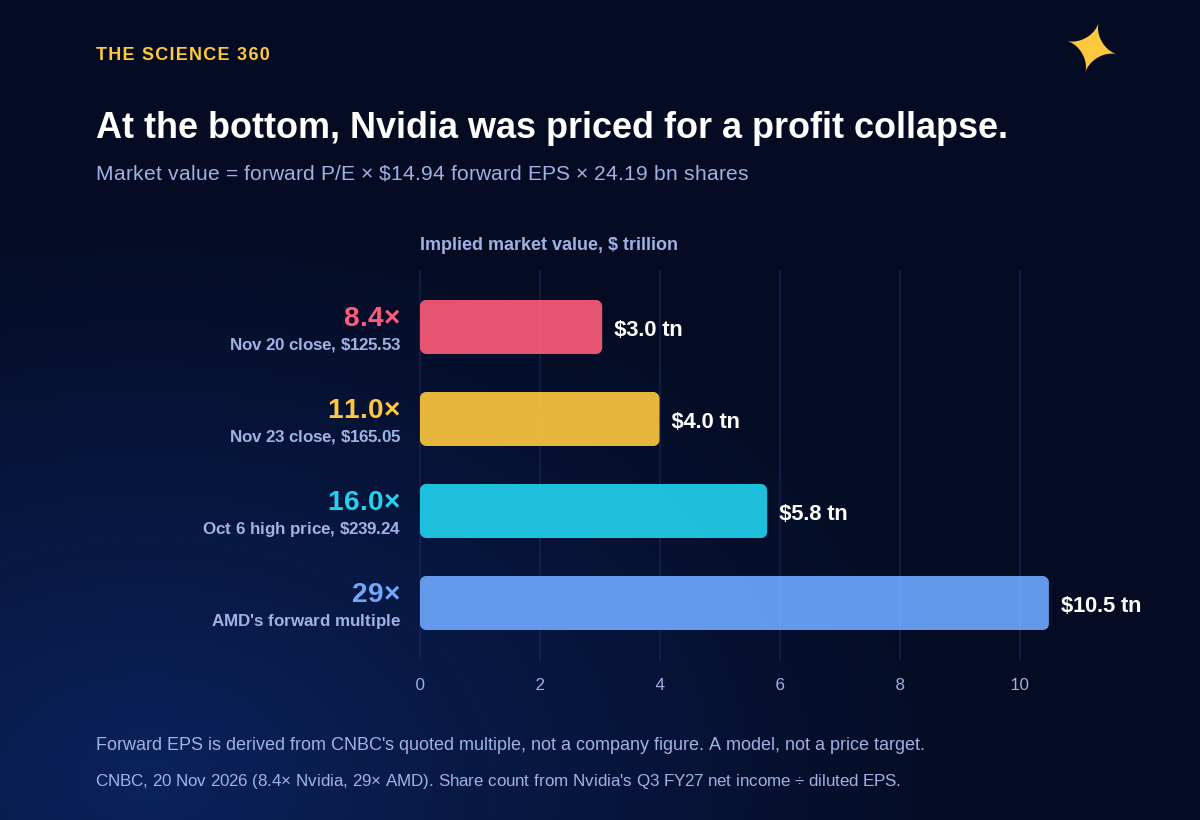
Even after Monday's jump, Nvidia sits at about 11 times forward earnings. A company growing revenue 100% a year normally trades at several times that. A multiple this low tells you the market is doing one of three things:
- Doubting the "E". If analysts' forward earnings are too high because AI capex rolls over in 2027, today's price could already be fair. A 40% earnings miss would turn 11 times into roughly 18 times.
- Charging a governance discount. The SEC accounting inquiry, the Singapore revenue questions, congressional testimony and the unfinished board investigation are all open. Our event study shows a CAR of −6.4% still outstanding after the reinstatement, about $0.5 trillion that has not come back.
- Mispricing it. If neither of the first two happens, the stock is cheap. That is the bull case, and it is exactly what the 13-sigma Monday was betting on.
What could still go wrong?
Reinstating a CEO does not close the files. These are the open items, with dates where they exist:
- SEC and accounting. Reuters reported SEC staff are examining potential accounting issues. The Financial Times reported Nvidia changed its geographic revenue reporting from billing address to customer headquarters as Singapore sales approached half of revenue, which removed Singapore from the breakdown. Reuters did not say whether that change is part of the inquiry, and investigations are not findings of wrongdoing.
- Export controls. US authorities have investigated Megaspeed since 2024 over alleged shipments of Nvidia chips to China. Huang has been one of the loudest critics of strict export rules, which is why lawmakers are focused on the relationship.
- Congress. Huang is due for a closed-door transcribed interview with House committees on 1 December, and the Senate Banking Committee says he will testify publicly on 3 December. Nvidia's general counsel is scheduled for 2 December.
- The board's own investigation. The committee's work "will proceed to conclusion", the board said. If it finds something new, the board that has now reversed itself once faces the same question again.
- Key person risk. The episode showed Nvidia has no obvious successor. Bernstein's Stacy Rasgon put it bluntly: "Jensen is Nvidia." Expect investors to push for a visible succession plan.
The Crimson Aura: how the internet covered it
No serious piece about this fortnight can skip the memes, because for a while they travelled faster than the filings. Within days the internet had rebuilt the Coldplay kiss-cam clip with Huang in it, made a foldable-phone gag, retitled a romantic comedy "500 Chips of Summer" and set a dancing Huang to Jason Derulo's "Mi Chico" in the Nvidia car park. The spelling "Jason Huang" spread with it, half typo and half joke, and in our office the running joke became that the leather jacket now comes with a crimson aura. We leaned into that on our cover image. The irony did not escape anyone: many of those clips came from generative video tools, exactly the kind of software that runs on Nvidia's data centre GPUs.
Huang himself said on his return that he would "be a better CEO the second time around". The market has given him roughly $0.7 trillion of credit for that promise in one day. The next three earnings reports will tell us whether the other half of the crash, the part that had nothing to do with him, was a mistake too.
What to watch next
- 30 November to 3 December: GTC Washington, D.C., overlapping with the congressional hearings.
- 2 December: record date for the $0.25 quarterly dividend, paid 23 December.
- Late February 2027: Q4 fiscal 2027 results. The test is whether revenue lands near $130 billion and whether like-for-like growth reaccelerates above the 4% implied by the guide.
FAQ
Is Jensen Huang back as Nvidia CEO?
Yes. Nvidia's board unanimously reinstated Jensen Huang as president and CEO, effective immediately, on 23 November 2026. He had resigned on 12 November after disclosing an extramarital affair. Colette Kress, who was interim CEO, remains CFO, and the board's independent investigation continues.
How much did Nvidia stock go up when Jensen Huang returned?
Nvidia closed at $165.05 on 23 November 2026, up 31.5% from $125.53. That was its biggest one-day gain since 2003 and added about $956 billion of market value, lifting the company back to roughly $4 trillion.
Why did Nvidia stock fall so much in November 2026?
Two things overlapped. An AI chip sell-off had already cut the stock about 24% from its 6 October high by 5 November. Then Huang's affair disclosure on 8 November, his resignation on 12 November and a 20 November report of an SEC accounting inquiry added a company-specific loss our event study puts near $1.2 trillion.
How much of Nvidia’s revenue comes from gaming now?
Gaming was a record $16.0 billion in fiscal 2026 but only 7.4% of revenue, down from about half in fiscal 2020. From fiscal 2027 Nvidia reports gaming inside Edge Computing, which made $8.2 billion in the quarter to October 2026 against $107.6 billion from data centre.
Is Nvidia stock undervalued after the Huang comeback?
On CNBC's figure of 8.4 times forward earnings at the 20 November low, the 23 November close works out to about 11 times, far below AMD's 29 times. That multiple prices in either a sharp fall in profits or lasting governance risk. It is a model, not investment advice.
This article explains market data and is not investment advice. Prices are closing prices to 23 November 2026.
Related on The Science 360
Sources
- NVIDIA, Financial Results for Third Quarter Fiscal 2027 (press release, 17 Nov 2026), SEC EDGAR
- NVIDIA, Second Quarter Fiscal 2027 results
- NVIDIA, First Quarter Fiscal 2027 results (new Data Center / Edge Computing segments)
- NVIDIA, Fourth Quarter and Fiscal 2026 results
- NVIDIA, Fourth Quarter and Fiscal 2025 results, SEC EDGAR
- NVIDIA, First Quarter Fiscal 2023 results
- NVIDIA, Form 10-K for fiscal 2023, SEC EDGAR
- CNBC, "Jensen Huang reinstated as Nvidia CEO. Stock skyrockets 31%" (23 Nov 2026)
- CNBC, "Nvidia stock closes down over 4% after CEO Jensen Huang announces resignation" (12 Nov 2026)
- CNBC, "Nvidia closes below $4T market cap for first time since July 2025" (13 Nov 2026)
- CNBC, "Nvidia stock plunges 14%, wraps up longest weekly losing streak since 2008" (20 Nov 2026)
- Fortune, "Wall Street just put a $1 trillion price on Jensen Huang" (23 Nov 2026)
- Al Jazeera, "Nvidia board reinstates Jensen Huang as CEO" (23 Nov 2026)
- Business Insider via Yahoo Finance, "Nvidia just posted its biggest single-day stock rally since 2003" (23 Nov 2026)
- Decrypt via Yahoo Finance, "Nvidia Shares Sink to 52-Week Low After Report SEC Is Probing Accounting" (20 Nov 2026)
- Trefis, "What Sent NVIDIA Stock Lower?" (6 Nov 2026)
- Guru3D, Nvidia Q3 FY2027 report (19 Nov 2026)
- Tom's Hardware, fiscal 2025 gaming revenue
- Newsweek, the Jensen Huang meme wave
- Daily closing prices for NVDA, the Nasdaq-100, SOXX and AMD, Nasdaq data via Yahoo Finance, 25 Nov 2024 to 23 Nov 2026.
Cover: The Science 360. Charts: our calculations from the sources listed.