Why Phone Charging Slows After 80%: The CC-CV Curve

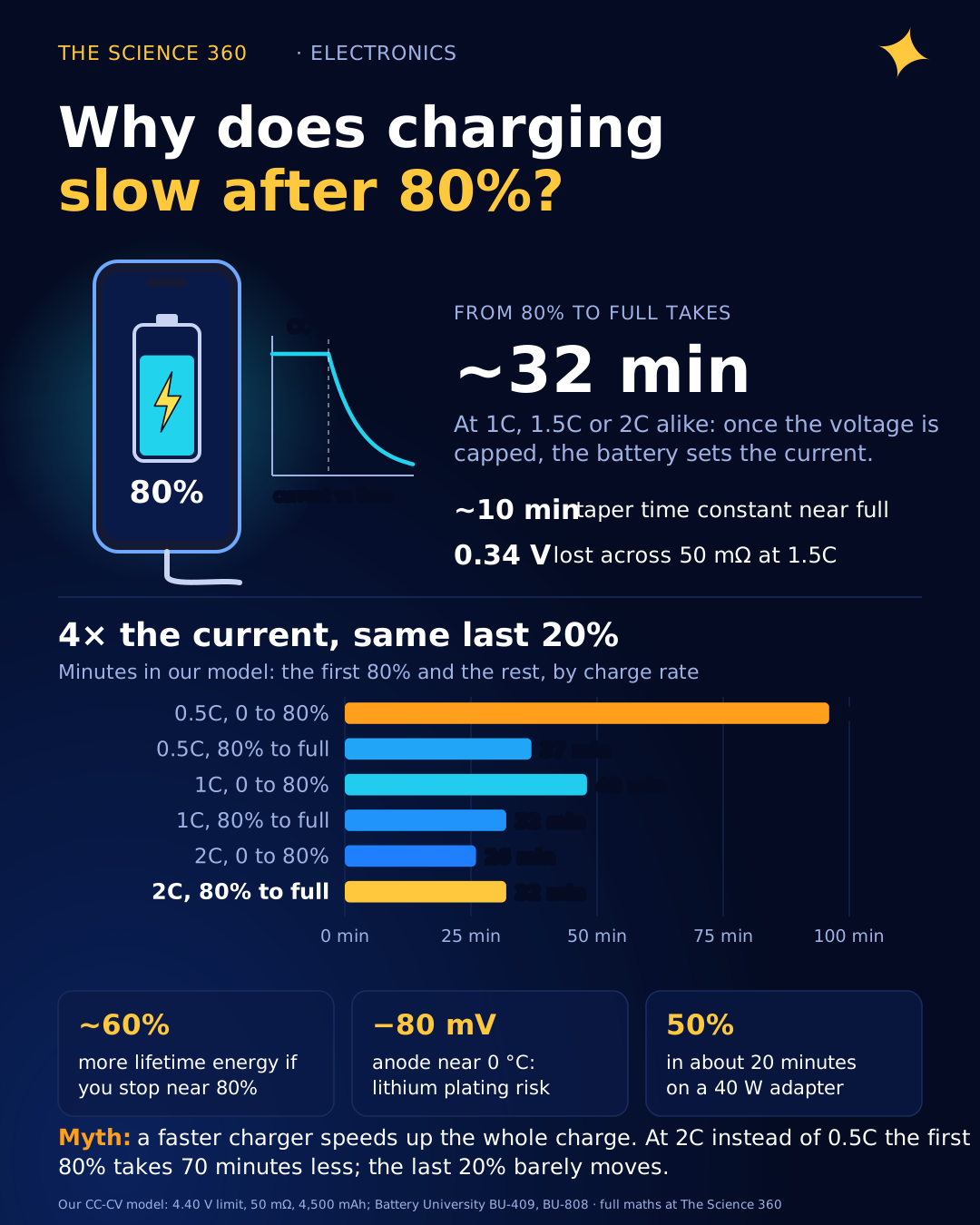
Apple says an iPhone 17 reaches 50 percent in about 20 minutes on a 40 W adapter. Nobody advertises how long the trip to 100 percent takes, and there is a reason. In the charging model I built for this post, a 4,500 mAh phone cell charging at that rate gets to 50 percent in 20 minutes, 80 percent in 33 minutes, and needs another half hour to finish. Slow the charger down to a quarter of the current and the last stretch, from 80 percent to full, takes almost exactly as long.
That last fact is the clue. The slowdown is not mainly your phone being cautious with its settings. It is what happens to any lithium-ion cell charged against a fixed voltage ceiling, and once you see why, the 80 percent number, battery wear and "optimized charging" all fall into place.
What is CC-CV charging?
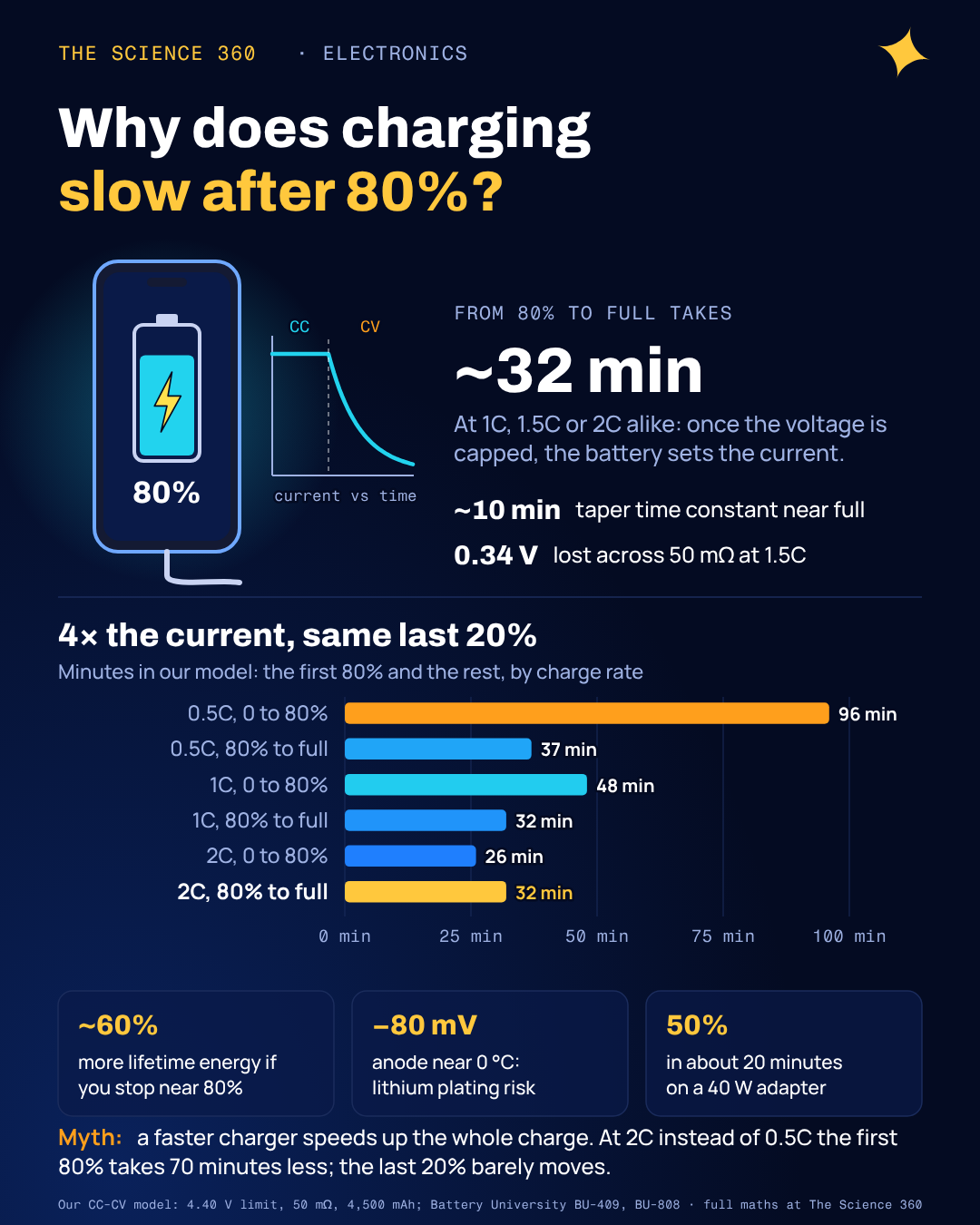
Almost every lithium-ion charger uses two stages, which Battery University describes as a constant-current stage followed by a constant-voltage "saturation" stage.
- Constant current (CC). The charger pushes a fixed current, as high as the cell and the phone's thermal design allow. The cell voltage climbs steadily as it fills.
- Constant voltage (CV). When the cell voltage hits its limit, the charger stops raising it and holds it there. From then on the battery decides how much current flows, and the answer keeps getting smaller. Charging ends when the current falls to about 3 to 5 percent of the cell's amp-hour rating.
Figure 1 shows the whole thing for a modelled phone cell at 1.5C (6.75 A into a 4,500 mAh cell, roughly 28 W, which is what a modern fast charger delivers once conversion losses are taken out).
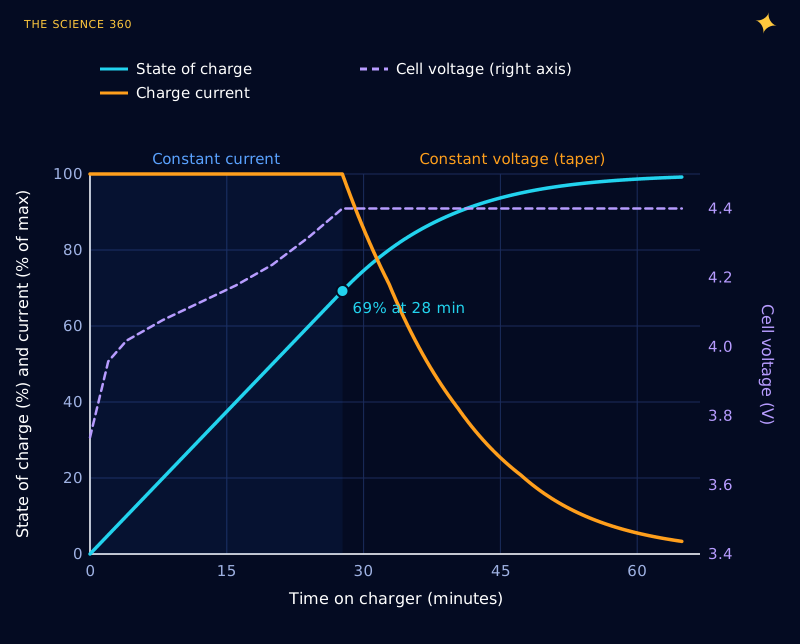
Nothing in that curve is a software decision. Once the voltage is pinned, the current has to fall, for the reason in the next section.
Why does the current fall in the constant-voltage stage?
Treat the cell as its resting voltage (which depends on how full it is) in series with a small internal resistance . Whatever voltage the charger applies, the current is set by the difference:
During CC the charger raises its voltage to keep fixed. During CV the charger voltage is fixed at the limit, so the current is simply the gap divided by . As the cell fills, rises toward the limit and the gap shrinks. Here is the worked version for our model cell (4.40 V limit, R = 50 mΩ, capacity 4.5 Ah):
When does CC end?
CV begins at that resting voltage, when the cell is about 69% full.
Current during CV
Resting voltages: about 4.16 V at 80%, 4.27 V at 90% and 4.33 V at 95%.
The taper time constant near full
Slope of near the top ≈ 0.13 V per 10% of charge:
That τ is the same idea as the time constant of a capacitor charging through a resistor: the battery behaves like a very large capacitor near the top of its range, and the current decays roughly exponentially, falling by a factor of e (to 37 percent) every 10 minutes or so. Each percent therefore takes longer than the one before. That is why the last few percent drag even on a charger with power to spare.
Notice what sets the 80 percent "knee". It is the voltage the internal resistance eats, . A bigger current wastes more voltage across , so the cell hits the limit sooner and spends longer in the taper. That leads to the most counterintuitive result in this post.
The misconception: a faster charger speeds up the whole charge
Most explanations say that fast charging "slows down near the end to protect the battery", which implies a slow charger would just do the same thing slower. Run the same model at four currents and look at Figure 2.
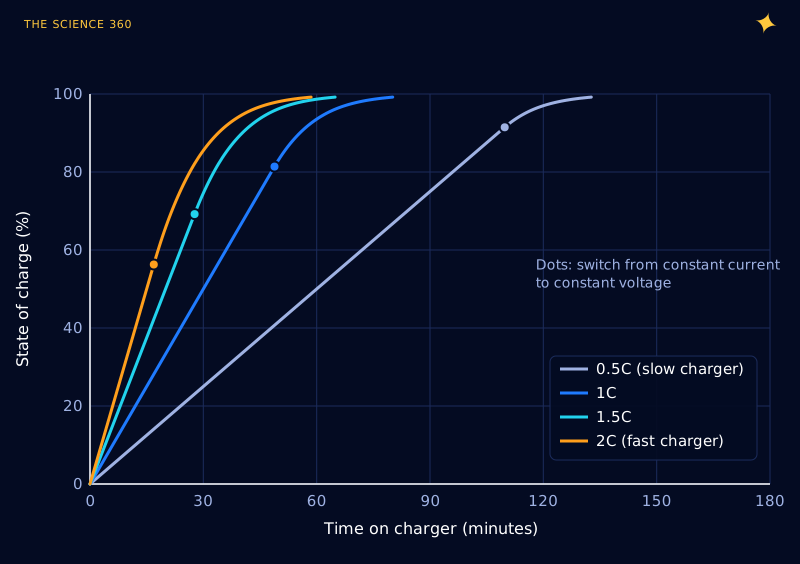
0.5C: 0 to 80% in 96 min; 80% to done in 37 min
1C: 0 to 80% in 48 min; 80% to done in 32 min
1.5C: 0 to 80% in 33 min; 80% to done in 32 min
2C: 0 to 80% in 26 min; 80% to done in 32 min
The first 80 percent scales almost perfectly with current. The last 20 percent barely changes, because in the CV stage the current is set by the battery, not the charger. Battery University makes the same point from measurements: a higher charge current fills a cell to about 70 percent quickly but lengthens the saturation stage, so it does not hasten the full charge by much. This is why phone makers advertise "50 percent in 20 minutes" and never "100 percent in 60".
Why not just push full current all the way to 100%?
Because two different parts of the cell would be damaged, and the voltage limit protects both.
The cathode and electrolyte. The voltage limit exists because a cobalt-oxide cathode becomes unstable when too much lithium is pulled out of it, and the electrolyte starts oxidising at high potentials. Battery University gives 4.20 V ± 50 mV as the classic limit for cobalt-blend cells, with high-capacity designs going to 4.30 V or higher; current phone cells typically run higher still, around 4.4 V or more, using cathode coatings and additives to cope. If the charger kept pushing constant current past the limit, the terminal voltage, and with it the stress on the cathode, would keep climbing.
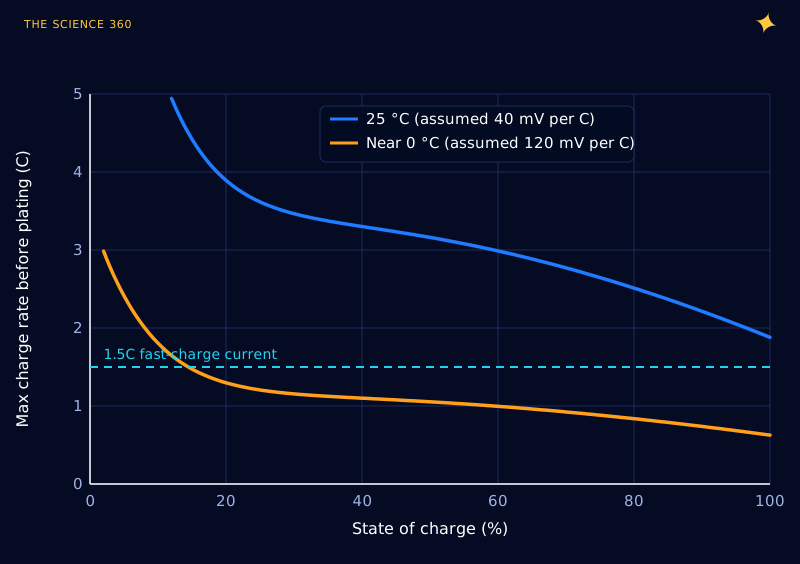
The anode, and lithium plating. This is the part most articles skip. While charging, lithium ions have to slide into the gaps between graphite layers in the anode. The graphite's potential relative to lithium metal is only about 0.1 V when the cell is nearly full, and charging current pushes it lower by an overpotential that grows with current. If it goes below 0 V versus lithium, it becomes easier for the ions to deposit as metallic lithium on the surface than to slip inside. Research groups such as the Cui group at Stanford have measured graphite potentials dropping below 0 V at higher charging rates, and NREL frames the whole challenge of very fast charging as staying ahead of plating onset. Plated lithium is permanently lost capacity, and in bad cases it grows into needles that can short the cell.
Figure 3 makes that budget visible with a simple model: the graphite's resting potential (from a widely used fit by Doyle and colleagues) divided by an assumed overpotential per unit of charge rate.
Plating margin at 80% charge, 1.5C
Graphite potential at rest ≈ 100 mV versus Li.
The arrow gives the anode potential. At 25 °C it stays safe; near 0 °C it goes below lithium, a plating risk.
This is why phones refuse to fast charge when cold, why Apple notes that fast charging might not work when the phone is too cold or too hot, and why Battery University's plainest rule is not to charge at freezing temperatures. It is also why modern phones often step the current down in several stages before the voltage limit is even reached: the safe current shrinks as the anode fills.
How much does stopping at 80% actually help the battery?
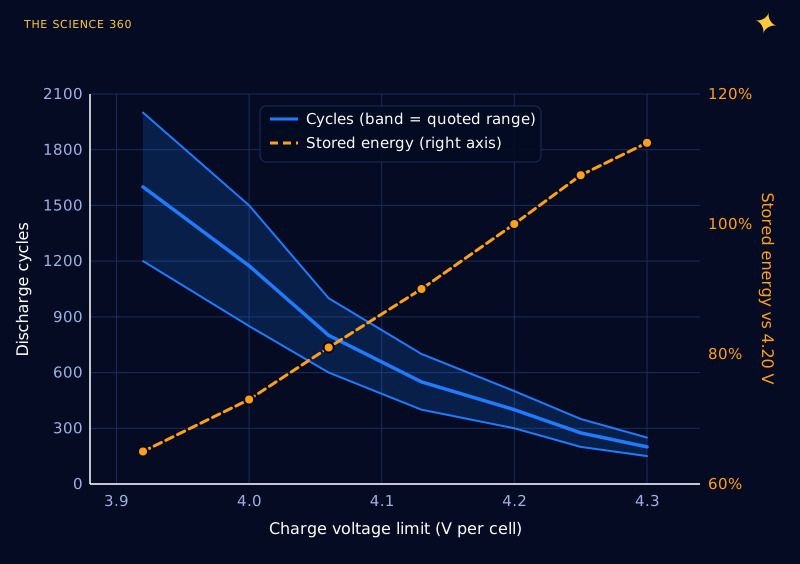
A lot, and the reason is voltage rather than percent. Battery University's table for cobalt-based cells charged to different voltage limits (Figure 4) shows the trade.
Reading the table
Full charge at 4.20 V: 300 to 500 cycles, 100% energy. Stop at 4.06 V (about 81% energy): 600 to 1,000 cycles. Using range midpoints, lifetime energy delivered in full-charge equivalents:
About 60% more.
So stopping at roughly 80 percent costs you a fifth of each day's capacity and roughly doubles the number of cycles. Time matters too: a cell parked at full voltage ages even when nobody is using it, which is why the features below focus on how long the phone sits at 100 percent.
What do optimized and adaptive charging actually do?
They exploit the curve above. Apple's Optimized Battery Charging uses on-device learning of your routine to "delay charging past 80% in certain situations", showing "Charging On Hold" while it waits, then finishes shortly before you usually unplug. Google's Adaptive Charging on Pixel does the same overnight, and many Android phones offer a fixed cap at around 80 to 85 percent. Some phones also pause when warm.
Physically, the phone is choosing to spend the night at a resting voltage near 4.1 V rather than at the limit. The charging current, the plating budget and the final capacity are unchanged; only the hours spent at the top are cut. If your phone seems to "stop at 80", check those settings before blaming the charger.
FAQ
Is it bad to charge my phone to 100%?
Not dangerous, but it ages the battery faster than stopping lower. Wear depends strongly on how high the cell voltage goes and how long it stays there. Reaching 100% occasionally is fine; sitting at 100% for many hours every night is what charge limits and optimized charging try to avoid.
Does fast charging damage the battery?
Fast charging at moderate temperature, in the low and middle state of charge range, causes little extra wear, which is why phones only charge fast there. The risky combination is high current at high state of charge or in the cold, which can plate metallic lithium on the anode. Charge controllers are designed to avoid exactly that.
Why does my phone stop charging at 80%?
Usually because a battery protection feature is on, such as Optimized Battery Charging on iPhone or Adaptive Charging on Pixel, which pauses near 80% and finishes before you normally unplug. Heat can also pause charging. A fixed charge limit setting will hold it at 80% permanently.
Why does the last 1% take so long to charge?
In the constant-voltage stage the charging current is proportional to the gap between the charger's voltage limit and the battery's own voltage. As the battery fills, that gap shrinks, so the current falls roughly exponentially and each percent takes longer than the last.
Related on The Science 360
Sources
- Apple Support, "Fast charge your iPhone" (iPhone 17: up to 50% in about 20 minutes with a 40 W adapter; fast charging may not work when too cold or hot): support.apple.com/en-us/102574
- Apple Support, "About Optimized Battery Charging" (delays charging past 80%, "Charging On Hold"): support.apple.com/en-us/102338
- Battery University, BU-409 "Charging Lithium-ion" (CC then saturation stage, 4.20 V ± 50 mV, termination at 3 to 5% of rated current, higher current lengthens saturation, do not charge at freezing): batteryuniversity.com/article/bu-409-charging-lithium-ion
- Battery University, BU-808 "How to Prolong Lithium-based Batteries" (table of cycles versus charge voltage; 0.10 V lower roughly doubles cycle life): batteryuniversity.com/article/bu-808-how-to-prolong-lithium-based-batteries
- Hansen and Cui et al., PNAS 2020 (graphite potentials below 0 V versus Li at higher charging rates; temperature and plating): web.stanford.edu/group/cui_group/papers/Hansen_Cui_PNAS_2020.pdf
- NREL, fast-charging pouch cell study (plating onset as the limit to 80% in 10 minutes): nrel.gov/docs/fy23osti/86256.pdf
- Gao et al., Joule 2021 (lithium intercalation versus plating on graphite particles): mit.edu/~bazant/papers/pdf/Gao_2021_Joule_Li_metal_graphite.pdf
- Review on lithium plating onset criteria (0 V criterion alone is inadequate), Journal of Materials Chemistry A, 2024: pubs.rsc.org/en/content/articlepdf/2024/ta/d4ta00244j
- Doyle, Newman, Gozdz, Schmutz and Tarascon, "Comparison of Modeling Predictions with Experimental Data from Plastic Lithium Ion Cells", J. Electrochem. Soc. 143, 1890 (1996), source of the graphite open-circuit potential fit: doi.org/10.1149/1.1836921
Method note: Figures 1 to 3 come from a deliberately simple model (resting voltage curve plus one resistance, 4.40 V limit, termination at 0.05C). Real phones use multi-step current profiles, temperature-dependent limits and cells with diffusion delays, so exact minutes differ by phone. The relationships, not the minutes, are the point.
Header image: NASA (image iss064e041250), regraded for this article.