How Much Power Is in a Lightning Bolt? 1.21 GW Checked
At 10:04 pm on Saturday, November 12, 1955, lightning hits the Hill Valley courthouse clock tower, runs down Doc Brown's cable, and dumps 1.21 gigawatts into a DeLorean doing 88 miles per hour. The gag works because everyone in 1985 knew a gigawatt was a ridiculous amount of power. What almost nobody checks is whether lightning is the right size of ridiculous.
The short version: it is too big, not too small. A real stroke blows straight past 1.21 GW on its way to a peak somewhere between tens of gigawatts and a few terawatts. The problem is the clock. That peak lasts for tens of millionths of a second, and if you do the circuit properly, the energy that would actually land in the car is less than its own kinetic energy at 88 mph. Here is how both halves of that sentence fall out of real measurements.
Power and energy are not the same thing
The confusion behind most "how much power is in lightning" answers is a units problem. Power is a rate, measured in watts (joules per second). Energy is an amount, measured in joules or kilowatt-hours. A camera flash and a fridge make the point: the flash capacitor dumps a few joules in a millisecond, so it briefly runs at kilowatts, while the fridge draws about 100 W all day and uses millions of joules.
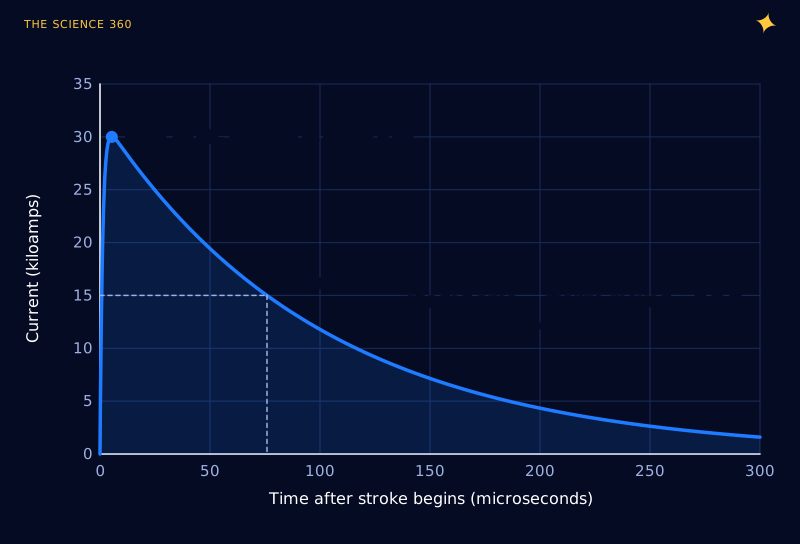
Lightning is the most extreme camera flash on Earth. Figure 1 shows what the current in a typical first return stroke looks like, using a simple double-exponential model with the median values from tower measurements: a 30 kA peak reached in about 5 microseconds, falling to half that by about 75 microseconds.
A cloud-to-ground flash usually contains several of these strokes, typically three or four, spaced tens of milliseconds apart down the same channel. That is why lightning appears to flicker. Subsequent strokes are smaller: a median of about 12 kA rather than 30 kA.
How much power is in a lightning bolt?
The number you will see quoted most often comes from multiplying the voltage by the current. NOAA's National Severe Storms Laboratory says lightning can involve 100 million to 1 billion volts, and the typical peak current is about 30,000 amps. Multiply and you get a headline figure:
Upper-bound estimate:
That is an upper bound, and here is why. The 100 MV is the potential difference between the charge region in the cloud and the ground, kilometres away. Multiplying it by the current gives the rate at which the whole electrical system (cloud, channel, branches, ground) gives up energy at the moment of peak current. It is not the power flowing past any single point you could put a cable on.
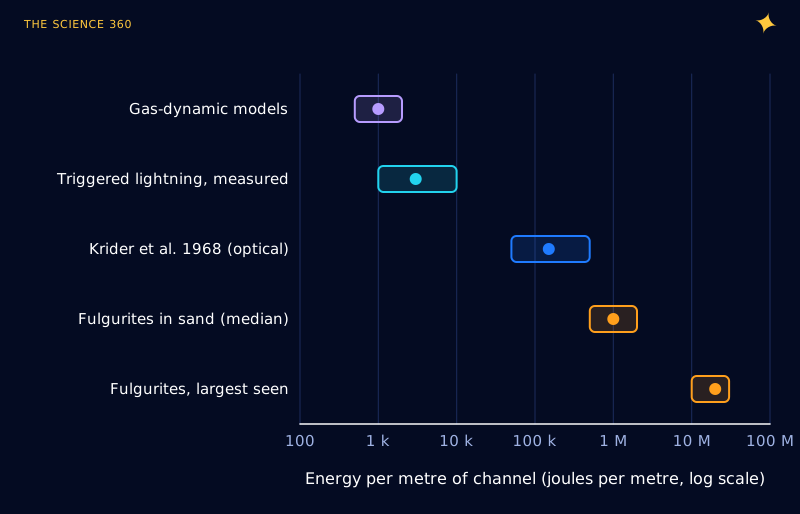
A second estimate goes through the energy actually deposited in the channel, the thin column of air that gets heated to around 30,000 °C. Here the research literature disagrees with itself by about two orders of magnitude, which almost nobody writing about this topic mentions. Gas-dynamic models of the expanding channel and direct measurements on rocket-triggered lightning point to about 103 to 104 joules per metre. An older optical estimate by Krider and colleagues (1968) came out one to two orders of magnitude higher, near 105 J/m. Figure 3, further down, shows the spread.
Channel estimate, assuming a 5 km channel and ~100 µs of strong current
Low:
High:
So the honest answer is a range: a typical stroke peaks somewhere between about 50 GW and a few TW. Even the bottom of that range is 40 times Doc's 1.21 GW. As a power, his number is not crazy. It is, if anything, modest.
How much energy is in a lightning bolt?
Energy is easier to pin down from charge and voltage. If a charge Q drops through a potential difference V, the energy released is about Q × V. From Figure 1 the first stroke moves 3.2 C. Add three subsequent strokes at roughly 0.5 C each and the flash moves about 5 C.
Energy of a whole flash:
First stroke:
Whole flash:
In kilowatt-hours:
Average US home:
of one home's electricity, per gigajoule.
That lands inside the range Wikipedia summarises from NOAA material, 200 MJ to 7 GJ per flash, and near the 1 GJ figure often used for an average negative bolt. The spread is real: flash charge varies by more than a factor of ten, and so does cloud potential. In 2019 the GRAPES-3 team in India used the drop in cosmic-ray muons passing through a storm to estimate a potential of 1.3 billion volts, about ten times the previous balloon-measured record of around 130 MV. Outside researchers called the storm model simplified, so treat it as an upper end rather than a typical value.
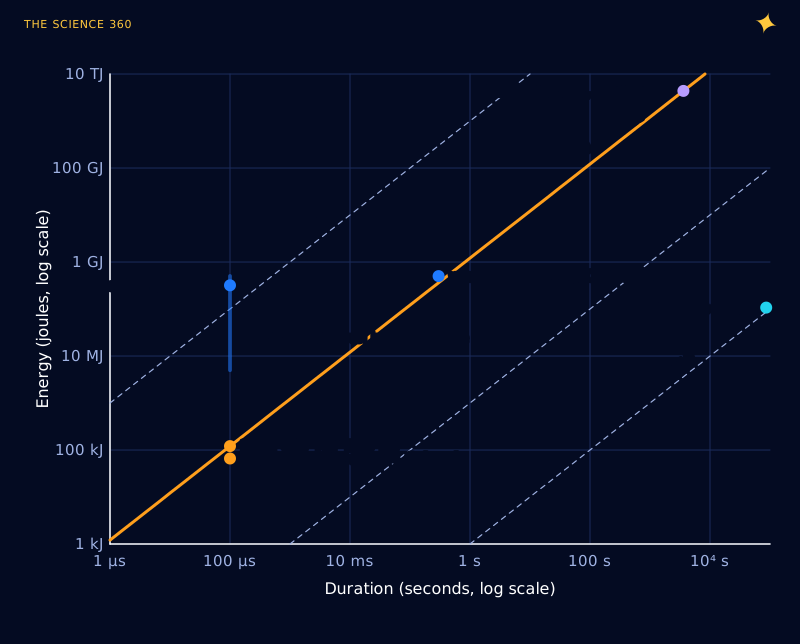
Figure 2 is the single picture worth keeping. Diagonals are constant power. A lightning stroke sits up near the terawatt line, but it sits at the far left of the chart, at 100 microseconds. A 1 GW nuclear reactor running for an hour produces about 3.6 TJ, several thousand flashes' worth.
The misconception: “one bolt could power a town”
Popular articles routinely claim a single bolt could run a small town, or "a city for a second". The arithmetic usually multiplies the 3 TW upper-bound power by something, or assumes all of a gigajoule could be stored. Both steps fail.
First, the energy is not sitting at the ground waiting for you. Most of it goes into heating and expanding the air along kilometres of channel and its branches, which is what makes thunder, and into processes inside the cloud. Fulgurites tell the story from the receiving end. When Pasek and Hurst measured 266 fulgurites (glass tubes fused by lightning in Florida quartz sand), the energy per metre deposited in the sand had a geometric mean of about 1 MJ/m, with the largest above 20 MJ/m. That is energy delivered to a metre or so of ground, not the whole flash, and it is gone the instant it melts the sand.
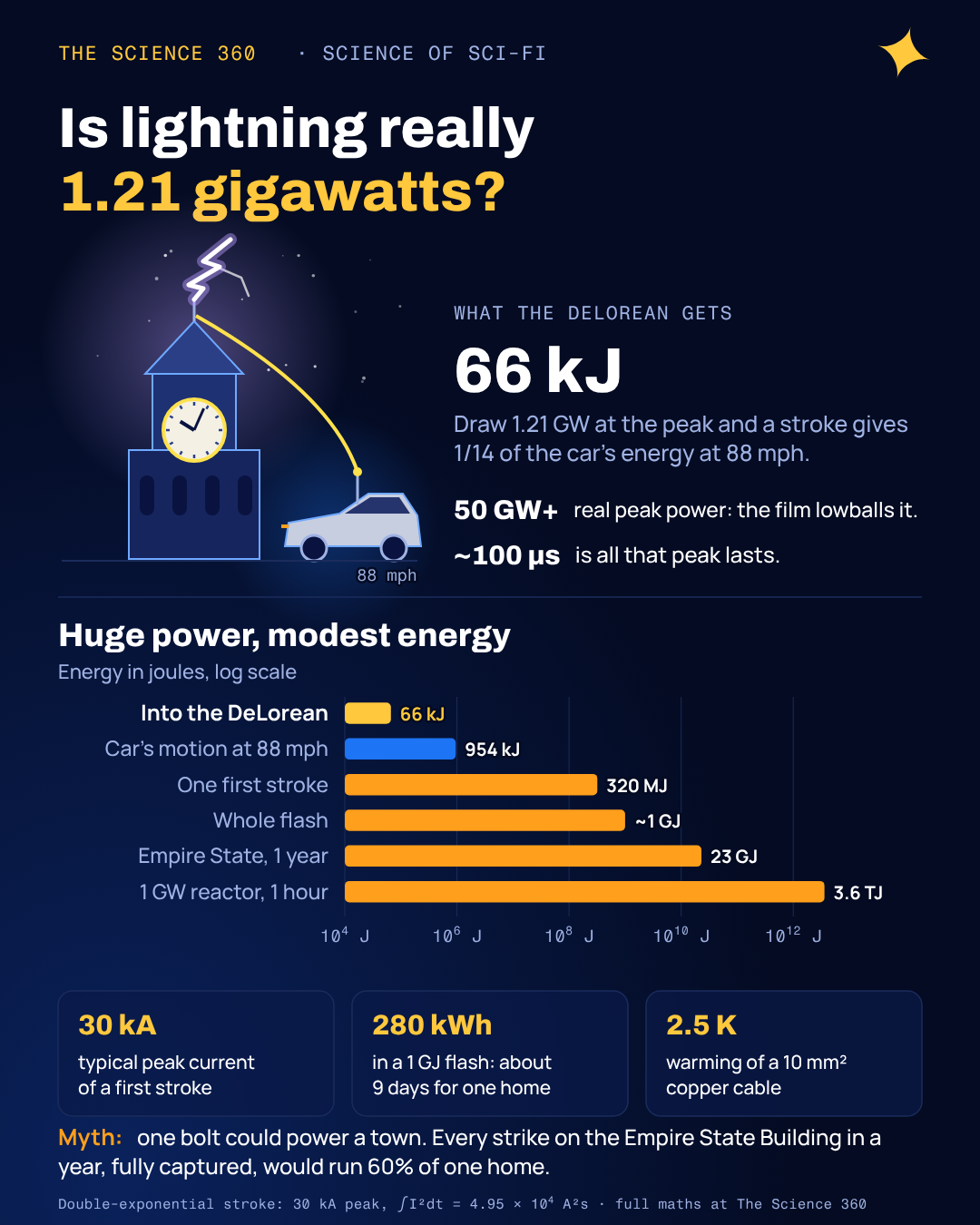
Second, you cannot pick the spot. Lightning strikes the same tall structures repeatedly, and the Empire State Building is the classic case, hit about 23 times a year on average. Give it a perfect lightning harvester:
Best-case harvest at the Empire State Building
Average US home: 10,791 kWh per year. Result: 60% of one house, assuming 100% capture, which is impossible.
Scale it up to the whole planet and the picture does not improve. Satellites count about 44 flashes per second worldwide, most of them inside clouds. At 1 GJ each that is about 44 GW averaged over the globe, compared with an average world electricity demand of roughly 3.4 TW (about 30,000 TWh a year). All the lightning on Earth, perfectly captured, would be around 1% of our electricity, scattered across every continent and ocean in microsecond bursts.
Would Doc’s cable survive the strike?
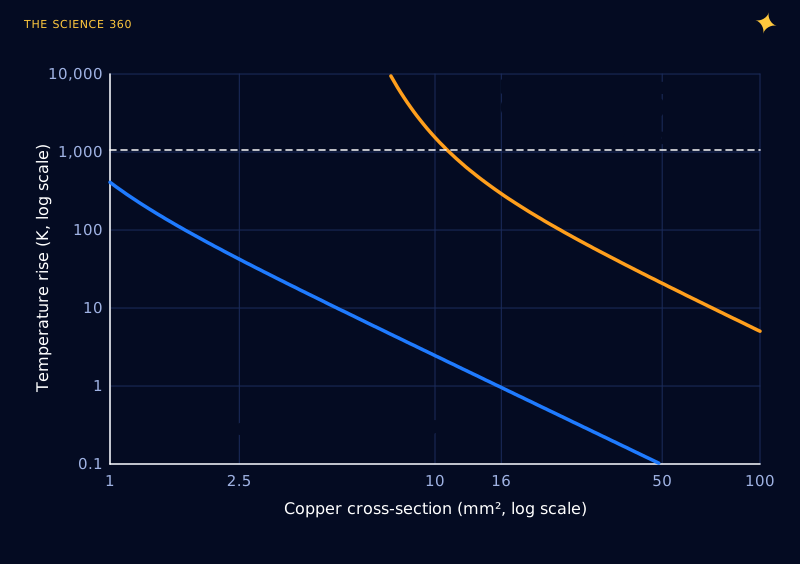
Here the film does better than you might expect. A conductor heats up according to the integral of current squared over time (the action integral, also called specific energy), not according to the cloud's voltage. For our median first stroke that integral is about 5 × 10⁴ A²s. Assuming no heat escapes during the strike, a copper wire of cross-section A warms by:
Temperature rise of a copper conductor (adiabatic, constant resistivity)
For :
A median stroke barely warms a 10 mm² copper cable. Lightning protection standards design for rarer, nastier events. IEC 62305 sizes its level I protection for a first positive stroke of 200 kA with a specific energy of 10 MJ/Ω (107 A²s). Including copper's rising resistance as it heats, that stroke melts a 10 mm² conductor but warms a 50 mm² one by only about 20 K, which is why down conductors look like thick cable rather than wire.
So how much of the bolt would reach the DeLorean?
This is the part the movie hand-waves, and it is the most interesting calculation. Lightning behaves like a current source: tens of kiloamps pushed by a huge voltage through a channel with an impedance of hundreds to thousands of ohms. Drop a load of a few ohms into that circuit and the current hardly changes. So the power the load receives is set by its own resistance, , not by the cloud's 100 MV.
What resistance would the time machine need to absorb exactly 1.21 GW at the 30 kA peak?
Step 1. Load resistance for 1.21 GW at 30 kA
Voltage across it at peak:
Step 2. Energy it absorbs over the whole stroke
Step 3. Compare with the car itself
88 mph = 39.3 m/s; stock DeLorean curb weight 1,233 kg:
That is the punchline. Design the flux capacitor to draw Doc's 1.21 GW at peak and the lightning delivers 66 kJ, about one fourteenth of the energy the car already carries just from driving at 88 mph. The 1.21 GW is only reached for a few microseconds around the peak; for most of the 76 microseconds to half value, the load sees less. In that time the car moves about 3 mm, so at least the timing on the hook is forgiving once the strike happens.
You could draw more by raising R, but there is a ceiling. Raise the load toward the channel impedance and the current starts to fall, and the most you can ever extract is a share of the energy the stroke spends heating the channel, which Figure 3 says is somewhere around 5 to 500 MJ. Even the optimistic end, delivered in 100 microseconds, means building a capacitor bank or inductor that can swallow hundreds of megajoules at tens of kilovolts in a time shorter than a camera shutter. Nobody builds that for a reason.
Why 1.21 gigawatts was a good movie number
Whatever the writers' reasoning, the scale is well chosen. A 1955 inventor could not buy or build a gigawatt, because a gigawatt is the output of a large power station: a typical commercial reactor produces about a gigawatt of electricity. The number also keeps the story honest in a way the writers may not have intended. Doc never says he needs 1.21 GW for an hour; he needs that power, briefly, at the moment the car hits 88. Lightning provides power in that form and essentially nothing else does. Where the film cheats is in the energy bookkeeping, and that is a forgivable cheat for a story about a plutonium-powered sports car.
FAQ
Is a lightning bolt really 1.21 gigawatts?
No single number fits, but 1.21 gigawatts is on the low side. Peak power in a typical cloud-to-ground stroke is somewhere between tens of gigawatts and a few terawatts, depending on how you estimate it. The catch is that the peak lasts only tens of microseconds, so the energy is modest.
How much energy is in a lightning bolt in kWh?
Published estimates for a whole flash run from about 200 megajoules to 7 gigajoules, with 1 gigajoule a common round figure. One gigajoule is about 280 kWh, which is roughly nine days of electricity for an average US home, and most of it is spent heating the air along the channel rather than reaching the ground.
Could we harness lightning to power homes?
Not usefully. Even the Empire State Building, struck about 23 times a year, would collect roughly 23 GJ a year if it captured every joule of every flash, which is about 6,400 kWh and less than one average US home uses. In practice only a small fraction of the energy is available at the strike point.
How many volts and amps are in a lightning bolt?
A typical negative cloud-to-ground first stroke peaks at about 30,000 amps, and the cloud sits at a potential of order 100 million volts relative to the ground, with one muon-based estimate reaching 1.3 billion volts. Multiplying the two gives an upper bound on power, not the power you could catch.
Why does Doc Brown say jigowatts?
The script spells it that way and the line stuck. Both pronunciations of the giga prefix have been used, but the modern standard pronunciation starts with a hard g. Physically it is the same unit: one billion watts.
Sources
- NOAA National Severe Storms Laboratory, Lightning FAQ (100 million to 1 billion volts, billions of watts, channel temperature): nssl.noaa.gov/education/svrwx101/lightning/faq/
- Wikipedia, "Lightning" (30 kA typical negative stroke, 200 MJ to 7 GJ per flash, 44 flashes per second globally): en.wikipedia.org/wiki/Lightning
- V. A. Rakov, "The Physics of Lightning", Surveys in Geophysics 34 (2013), energy per unit length from gas-dynamic models versus Krider et al. (1968): doi.org/10.1007/s10712-013-9230-6
- M. Pasek and M. Hurst, "A Fossilized Energy Distribution of Lightning", Scientific Reports 6, 30586 (2016), via USF summary: pure.lib.usf.edu and news release eurekalert.org/news-releases/613967
- APS Physics, on the GRAPES-3 1.3 GV thunderstorm potential (Phys. Rev. Lett. 2019): physics.aps.org/articles/v12/29 and Physics World: physicsworld.com
- Median first and subsequent stroke peak currents (30 kA and 12 kA, Berger et al. data): "Statistical Distributions of Lightning Parameters with Emphasis on their Extremely High Values", Elektrichestvo
- IEC 62305-1 lightning protection level parameters (200 kA, 10 MJ/Ω for LPL I), as tabulated in a manufacturer's guide: resources.ipd.com.au lightning protection guide, p. 24
- US Energy Information Administration, average residential electricity use (10,791 kWh in 2022): eia.gov/tools/faqs/faq.php?id=97
- CBS New York, lightning and the Empire State Building (about 23 strikes per year): cbsnews.com
- Wikipedia, "DMC DeLorean" (curb weight 1,233 kg): en.wikipedia.org/wiki/DMC_DeLorean
- Back to the Future fan wiki, minute-by-minute timeline (clock tower strike at 10:04 pm, November 12, 1955): backtothefuture.fandom.com
Method note: the stroke waveform is a double-exponential model matched to median peak current, rise time and time to half value; the energy figures use E ≈ QV with an assumed 100 MV cloud potential and a 5 km channel. Real flashes vary by an order of magnitude in both directions.
Header image: lightning at Launch Pad 39B, NASA Kennedy Space Center, 10 June 2022, regraded for this article.