Could a Nuke Stop an Asteroid? Armageddon vs DART Math
On 26 September 2022 a 580 kg spacecraft hit a 151 m asteroid at 6.14 km/s and changed its speed by 2.7 millimetres per second. That is slower than a garden snail. It was also the most successful planetary defence test in history, and it explains better than any movie why the plan in Armageddon could never work: moving a rock is all about time, and almost not at all about bang.
In the 1998 film a Texas-sized asteroid, about 1,000 km across, is spotted 18 days before impact. A drilling crew plants a nuclear bomb deep inside it, the asteroid splits in two, and both halves sail past Earth. We can run every step of that with real numbers. The film's bomb falls short by more than eight orders of magnitude, and the reason is not the one usually given.
How big a target is Earth, really?
Before asking how hard to push an asteroid, we need to know how far it has to move. The obvious answer, "one Earth radius", is wrong. Earth's gravity bends incoming objects toward it, so it catches things that would otherwise have passed by. Astronomers call this gravitational focusing, and it makes Earth's effective target radius:
, , approach speed (about the film's 22,000 mph)
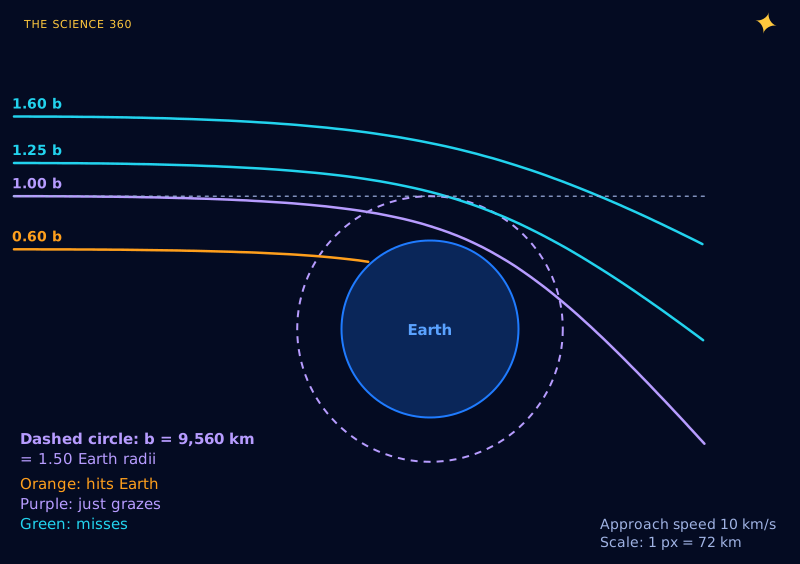
So an asteroid aimed at Earth's centre has to be shifted by about 9,600 km to miss. Slower asteroids are even worse, because gravity has longer to bend them in.
How much push does it take to make an asteroid miss?
There are two ways to cover that 9,600 km, and the difference between them is the most important idea in planetary defence.
Push it sideways, late. If you only have days, you give the asteroid a sideways velocity and wait. The displacement is just speed times time, so .
Change its orbit, early. If you have years, you speed it up or slow it down along its orbit. That changes its orbital period by a tiny amount, and the timing error builds up with every lap around the Sun. Ahrens and Harris showed in 1992 that an along-track push grows into a displacement of about 3Δv·t, three times better than a sideways shove and compounding with time.
Required to shift arrival by
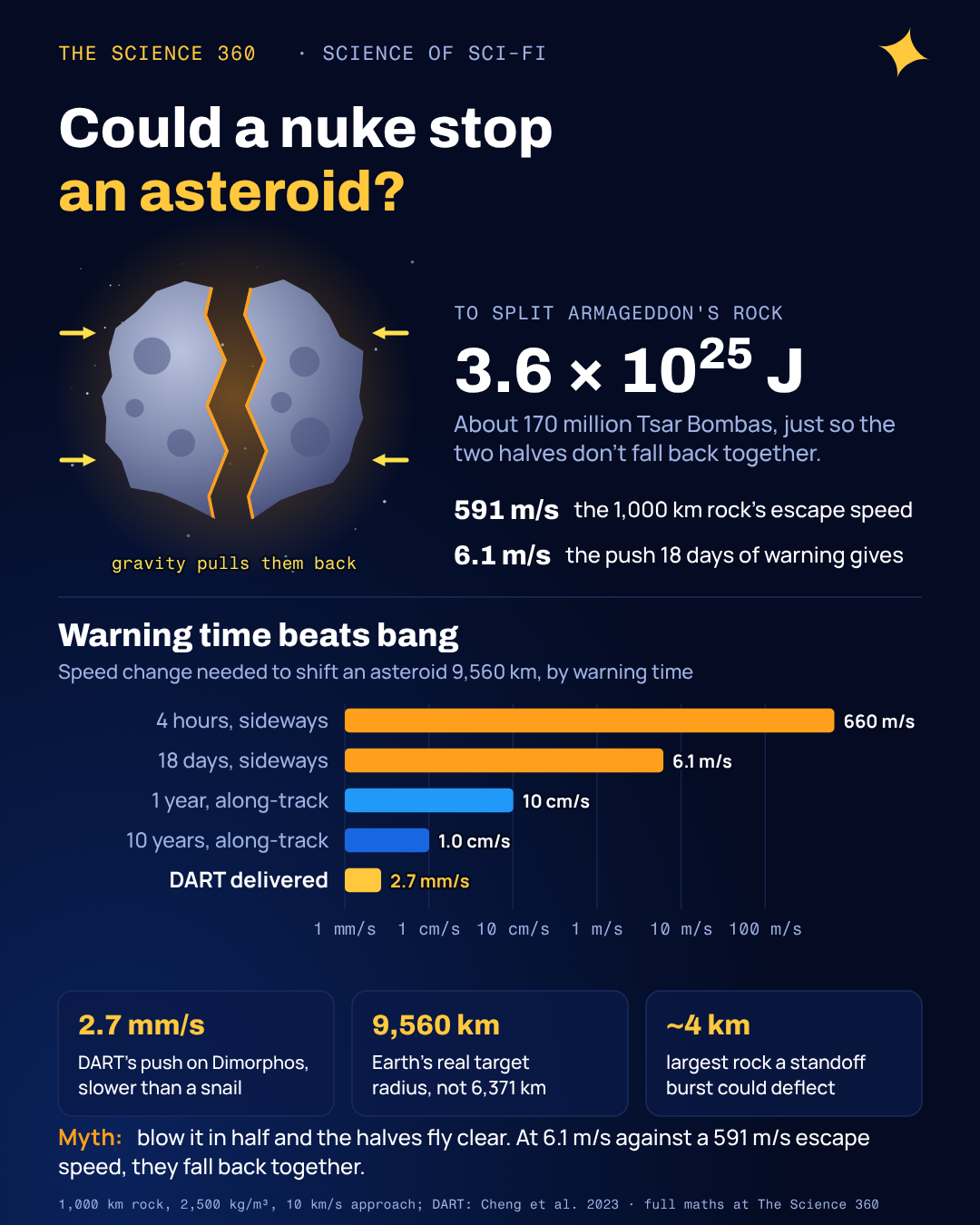
4 hours, sideways:
18 days, sideways:
1 year, along-track:
10 years, along-track:
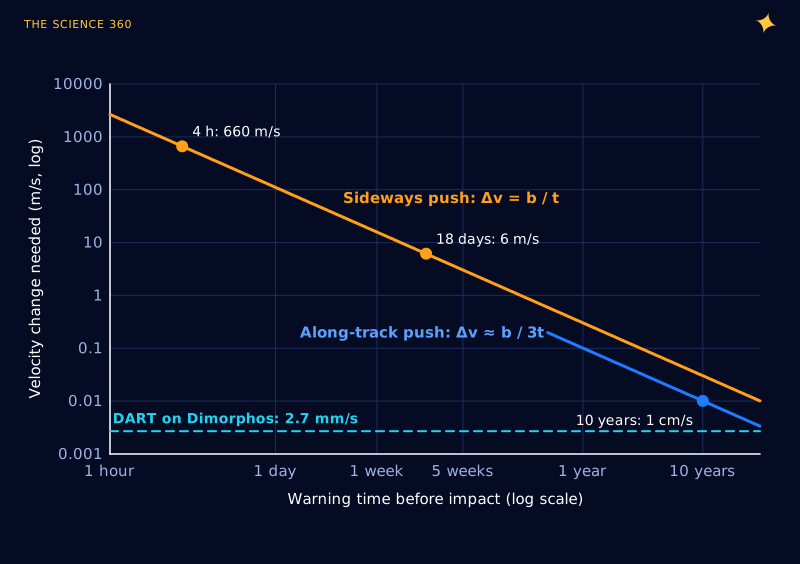
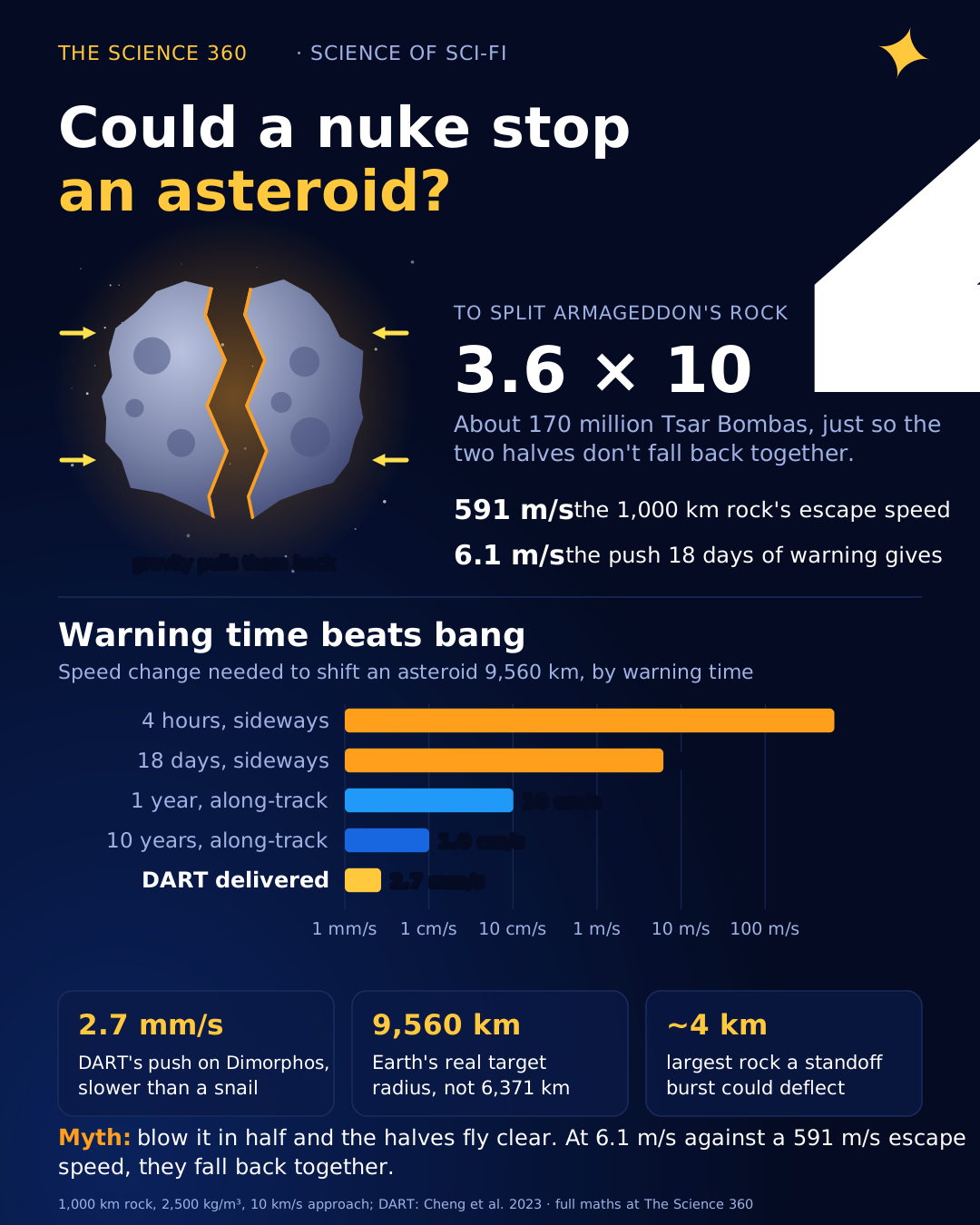
Look at where DART sits on that chart. Its 2.7 mm/s is close to what you would need with a few decades of warning. That is the real lesson of the mission: with enough lead time, a modest spacecraft is enough.
What did DART actually measure?
Dimorphos orbits a larger asteroid, Didymos, every 11 hours 55 minutes. That made it a perfect test: instead of trying to measure a tiny change in an orbit around the Sun, astronomers could time the moonlet's orbit with telescopes on Earth. After the impact, the period dropped by about 32 minutes (later refined to about 33).
From that period change, Cheng and colleagues derived a 2.70 ± 0.10 mm/s cut in Dimorphos's along-track speed. The interesting part is how much bigger that is than the spacecraft alone could manage:
Momentum check
DART:
Dimorphos (mass , assumed density 2,400 kg/m³):
Ratio (the paper's full geometry gives , range 2.2 to 4.9 depending on the true mass)
The extra push came from debris. DART blasted out a plume of rock, and that ejecta flying off in one direction shoved the asteroid in the other, like a rocket exhaust. The momentum enhancement factor, β, is what mission planners care about most, and DART's value of more than 3 means ejecta did most of the work.
Now scale it up. A DART-class impactor gives a velocity change inversely proportional to the target's mass, which goes as diameter cubed.
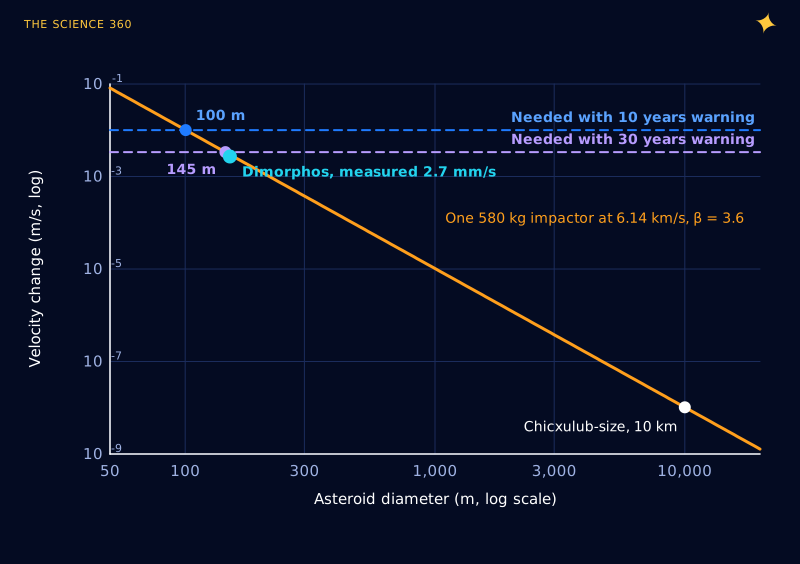
This is where nuclear devices come back into the story, legitimately. Above a few hundred metres, or with short warning, a kinetic impactor simply cannot carry enough momentum.
How would a nuclear deflection actually work?
Not the way Armageddon shows it. The realistic concept is a standoff burst: detonate the device some distance from the surface. In space there is no air to carry a blast wave, so most of the energy arrives as X-rays and neutrons, which soak into the top few centimetres of rock and flash it to vapor. That vapor expands away from the surface and pushes the asteroid the other way, the same rocket effect as DART's ejecta but spread over a whole hemisphere.
In 2024 a Sandia team led by Nathan Moore tested this on the Z machine, hitting 12 mm mock asteroids of quartz and fused silica with an intense X-ray pulse. The targets were pushed off at around 70 m/s. Scaling the result up, the authors estimated that this mechanism could deflect asteroids of up to about 4 ± 1 km across. That is a model extrapolation, not a test on a real asteroid, and it depends on the asteroid's composition.
Disruption, the Armageddon approach, is also on the table for small bodies. Simulations by Patrick King and colleagues in 2021 found that a 1 megaton device detonated next to a 100 m asteroid two months before impact could cut the mass reaching Earth by a factor of about a thousand, because the fragments spread out along the orbit before arrival. That works because a 100 m rubble pile is barely held together by its own gravity. Our next calculation shows what happens when that stops being true.
Could Armageddon’s bomb split the asteroid in half?
Here is the part most write-ups skip. A 1,000 km asteroid is not a rock. It is a small world, larger than the dwarf planet Ceres (about 940 km), and it has real gravity. Split it and the two halves attract each other.
Step 1. Mass (diameter 1,000 km, assumed rock density 2,500 kg/m³)
Step 2. Its own escape speed
Step 3. Energy to separate two halves
Model each half as a sphere of mass , radius , touching:
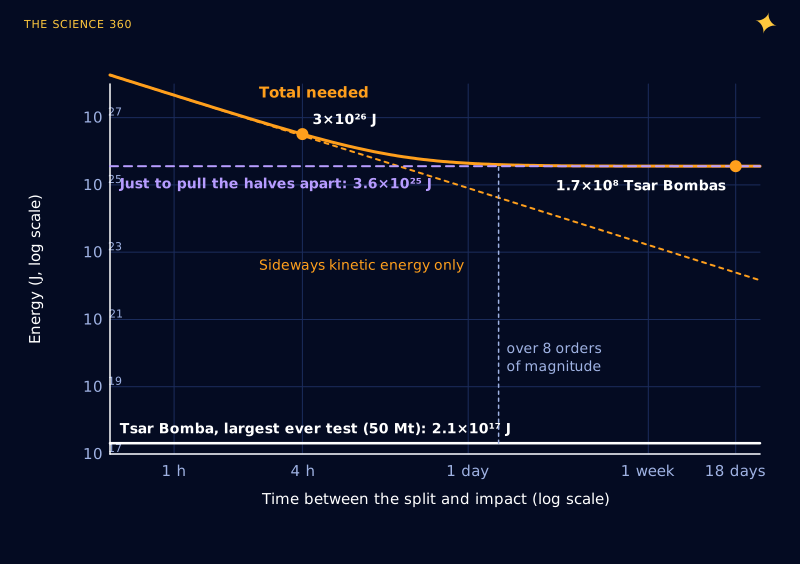
Now the comparison with the film's requirement. Even if the bomb had gone off the moment the asteroid was discovered, 18 days out, each half only needs to drift sideways at 6.1 m/s. But 6.1 m/s is a hundred times less than the escape speed of 591 m/s. Two halves pushed apart that gently would slow, stop and fall back into each other within hours, re-forming one lumpy asteroid still on course for Earth.
Step 4. Compare with the biggest bomb ever
Tsar Bomba, 1961, about 50 Mt:
Split 18 days out:
Split 4 hours out:
A team of University of Leicester students did a version of this calculation in 2011 and got 800 trillion terajoules (8 × 1026 J), which sits close to our late-split curve. Their framing was that a bomb would need to be about two billion times bigger than anything ever tested. The figure is the same order of magnitude whichever way you set up the geometry. What our version adds is the floor: even with all 18 days, the asteroid's own gravity demands more than eight orders of magnitude beyond the Tsar Bomba.
And all that assumes every joule goes into neatly separating two clean halves. A bomb buried at the film's 800 feet, about 240 m, is buried to 0.05% of the asteroid's radius. It would dig a crater and heat some rock. The other 99.9% of the asteroid would not notice.
Would we really get only 18 days of warning?
Not for anything like this. A 1,000 km object would be one of the largest bodies in the inner Solar System and visible in small telescopes long before it got close. NASA's surveys estimate they have already found more than 90% of near-Earth asteroids 1 km and larger, and none of them is on a collision course for at least the next century. The objects that could still surprise us are the small ones, tens to hundreds of metres across. Those are exactly the size range where DART-style impactors and standoff nuclear bursts are credible.
The film's asteroid, if it existed, would hit with , roughly 150,000 Chicxulub impacts. At that point no plan exists, and the honest physics answer is the one the screenplay avoids.
Deflect or disrupt: which is the better plan?
The planetary defence community's order of preference, from the numbers above, is roughly this:
- Decades of warning, under a few hundred metres: kinetic impactor, possibly several. DART proved it works, and β of 3 or more makes it more effective than once thought.
- Years of warning, larger bodies: standoff nuclear burst for deflection, keeping the asteroid in one piece so its path stays predictable.
- Months of warning, small bodies: nuclear disruption, accepting that fragments will be spread out and most will miss.
- Days of warning, anything big: evacuate the impact zone. For a small object, that is a survivable plan. For a planet-killer, nothing helps.
FAQ
Could a nuke stop an asteroid?
For asteroids up to a few kilometres across, probably yes, if it is detonated near the surface rather than buried, and with months to years of warning. The X-rays heat a thin surface layer, which blasts off and pushes the asteroid aside. Lab experiments at Sandia in 2024 scaled this to asteroids of about 4 km. A planet-sized rock like the one in Armageddon is far beyond any weapon.
Is the Armageddon asteroid plan realistic?
No. A 1,000 km asteroid has its own surface escape speed of about 590 m/s, so two halves split apart would fall back together unless pushed apart with about 3.6 × 1025 J. That is roughly 170 million times the largest bomb ever tested, before any energy is spent pushing the halves clear of Earth.
How much did DART move the asteroid?
DART slowed Dimorphos in its orbit around Didymos by 2.70 ± 0.10 mm/s, shortening its 11 hour 55 minute orbit by about 32 minutes. The ejecta thrown off by the impact multiplied the push by a factor of about 3.6 compared with the spacecraft's own momentum.
How much warning do we need to deflect an asteroid?
The required velocity change scales inversely with warning time. Ten years ahead, a push of about 1 cm/s along the asteroid's orbit is enough to shift its arrival point by 1.5 Earth radii. With one year it takes about 10 cm/s, and with weeks it takes metres per second, which is why early detection matters more than the size of the weapon.
Is it better to deflect or destroy an asteroid?
Deflection is preferred when there is time, because it moves the whole body predictably. Disruption risks turning one impactor into many. Simulations by King and colleagues in 2021 suggest that for a 100 m asteroid a nearby 1 megaton blast two months before impact could still send about 99.9% of the mass past Earth, so disruption is a credible last resort for small objects.
Sources
- Cheng, A. F. et al. (2023), "Momentum transfer from the DART mission kinetic impact on asteroid Dimorphos", Nature 616, 457 (Δv 2.70 ± 0.10 mm/s, β = 3.61, range 2.2 to 4.9): arxiv.org/abs/2303.03464
- Daly, R. T. et al. (2023), "Successful kinetic impact into an asteroid for planetary defence", Nature 616, 443 (Dimorphos volume-equivalent diameter 151 ± 5 m, inferred mass 4.3 × 10⁹ kg): nature.com/articles/s41586-023-05810-5
- NASA, DART mission results (orbit period change of 32 minutes): science.nasa.gov/mission/dart
- Moore, N. W. et al. (2024), X-ray driven deflection of mock asteroids on Sandia's Z machine, Nature Physics; summary in Physics World: physicsworld.com
- King, P. et al. (2021), late-time small body disruptions, Acta Astronautica; summary via Phys.org: phys.org/news/2021-10-late-time-small-body-asteroid-disruptions-earth
- Ahrens, T. J. and Harris, A. W. (1992), "Deflection and fragmentation of near-Earth asteroids", Nature 360, 429: doi.org/10.1038/360429a0
- NBC News on the Leicester "Could Bruce Willis Save the World?" paper (800 trillion terajoules, 1,000 km asteroid, 18 days warning): nbcnews.com/id/wbna48729025
- NASA Goddard, Earth Fact Sheet (radius, escape velocity, GM): nssdc.gsfc.nasa.gov/planetary/factsheet/earthfact.html
- NASA Planetary Defense, near-Earth object survey completeness: science.nasa.gov/planetary-defense
Method note: the trajectories, the required Δv curves, the DART scaling and the Armageddon split energies are my own calculations from the cited inputs. The asteroid's density (2,500 kg/m3) and the 10 km/s approach speed are assumptions; the film's 800 foot drilling depth is as stated on screen.
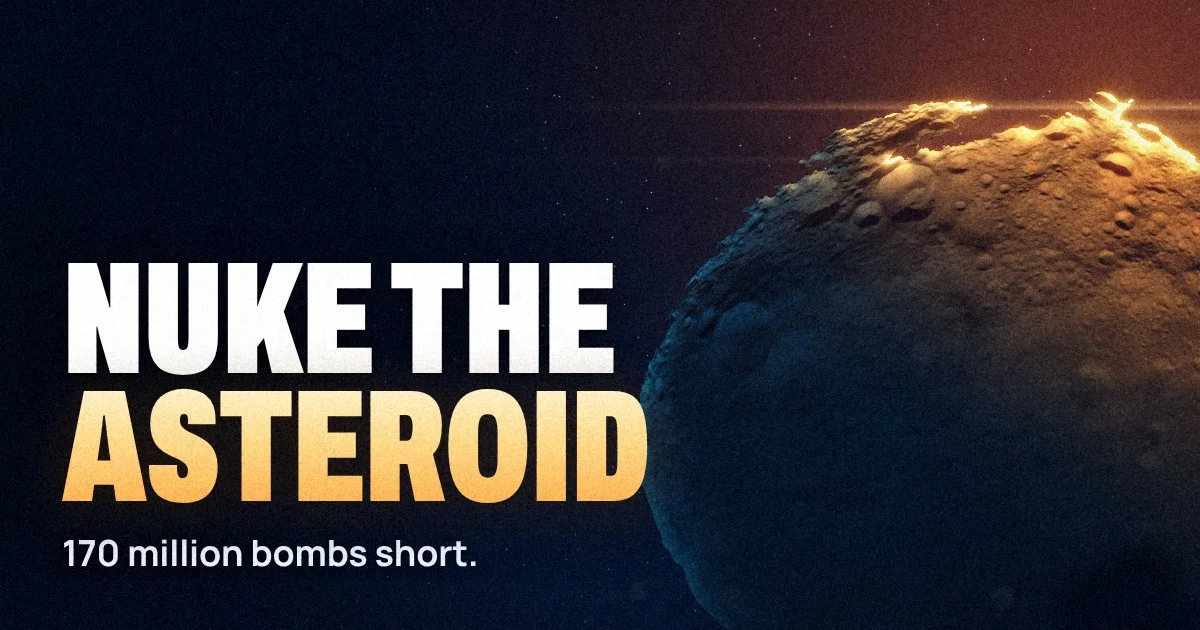
Header image: asteroid Vesta from NASA's Dawn mission (PIA14778, NASA/JPL-Caltech/UCLA/MPS/DLR/IDA), relit for this article.