What happens when an asteroid hits Earth?
It depends mostly on size. A stony asteroid smaller than about 50 m usually breaks up and explodes in the air, like Chelyabinsk in 2013 (about 20 m, 540 kt, burst 32 km up). A rock of a few hundred metres reaches the ground and digs a crater several kilometres wide, and a 10 km rock like the one that ended the dinosaurs releases about 75 million Mt, enough to change the climate of the whole planet.
The simulator uses the equations of the Earth Impact Effects Program by Collins, Melosh and Marcus (2005), the same model behind the Purdue and Imperial College calculators. Set the diameter, density, speed and entry angle. The side view shows where the rock breaks up and whether it bursts in the air or reaches the ground; the map below draws the damage rings over a made-up city 60 km across. For a 60 m stony rock at 15 km/s the energy is 9.1 Mt, about 608 Hiroshima bombs, and it explodes 8 km above the ground. For the Hollywood version of the problem, see our post on nuking an asteroid like in Armageddon.
Key results from the simulation
- Energy grows with the cube of size: a 140 m stony rock at 17 km/s carries 150 Mt, about 9,924 Hiroshima bombs. Double the diameter and the energy goes up 8 times; double the speed and it goes up 4 times.
- The air stops small rocks: with the default stony density, Chelyabinsk (20 m) bursts 32 km up and Tunguska (60 m) bursts 8 km up. An iron rock of the same 60 m size reaches the ground and makes a 1.6 km crater.
- Craters are about 10 to 20 times the rock: a 45 m iron rock makes a 1.3 km crater (the real Meteor Crater in Arizona is about 1.2 km); Apophis, if it hit, would make about 4.7 km.
- Blast reach grows with the cube root of energy: Apophis has about 128 times Tunguska's energy, yet its window-breaking ring (120 km) is less than 3 times wider than Tunguska's (45 km).
Six impacts, real and what if
Each section gives the numbers the simulation shows for that setup and what they mean on the ground. The real events use published estimates of size and speed; the what-if cases (Apophis, Bennu) are not going to happen in the next century, they show what that size would do.
Chelyabinsk 2013: a 20 m rock that never landed
20 m stony, 19 km/s, 18 degreesOn 15 February 2013 a rock about 20 m across entered over Russia at 19 km/s on a shallow 18 degree path. The model gives 540 kt (about 36 Hiroshima bombs), breakup starting near 56 km and an airburst at 32 km. Observers put the peak brightness at about 30 km, so the model is close.
Here the model shows its weak spot. It predicts only 0.14 kPa of overpressure on the ground, below every damage ring, yet the real shock wave broke windows across Chelyabinsk and about 1,500 people were hurt, mostly by flying glass. Glass starts to crack at around 1 kPa, well under the 6.9 kPa "all windows shatter" ring, and the curve fitted to nuclear tests is least reliable for bursts this high. Treat the empty map as "no structural damage", not "nothing happens".
Tunguska 1908: the forest flattener
60 m stony, 15 km/s, 35 degreesIn 1908 something exploded over Siberia and knocked down about 80 million trees over roughly 2,000 square km. Size estimates run from about 50 to 80 m and energy estimates from 3 to 30 Mt, so the preset (60 m stony at 15 km/s) is one plausible version. It gives 9.1 Mt and an airburst 8 km up.
Over our made-up city that burst would flatten wooden houses out to 15 km, collapse brick buildings to 7.2 km and shatter windows to 45 km. The real Tunguska damage zone had a radius of about 25 km, between the model's wood and glass rings. Angle matters: drop the same rock straight down (90 degrees) and it has less air to cross, reaches the ground and digs a 810 m crater.
Related reading: How much energy would it take to blow up Earth?
Meteor Crater, Arizona: iron gets through
45 m iron, 15 km/s, 45 degreesAbout 50,000 years ago an iron body some 40 to 50 m across hit northern Arizona. Iron is strong and dense, so the air barely slows it: the model has it start to break up only 13 km up and hit at 10.3 km/s, close to the roughly 12 km/s that Melosh and Collins (2005) worked out from the crater's missing melt.
The model crater is 1.3 km across against the real 1.2 km, a good match. The impact releases 10 Mt, comparable to Tunguska, but it is delivered to the ground: brick buildings would collapse to 6.5 km and the ground shock equals a magnitude 5.0 earthquake.
A 140 m "city killer"
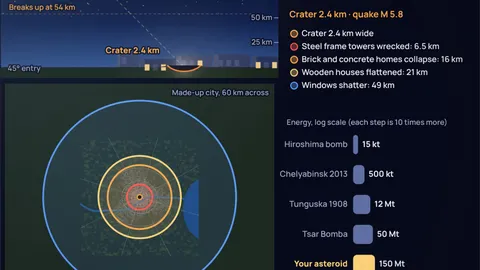
140 m stony, 17 km/s, 45 degrees140 m is the size NASA was told by the US Congress to find 90 percent of, because that is roughly where an impact stops being local and becomes regional. The preset gives 150 Mt, about 9,924 Hiroshima bombs, a 2.4 km crater and a ground shock of magnitude 5.8.
On the city map, steel towers are wrecked to 6.5 km, brick homes collapse to 16 km, wooden houses to 21 km, and windows shatter to 49 km. That covers every part of a large city. Our companion post walks through this case over Mumbai.
Related reading: What would happen if an asteroid hit Mumbai?
Apophis: the 2029 flyby, played as a hit
340 m stony, 12.6 km/s, 45 degrees (what if)Apophis is about 340 to 375 m across and will pass about 32,000 km above Earth's surface on 13 April 2029, closer than geostationary satellites. Radar in 2021 ruled out any impact for at least 100 years. As a what if: 1,200 Mt, a 4.7 km crater, windows broken to 120 km.
The ground shock would be a magnitude 6.6 event. Because it would hit below 15 km/s, the Collins model does not compute a fireball for it; that is a limit of the model, not a promise that there would be no heat.
Chicxulub: the dinosaur killer
10 km stony, 20 km/s, 60 degrees66 million years ago a rock roughly 10 km wide hit what is now Mexico's Yucatán coast, probably at about 60 degrees. The model gives 75 million Mt and a 129 km crater. The real structure is about 180 to 200 km across, so the scaling law comes out low here; its constants are only known to within a range of 0.8 to 1.5, and a 12 km rock gives a closer match.
The map switches to a globe because the rings stop fitting on a city: windows break to 4,950 km, third degree burns reach 1,200 km. None of that is what killed the dinosaurs. The global effects (ejecta re-entering the atmosphere, soot and sulphur blocking sunlight for years) are outside this model.
Every preset side by side
| Impact | Size and type | Energy | Hiroshimas | Outcome | Brick homes collapse | Windows shatter |
|---|---|---|---|---|---|---|
| Chelyabinsk | 20 m stony | 540 kt | 36 | Airburst at 32 km | none | none |
| Tunguska | 60 m stony | 9.1 Mt | 608 | Airburst at 8 km | 7.2 km | 45 km |
| Meteor Crater | 45 m iron | 10 Mt | 667 | Crater 1.3 km | 6.5 km | 20 km |
| 140 m rock | 140 m stony | 150 Mt | 9,924 | Crater 2.4 km | 16 km | 49 km |
| Apophis (what if) | 340 m stony | 1,200 Mt | 78,088 | Crater 4.7 km | 40 km | 120 km |
| Bennu (what if) | 490 m rubble | 1,500 Mt | 98,002 | Crater 4.6 km | 42 km | 127 km |
| Chicxulub | 10 km stony | 75 million Mt | 5,005,724,432 | Crater 129 km | 1,640 km | 4,950 km |
Computed with the Collins, Melosh and Marcus (2005) equations: stony density 3000 kg/m³, iron 7800, rubble pile 1200, comet 1000, target rock 2500. One Hiroshima bomb is taken as 15 kt of TNT. Distances are ground range from the burst or impact point on flat ground. Size and speed estimates for the real events are uncertain by tens of percent.
How the simulation works
Energy. The rock is a sphere of diameter L and density ρ, so its mass is (π/6)ρL³ and its kinetic energy at the top of the atmosphere is ½mv². One megaton of TNT is 4.184 × 10¹⁵ J.
Breakup. The rock is given a strength from its density, log₁₀ Y = 2.107 + 0.0624 √ρ (Y in pascals). As it descends, the air pressure on its nose, ρ_air v², grows until it exceeds Y; the model finds that altitude with the analytic fit of Collins and others (their equation 11). Small, strong, fast rocks can reach the ground intact.
Pancake and airburst. After breakup the crushed rock spreads sideways (the pancake model of Chyba and others, 1993). If it spreads to 7 times its original width before reaching the ground, all its energy is released at that altitude: an airburst, no crater. Otherwise the swarm hits the ground at a reduced speed, which the model integrates analytically.
Crater. The transient crater diameter is D = 1.161 (ρ/ρ_t)^(1/3) L^0.78 v^0.44 g^-0.22 sin^(1/3)θ (metres, their equation 21). Small craters end up 1.25 times wider; above 3.2 km the crater collapses into a complex crater, D_final = 1.17 D^1.13 / 3.2^0.13 in km (equation 27).
Blast rings. Peak overpressure versus distance comes from fits to US nuclear test data (Glasstone and Dolan 1977), scaled by the cube root of energy, with separate curves for surface and air bursts (equations 54 to 58). The rings mark 273 kPa (steel frame buildings wrecked), 42.6 kPa (brick buildings collapse), 26.8 kPa (wooden houses flattened) and 6.9 kPa (windows shatter).
Heat and shaking. For ground impacts faster than 15 km/s the fireball radius is 0.002 E^(1/3) metres and the third degree burn ring uses 0.42 MJ/m² at 1 Mt scaled by E^(1/6), with the horizon cutting off part of the fireball far away. The ground shock magnitude is M = 0.67 log₁₀E − 5.87, which assumes 1 part in 10,000 of the energy goes into seismic waves. Compare that with real earthquakes in the earthquake energy calculator.
What the model leaves out
- Real shapes and strengths: asteroids are not uniform spheres, and real strength varies by a factor of 10 or more between rocks of the same density. Breakup altitudes can be off by tens of kilometres.
- Low-level glass damage: the rings start at 6.9 kPa. Glass cracks at much lower pressures, which is why the Chelyabinsk preset shows no rings even though thousands of windows broke.
- Fireballs below 15 km/s and for airbursts: following the paper, heat is only computed for fast ground impacts. Large slow impacts and big airbursts do produce intense heat; Tunguska scorched trees near the centre.
- Water impacts and tsunamis: every impact here lands on rock. An ocean impact makes a smaller crater on the sea floor and a wave, which the model does not draw.
- Earth curvature and terrain: the city map is flat; hills, buildings and the horizon shield some areas. Only the globe view and the heat calculation account for curvature.
- Global effects: for rocks above about 1 km the dust, soot and climate effects matter more than any ring on a map, and they are not modelled.
Common misconceptions
"Every asteroid that hits Earth makes a crater." No. Rocks up to a few tens of metres, unless made of iron, are usually crushed by the air and explode several kilometres up. Chelyabinsk and Tunguska both left no crater.
"A nuclear bomb is the best comparison." Only for energy. A 1 Mt asteroid delivers its energy as a moving mass with no radiation, and an airburst spreads the blast differently than a bomb detonated on the ground. Our Armageddon post looks at why blowing one up is harder than the films suggest.
"Twice as big means twice the damage." Twice the diameter means 8 times the energy, but because blast range grows with the cube root of energy, the damage radius only doubles, and the damaged area goes up 4 times.
Frequently asked questions
How big does an asteroid have to be to destroy a city?
A stony asteroid of about 50 to 60 m, like Tunguska, can flatten wooden houses over a radius of about 15 km even as an airburst. At 140 m it reaches the ground with about 150 Mt, collapses brick buildings out to 16 km and breaks windows to 49 km, enough to wreck any city on Earth.
How big an asteroid would end humanity?
There is no sharp line, but rocks above about 1 km cause global effects such as dust and soot that cool the planet, and a 10 km rock like Chicxulub releases about 75 million Mt and caused a mass extinction. Rocks under a few hundred metres cause regional disasters, not global ones.
Will Apophis hit Earth in 2029?
No. Apophis will pass about 32,000 km above Earth on 13 April 2029, closer than geostationary satellites, and radar measurements in 2021 ruled out any impact for at least the next 100 years. The simulation shows what a rock its size would do only as a what if.
Why do small asteroids explode in the air?
At 15 to 20 km/s the air pressing on the front of the rock reaches millions of pascals, more than most stony asteroids can withstand. The rock breaks, the fragments spread sideways, the drag rises sharply and the whole kinetic energy is released within a few kilometres of altitude, like a bomb going off in the sky.
How accurate is this asteroid impact simulator?
It uses the published Collins, Melosh and Marcus (2005) scaling laws, which match Meteor Crater and the Chelyabinsk burst height well. The crater constants are uncertain by a factor of about 1.5, strength varies widely between rocks, and the blast rings are fits to nuclear test data, so treat every number as good to tens of percent.
Keep learning
What Would Happen If an Asteroid Hit Mumbai?
A 140 m asteroid over Mumbai: 150 megatons, a 2.4 km crater and windows broken 49 km away. Three sizes worked through with the Collins impact equations.

Could a Nuke Stop an Asteroid? Armageddon vs DART Math
Splitting Armageddon's asteroid needs 10⁸ Tsar Bombas just to beat its own gravity. DART shows what works instead: millimetres per second, years ahead.
This much Energy can Blown up Entire Earth
There are super Weapons in The Star Wars Franchise. That can Release Enough energy to Blow up a Planet. But how much energy does it take?
How Much Energy to Destroy a Planet? Death Star Math
Blowing Earth apart takes 2.49×10³² J, 11% more than the textbook figure, or 7.5 days of the Sun's whole output. The Death Star math, layer by layer.