What causes the seasons on Earth?
Seasons are caused by the tilt of Earth's axis, not by its distance from the Sun. Earth's axis is tilted 23.44° from the plane of its orbit and keeps pointing the same way in space all year. For half the year the northern hemisphere leans toward the Sun, so sunlight arrives more steeply and days are longer (summer in the north, winter in the south). For the other half it leans away. Earth is actually closest to the Sun in early January, in the middle of northern winter.
The simulation above lets you move through the year and read off two things that matter. The first is day length, which follows from cos ω = −tan φ tan δ, where φ is your latitude and δ is the declination, the latitude where the Sun is overhead. The second is the height of the Sun at noon, 90° − |φ − δ|. At 40° N on June 21 the day is 14 h 51 m long and the noon Sun is 73.4° high. On December 21 the day is 9 h 09 m and the noon Sun only 26.6°. For more about our home planet and its neighbours see 20 facts about the solar system.
Key results from the simulation
- Tilt, not distance: Earth is 147.1 million km from the Sun on January 3 and 152.1 million km on July 4. That is a difference of only about 3 percent, and it puts the nearest point in northern winter.
- The Sun's overhead latitude swings ±23.44°: from 23.4° N on June 21 to 23.4° S on December 21, which marks the tropics.
- Day length at 40° N: 14 h 51 m at the June solstice, 9 h 09 m at the December solstice, and 11 h 59 m at the equinox.
- Noon Sun height at 40° N: 73.4° in June against 26.6° in December. A steeper beam spreads the same energy over less ground.
Six moments in Earth’s year
Each section gives the numbers the simulation shows for that date and place, explains them, and has a button that sets the date (and the latitude where it matters). Day lengths are for local solar time, ignoring atmospheric refraction.
June solstice at 40° N: the longest day
Jun 21, the Sun is overhead at 23.4° NOn about June 21 the north pole leans as far toward the Sun as it ever does. The Sun is overhead at 23.4° N (the Tropic of Cancer), and at 40° N it climbs to 73.4° at noon. The day lasts 14 h 51 m, with sunrise near 04:35 and sunset near 19:25.
Two effects add up: the Sun is higher, so the same beam heats a smaller patch of ground, and it is up for longer, so the heating lasts more hours. Notice that the hottest weeks come later, in July and August, because land and ocean take weeks to warm up. The same date is the shortest day in the southern hemisphere: 9 h 09 m at 40° S, with the noon Sun at 26.6°.
December solstice at 40° N: the shortest day
Dec 21, the Sun is overhead at 23.4° SSix months later the north pole leans away and the Sun is overhead at 23.4° S, the Tropic of Capricorn. At 40° N the noon Sun reaches only 26.6°, the day is 9 h 09 m long and the Sun rises near 07:25 and sets near 16:35.
Compare the two solstices on the day-length chart in the panel: the faint dashed lines are the two extremes at your latitude, and today's curve sits between them. In the southern hemisphere this is midsummer, with 14 h 51 m of daylight at 40° S. Earth is 147.2 million km from the Sun on this date, only about two weeks before its closest approach.
The March equinox: equal day and night
About March 21, the Sun is overhead at 0.1° STwice a year, around March 20 and September 22, Earth's axis leans neither toward nor away from the Sun. The Sun is overhead on the equator, the day and night terminator runs straight through both poles, and every place on Earth gets close to 12 hours of daylight. In the simulation at 40° N the day is 11 h 59 m and the noon Sun is 49.9° high.
The word "equinox" means "equal night". The declination formula used here is a simple cosine, so it puts the zero point on day 81 (Mar 22), a day or two later than the real equinox, and gives day length to within a few minutes. That is more than good enough to see the pattern. For a bigger picture of the planets, see solar system facts.
The Arctic Circle at midsummer: almost no night
66.5° N on Jun 21Close to the pole the effect of the tilt is extreme. At 66.5° N, a hair south of the Arctic Circle (66.56° N, which is 90° − 23.44°), the June solstice day is 23 h 25 m long, with the Sun just dipping below the horizon around local midnight. On the circle itself the Sun stays up for 24 hours on one day, and farther north, for weeks or months.
On December 21 the same place gets 0 h 35 m of daylight and a noon Sun only 0.1° high. North of the circle the Sun does not rise at all around the winter solstice, which is called polar night. This is why the seasons feel so different at high latitudes, and why the tilt matters for climate. See also climate change and the Google Doodle.
The equator: 12 hours of daylight all year
0° on Mar 22On the equator the day is 12 h 00 m long on every date, and at the equinox the noon Sun passes directly overhead (89.9°). At the solstices the noon Sun is still 66.6° high in June and 66.6° in December, so sunlight is strong all year. Seasons there are set by wet and dry periods, not by temperature.
The Sun is directly overhead at noon twice a year on the equator, near the equinoxes, and once a year on each tropic. Anywhere between the two tropics, at 23.44° N and S, the Sun can be exactly overhead on some dates. Outside them, it never is.
January 3: closest to the Sun, in the middle of winter
Jan 3, 147.1 million kmEarth's orbit is a slightly flattened circle. On about January 3 it is 147.1 million km from the Sun, and on about July 4 it is 152.1 million km. The difference makes sunlight about 7 percent weaker at the farthest point, yet it is the northern hemisphere's summer then. At 40° N the January 3 day is only 9 h 14 m long with the noon Sun at 27.1°.
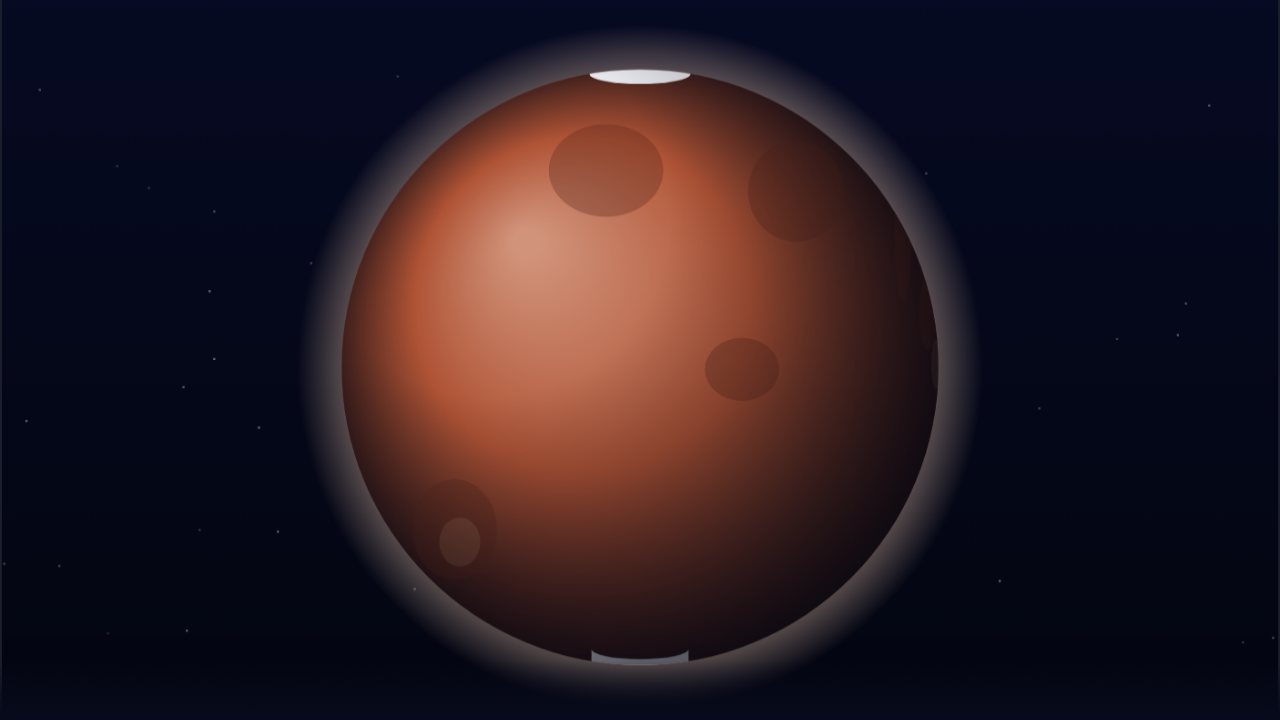
If distance caused the seasons, the whole planet would be warm in January and cool in July. It is the opposite for the south and the north at the same time, which only the tilt can explain. Mars has a similar tilt of about 25° and so has seasons too, plus a much more elongated orbit, as discussed in could Mars be terraformed.
Day length and noon Sun at four places
| Place | June day | June noon Sun | December day | December noon Sun |
|---|---|---|---|---|
| Equator (0°) | 12 h 00 m | 66.6° | 12 h 00 m | 66.6° |
| 40° N | 14 h 51 m | 73.4° | 9 h 09 m | 26.6° |
| 66.5° N | 23 h 25 m | 46.9° | 0 h 35 m | 0.1° |
| 40° S | 9 h 09 m | 26.6° | 14 h 51 m | 73.4° |
Values come from the formulas the simulation uses, for the solstice dates (June 21 and December 21) in local solar time, without atmospheric refraction. Real sunrise and sunset times at a given town differ by a few minutes.
How the simulation works
The slider is the day of the year N, from 1 (January 1) to 365. The solar declination, the latitude where the Sun is directly overhead, is δ = −23.44° × cos(360° ÷ 365 × (N + 10)). This is a standard approximation: it is −23.44° near December 21, zero near the equinoxes, and +23.44° near June 21. In the globe view this is the yellow line, and the glowing dot is the sub-solar point.
The globe is drawn with north up and the Sun to the right. The day and night boundary, the terminator, is a great circle at 90° from the sub-solar point, so it tilts as δ changes and leaves the pole in permanent light or darkness when |δ| is large. The twilight edge is softened a little for looks.
For a latitude φ the Sun rises when cos ω = −tan φ tan δ, where ω is the hour angle of sunrise. The day length is 2ω ÷ 15° hours, because Earth turns 15° per hour. If the right side is above 1 there is no sunrise (polar night), if it is below −1 the Sun never sets. The Sun's height at noon is 90° − |φ − δ|, and at any hour t it satisfies sin h = sin φ sin δ + cos φ cos δ cos(15° × (t − 12)). That last equation draws the chart in the panel.
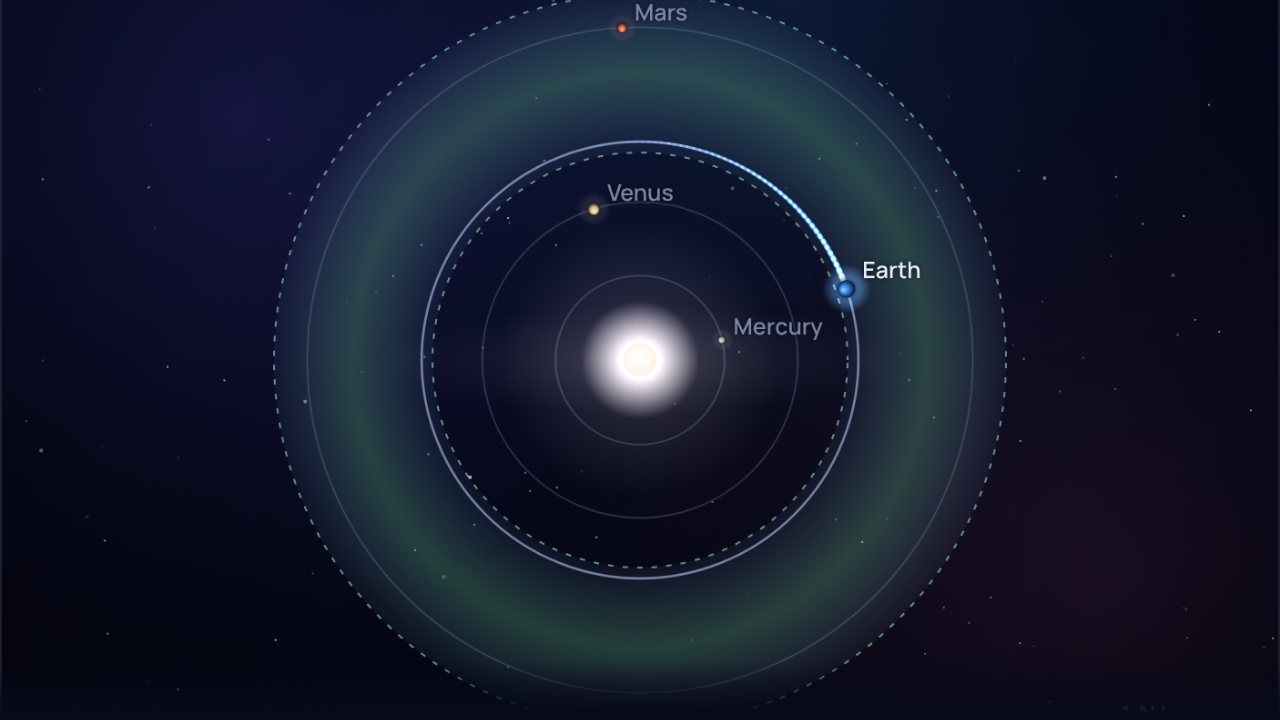
In the orbit view Earth's axis is tilted 23.44° toward a fixed direction in space, so the picture repeats the same tilt at the four marked positions. The Earth–Sun distance in the readout is 149.6 million km × (1 − 0.0167 cos(360° ÷ 365.25 × (N − 3))). The orbit is drawn as a circle, as its real shape differs from one by less than 2 percent. Play runs the year as a time-lapse of about 15 days per second.
What the model leaves out
- Atmosphere and refraction: air bends sunlight, so the Sun is visible a few minutes before the geometric sunrise and after sunset. Twilight adds more light. The day lengths here are geometric.
- Equation of time: the Sun is up to about 16 minutes early or late against a clock through the year, so real noon is not exactly at 12:00 and sunrise times shift a little.
- Weather and oceans: temperature depends on clouds, ocean currents and land. That is why the hottest weeks come about a month after the longest day, and why places on the same latitude can have different climates.
- Changes in tilt: Earth’s tilt varies between about 22.1° and 24.5° over roughly 41,000 years. It is fixed in the simulation.
- Leap years and the real equinox date: the cosine formula puts the equinox about a day or two late and ignores leap years.
- The orbit shape: the diagram is circular and shown at a tilted angle. The distance in the readout uses the real eccentricity of 0.0167.
Common misconceptions
“Summer is when Earth is closest to the Sun.” No. Earth is closest in early January, when the northern hemisphere is in winter. The distance changes by only about 3 percent, and the whole planet is closer at the same time, so it cannot produce opposite seasons in the north and south.
“The tilt changes during the year.” No. The axis keeps pointing toward nearly the same spot in the sky (close to the North Star) all year. What changes is which side of Earth is tilted toward the Sun, because Earth moves around the orbit.
Frequently asked questions
Why do we have seasons?
Because Earth's axis is tilted 23.44° and points the same way as Earth orbits the Sun. When a hemisphere leans toward the Sun it gets more direct sunlight and longer days, which is summer. Half a year later it leans away, which is winter. The distance to the Sun plays almost no role.
Is Earth closer to the Sun in summer?
No. Earth is closest to the Sun (147.1 million km) in early January and farthest (152.1 million km) in early July. In the northern hemisphere that makes the closest point a winter date. Seasons are opposite in the two hemispheres at the same time, which distance cannot explain.
What is the difference between a solstice and an equinox?
At a solstice (around June 21 and December 21) one pole leans as far as it can toward the Sun, giving the longest and shortest days. At an equinox (around March 20 and September 22) neither pole leans toward the Sun, and day and night are nearly equal everywhere.
Why is it hottest after the longest day?
Land and oceans store heat. Even after the days start to shorten, they are still gaining more heat than they lose, so temperatures keep rising for several weeks. This seasonal lag is why July and August are usually hotter than June in the northern hemisphere.
How long is the day at the equator?
About 12 h 00 m all year round. Because the Sun's path is always close to straight overhead, sunrise and sunset change by only a few minutes between seasons.
Do other planets have seasons?
Yes, any planet with a tilted axis does. Mars has a tilt of about 25° and seasons much like Earth's, and Uranus is tipped almost on its side, giving extreme seasons that last decades. Mercury is almost upright and has almost none. See solar system facts for more.
Keep learning
Top 20 Interesting Facts About Our Solar System
Here, we'll delve into the top 10 interesting facts about our solar system that will leave you in awe of the cosmos

Climate Change: Google Doodle Today
On April 22, 2023, Google has dedicated its daily Doodle to raise awareness about climate change. This Doodle is important because it highlights the pressing need for everyone to take action towards mitigating the adverse

Could Mars Be the First Terraformed Planet?
Mars: Could it be the first terraformed planet? Explore the challenges, potential solutions, and ethical considerations.