What happens to Earth if the Sun is replaced by another star?
If you swapped the Sun for a lighter or heavier star, Earth would keep the same orbit but the year, the sunlight and the climate would all change. A heavier star pulls harder, so Earth orbits faster and the year gets shorter. It is also far brighter, so Earth would be too hot. A red dwarf has the opposite effect: a longer year and a frozen planet. Use the simulation above to try any star from 0.3 to 3 times the Sun’s mass, or follow the guide below, which walks through six different stars one at a time. Looking for the dramatic versions with Polaris, Betelgeuse or a black hole? Read What if we Replace the SUN?.
Key results from the simulation
- Year length: with Earth fixed at 1 AU, the year shrinks as 1 ÷ √M. A star of 2 solar masses gives a 258-day year.
- Sunlight: a star’s brightness rises much faster than its mass. At 2 solar masses it is about 16 times brighter than the Sun.
- Habitable zone: the safe distance for liquid water moves outward with brightness. For the Sun it spans about 0.95 to 1.68 AU.
- Lifetime: heavy stars burn out fast. A 3 solar mass star lasts roughly half a billion years, too short for complex life to appear.
Earth around six different stars
Each section below gives the numbers the simulation shows for that star, explains why they come out that way, and has a button that loads the star into the simulation above. Distances are in AU, where 1 AU is the Earth–Sun distance of about 150 million kilometres.
A red dwarf (0.3 solar masses): a long, frozen year
Most common star type in the galaxyRed dwarfs are small, cool and dim. At 0.3 solar masses the star is only about 1.4 percent as bright as the Sun, and its surface is around 3,440 K. Put Earth at its usual 1 AU and it receives so little light that the surface would sink to roughly minus 170 °C in this simple model.
The habitable zone sits far closer in, between about 0.11 and 0.20 AU. That is well inside Mercury’s orbit, so a real planet there would circle its star in days. Earth’s year at 1 AU would be a slow 667 days. Red dwarfs also live almost forever, over 200 billion years, which is why astronomers keep searching them for habitable worlds.
A smaller, cooler star (0.5 solar masses): still too cold
Orange dwarfAt half the Sun’s mass the star shines with only 6 percent of the Sun’s light. Earth’s year stretches to 517 days, and the model puts its surface near minus 130 °C.
The habitable zone moves to 0.24–0.42 AU. Notice how fast it shrinks: halving the mass cuts the brightness by a factor of sixteen, so the ring collapses inward. Earth ends up far outside it, which shows why the zone depends on brightness much more than on mass.
The Sun (1 solar mass): the baseline
Our own starThis is the reference case. Earth takes 365.25 days to orbit, receives exactly one “sun” of light, and has an equilibrium temperature near 288 K, or 15 °C. The habitable zone runs from about 0.95 to 1.68 AU, so Earth sits comfortably near its inner half.
The Sun will stay on the main sequence for about 10 billion years. That is long enough for life to appear, evolve and become complex, which is the clock that matters for habitability. To read more about the planets that share this star, see our guide to the solar system.
Related reading: Top 20 Interesting Facts About Our Solar System
A slightly heavier star (1.5 solar masses): hot and fast
Hotter than the SunA star only 50 percent heavier than the Sun is already about five times brighter. Earth’s year drops to 298 days and the model temperature climbs to around 160 °C, hot enough to boil the oceans away.
The habitable zone moves out to 2.1–3.8 AU, which is beyond Mars. If you could slide Earth out to that distance it would be comfortable again. This is the key idea behind the habitable zone: it is a distance, not a property of the planet.
A Sirius-like star (2 solar masses): white and short-lived
White main-sequence starAt twice the Sun’s mass the star is almost 16 times brighter and about 8,700 K at the surface, so it glows white. Earth’s year is only 258 days and the surface would reach several hundred degrees.
The habitable zone now stretches from 3.8 to 6.7 AU, out near where Jupiter orbits. The star will last only about 1.3 billion years. Sirius A, the brightest star in our night sky, is a real example of this type.
Related reading: 10 Cosmic Objects That Will Amaze You
A blue-white star (3 solar masses): brilliant and brief
Short-lived giantAt three solar masses the star is about 65 times as bright as the Sun with a surface near 10,600 K. Earth would whip around it in 211 days, and the model puts the surface at roughly 550 °C.
The habitable zone is out at 7.7–13.6 AU. But the star burns through its fuel in under half a billion years. On Earth, complex animals took far longer than that to appear, so life would likely not get the time it needs.
All six stars side by side
| Star mass | Year | Brightness | Surface temp. | Habitable zone | Lifetime |
|---|---|---|---|---|---|
| 0.3 (red dwarf) | 667 d | 0.014× | 3,440 K | 0.11–0.20 AU | ~208 Gyr |
| 0.5 (orange dwarf) | 517 d | 0.06× | 3,940 K | 0.24–0.42 AU | 80 Gyr |
| 1.0 (the Sun) | 365 d | 1× | 5,770 K | 0.95–1.68 AU | 10 Gyr |
| 1.5 | 298 d | 5.1× | 7,360 K | 2.1–3.8 AU | 3 Gyr |
| 2.0 (like Sirius A) | 258 d | 15.8× | 8,730 K | 3.8–6.7 AU | 1.3 Gyr |
| 3.0 (blue-white) | 211 d | 65× | 10,580 K | 7.7–13.6 AU | 0.46 Gyr |
Values come from the same formulas the simulation uses. They describe a simplified, circular, top-down model, so treat them as good estimates rather than exact figures.
How the simulation works
The orbital period comes from Kepler’s third law. The star’s brightness follows the mass–luminosity relation for main-sequence stars, and its colour comes from its surface temperature. The habitable zone uses the Kopparapu limits, the same climate-model boundaries astronomers use for exoplanets. Earth’s temperature estimate is the planet’s equilibrium temperature scaled from today’s 288 K.
What the model leaves out
- The atmosphere: clouds, ice and greenhouse gases would shift Earth’s real temperature a lot. The estimate ignores them, so very bright stars read hotter than a real planet might be.
- Tidal locking: planets close to a red dwarf usually keep one face to the star, which changes climate completely.
- Star activity: red dwarfs throw off strong flares that could strip a planet’s air.
- Orbit shape: every orbit is drawn as a perfect circle for clarity.
Common misconceptions
“A bigger star means a bigger habitable zone in a good way.” Not quite. The zone moves outward and gets wider, but the star’s short life can cancel the benefit.
“Red stars are hotter because red is a warm colour.” In stars the opposite is true: red means cool and blue means hot.
Frequently asked questions
Would Earth freeze or burn around a different star?
It depends on the star’s brightness. Around a 0.3 solar mass red dwarf, Earth would get about 1.4 percent of today’s sunlight and freeze. Around a 2 solar mass star it would get about 16 times more and be far too hot.
Why is the year shorter around a heavier star?
A heavier star has stronger gravity, so a planet at the same distance must move faster to stay in orbit. Kepler’s third law gives a year of 365.25 days divided by the square root of the star’s mass in solar masses.
What is the habitable zone?
It is the band of distances where a planet with an Earth-like atmosphere could keep liquid water on its surface. It moves outward around brighter stars and inward around dimmer ones.
Why can’t life last around a blue star?
Heavy stars burn their fuel quickly. A 3 solar mass star lives under half a billion years, while life on Earth took billions of years to become complex.
Which star would be best for life?
Stars close to the Sun’s mass are a sweet spot: bright enough to warm a planet and long-lived enough to give life billions of years. Smaller stars last longer but are harder on planets, and bigger ones don’t last long enough.
Are the planet sizes to scale?
No. Distances are to scale, but the planets and the star are drawn larger so you can see them. Real planets would be far too small to appear on this view.
Keep learning
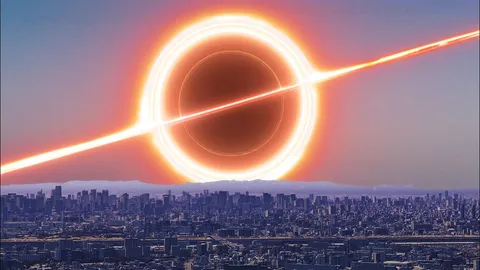
What if we Replace the SUN?
What if we dared to swap out the Sun for some of the most massive and intriguing objects in the cosmos? let's find out
Top 20 Interesting Facts About Our Solar System
Here, we'll delve into the top 10 interesting facts about our solar system that will leave you in awe of the cosmos
10 Cosmic Objects That Will amaze you
The universe is a vast and beautiful place, filled with cosmic objects that leave us in awe. In this blog, we'll explore ten of the most stunning and