How big is Earth compared with the Sun, Jupiter and the biggest stars?
Earth is 12,742 km across. Jupiter is about 11 times wider, the Sun is about 109 times wider, and the red supergiant UY Scuti is roughly 99,300 Earths across. Because volume grows with the cube of the width, the Sun holds about 1.3 million Earths, and UY Scuti holds close to 980 trillion. The simulation above draws every body with a diameter proportional to its real one, at one shared scale, so you can see what those ratios look like.
Pick two or more bodies with the buttons, drag sideways to pan along the row, use the slider to zoom, or tap a body to zoom to it. Small worlds shrink to a ringed dot when you zoom out far enough, which is the honest picture: Earth really is a speck next to a giant star. For the Sun and Solar System numbers, see Top 20 Interesting Facts About Our Solar System.
Key results from the simulation
- Earth and the Moon: Earth is 3.67 times wider than the Moon, and about 49 Moons would fit inside Earth by volume.
- Jupiter: 139,822 km across, 11 Earths wide and about 1,320 Earths by volume.
- The Sun: 1,391,400 km across, 109 Earths wide and about 1.3 million Earths by volume.
- Giant stars: Betelgeuse (about 764 solar radii) and UY Scuti (about 909) would each reach beyond the orbit of Mars if they replaced the Sun, with radii of about 3.6 and 4.2 AU.
Six comparisons, from the Moon to the largest stars
Each section gives the numbers the simulation shows for that set of bodies and has a button that selects the set and fits it on the stage. All diameters are mean values, and the sizes of Betelgeuse and UY Scuti are uncertain, as noted below.
Earth and the Moon
3.67 times widerThe Moon is 3,475 km across, about 27% of Earth's 12,742 km. By volume it is about 1/49 of Earth, which means about 49 Moons would fit inside Earth.
No other planet in the Solar System has a moon this large compared with itself. The gap between the two in the simulation is not their real distance: the Moon orbits about 384,400 km away, roughly 30 Earth widths, and the comparison here only keeps the sizes to scale.
The Moon, Mercury, Mars and Earth
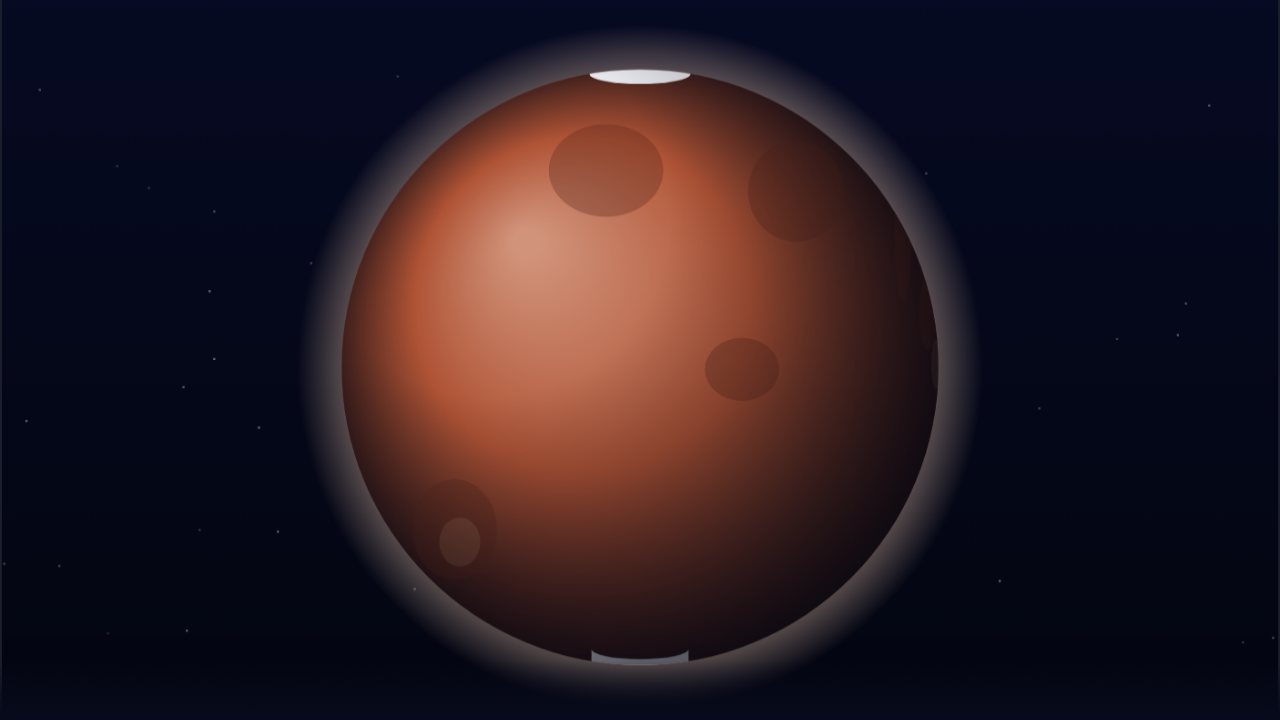
Four rocky worldsMercury, the smallest planet, is 4,879 km across: 0.383 of Earth's width and only about 40% wider than the Moon. Mars is 6,779 km across, 0.532 of Earth's width, and holds about 1/7 of Earth's volume.
Venus, at 12,104 km, is nearly Earth's twin in size and is not in the list. Size alone does not say what a world is like: Mercury is barely bigger than the Moon but is far denser, so it is much heavier.
Earth, Neptune and Jupiter
Ice giant and gas giantNeptune is 49,244 km across, 3.86 Earths wide, and holds about 57.7 Earths by volume. Jupiter is 139,822 km across, 2.84 times wider than Neptune, with about 1,320 Earths by volume. Jupiter's width is a mean of its equator and poles, because it is flattened by its spin.
Neptune is the smallest of the giant planets in this list but still nearly four Earths wide, and its winds are the fastest measured on any planet. Read why in Why Neptune's Winds are the Fastest.
Related reading: Why Neptune's Winds are the Fastest?
Earth, Jupiter and the Sun
Sun: 1,391,400 km acrossThe Sun is 109 Earths wide and 9.95 times wider than Jupiter. By volume it holds about 1.3 million Earths, or about 985 Jupiters. It also holds about 99.8% of the Solar System's mass.
Jupiter is about a tenth of the Sun's width but only about a thousandth of its mass, which is why Jupiter is a planet and the Sun is a star. To see what would change if the Sun were a different star, try Replace the Sun.
Related reading: Top 20 Interesting Facts About Our Solar System
The Sun, Sirius A, Pollux and Arcturus
Three famous starsSirius A, the brightest star in our night sky, is only about 1.71 times the Sun's radius, 2.38 million km across. Pollux, an orange giant about 34 light-years away, is roughly 9 solar radii, 12.5 million km across. Arcturus, 37 light-years away, is about 25.4 solar radii, 35.3 million km across.
Arcturus is about 16,400 times the Sun's volume. Stars at this stage have swollen as they run out of hydrogen in the core, which is the fate that awaits the Sun in several billion years. More strange objects are in 10 Cosmic Objects That Will Amaze You.
Related reading: 10 Cosmic Objects That Will amaze you
Betelgeuse and UY Scuti, next to the Sun
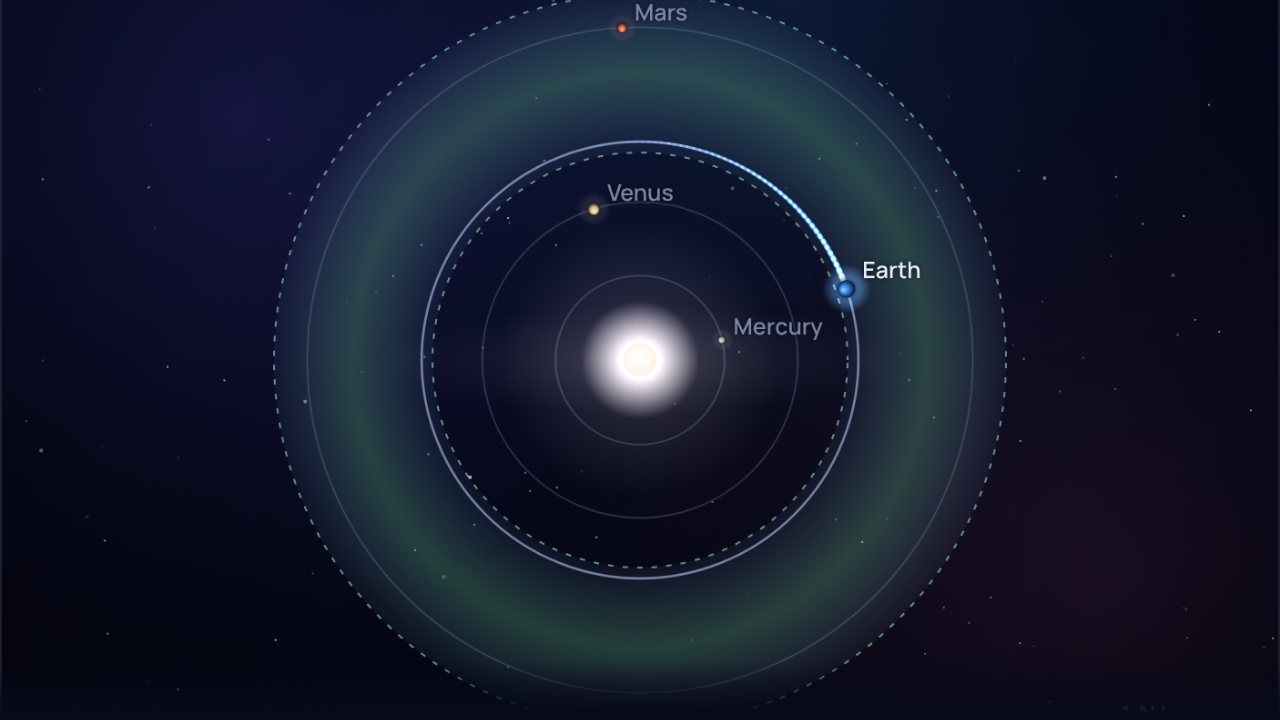
Red supergiantsBetelgeuse is drawn at about 764 solar radii, 1.06 billion km across and 83,400 Earths wide. UY Scuti is drawn at about 909 solar radii, 1.26 billion km across and 99,300 Earths wide. Placed where the Sun is, their surfaces would lie about 3.6 AU and 4.2 AU out, past Mars and the main asteroid belt but inside Jupiter's orbit at 5.2 AU.
These sizes are uncertain. Published radii for Betelgeuse run from roughly 640 to 1,000 solar radii, and it pulsates, so its size changes. For UY Scuti, older estimates were near 1,700 solar radii and newer, Gaia-based ones are close to 900. Such stars have no sharp surface, so the number depends on how and where it is measured.
All twelve bodies side by side
| Body | Type | Diameter | Width vs Earth | Earths by volume |
|---|---|---|---|---|
| Moon | Moon | 3,475 km | ×0.27 | 1/49 |
| Mercury | Planet | 4,879 km | ×0.38 | 1/18 |
| Mars | Planet | 6,779 km | ×0.53 | 1/7 |
| Earth | Planet | 12,742 km | ×1 | 1 |
| Neptune | Planet | 49,244 km | ×3.86 | 57.7 |
| Jupiter | Planet | 139,822 km | ×11 | 1,320 |
| Sun | Star | 1,391,400 km | ×109 | 1.3 million |
| Sirius A | Star | 2.38 million km | ×187 | 6.52 million |
| Pollux | Star | 12.5 million km | ×983 | 949 million |
| Arcturus | Star | 35.3 million km | ×2,770 | 21.3 billion |
| Betelgeuse | Star | 1.06 billion km | ×83,400 | 581 trillion |
| UY Scuti | Star | 1.26 billion km | ×99,300 | 978 trillion |
Diameters are mean values: planets and the Moon use mean radii, the Sun uses a radius of 695,700 km, and the stars use the solar radii quoted in the text. Betelgeuse and UY Scuti are the least certain. "Earths by volume" is the width ratio cubed, so 1/49 means the body has one forty-ninth of Earth's volume.
How the simulation works
Each body has a diameter d in kilometres. The slider sets the view width V, the number of kilometres across the stage, so every body is drawn d × W ÷ V pixels wide, where W is the stage width in pixels. Because the same V applies to every body, a disc drawn twice as wide is twice as wide in reality. Bodies are laid out smallest to largest with a gap of 30% of the larger neighbour, and dragging pans the view along that row. "Fit all" sets V so the whole row fits, and so the largest body fits the stage height.
The readouts use the body nearest the middle of the stage. Width against Earth is d ÷ 12,742 km, and the number of Earths that fit by volume is that ratio cubed, because volume goes with the cube of the radius. A star's diameter is twice its radius in solar radii times 695,700 km, which gives 1,391,400 km for the Sun. Bodies under 3 pixels across are drawn as a dot inside a ring so they can still be found, and the dot is larger than the body.
The surfaces are generated by code and are stylised, not photographs. Planets are lit from the upper left. When you change the selection or tap a body, the view zooms out and in again so you can follow where it goes.
What the model leaves out
- Distances: the gaps between bodies are for readability. They are not orbital distances, and the stars are many light-years apart.
- Shape: every body is drawn as a perfect sphere. Jupiter and Saturn are visibly flattened, and the diameters here are means.
- Uncertain star sizes: supergiants have no sharp edge, and their measured radius depends on the wavelength used and the distance. The values here are single published estimates.
- Mass and gravity: the simulation compares size only. A larger body is not necessarily heavier, and surface gravity is not shown.
- Colour: the colours are stylised. The Sun looks white from space, and star colours here are only a guide to their temperature.
Common misconceptions
"A bigger star must be much more massive." Red supergiants are huge but thin. Betelgeuse is estimated at roughly 10 to 20 solar masses, yet it is about 450 million Suns by volume.
"Jupiter is almost a star." Jupiter is about 10 times narrower than the Sun and about a thousandth of its mass. It would need roughly 80 times more mass to fuse hydrogen.
"UY Scuti is certainly the biggest star." It is one of the largest known, but the sizes of such stars are uncertain and the ranking changes with each new measurement.
Frequently asked questions
How many Earths fit in the Sun?
About 109 Earths fit side by side across the Sun, and about 1.3 million Earths fit inside it by volume. To see it for yourself, try Replace the Sun.
How big is Earth compared with Jupiter?
Jupiter is 139,822 km across against Earth's 12,742 km, so it is about 11 times wider, and about 1,320 Earths would fit inside it by volume.
What is the biggest star in the universe?
Nobody can say for certain. Red supergiants such as UY Scuti and Betelgeuse are among the largest known, with radii of hundreds to over a thousand times the Sun's, but their sizes are uncertain and some other stars have estimates that are larger still. See 10 Cosmic Objects That Will Amaze You.
How big is UY Scuti compared with the Sun?
This page uses about 909 solar radii, so UY Scuti is about 909 times wider than the Sun and about 750 million times its volume. Older estimates of about 1,700 solar radii are now thought too large.
How big is Betelgeuse compared with the Solar System?
At about 764 solar radii, Betelgeuse has a radius of about 3.6 AU. If it replaced the Sun, its surface would lie past the main asteroid belt but inside Jupiter's orbit at 5.2 AU. Published sizes range from roughly 640 to 1,000 solar radii.
Is the Moon bigger than Mercury?
No. Mercury is 4,879 km across and the Moon is 3,475 km. Two moons are bigger than Mercury, Jupiter's Ganymede at 5,268 km and Saturn's Titan at 5,149 km, but Mercury is about twice as massive as either.
Keep learning
Top 20 Interesting Facts About Our Solar System
Here, we'll delve into the top 10 interesting facts about our solar system that will leave you in awe of the cosmos
10 Cosmic Objects That Will amaze you
The universe is a vast and beautiful place, filled with cosmic objects that leave us in awe. In this blog, we'll explore ten of the most stunning and

Why Neptune's Winds are the Fastest?
Neptune, is known for its striking blue color and its supercharged winds that outpace those of any other planet in our solar system but why?