How big is the universe compared with a human?
The observable universe is about 93 billion ly across, roughly 5.2×10²⁶ times the height of a person. A proton, the smallest object here, is about 1.68 fm wide. From proton to cosmos is about 42 powers of ten, and the simulation above lets you walk through all of them with one slider. Every object is drawn at true relative scale against a ruler in real units, which is also why no single picture can ever show everything at once.
Use the slider, drag sideways across the stage, tap a dot on the map along the top, or press Smaller and Bigger to step from object to object. The dashed rings show the neighbouring objects' sizes at the same scale. For the cosmic end of the scale, see Cosmic Bubble in Our Universe: Hubble sphere and Are there Multiple Galaxies in the Universe?.
Key results from the simulation
- The range: from 1.68 fm to 93 billion ly is a factor of about 10^42. Each step along the slider is a power of ten in size.
- Light as a yardstick: light crosses the Sun in 4.64 s, the 60 AU of the planets' orbits in 8.34 h, and the Milky Way in 100,000 years.
- Mostly empty: the nearest star system is 4.37 ly away, about 30 million Sun-widths. A hydrogen atom's cloud is about 63,000 times wider than its proton.
- A size we can only see: the observable universe is 93 billion ly across even though it is only 13.8 billion years old, because space expanded while the light travelled.
Six zoom levels, from an atom to the universe
Each section gives the numbers the simulation shows at that zoom and has a button that moves the slider there. Sizes are standard or typical values, and where an object varies (a hair, a grain of sand, a galaxy) the page says so.
A hydrogen atom: an electron cloud around a tiny nucleus
106 pm acrossA hydrogen atom is about 106 pm across, which is 1.06 ångströms. That is 16 billion times smaller than you, and light crosses it in 3.5×10⁻¹⁹ s. The blue cloud is not a surface: it is the region where the electron is likely to be found, densest near the middle and fading smoothly outward.
The nucleus at the centre is a single proton about 1.68 fm wide, about 63,000 times smaller than the cloud. In the simulation it is enlarged to a visible dot, because at true scale it would be far smaller than one pixel. Most of an atom's volume is empty space.
A red blood cell, a virus and a strand of DNA
7 µm acrossA red blood cell is about 7 µm wide, 243,000 times smaller than a human. A coronavirus (about 100 nm) is roughly 70 times smaller than the cell, and the DNA double helix, 2 nm wide, is 50 times narrower than the virus is wide.
Light crosses the cell in 2.3×10⁻¹⁴ s. A human hair, at about 70 µm, is about 10 cell widths thick, and your body holds roughly 25 trillion red blood cells. Step down with the Smaller button to watch the virus and the helix appear.
A human, a tower and a mountain
1.7 m tallThis is the yardstick for every readout: a person about 1.7 m tall. The Eiffel Tower (330 m) is about 194 humans tall, and Mount Everest (8,849 m above sea level) is about 5,200 humans tall. Light crosses your height in 5.67 ns and Everest's height in 29.5 µs.
Between you and Everest there are about 3.7 powers of ten. Between you and the Sun there are about 9. Everyday life covers only the narrow middle of the scale, which is why both ends feel so strange.
Earth, the Moon and the Sun
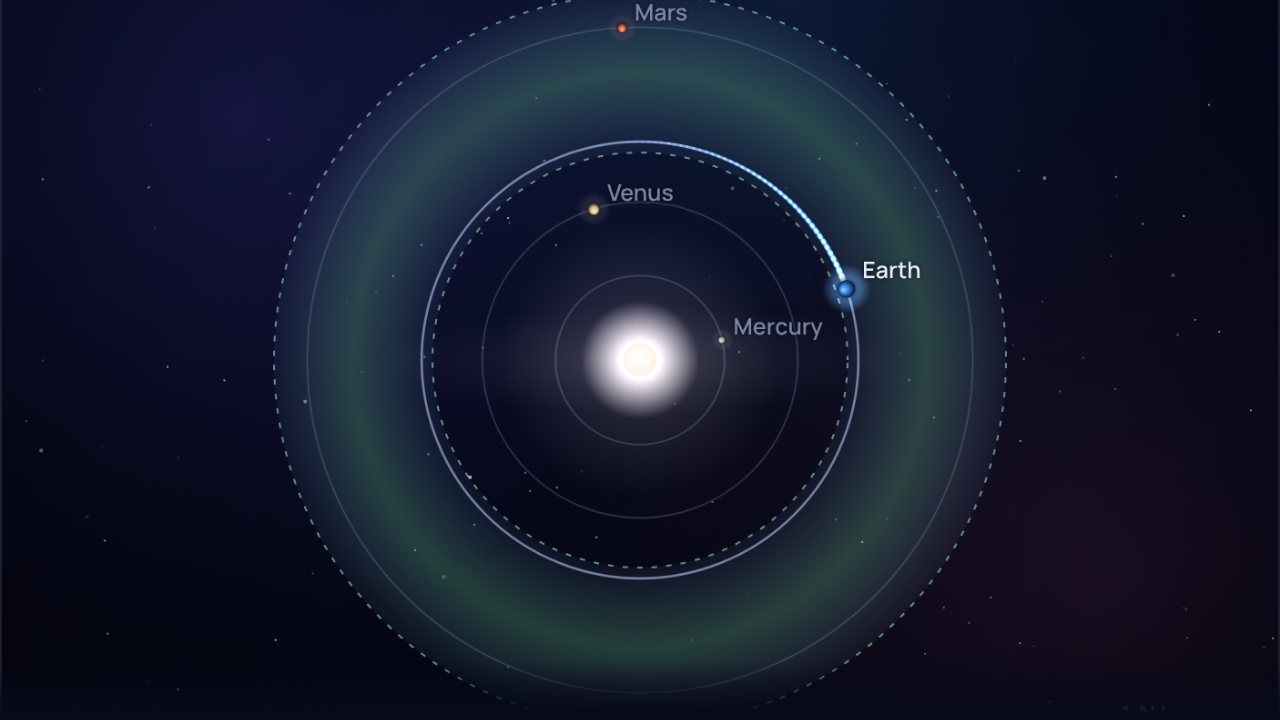
12,742 km acrossEarth is 12,742 km across and the Moon is 3,475 km, about 27% of Earth's width. Light could circle Earth about 7.5 times a second. The Sun is 1.391 million km wide, which is 109 Earths side by side and about 1.3 million Earths by volume.
Light takes 4.64 s to cross the Sun and about 8.32 min to travel the 1 AU from the Sun to Earth. Earth's orbit is 2 AU across and the planets out to Neptune span 60.1 AU. To see what would change if the Sun were a different star, try Replace the Sun. More solar system numbers are in Top 20 Interesting Facts About Our Solar System.
Related reading: Top 20 Interesting Facts About Our Solar System
The Milky Way and its neighbours
100,000 ly acrossOur galaxy is about 100,000 ly across, so light needs about 100,000 years to cross it. The Sun sits roughly 26,000 light-years from the centre, marked in the picture, and the galaxy holds somewhere between 100 and 400 billion stars. The nearest star system, Alpha Centauri, is 4.37 ly away, about 30 million Sun-widths.
Andromeda is about 220,000 ly across and about 2.5 million light-years away, so its distance is only about 11 of its own widths. It is approaching us at roughly 110 km/s, and whether and when the two galaxies merge is still being studied. Our whole neighbourhood, the Local Group, spans about 10 million ly and holds more than 80 galaxies. See 10 Cosmic Objects That Will Amaze You.
Related reading: Are there Multiple Galaxies? in the Universe
The observable universe
93 billion ly acrossThe observable universe is about 93 billion ly across. The Laniakea Supercluster, which contains our Local Group, is about 520 million ly across, so the observable universe is about 179 times wider. In the simulation the orange rim is where the cosmic microwave background comes from, the oldest light we can detect, and you are always at the centre because the edge is defined by what can reach you.
Light would need 93 billion years to cross it, far longer than the universe's 13.8 billion years. There is no contradiction: the light that reaches us from the edge started out much closer, and space expanded while it travelled. The radius is today's distance to the matter that emitted the oldest light we see. The full story is in Cosmic Bubble in Our Universe: Hubble sphere.
Related reading: Cosmic Bubble in Our Universe: Hubble sphere
Every object in the simulation
| Object | Size | Times a human | Light crosses in |
|---|---|---|---|
| Proton | 1.68 fm | ÷ 1×10¹⁵ | 5.6×10⁻²⁴ s |
| Hydrogen atom | 106 pm | ÷ 16 billion | 3.5×10⁻¹⁹ s |
| DNA double helix | 2 nm | ÷ 850 million | 6.7×10⁻¹⁸ s |
| Coronavirus | 100 nm | ÷ 17 million | 3.3×10⁻¹⁶ s |
| Red blood cell | 7 µm | ÷ 243,000 | 2.3×10⁻¹⁴ s |
| Human hair | 70 µm | ÷ 24,300 | 2.3×10⁻¹³ s |
| Grain of sand | 500 µm | ÷ 3,400 | 1.7×10⁻¹² s |
| Human | 1.7 m | about 1× | 5.67 ns |
| Eiffel Tower | 330 m | × 194 | 1.1 µs |
| Mount Everest | 8,849 m | × 5,210 | 29.5 µs |
| Moon | 3,475 km | × 2 million | 11.6 ms |
| Earth | 12,742 km | × 7.5 million | 42.5 ms |
| Sun | 1.391 million km | × 820 million | 4.64 s |
| Earth’s orbit | 2 AU | × 180 billion | 16.6 min |
| Solar System | 60.1 AU | × 5.3 trillion | 8.34 h |
| One light-year | 1 ly | × 5.6×10¹⁵ | 1 year |
| Alpha Centauri | 4.37 ly | × 2.4×10¹⁶ | 4.37 years |
| Orion Nebula | 24 ly | × 1.3×10¹⁷ | 24 years |
| Milky Way | 100,000 ly | × 5.6×10²⁰ | 100,000 years |
| Andromeda Galaxy | 220,000 ly | × 1.2×10²¹ | 220,000 years |
| Local Group | 10 million ly | × 5.6×10²² | 10 million years |
| Laniakea Supercluster | 520 million ly | × 2.9×10²⁴ | 520 million years |
| Observable universe | 93 billion ly | × 5.2×10²⁶ | 93 billion years |
Sizes are standard or typical values, rounded as shown. "× n" means n times a human's 1.7 m height; "÷ n" means a human is n times bigger. Alpha Centauri is listed as its distance from the Sun, and the Eiffel Tower and Everest by height. For the densest end of the scale, see How small can you squeeze it?.
How the simulation works
The slider is L, the base-10 logarithm of a size in metres, from -15.4 to 27.4. The stage draws everything at one number of pixels per metre, D0 ÷ 10^L, where D0 is a fixed fraction of the stage. An object of size s is therefore drawn s × D0 ÷ 10^L pixels across, and the dashed ring for each object has exactly that diameter. The ruler along the bottom uses the same pixels per metre, so its labels are real lengths. The highlighted object is the one whose size is closest to 10^L on a logarithmic scale.
Light-crossing time is t = size ÷ c with c = 299,792,458 m/s, and years use 31,557,600 s. "Times a human" is size ÷ 1.7 m. One astronomical unit is 149,597,870,700 m and one light-year is 9.4607 × 10^15 m.
The picture eases toward a new zoom in logarithmic steps. Orbits and light pulses move for effect: orbits are time-lapsed (one Earth year is about 6 seconds) and the light pulses cross in about 6 seconds whatever their real crossing time. The illustrations are generated by code, not photographs.
What the model leaves out
- Soft edges: an atom, a star and a galaxy have no hard surface, so each size is a convention. The Milky Way's 100,000 light-years is the stellar disc, and its faint halo is much larger.
- Variation: hairs, grains of sand, viruses and blood cells all vary. The page uses a typical value for each.
- Shapes and motion: orbits are drawn as circles, galaxies as idealised spirals, and nothing here rotates at its real rate.
- Cosmology: the size of the observable universe depends on the cosmological model and on what "now" means across expanding space. About 93 billion light-years is the standard estimate.
- Smaller and larger: electrons and quarks show no measurable size, and nobody knows how large the whole universe is beyond what we can observe.
Common misconceptions
"A light-year is a unit of time." It is a distance, about 9.46×10¹² km. That is why the one-light-year object here is a length, and why light takes exactly one year to cross it.
"The universe must be 93 billion years old if it is 93 billion light-years wide." The age is 13.8 billion years. Space itself expanded while light crossed it, so distances to the matter we see today are larger than the age times the speed of light.
"Stars in a galaxy are crowded together." The Sun's nearest neighbour is about 30 million Sun-widths away. Galaxies look dense in pictures only because they are drawn at a scale where stars have been made much larger than life.
Frequently asked questions
How big is the universe?
The observable universe, the part whose light has had time to reach us, is about 93 billion ly across. Nobody knows the size of the whole universe: it may be much larger than the observable part, and it may be infinite. See Cosmic Bubble in Our Universe: Hubble sphere.
What is the smallest thing in the universe?
Electrons and quarks show no measurable size: experiments rule out any size larger than about 10^-18 m, which is more than a thousand times smaller than a proton (1.68 fm). The Planck length, about 1.6 × 10^-35 m, is a theoretical scale where current physics is expected to break down, not a measured object. This simulation starts at the proton, the smallest familiar object.
What is bigger than the observable universe?
Possibly the rest of the universe. The observable universe is limited by how far light has travelled since the Big Bang, not by an edge in space. Beyond it there is probably more universe that looks much like ours, but no light from it has reached us yet, so we cannot measure it.
How many Earths fit in the Sun?
About 109 Earths fit side by side across the Sun's width (1.391 million km against 12,742 km). By volume, about 1.3 million Earths fit inside it. Try the Earth and Sun zoom above, or Replace the Sun.
How long would it take to travel to Alpha Centauri?
Light takes 4.37 years. At Voyager 1's speed of about 17 km/s it would take about 77,000 years to cover 4.37 ly. Voyager is not heading for that star, but the number shows why interstellar travel needs speeds far beyond today's spacecraft.
How do you compare things that differ by billions of times?
Use powers of ten. A logarithmic scale gives every factor of ten the same length, so a proton, a human and a galaxy can share one slider. The simulation does exactly that, then draws one object at true scale so you can see how large the next step really is. See Top 20 Interesting Facts About Our Solar System for more everyday comparisons.
Keep learning

Cosmic Bubble in Our Universe: Hubble sphere
What is the Hubble sphere and how does it help us understand the universe? Discover the boundary that marks the maximum distance
Are there Multiple Galaxies? in the Universe
The universe is a vast, mysterious expanse that has fascinated humans for centuries. "Are there multiple galaxies?"
10 Cosmic Objects That Will amaze you
The universe is a vast and beautiful place, filled with cosmic objects that leave us in awe. In this blog, we'll explore ten of the most stunning and
Top 20 Interesting Facts About Our Solar System
Here, we'll delve into the top 10 interesting facts about our solar system that will leave you in awe of the cosmos