How much more energy does a bigger earthquake release?
Each whole step in magnitude releases about 31.6 times more energy, so a magnitude 8 releases 1,000 times the energy of a magnitude 6, and a magnitude 9 releases about 31,600 times as much. The seismogram, by contrast, is only 10 times taller per step. Both follow from the way magnitude is defined, as a logarithm.
The calculator uses the Gutenberg-Richter energy relation quoted by the US Geological Survey, log₁₀ E = 11.8 + 1.5 M with E in ergs, which is log₁₀ E = 1.5 M + 4.8 with E in joules. A magnitude 6.0 earthquake radiates about 6.3 × 10¹³ J, the same as the roughly 15 kiloton Hiroshima bomb. The 2015 Nepal earthquake (M 7.8) radiated about 504 Hiroshimas, and the 1960 Chile earthquake (M 9.5), the largest ever recorded, about 179,000. For other ways to picture energy at this scale, see how much energy is in one gram of matter.
Key results from the simulation
- Energy: about 31.6 times per step. 31.6 times for one step, 1,000 times for two, 31,600 times for three. That is 10 to the power 1.5 per step.
- Seismogram height: 10 times per step. A magnitude 8 trace is 100 times taller than a magnitude 6 trace at the same distance, so on a shared scale the smaller quake looks almost flat.
- In TNT: M5 is about 477 t TNT, M6 about 15.1 kt TNT (one Hiroshima), M7 about 477 kt TNT, M8 about 15.1 Mt TNT, M9 about 477 Mt TNT.
- Famous quakes: Northridge 1994 (M 6.7) 169 kt TNT; Nepal 2015 (M 7.8) 7.56 Mt TNT; Japan 2011 (M 9.1) 674 Mt TNT; Chile 1960 (M 9.5) 2.68 Gt TNT.
Six comparisons worth trying
Each button sets quake A and quake B. The energies are the radiated seismic energy from the Gutenberg-Richter relation; the shaking you would feel also depends on depth, distance and the ground under you.
How much stronger is a magnitude 8 than a magnitude 6?
A: M 8.0 · B: M 6.0Two steps apart. The magnitude 8 trace is 100 times taller on the seismogram, and the energy is 31.6 × 31.6 = 1,000 times bigger: 6.3 × 10¹⁶ J against 6.3 × 10¹³ J.
In the cube view the M6 cube is a tenth of the width of the M8 cube, because volume grows with the cube of width and 10 × 10 × 10 = 1,000. If you remember one rule from this page, make it this one: two magnitude steps is a thousand times the energy.
Nepal 2015 against the Hiroshima bomb
A: Gorkha, M 7.8 · B: M 6.0The Gorkha earthquake of 25 April 2015 was magnitude 7.8. It radiated about 3.2 × 10¹⁶ J, equal to 7.56 Mt TNT or about 504 Hiroshima bombs. Quake B is set to M 6.0, which radiates almost exactly one Hiroshima's worth.
The comparison is about energy only. A bomb releases its energy in a split second at one point; an earthquake releases it over tens of seconds along a fault more than 100 km long, mostly as heat and fractured rock, and only the radiated part shakes buildings. The Himalayan arc has produced several quakes this size, which is why seismologists watch it closely.
Japan 2011 against Nepal 2015
A: Tohoku, M 9.1 · B: Gorkha, M 7.8The Tohoku earthquake of 11 March 2011 was magnitude 9.1, 1.3 steps above Nepal. That sounds close, but it means 89.1 times the energy: 2.8 × 10¹⁸ J against 3.2 × 10¹⁶ J.
On the seismograph, the Nepal trace at the same distance would be about 20 times smaller. Most of Tohoku's damage came from the tsunami it raised, which this calculator does not model.
Chile 1960: the largest earthquake ever recorded
A: Valdivia, M 9.5 · B: Tohoku, M 9.1The 22 May 1960 Chile earthquake was magnitude 9.5. Only 0.4 steps above Tohoku, it released 4 times the energy: about 1.1 × 10¹⁹ J, or 2.68 Gt TNT.
That is about 179,000 Hiroshima bombs. Sumatra 2004 (M 9.1) and Japan 2011 (M 9.1) share third place in the USGS list; Alaska 1964 (M 9.2) is second.
Why an M7 is a thousand M5s
A: M 7.0 · B: M 5.0A magnitude 5 is felt widely and can crack plaster; a magnitude 7 can destroy a city. The energy ratio is 1,000, so to release the energy of one M7 you would need about a thousand M5s.
This is also why small quakes do not "let off pressure" and prevent a big one. A fault would need a thousand M5s to match one M7, and about 31,600 of them to match an M8. Real faults do not produce small quakes anywhere near that fast.
Bhuj 2001 against Northridge 1994
A: Bhuj, M 7.7 · B: Northridge, M 6.7The 26 January 2001 earthquake in Kachchh, Gujarat, was magnitude 7.7, one of the most damaging quakes ever recorded inside a continental plate. Northridge in Los Angeles in 1994 was M 6.7. One step apart: 31.6 times the energy and 10 times the seismogram height.
Bhuj radiated about 5.35 Mt TNT. Turkey and Syria in February 2023 (M 7.8) and Nepal 2015 (M 7.8) were in the same class.
Earthquake magnitude, energy and TNT equivalent
| Magnitude | Energy (joules) | TNT equivalent | Hiroshima bombs | Example |
|---|---|---|---|---|
| 3.0 | 2.0 × 10⁹ J | 477 kg TNT | 0.000032 | Felt indoors, no damage |
| 4.0 | 6.3 × 10¹⁰ J | 15.1 t TNT | 0.001 | Rattles windows |
| 5.0 | 2.0 × 10¹² J | 477 t TNT | 0.032 | Cracks plaster |
| 6.0 | 6.3 × 10¹³ J | 15.1 kt TNT | 1 | Damage near the epicentre |
| 6.7 | 7.1 × 10¹⁴ J | 169 kt TNT | 11.3 | Northridge 1994 |
| 7.0 | 2.0 × 10¹⁵ J | 477 kt TNT | 31.8 | Major quake |
| 7.8 | 3.2 × 10¹⁶ J | 7.56 Mt TNT | 504 | Nepal 2015, Turkey 2023 |
| 8.0 | 6.3 × 10¹⁶ J | 15.1 Mt TNT | 1,010 | Great quake |
| 9.1 | 2.8 × 10¹⁸ J | 674 Mt TNT | 44,900 | Japan 2011, Sumatra 2004 |
| 9.5 | 1.1 × 10¹⁹ J | 2.68 Gt TNT | 179,000 | Chile 1960, largest recorded |
Energy is the radiated seismic energy from log₁₀ E = 1.5 M + 4.8 (joules). One tonne of TNT is 4.184 × 10⁹ J and one Hiroshima bomb is taken as 15 kilotons. USGS also gives a rough alternative, log₁₀ E = 5.24 + 1.44 Mw, which differs from this table by 38% at M5 and 21% at M9: real quakes of the same magnitude can differ in radiated energy by a factor of several.
How the simulation works
Magnitude. Modern magnitudes (moment magnitude, Mw) are built to match the older Richter scale. On both, one unit up means the seismogram amplitude is 10 times larger, measured at the same distance with the same kind of instrument.
Energy. Beno Gutenberg and Charles Richter found empirically that the energy radiated as seismic waves follows log₁₀ E = 11.8 + 1.5 M in ergs. In joules that is log₁₀ E = 1.5 M + 4.8. The factor 1.5 means each unit is 10^1.5 = 31.6 times more energy. USGS rounds this to 32.
Seismograms. The two traces are drawn on one shared scale: the bigger quake fills its strip, the smaller one is scaled down by 10 to the power of the difference. Below about 1 percent it is too small to see, and the label says so. The wave shapes (a small P wave, a stronger S wave, then long surface waves) are illustrative, not recordings.
Cubes and towns. Each cube has a volume proportional to the energy, so its width grows as the cube root. The towns shake on a compressed scale so that every magnitude is visible; real ground motion also depends on depth, distance and soil, and the drawings are not a prediction of damage.
TNT. One tonne of TNT is 4.184 × 10⁹ J by definition. Hiroshima is taken as 15 kilotons.
What the model leaves out
- Distance, depth and soil: a shallow M6 under a city can do more harm than a deep M7 far away. Soft soils, like the old lake bed under Mexico City, amplify shaking. Intensity at your location is a different scale (Modified Mercalli).
- Total versus radiated energy: most of a fault's energy goes into heat and breaking rock. The formula gives only the part radiated as seismic waves, and even that varies by a factor of several between quakes of the same magnitude.
- Which magnitude: the original Richter scale saturates above about M7. The famous quakes here use moment magnitude from USGS, which does not saturate.
- Tsunamis, landslides and aftershocks: often the biggest killers after a large quake, and not modelled.
- The wave shapes: the seismograms are drawn from a simple recipe to show the size difference, not real records.
Common misconceptions
"A magnitude 8 is twice as strong as a magnitude 4." No. Four steps is 10,000 times the seismogram height and about a million times the energy.
"The Richter scale goes up to 10." There is no upper limit in the definition. In practice the size of the largest faults limits real quakes: the biggest recorded is M 9.5.
"Small quakes release pressure and prevent big ones." It would take about 1,000 magnitude 5 quakes to release the energy of one magnitude 7, far more than real faults produce.
Frequently asked questions
How much stronger is a magnitude 8 than a magnitude 6?
A magnitude 8 releases about 1,000 times more energy than a magnitude 6, and its seismogram is 100 times taller at the same distance. Each whole step is about 31.6 times the energy and 10 times the amplitude.
How much energy does an earthquake release?
Use log₁₀ E = 1.5 M + 4.8 for the radiated energy in joules. A magnitude 6 releases about 6.3 × 10¹³ J (about one Hiroshima bomb), a magnitude 7 about 2.0 × 10¹⁵ J, a magnitude 8 about 6.3 × 10¹⁶ J and a magnitude 9 about 2.0 × 10¹⁸ J.
How many atomic bombs is a magnitude 9 earthquake?
About 31,800 Hiroshima-size bombs (15 kilotons each), or 477 Mt TNT. The 2011 Japan earthquake (M 9.1) was about 44,900 and the 1960 Chile earthquake (M 9.5) about 179,000.
Why is each magnitude 32 times more energy but only 10 times the shaking?
Magnitude is defined from the amplitude of the seismogram, which grows 10 times per step. Bigger quakes also shake for longer and at lower frequencies, so the energy, which depends on amplitude squared and on duration, grows faster: by 10 to the power 1.5, about 31.6, per step.
What was the strongest earthquake ever recorded?
The 22 May 1960 earthquake near Valdivia, Chile, magnitude 9.5. It radiated about 1.1 × 10¹⁹ J, roughly 4 times the energy of the 2011 Japan earthquake.
Keep learning
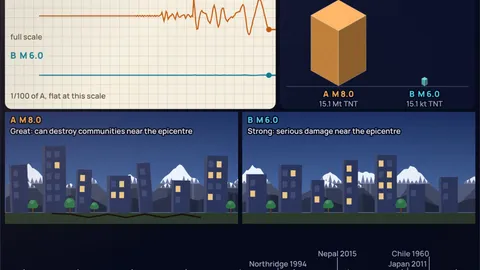
How Much Stronger Is a Magnitude 8 Than a Magnitude 6?
A magnitude 8 earthquake releases 1,000 times the energy of a magnitude 6 but shakes the seismogram only 100 times harder. The maths, with real quakes.
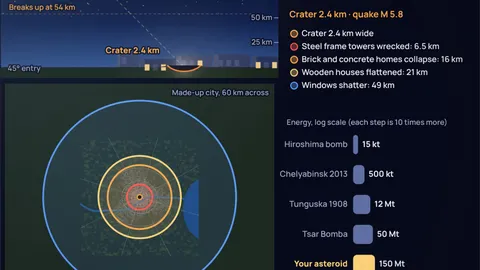
What Would Happen If an Asteroid Hit Mumbai?
A 140 m asteroid over Mumbai: 150 megatons, a 2.4 km crater and windows broken 49 km away. Three sizes worked through with the Collins impact equations.
How Much Energy Is in 1 Gram of Matter? E = mc² Worked
One gram of mass is 9 × 10¹³ J, about 21 kilotons of TNT. Why bombs convert under 0.1% of their fuel, plotted from a fitted binding-energy curve.
This much Energy can Blown up Entire Earth
There are super Weapons in The Star Wars Franchise. That can Release Enough energy to Blow up a Planet. But how much energy does it take?