How Much Stronger Is a Magnitude 8 Than a Magnitude 6?
On 25 April 2015 a fault under Nepal slipped and the Gorkha earthquake, magnitude 7.8, shook Kathmandu. Four years earlier the Tohoku earthquake off Japan was magnitude 9.1. The numbers look close, 7.8 and 9.1, a difference you might round away. In energy, Tohoku was about 89 times bigger. That gap between how magnitudes look and what they mean is what this post is about.
You can set any two magnitudes side by side in the earthquake energy calculator. It draws both seismograms on one scale, shows the energy as cubes, and puts both quakes on a magnitude ruler marked in tonnes of TNT.
What does one step of magnitude mean?
Charles Richter built his scale in 1935 from a simple measurement: the largest swing of the needle on a standard seismograph, 100 km from the quake. Earthquakes vary so much in size that he used the logarithm of that swing. One step up means the swing is 10 times larger. Modern seismologists use the moment magnitude, Mw, which is built from the physics of the fault but was calibrated to agree with Richter’s numbers where both work. The rule of 10 times per step carries over.
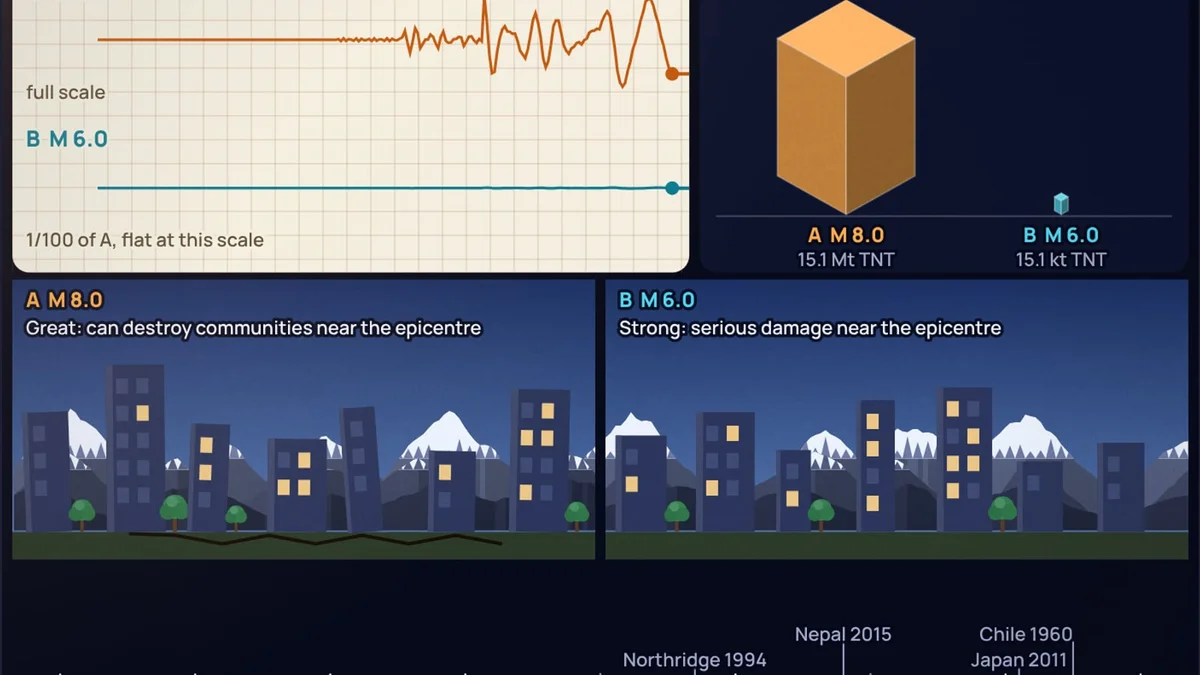
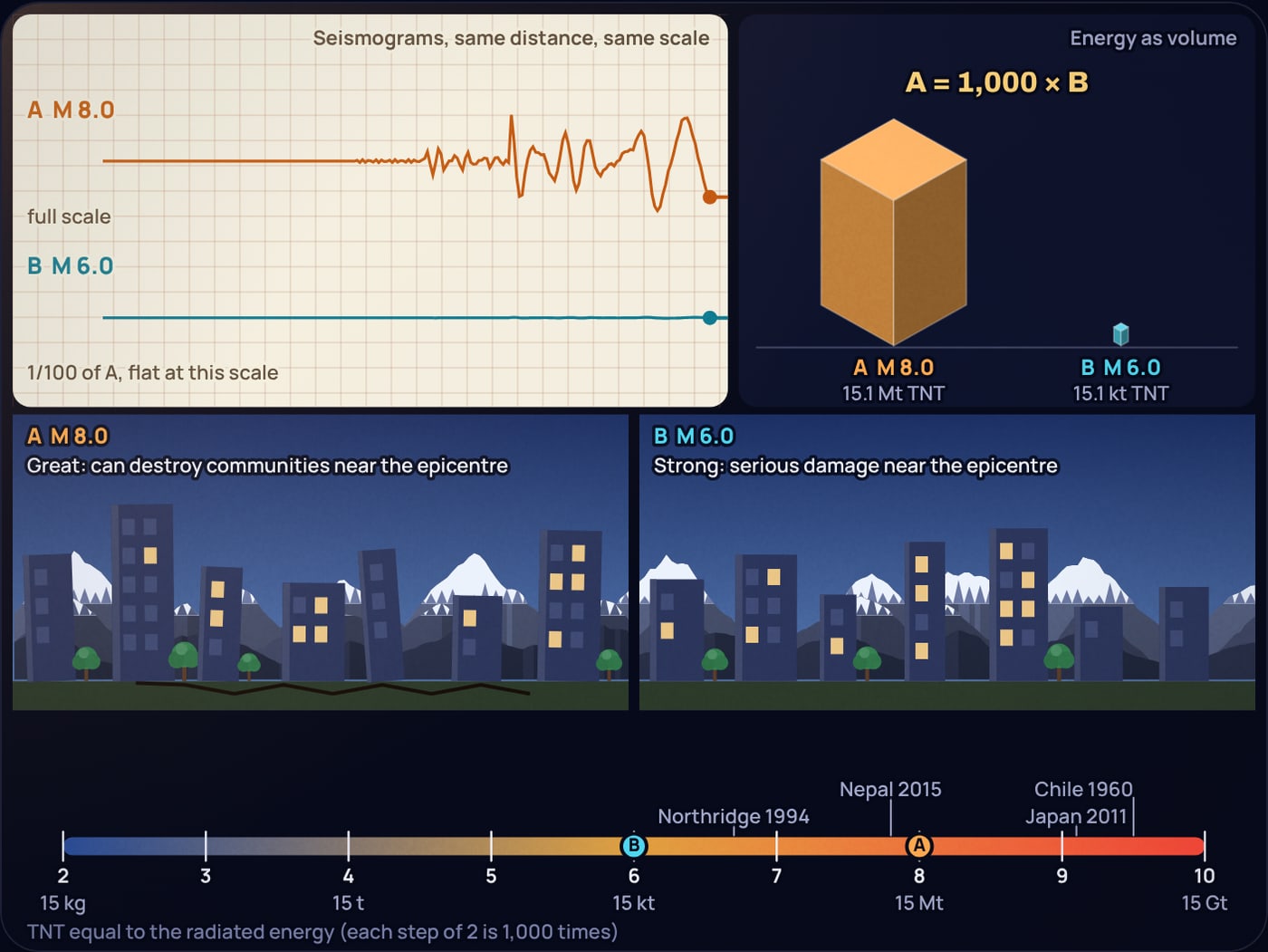
So a magnitude 8 draws a trace 100 times taller than a magnitude 6, recorded at the same distance on the same instrument. In Figure 1 the M6 trace is almost a flat line. Nothing is wrong with the drawing: at a shared scale, 1 percent of the height is just a pencil line.
Why is the energy 32 times per step, not 10?
Because a bigger earthquake shakes harder, for longer, and over a bigger area of fault. Gutenberg and Richter measured the energy carried away by seismic waves for many quakes and found an empirical rule, published by the US Geological Survey as with in ergs. One joule is 10 million ergs, so in SI units:
The factor 1.5 is the whole story. One step adds 1.5 to the logarithm, which multiplies the energy by . USGS rounds this to 32.
Worked example: magnitude 8 against magnitude 6.
The seismogram ratio is . Energy and amplitude part ways because energy carries the extra factor of 10 to the power 0.5 per step.
There is a deeper reason for the 1.5. The moment magnitude is defined from the seismic moment , the rigidity of the rock times the area of fault that slipped times the average slip, as with in newton metres. Turn it round and the moment grows as . Radiated energy is roughly proportional to the moment, so it inherits the same 1.5.
How much energy is that in TNT and Hiroshima bombs?
One tonne of TNT is defined as J, and the Hiroshima bomb released about 15 kilotons. That gives a handy anchor: a magnitude 6.0 earthquake radiates almost exactly one Hiroshima of seismic energy, and every two steps multiplies it by 1,000.
| Magnitude | Radiated energy | TNT equivalent | Hiroshima bombs | Example |
|---|---|---|---|---|
| 4.0 | 6.3 × 10¹⁰ J | 15 t | 0.001 | Rattles windows |
| 5.0 | 2.0 × 10¹² J | 477 t | 0.03 | Cracks plaster |
| 6.0 | 6.3 × 10¹³ J | 15 kt | 1 | Damage near the epicentre |
| 6.7 | 7.1 × 10¹⁴ J | 169 kt | 11 | Northridge 1994 |
| 7.0 | 2.0 × 10¹⁵ J | 477 kt | 32 | Major quake |
| 7.8 | 3.2 × 10¹⁶ J | 7.6 Mt | 504 | Nepal 2015, Turkey 2023 |
| 8.0 | 6.3 × 10¹⁶ J | 15 Mt | 1,010 | Great quake |
| 9.1 | 2.8 × 10¹⁸ J | 674 Mt | 44,900 | Japan 2011, Sumatra 2004 |
| 9.5 | 1.1 × 10¹⁹ J | 2.7 Gt | 179,000 | Chile 1960 |
Worked example: Nepal 2015 in Hiroshima bombs.
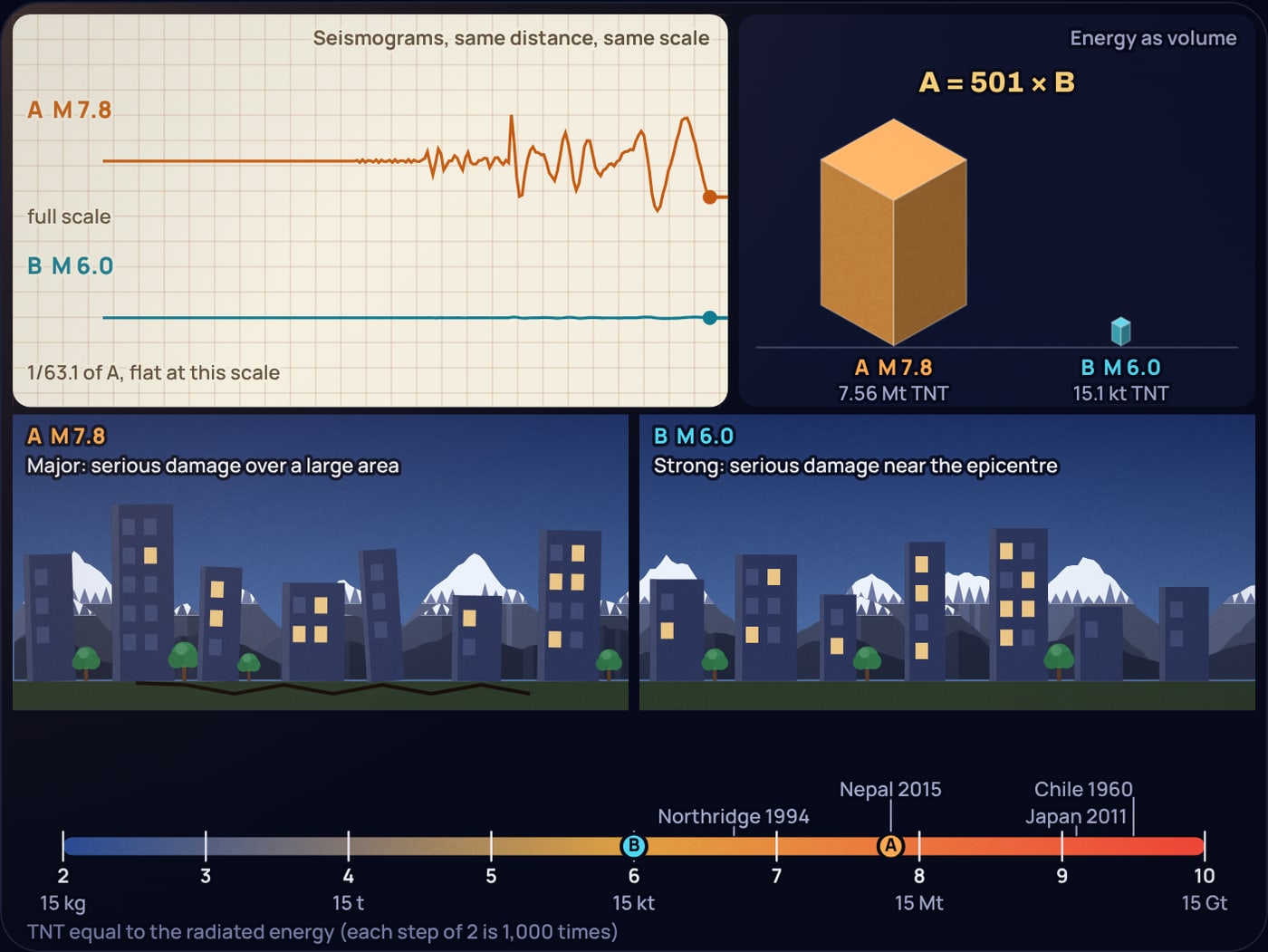
The comparison is about energy only, and it flatters the bomb in one way and the quake in another. A bomb puts its energy out in a millionth of a second at one point. An earthquake spreads it over tens of seconds along a fault more than 100 km long. And the radiated seismic energy is only the part that travels as waves; most of the energy released by the fault goes into heat and broken rock. For a sense of how these numbers compare with other big releases, see how much energy is locked in one gram of matter and the asteroid impact post, where a 140 m asteroid shakes the ground like a magnitude 5.8.
Japan 2011 against Nepal 2015
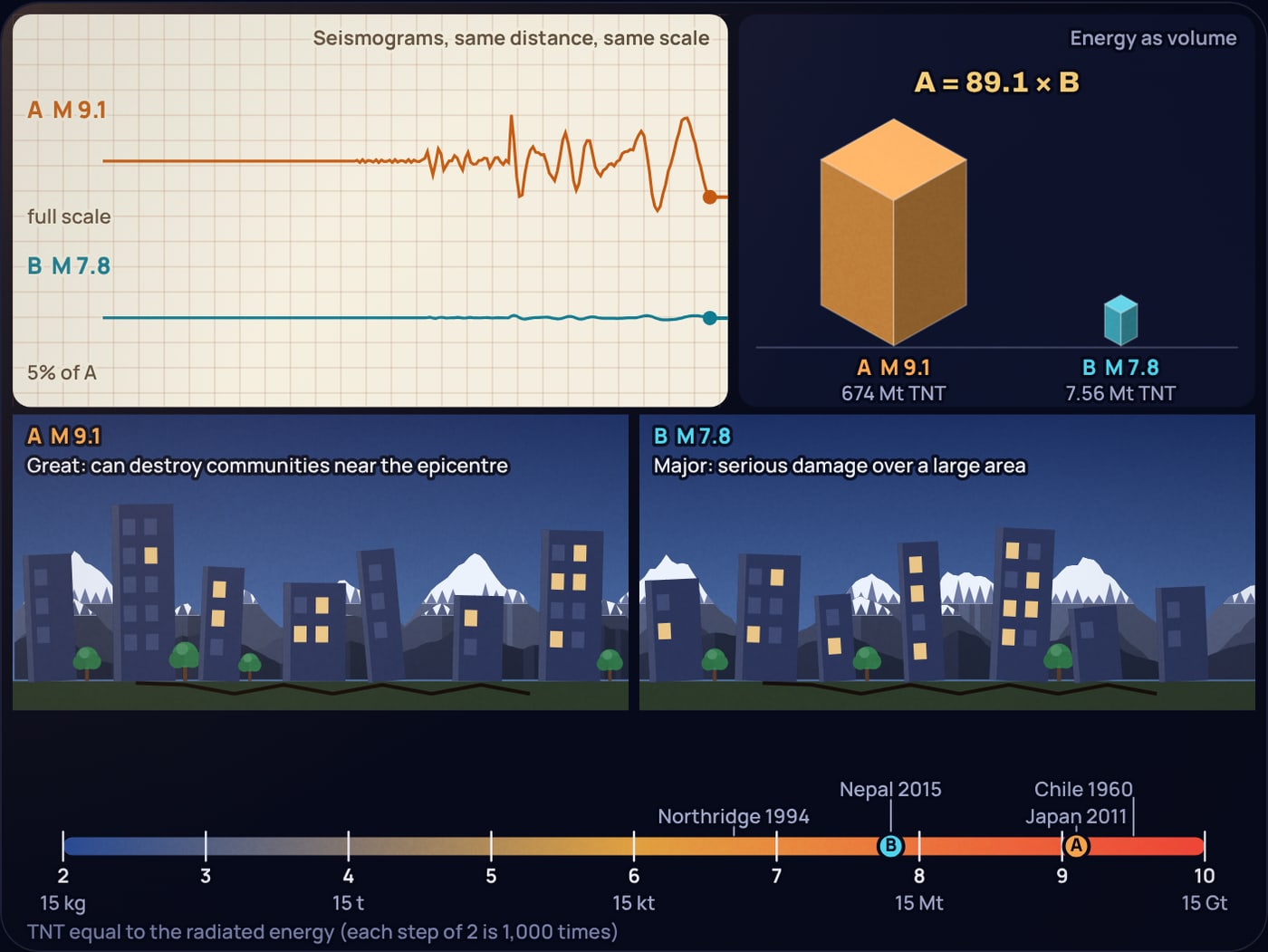
Here the difference is 1.3 magnitude units. The trace ratio is and the energy ratio is . Tohoku radiated about 674 megatons of TNT equivalent, about 45,000 Hiroshimas. Most of its deaths came from the tsunami, not the shaking, which is a reminder that energy is only one part of the damage story.
At the very top of the list sits Chile, 22 May 1960, magnitude 9.5. It is only 0.4 steps above Tohoku, yet that is 4 times the energy, about 2.7 gigatons of TNT. In the Chile against Japan setup the two cubes are close in width, because a cube 4 times the volume is only 1.6 times wider.
Does a bigger magnitude always mean more damage?
No. Magnitude measures the earthquake; the damage depends on where you are. Three things matter as much as magnitude.
Distance and depth. Shaking falls off quickly with distance. A shallow magnitude 6 directly under a city can do more harm than a magnitude 7 a hundred kilometres away or 600 km deep.
Ground. Soft sediments amplify shaking. The 1985 Mexico City disaster happened more than 300 km from the epicentre, on an old lake bed that rang like a bell.
Buildings. The 2001 Bhuj earthquake in Gujarat (magnitude 7.7) and the 2010 Haiti earthquake (magnitude 7.0) killed far more people than quakes of similar size in places with stronger building codes.
That is why the towns in the simulator shake on a compressed scale and are labelled with the general USGS style classes (“strong”, “major”, “great”) rather than a prediction. The local shaking is measured on a different scale, the Modified Mercalli intensity, which runs in Roman numerals from I to XII.
Two common misunderstandings
"A magnitude 8 is twice a magnitude 4." It is 4 steps: 10,000 times the trace height and , a million times the energy.
"Lots of small quakes let off pressure and prevent a big one." Try the numbers. To release the energy of one magnitude 7.8 you would need magnitude 5 quakes. A fault producing hundreds of M5s a year is very unusual; one producing thousands would be front page news. Small quakes do relieve a little stress, but nowhere near enough.
How accurate is the energy formula?
Good to within a factor of about 2 for typical quakes. Two earthquakes of the same moment magnitude can differ in radiated energy by a factor of several, depending on how fast the fault slipped. USGS also gives a rough alternative, , which gives 38 percent more energy than the Gutenberg-Richter rule at magnitude 5 and 26 percent less at magnitude 9. The ratio between two magnitudes, which is what most people want to know, is much more robust: 31.6 times per step under Gutenberg-Richter, 27.5 times under the USGS alternative. Both say "about 30".
The quickest way to get a feel for it is to play. Open the calculator with magnitude 7 against magnitude 5, then drag quake B up one tenth at a time and watch the small cube grow.
Sources
- USGS: Earthquake magnitude, energy release, and shaking intensity
- Spence, Sipkin and Choy (1989), Measuring the size of an earthquake, USGS Earthquakes and Volcanoes 21 (scanned copy)
- USGS: 20 largest earthquakes in the world
- USGS: Rapid characterization of the 2015 Mw 7.8 Gorkha, Nepal, earthquake sequence
- USGS: The Mw 7.7 Bhuj earthquake, global lessons for earthquake hazard in intra-plate regions
Frequently asked questions
How much stronger is a magnitude 8 than a magnitude 6?
A magnitude 8 earthquake releases about 1,000 times more energy than a magnitude 6, and its seismogram is 100 times taller at the same distance. Each whole step is 10 times the amplitude and about 31.6 times the energy.
Is a magnitude 7 ten times stronger than a magnitude 6?
Ten times bigger on the seismogram, yes. In energy it is about 31.6 times bigger, which USGS rounds to 32. So the answer depends on whether you mean the wiggle a seismometer records or the energy the quake sends out.
How many Hiroshima bombs is a magnitude 7.8 earthquake?
About 500. A magnitude 7.8 quake, like Nepal in 2015 or Turkey in 2023, radiates about 3.2 times 10 to the 16 joules, roughly 7.6 megatons of TNT. The Hiroshima bomb was about 15 kilotons.
Can small earthquakes prevent a big one?
No. Because energy grows about 32 times per magnitude step, it would take roughly 1,000 magnitude 5 quakes to release the energy of one magnitude 7, and about 32,000 to match a magnitude 8. Faults do not produce small quakes anywhere near that fast.
What is the biggest possible earthquake?
The scale has no upper limit, but the size of real faults does. The largest recorded is the 1960 Chile earthquake, magnitude 9.5. A magnitude 10 would need a fault longer than any known one to slip at once.
 Charging a Capacitor: Where Half the Energy Goes
 Could an Iron Man Arc Reactor Work? The Fusion Numbers