What Would Happen If an Asteroid Hit Mumbai?
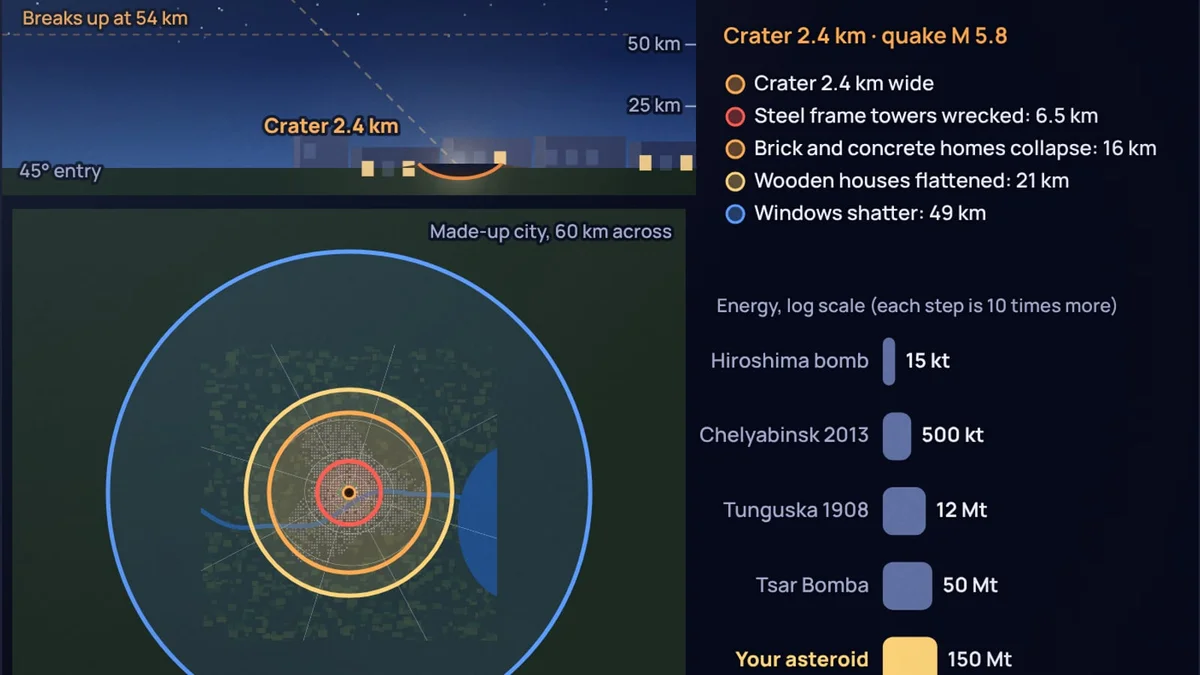
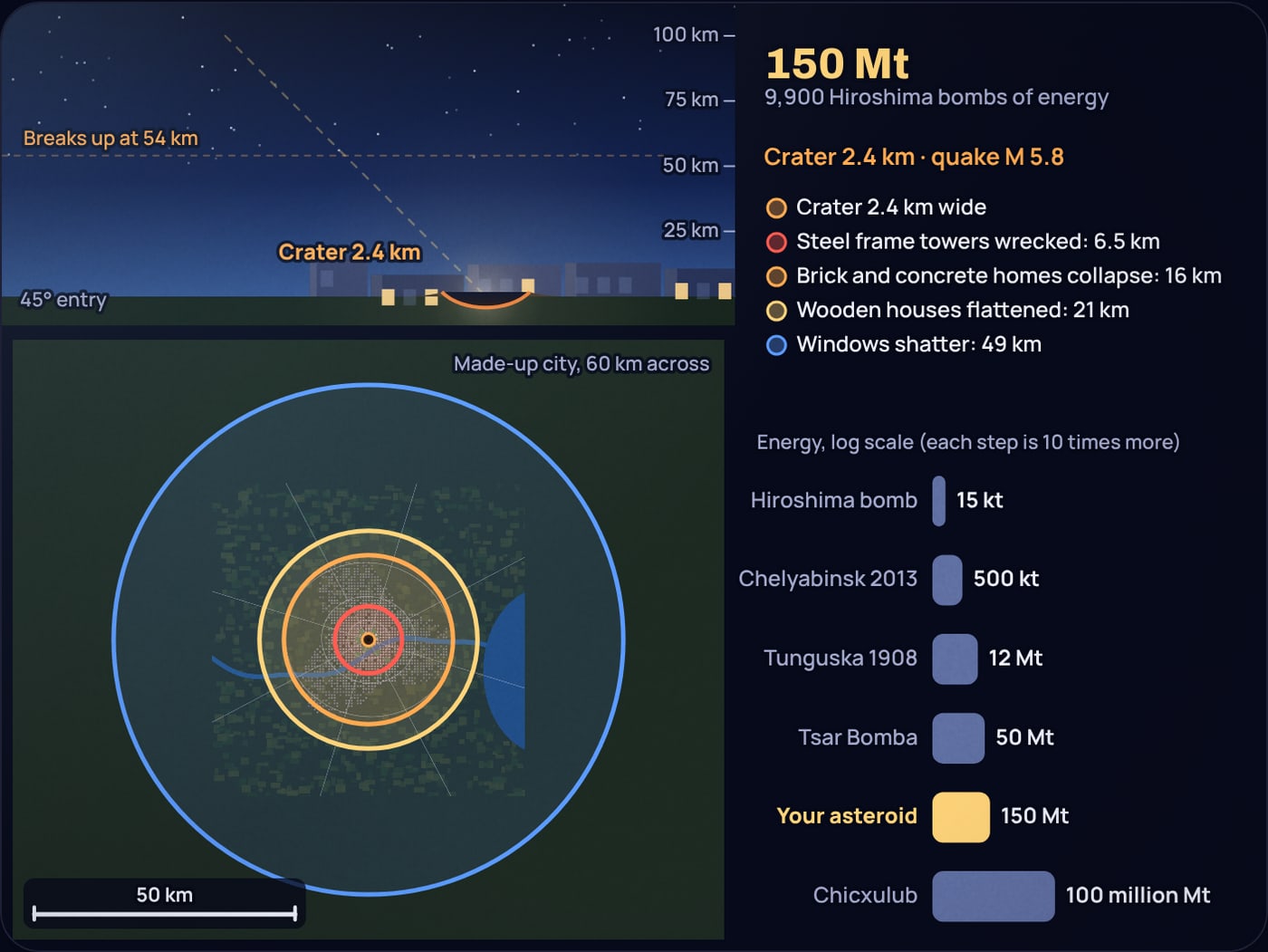
A stony rock 140 m across, the width of a cricket ground, arrives over Mumbai at 17 km/s. It weighs about 4.3 million tonnes and carries 150 megatons of kinetic energy, roughly 9,900 Hiroshima bombs. The air cannot stop it. It reaches the ground, digs a crater 2.4 km wide, and the blast collapses brick and concrete buildings out to 16 km. A city of 12.4 million people that is about 40 km long would be wrecked from end to end.
Those numbers come from the asteroid impact simulator, which runs the published equations of the Earth Impact Effects Program by Collins, Melosh and Marcus (2005). Below we go through three sizes over a city like Mumbai, show the arithmetic, and are honest about where the model is shaky.
How much energy does an asteroid carry?
Almost all of it is speed. Asteroids meet Earth at 11 to 72 km/s, and kinetic energy goes as the square of speed, so even a modest rock carries more energy than any bomb ever built. Treating the rock as a sphere of diameter and density :
Worked example: the 140 m rock. Stony asteroids are about 3,000 kg/m³.
Hiroshima was about 15 kilotons, so this is about 9,900 Hiroshima bombs, or three times the largest bomb ever tested, the 50 Mt Tsar Bomba.
The cube in the formula is the part people underestimate. Double the diameter and the energy goes up eight times. The Tunguska object of 1908 was perhaps 60 m wide; the 140 m rock is only 2.3 times wider but carries 16 times the energy.
Does every asteroid make a crater?
No, and this is the most common wrong idea about impacts. Small rocks are crushed by the air. As a rock dives, the air piling up in front of it pushes on its nose with a pressure of about . At 19 km/s and 30 km altitude that is millions of pascals, more than most stony asteroids can take. The rock cracks, the pieces spread sideways like a pancake, the drag shoots up and the whole energy is dumped within a few kilometres of height. That is an airburst. No crater, but a blast wave that reaches the ground.
Collins and colleagues turned this into a recipe. The rock’s strength comes from its density, the breakup height from the point where air pressure beats that strength, and the burst height from where the spreading swarm reaches seven times its original width. If that height is above the ground, it is an airburst; if not, the swarm hits and digs a crater.
A 20 m rock: Chelyabinsk over Mumbai
On 15 February 2013 a rock about 20 m wide came in over Chelyabinsk in Russia at 19 km/s on a shallow 18 degree path. Run the same rock in the simulator and it starts to break up near 56 km and bursts 32 km up with about 540 kilotons. Observers put the peak brightness at about 30 km, so the model lands close.
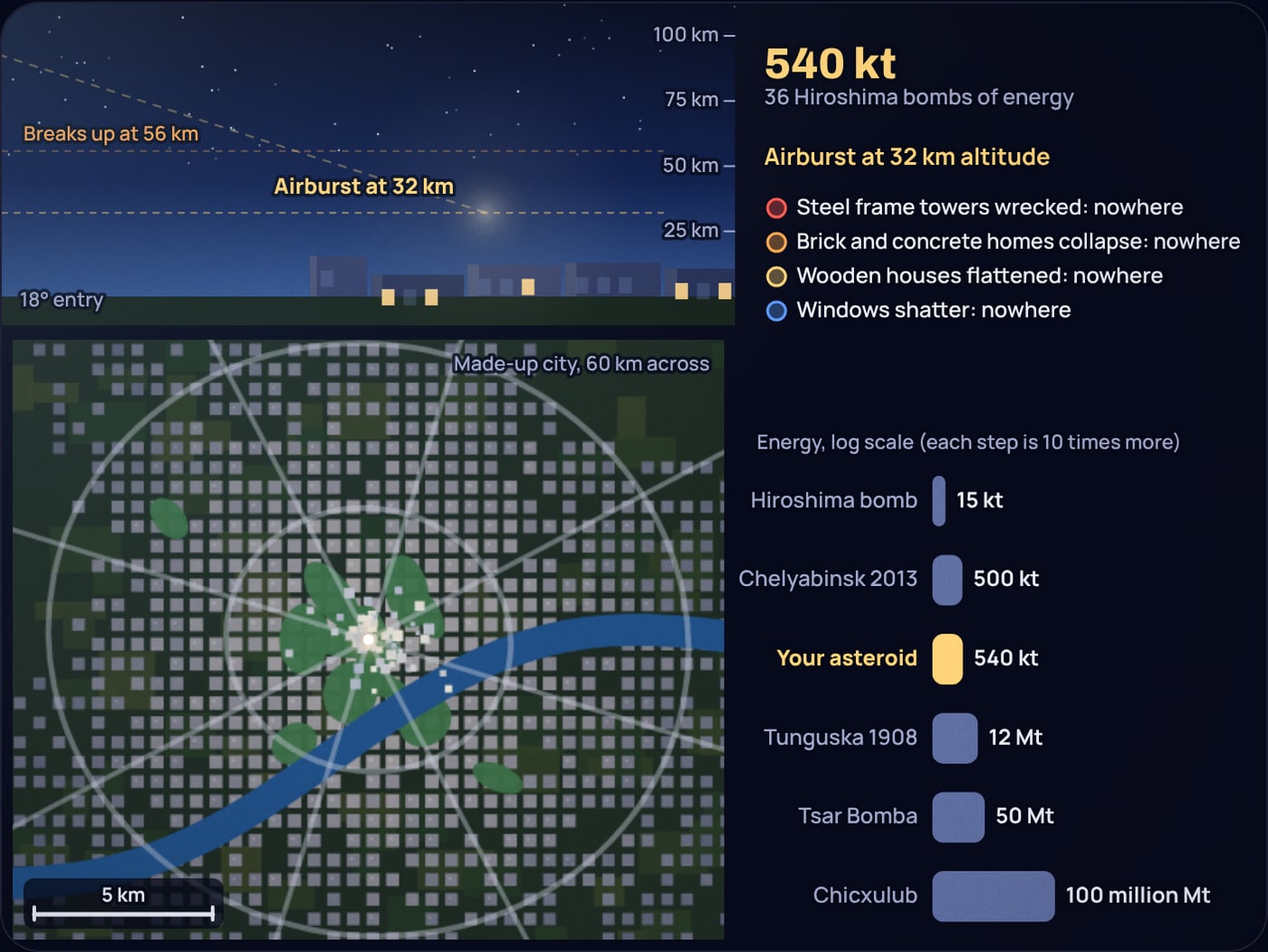
Here the model shows its limits, and it is worth being clear about them. It predicts a ground overpressure of only about 0.14 kPa, below every damage ring in the simulator, the smallest of which is 6.9 kPa (“all windows shatter”). In reality the shock broke windows across Chelyabinsk and about 1,500 people were hurt, mostly by flying glass. Glass starts to crack at around 1 kPa, and the curve the model uses for very high bursts comes from nuclear tests that were never set off 30 km up. Over Mumbai, a Chelyabinsk event would be a frightening flash, a boom a minute or two later and a lot of broken glass. The lesson people took from Chelyabinsk: do not go to the window after a bright flash.
A 60 m rock: Tunguska over Mumbai
In 1908 something exploded over the Tunguska river in Siberia and knocked down about 80 million trees over roughly 2,150 square kilometres. The size and energy are still argued over (estimates run from about 3 to 30 Mt), so take the preset as one plausible version: a 60 m stony rock at 15 km/s and 35 degrees. The model gives 9.1 Mt and a burst 7.8 km above the ground.
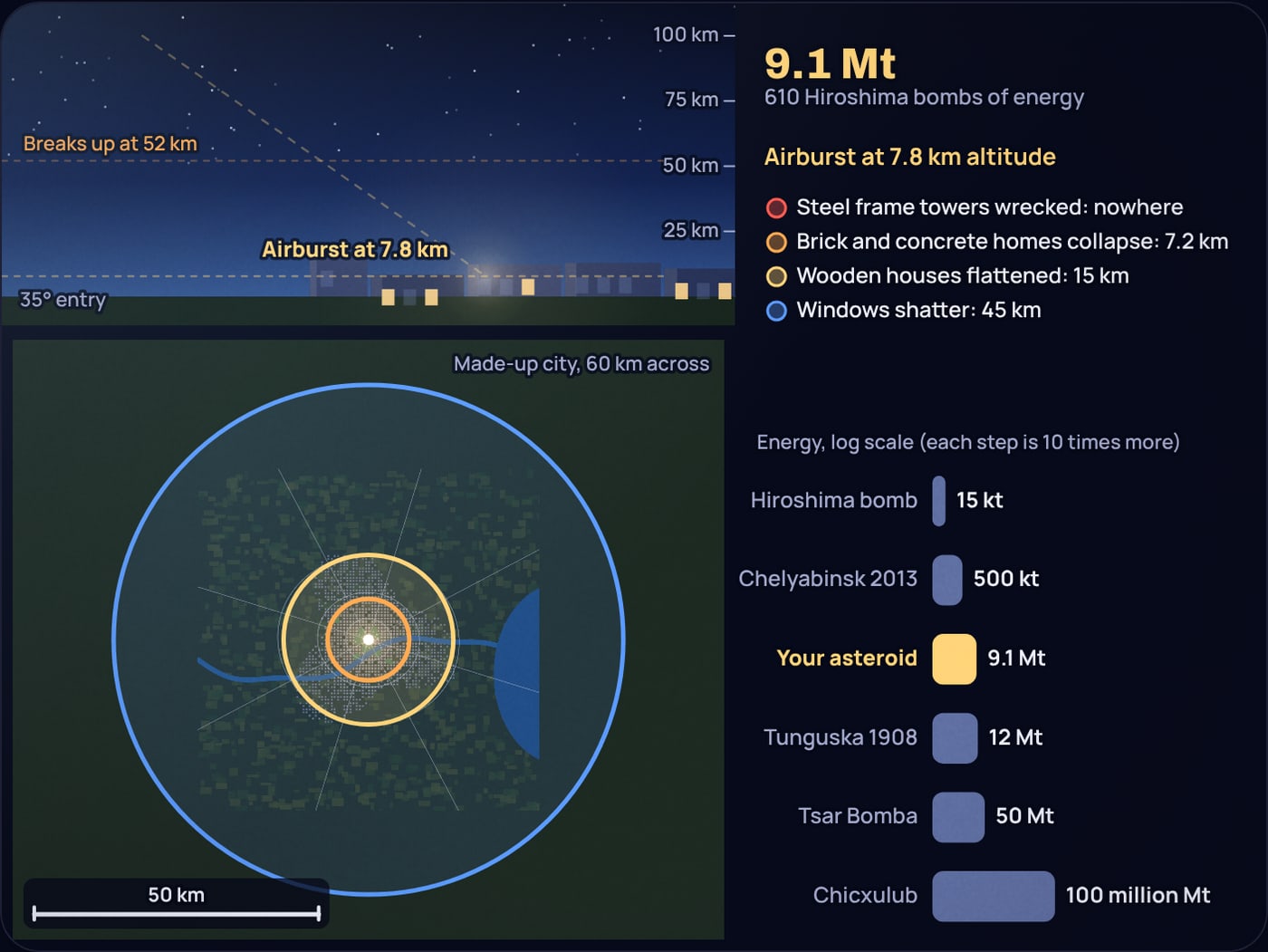
Over Mumbai, the rings work out like this. Brick and concrete buildings collapse within 7.2 km of the point below the burst. Light structures, which in Mumbai means a great deal of informal housing, are flattened out to 15 km. Windows break out to 45 km, which covers the whole of Greater Mumbai and much of Thane and Navi Mumbai. The real Tunguska damage zone had a radius of about 25 km, between the model’s 15 km and 45 km rings, which is about as good as a one-line formula can do.
An airburst is in some ways worse than a crater for a city. A burst a few kilometres up spreads its blast over a wide area, and the shock reflecting off the ground merges with the direct wave and strengthens it. Bomb designers use this on purpose.
A 140 m rock: the city killer
140 m is the size the US Congress asked NASA to find 90 percent of, because that is roughly where an impact stops being a local disaster and becomes a regional one. Our rock starts to crumble 54 km up, but it is too big to spread out before it lands, and it hits at about 12 km/s.
The crater comes from the scaling law Collins and colleagues took from Schmidt and Housen (1987), built on experiments and nuclear cratering data:
For our rock that gives a transient crater about 1.9 km across, and the final crater is 1.25 times wider, about 2.4 km. That is twice the width of Meteor Crater in Arizona, the best preserved impact crater on Earth, which a 40 to 50 m iron body dug about 50,000 years ago. The simulator’s Meteor Crater preset gives 1.3 km against the real 1.2 km.
The blast rings in Figure 1 are 6.5 km for steel frame towers, 16 km for brick and concrete, 21 km for wooden houses and 49 km for windows. The ground shock equals a magnitude 5.8 earthquake (the model assumes 1 part in 10,000 of the energy goes into seismic waves; compare it with real quakes in the earthquake energy calculator).
Why do the damage rings grow so slowly?
Blast pressure at a distance follows a simple rule from nuclear testing: a blast with 1,000 times the energy reaches the same pressure only 10 times farther away. Distance scales with the cube root of energy.
Worked example: cube root scaling. A 1 kiloton surface burst produces 75 kPa at 290 m (this is the reference point in the Collins blast formula). What distance gets the same pressure for 150 Mt?
So the 140 m rock delivers 75 kPa, enough to destroy most buildings, at about 15 km. The full formula in the simulator also bends the curve, but the cube root does most of the work.
This is why going from Tunguska to Apophis size, about 130 times the energy, only widens the window ring from 45 km to 120 km. Damage area grows, but much more slowly than energy. Doubling the asteroid’s width multiplies the energy by 8 but only doubles the damage radius.
| Asteroid | Energy | What happens | Brick buildings collapse | Windows shatter |
|---|---|---|---|---|
| 20 m stony (Chelyabinsk) | 540 kt | Airburst at 32 km | nowhere | nowhere in the model |
| 60 m stony (Tunguska) | 9.1 Mt | Airburst at 7.8 km | 7.2 km | 45 km |
| 140 m stony | 150 Mt | 2.4 km crater | 16 km | 49 km |
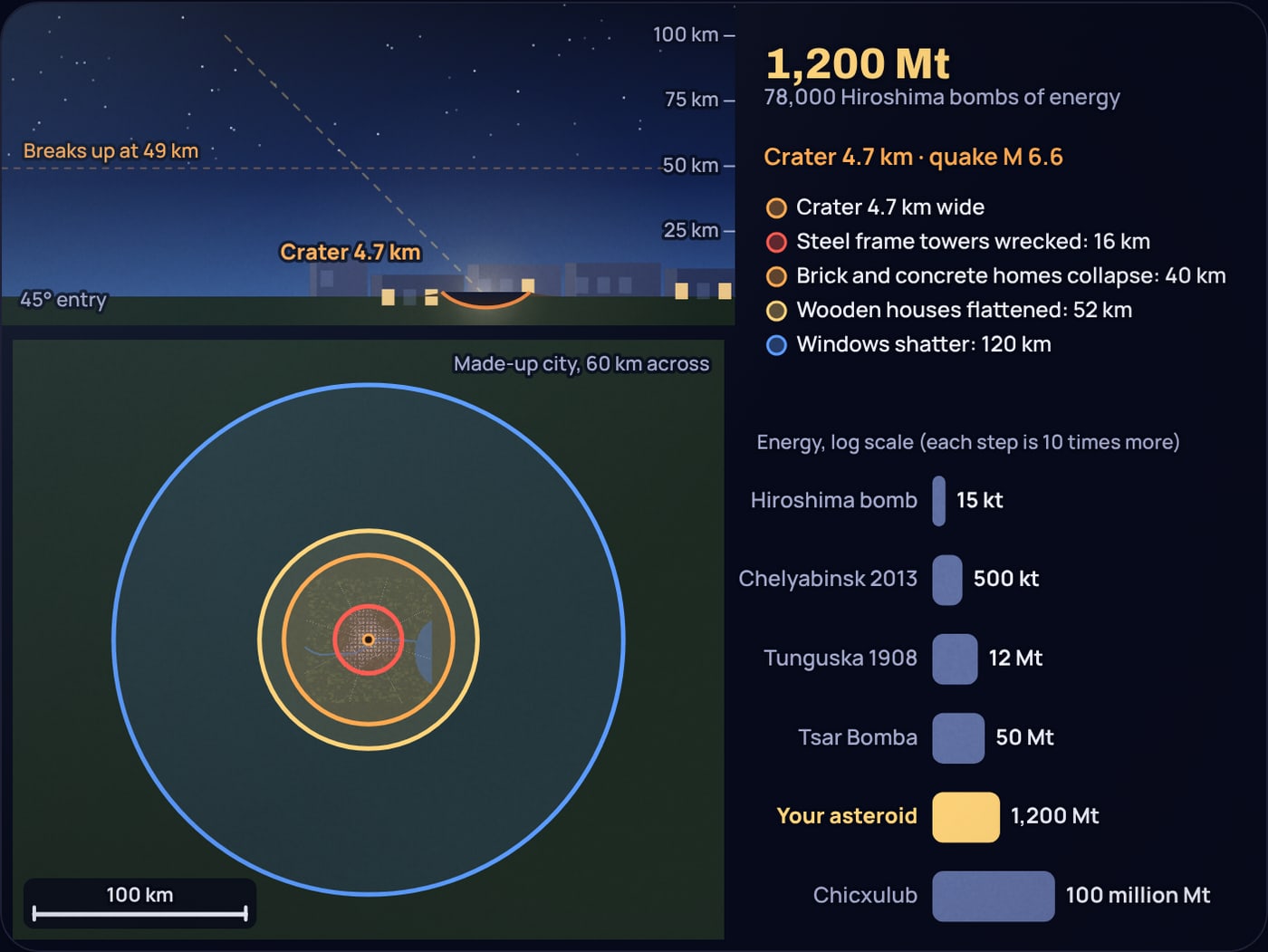
| 340 m stony (Apophis size) | 1,200 Mt | 4.7 km crater | 40 km | 120 km |
What about Apophis and Bennu?
Two asteroids get most of the headlines. Apophis, about 340 to 375 m across, will pass about 32,000 km above Earth on 13 April 2029, closer than the satellites that carry your television signal. Radar measurements in 2021 ruled out any impact for at least a century. Played as a what if, a rock that size releases about 1,200 Mt and digs a 4.7 km crater.
Bennu, the rubble pile that NASA’s OSIRIS-REx sampled, is about 490 m wide with a cumulative impact chance of about 1 in 1,750 through the year 2300, highest on 24 September 2182. If you want the Hollywood answer to that, our post on whether a nuke could stop an asteroid runs the numbers on Armageddon and on DART, the mission that actually nudged one.
What are the chances of an asteroid hitting Mumbai?
Small, and we can estimate how small. Collins and colleagues fitted the survey counts of near-Earth asteroids to a simple rule for how often an impact of a given energy happens somewhere on Earth: years.
Worked example: Tunguska over Mumbai.
The danger area is Mumbai (about 40 km by 15 km) with a 15 km margin on every side, the reach of the wooden house ring. So roughly one Tunguska over Mumbai every 100 million years.
Seen from the other side, a Tunguska somewhere on Earth every few hundred years is a real risk for the planet as a whole, and most of Earth is ocean or empty land, which is why we have seen only one in the last century. Rocks big enough for the 140 m case arrive somewhere about once every 5,000 years. Chelyabinsk-size events, the window breakers, come every few decades.
What the model leaves out
Treat every number above as good to tens of percent, not to the last digit. Real asteroids are not uniform spheres, and two rocks of the same density can differ tenfold in strength, which moves the burst height a lot. The crater constants are only known within a range of 0.8 to 1.5. The blast rings are fits to nuclear test data over flat ground; Mumbai’s high-rises would shield some areas and channel the blast in others. The model does not compute heat for impacts slower than 15 km/s or for airbursts, though both would start fires. And Mumbai sits on the sea: an ocean impact of a few hundred metres would make a tsunami, which this model does not draw.
For the extreme end, try the dinosaur killer preset: a 10 km rock with about 75 million megatons, where the map turns into a globe. For how much energy it would take to go further and break the planet apart, see this post on blowing up Earth.
The best next step is to try your own: open the simulator with the Tunguska rock, then switch the material from stony to iron and watch the airburst turn into a 1.6 km crater.
Sources
- Collins, Melosh and Marcus (2005), Earth Impact Effects Program, Meteoritics & Planetary Science 40, 817 to 840
- Popova and others (2013), Chelyabinsk airburst, summary by UC Davis
- NASA: 115 years ago, the Tunguska asteroid impact event
- ESA: Apophis
- NPR: Got plans for Sept. 24, 2182? Bennu impact odds
- Melosh and Collins (2005), Meteor Crater formed by low-velocity impact, Nature 434, 157
- City Population: Greater Mumbai, census 2011
Frequently asked questions
What would happen if an asteroid hit Mumbai?
It depends on size. A 20 m rock like Chelyabinsk would explode about 30 km up and mainly break windows. A 60 m rock like Tunguska would burst about 8 km up and flatten wooden houses over a 15 km radius. A 140 m rock would reach the ground with about 150 megatons, dig a 2.4 km crater and collapse brick buildings out to 16 km, which covers most of Mumbai.
How big does an asteroid need to be to destroy a city?
A stony asteroid of about 50 to 60 m can flatten weak buildings across a whole city even when it explodes in the air. At about 140 m, the size NASA was asked to find, it reaches the ground and levels brick and concrete buildings over a radius of about 16 km.
What are the chances of an asteroid hitting Mumbai?
Very small. A Tunguska-class impact happens somewhere on Earth roughly every 600 years, but Mumbai and its surroundings cover only about 6 millionths of Earth’s surface. That works out to roughly one such event over Mumbai every 100 million years.
Would an asteroid hitting the sea near Mumbai cause a tsunami?
A large one could. Rocks a few hundred metres across or bigger that hit deep water can raise waves that cross an ocean. Small rocks that burst in the air do not. The simulation and the numbers in this post assume a land impact, so treat the ocean case as a separate problem.
Can we stop an asteroid from hitting Earth?
Given years of warning, yes for small and medium rocks. NASA’s DART spacecraft changed the orbit of the asteroid moonlet Dimorphos in 2022 by hitting it. The key is finding the rock early, which is why surveys aim to catalogue every near-Earth asteroid bigger than 140 m.
- Asteroid impact simulator Pick an asteroid's size, material, speed and angle. Watch it airburst or dig a crater, with blast rings over a city and energy in Hiroshima bombs.
- Earthquake energy calculator Compare two earthquake magnitudes: seismograms on one scale, energy as cubes, TNT and Hiroshima equivalents, with Nepal, Japan and Chile presets.
 How Much Stronger Is a Magnitude 8 Than a Magnitude 6?
 What If Earth Became a Black Hole? (It Would Fit in Your Hand)