How Much Energy Is in 1 Gram of Matter? E = mc² Worked
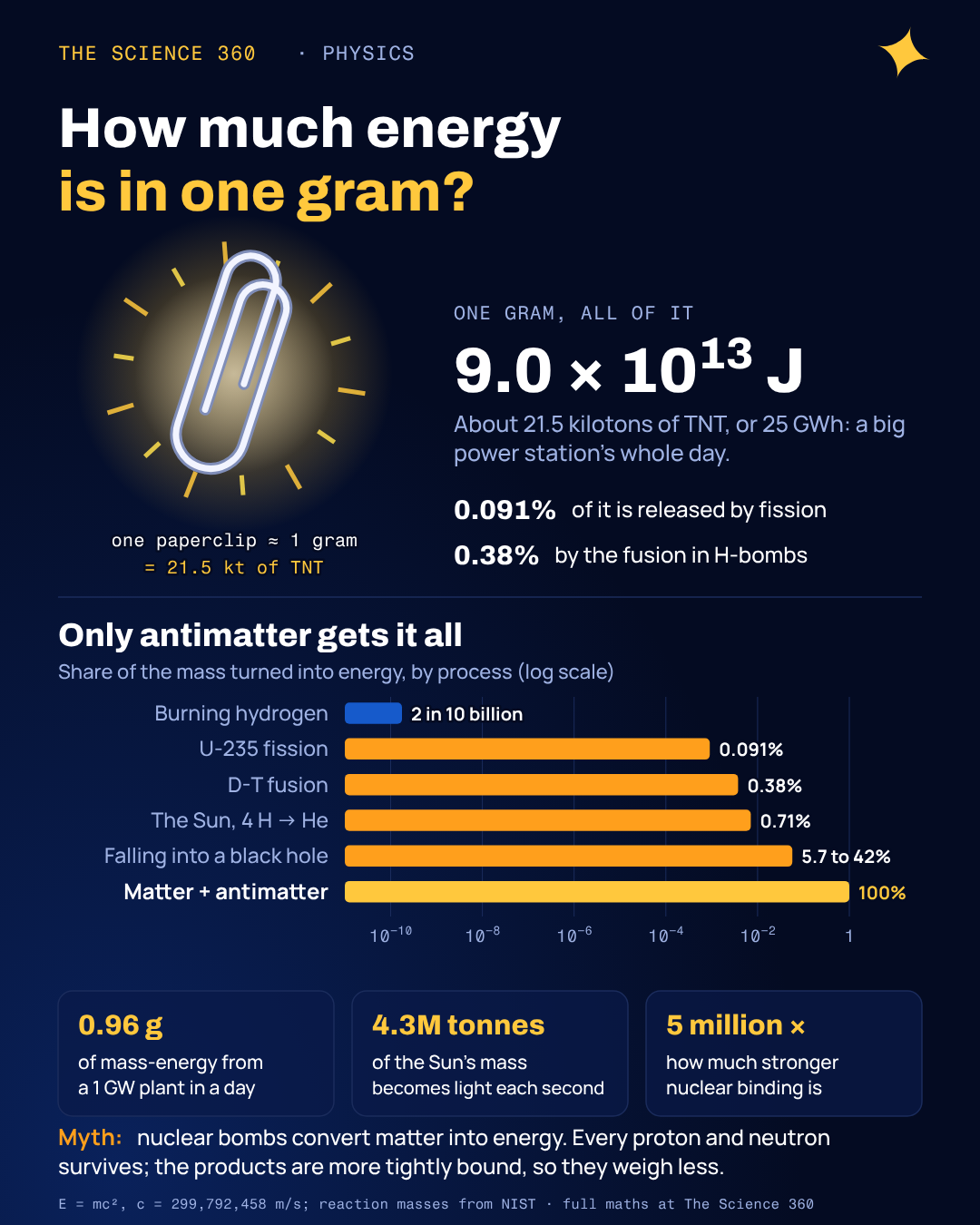
A paperclip weighs about a gram. If you could turn all of it into energy, you would get 90 trillion joules, more than the bomb that destroyed Hiroshima. The bomb itself held 64 kilograms of uranium, the mass of a person, and of that 64 kg it turned 0.7 grams into energy. Less than a paperclip.
That gap is the part most answers to this question skip. The search results give you the multiplication, 0.001 × c², and stop. But the more useful questions are why no practical process gets anywhere near that number, and what "converting mass to energy" actually means, because it does not mean what most people think. Nothing in a nuclear bomb is destroyed.
The calculation: 1 gram times c squared
The speed of light is exactly 299,792,458 m/s; since 1983 the metre has been defined from it. Everything else is arithmetic.
Energy equivalent of 1 gram
In other units
TNT, with 1 kiloton = 4.184 × 10¹² J, and electricity:
A 1 GW power station running for 24 hours: 8.64 × 10¹³ J, the mass-energy of 0.96 g.
So a large power station produces the mass-energy of about one gram per day. That is a useful anchor: a gram is a day of a city's electricity, if you could get at it. The catch, which the rest of this post is about, is that you almost never can.
The misconception: “nuclear bombs convert matter into energy”
The phrase is everywhere, and it suggests that atoms get used up, the way wood gets used up in a fire. They do not. Count the particles in a fission reaction and they all come out the other side:
One way uranium-235 can split, with masses from NIST
Protons: 92 → 56 + 36 = 92. Nucleons: 236 → 141 + 92 + 3 = 236.
That is released at the moment of fission.
The barium and krypton fragments are radioactive and decay over minutes to weeks, ending as stable praseodymium-141 and zirconium-92. Running the same sum to those end products gives 199 MeV, which is the "about 200 MeV per fission" figure you see quoted; part of the decay energy leaves as neutrinos and is lost even in a reactor.
Every proton and neutron survives. What changed is how tightly they are bound. A nucleus weighs less than the protons and neutrons in it, by an amount called the mass defect, and the more tightly bound the nucleus, the bigger the defect. When uranium splits into two more tightly bound fragments, the total mass drops, and the drop leaves as kinetic energy of the fragments, neutrons and gamma rays. The energy was always counted in the mass; it was the binding energy of the nucleus, just stored differently.
And here is the part almost nobody mentions: chemistry does exactly the same thing. When you burn hydrogen in oxygen, the water weighs less than the gases did. The fraction is just too small to weigh.
Mass lost when hydrogen burns
NIST: of liquid water = −285.83 kJ/mol. Energy per kilogram of water formed, and the mass fraction:
That is 0.18 micrograms per kilogram.
Burning hydrogen converts 2 parts in 10 billion of its mass. Fission converts 9 parts in 10,000. The difference between nuclear and chemical energy is not that one uses and the other does not. It is that nuclear binding is about five million times stronger.
The binding energy curve, from the liquid-drop formula
To see which reactions release energy, plot the binding energy per nucleon, the mass defect shared out among the protons and neutrons, against the number of nucleons. I computed it for every naturally occurring nuclide from NIST's atomic masses, then fitted the classic semi-empirical mass formula (the liquid-drop model) to all 2,949 nuclides with A of 16 or more in the same tables:
Semi-empirical mass formula, binding energy B for Z protons and N neutrons, A = Z + N
My least-squares fit: , , , , MeV. Root-mean-square error: 3.5 MeV on total binding energies of up to 1,800 MeV.
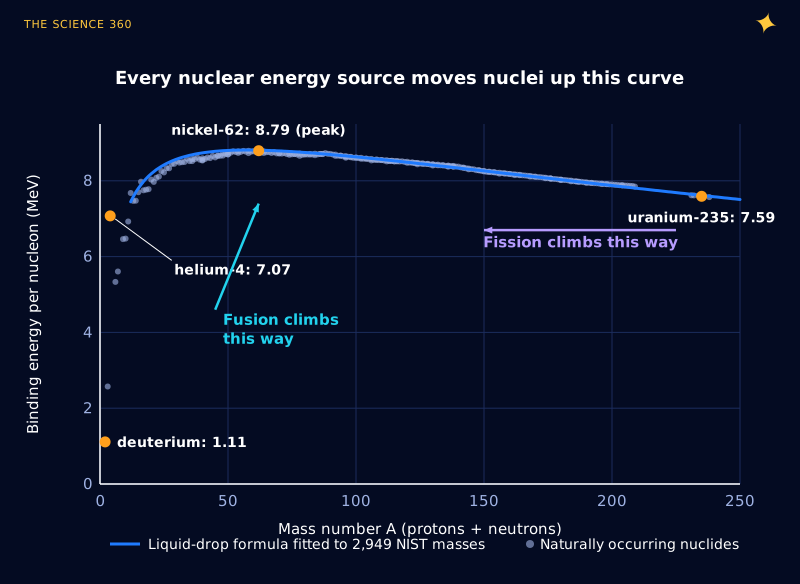
The curve explains both kinds of nuclear power at a glance. Uranium-235 sits at 7.59 MeV per nucleon. Split it into fragments near and 140, which sit around 8.3 to 8.7, and each of 236 nucleons gains roughly 0.85 MeV: about 200 MeV in total, matching the mass calculation. On the light side, the slope is steeper. Going from deuterium at 1.11 MeV per nucleon to helium-4 at 7.07 gains almost 6 MeV per nucleon, which is why fusion releases more energy per kilogram than fission.
Why does the curve peak near iron?
The liquid-drop formula treats the nucleus as a drop of incompressible nuclear fluid with an electric charge. Each term pulls the curve in one direction, and the peak is where they balance.
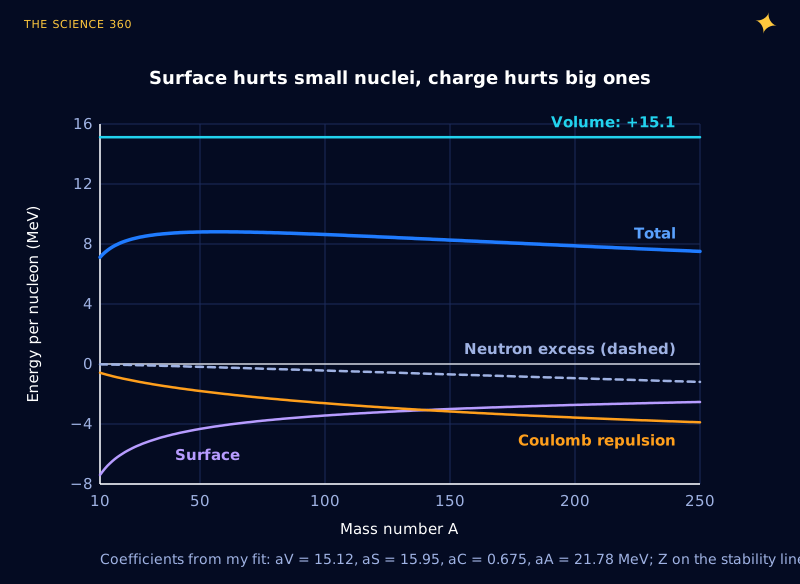
The volume term is the attraction each nucleon feels from its neighbours, the same for every nucleon inside the drop, so it is flat at 15 MeV each. Nucleons on the surface have fewer neighbours, which costs most in small nuclei, where a large fraction of them are on the surface. Protons all repel each other, and that cost grows roughly as , eventually dominating in heavy nuclei. Add a penalty for having too many neutrons, which heavy nuclei need to dilute the charge, and the total peaks near . Stars that burn their way up the curve stop there, which is why iron and nickel are so abundant and why a massive star's iron core can no longer support itself by fusion.
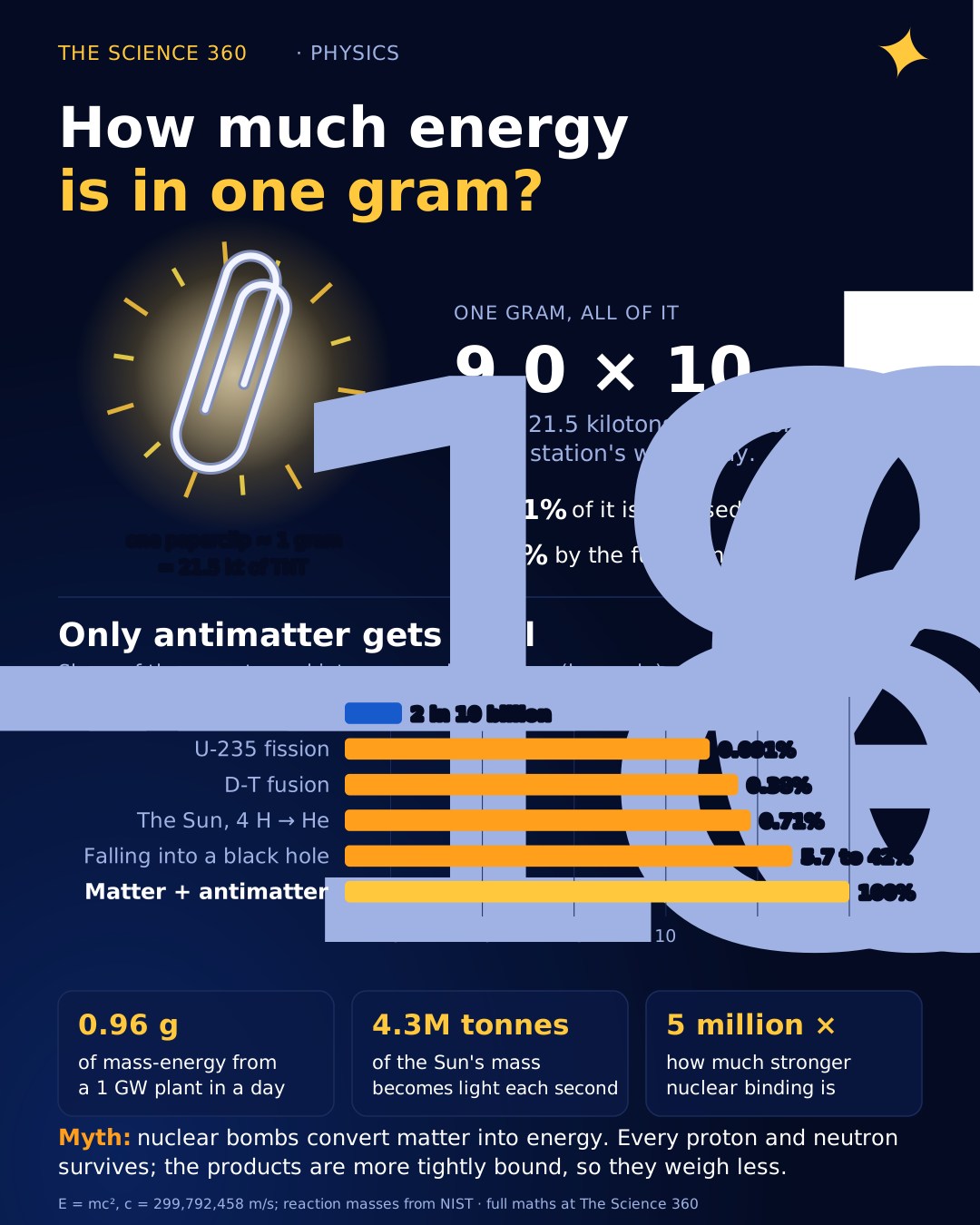
What fraction of mass does each process actually release?
Now we can answer the question that matters. Using NIST masses for each reaction:
Mass fraction released
U-235 fission, to stable end products:
:
(the Sun's net reaction):
Matter + antimatter: 100%
A common figure online says "fusion converts 0.7% of mass", and that is right only for the Sun's slow, four-step route from hydrogen to helium. The fusion actually used in hydrogen bombs and in experimental reactors like ITER is deuterium plus tritium, which converts 0.38%, about half as much. Deuterium-tritium wins because it happens at temperatures we can reach, not because it releases more.
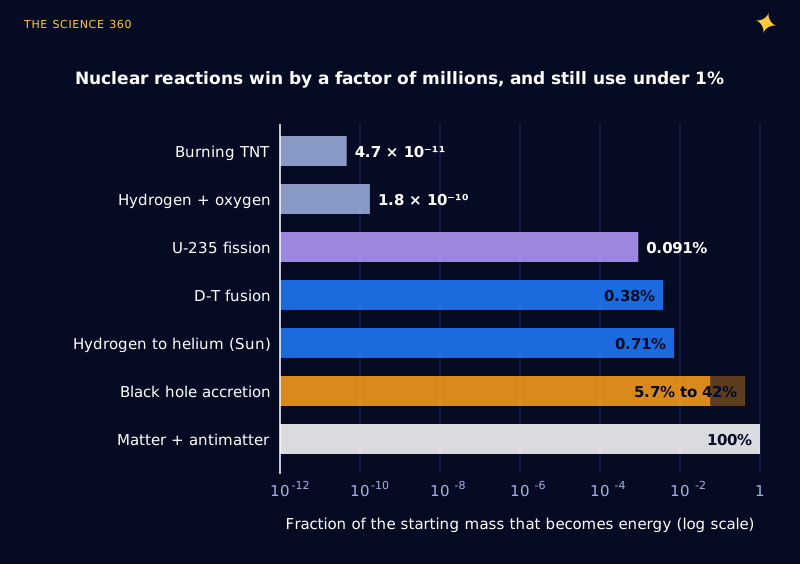
Two entries on that chart beat fusion. Annihilation is the only process that turns all of the mass into energy, because a particle and its antiparticle can disappear entirely. The other is gravity. Matter falling onto a black hole heats up and radiates before it crosses the horizon. For a non-spinning black hole, the innermost stable orbit is at and the energy given up getting there is of the rest mass. For a maximally spinning one it is . That is why quasars, powered by accretion, outshine whole galaxies. For a spin on how much mass stars squeeze into small spaces, see how much a teaspoon of neutron star weighs.
Where did the 0.7 grams go at Hiroshima?
Little Boy's yield is best estimated at 15 kilotons of TNT. It contained 64 kg of uranium enriched to an average of 80% uranium-235, and less than a kilogram of it fissioned, according to the figures Wikipedia attributes to Los Alamos and to John Coster-Mullen's study of the bomb. The rest is arithmetic.
Little Boy, from yield to mass
Fissions needed at 199 MeV (3.19 × 10⁻¹¹ J) each: 1.97 × 1024. Mass of U-235 fissioned:
Share of the 51 kg of U-235 that fissioned: 1.5%.
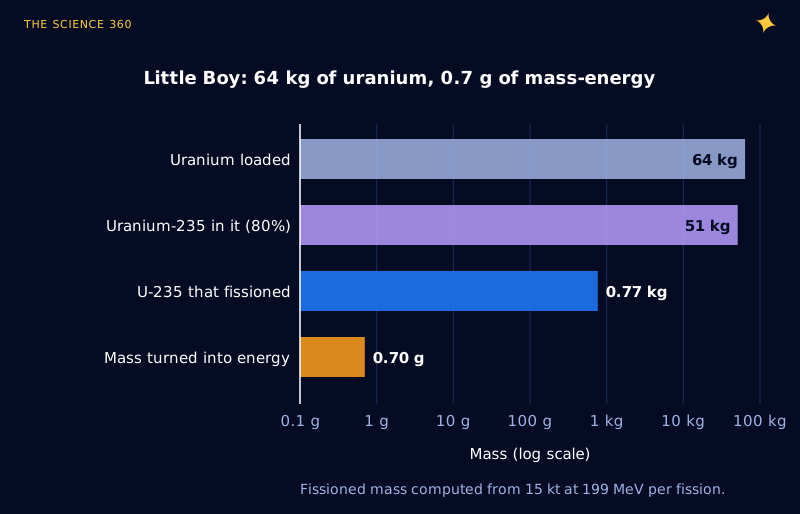
So the bomb did not "convert its uranium to energy". It used 1.5% of its fissile fuel, and that fuel gave up 0.09% of its mass. The 0.7 gram figure is exactly the mass deficit, and a careful enough scale could, in principle, have found the debris 0.7 g lighter than the bomb. If you want to see what a modern-scale yield does to an asteroid or what it would take to wreck a planet, those calculations are in the Armageddon nuke post and the Death Star energy post. And why even a far bigger blast could not set the air itself burning is worked through in could the atomic bomb ignite the atmosphere.
How much mass does the Sun lose?
Here is the same equation at its grandest. The Sun's luminosity is 3.828 × 1026 W, according to NASA's Sun fact sheet. Divide by c² and you have the mass it turns into light every second.
The Sun's mass-energy loss rate
That is 4.3 million tonnes per second. Hydrogen fused to do it, at 0.71%:
That is 600 million tonnes per second.
Even at that rate the Sun is in no hurry. Losing 4.26 × 10⁹ kg/s for 4.6 billion years adds up to 6 × 1026 kg, about 0.03% of its mass of 1.989 × 1030 kg. And this is the 0.71% route in action, every second of every day, in the core that sends sunlight on its slow way out.
Could we ever get the full 9 × 10¹³ joules?
Only with antimatter, and the problem is making it. Annihilating 1 gram of matter with 1 gram of antimatter releases twice the figure in the title, 1.8 × 10¹⁴ J or 43 kilotons, but producing the antimatter costs far more energy than it returns, because particle accelerators make it one particle at a time with tiny efficiency. Antimatter is a way to store energy, and a hopeless one by any practical measure. Fiction likes it anyway: in Project Hail Mary, the astrophage microbe stores its energy as mass, far beyond chemical density, which we pick apart in the astrophage physics post.
FAQ
How much energy is in 1 gram of matter?
gives = 8.99 × 10¹³ joules. That is about 21.5 kilotons of TNT, or 25 gigawatt-hours, roughly what a 1 gigawatt power station produces in a day. Only matter meeting antimatter releases all of it.
How much mass was converted to energy in the Hiroshima bomb?
About 0.7 grams. Little Boy's 15 kiloton yield is 6.3 × 10¹³ joules, which divided by c² is 0.7 g. The bomb held 64 kg of uranium; under a kilogram of it fissioned, and each fission turns only about 0.09% of the mass involved into energy.
What percentage of mass is converted to energy in fission and fusion?
Uranium-235 fission converts about 0.091% of the mass involved. Deuterium-tritium fusion, used in reactors and weapons, converts 0.38%. The Sun's net hydrogen to helium conversion reaches 0.71%. Burning fuel chemically converts only about one part in ten billion.
Does a nuclear bomb destroy matter?
No. Every proton and neutron that goes in comes out. The products are more tightly bound, so they weigh slightly less, and that missing mass is the energy released. Chemical reactions work the same way, but the mass change is millions of times smaller.
Related on The Science 360
Sources
- NIST, Atomic Weights and Isotopic Compositions (all nuclide masses used for the binding curve, fit and reaction Q values): physics.nist.gov
- NIST CODATA values: neutron mass 1.00866491606 u and 931.49410372 MeV per u: physics.nist.gov/cuu
- NIST Chemistry WebBook, water, standard enthalpy of formation of the liquid (−285.83 kJ/mol): webbook.nist.gov
- NASA Goddard, Sun Fact Sheet (luminosity 382.8 × 1024 J/s): nssdc.gsfc.nasa.gov
- Wikipedia, "Little Boy" (15 kt yield, 64 kg of uranium at 80% average enrichment, less than 1 kg fissioned, 0.7 g mass equivalent): en.wikipedia.org
- J. S. Díaz, "Explosion analysis from images: Trinity and Beirut", arXiv:2009.05674 (1 kt TNT = 4.18 TJ convention): arxiv.org/abs/2009.05674
Method note: binding energies use atomic masses with hydrogen atoms rather than bare protons, so electron masses cancel. The liquid-drop fit is an unweighted least-squares fit to every nuclide with A ≥ 16 in the NIST tables, which include some extrapolated masses far from stability. Black hole efficiencies are the standard innermost-stable-orbit values for Schwarzschild and extreme Kerr black holes.
Header image: NASA/SDO (image GSFC_20171208_Archive_e002035), regraded for this article.