How Much Energy to Destroy a Planet? Death Star Math
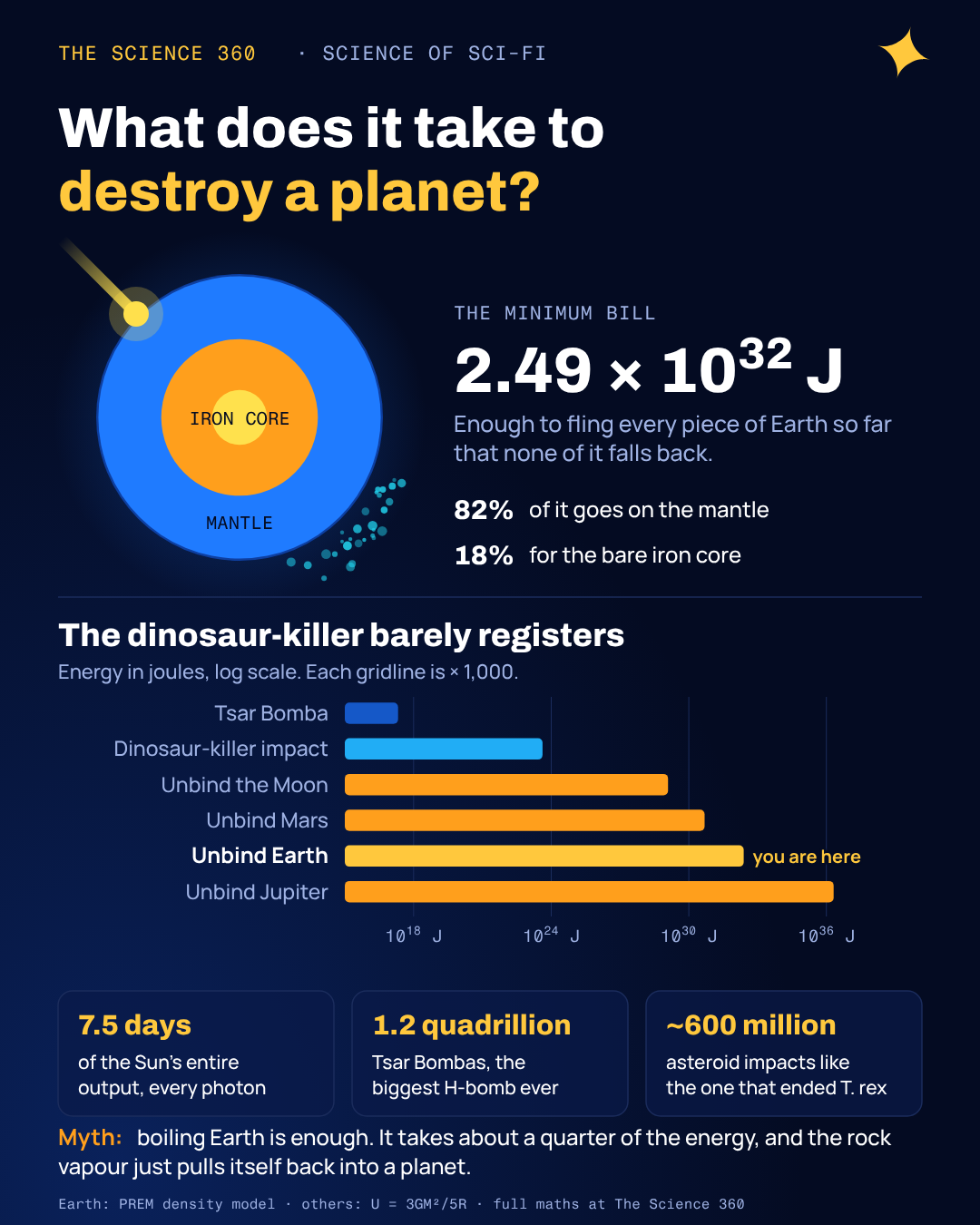
Alderaan takes about two seconds to die. The green beam lands, the planet flashes, and a shell of debris races outward faster than anything natural in the Solar System. For Earth, the bare minimum cost of that scene is 2.49 × 1032 joules. That is the Sun's entire output, every photon in every direction, collected for seven and a half days and delivered in one go.
Most articles stop at a slightly smaller number, 2.24 × 1032 J, from a formula that pretends Earth is a uniform ball. That figure is 11% low, and the reason is worth knowing: Earth keeps its heaviest material at the bottom of its gravity well. Below, we compute both, check what the film's debris implies, and explain why simply melting or vaporizing a planet does not count as destroying it.
What does “destroying a planet” actually mean, physically?
A planet is a pile of rock and metal held together by its own gravity. Rock strength barely matters at this scale (it stops mattering above a few hundred kilometres across, which is why planets are round). So cracking Earth open is easy and pointless: the pieces fall straight back together. To destroy a planet in the Death Star sense, every kilogram has to be moved so far away that the rest of the mass cannot pull it back.
The energy for that is the gravitational binding energy, U. Think of it as the reverse of how the planet formed: when Earth assembled from smaller bodies, that energy was released as heat. Giving it all back puts the material where it started, dispersed to infinity, at rest.
Here is the trap that a lot of explanations fall into. You might guess the answer is "give every kilogram escape velocity", which is . That overestimates, because the planet's gravity weakens as you strip it. The first layer you remove has to climb out of the full Earth's well. The last scrap of the core is fighting almost nothing.
Naive estimate: every kilogram launched at today's escape speed
This equals , and it is too big: the well gets shallower as layers leave.
How do you calculate a planet’s binding energy?
Peel the planet like an onion, one thin shell at a time. A shell at radius r with mass dm only feels the mass m(r) still inside it, so the work to lift it to infinity is G m(r) dm / r. Add up all the shells:
For a uniform density this integrates to the textbook result:
Now the worked calculation for Earth, assuming it were the same density all the way through:
Step 1. Inputs
Step 2.
Step 3. Multiply by 3/5
The factor 3/5 is the onion effect: on average, each kilogram leaves through a well 60% as deep as the full one. That matches the University of Leicester student paper that is cited by much of page one, which uses the same formula and gets 2.25 × 1032 J. (Its abstract prints 2 × 1027 J, a typo five orders of magnitude off, and that paper also guesses that a realistic Earth would come out "a few orders of magnitude larger". As you are about to see, it is 11% larger.)
Why does Earth’s iron core make it harder to destroy?
Earth is not uniform. Seismologists map its density from the travel times of earthquake waves, and the standard result is the Preliminary Reference Earth Model (PREM) of Dziewonski and Anderson. It has the planet at 13,090 kg/m3 at the centre, about 9,900 kg/m3 at the bottom of the liquid outer core, then a sudden drop to about 5,570 kg/m3 at the base of the mantle, and roughly 2,600 to 3,400 kg/m3 near the surface.
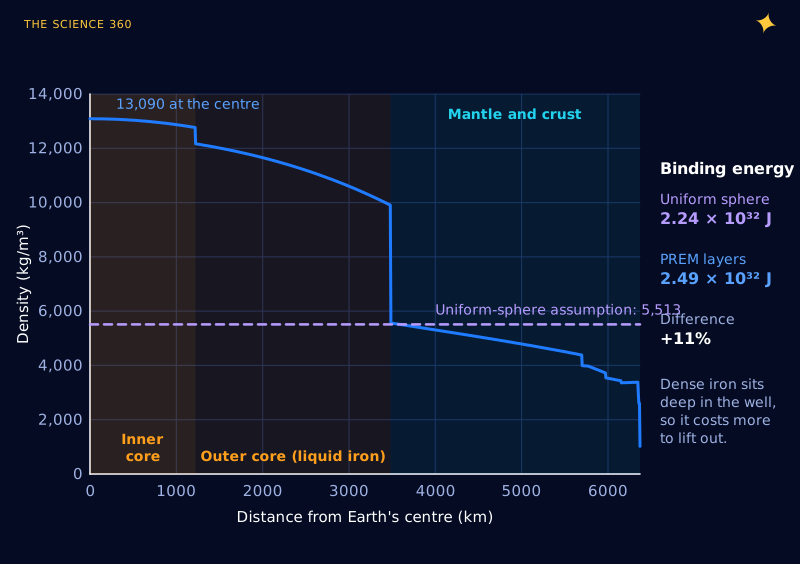
I put the PREM density polynomials into the shell integral above and integrated it numerically in 200,000 steps. The result is 2.489 × 1032 J, which agrees with the value quoted in standard references (2.49 × 1032 J). The integration also gives Earth's total mass as 5.973 × 1024 kg, a good sign the density table went in correctly.
The reason it is higher is simple. Mass concentrated near the centre sits deeper in the gravity well, so more work is needed to haul it out. Half of Earth's radius is core, and the core holds about a third of the mass at more than twice the density of the rock above it.
The same integral answers a question nobody seems to ask: what does it cost to strip the planet from the outside in?
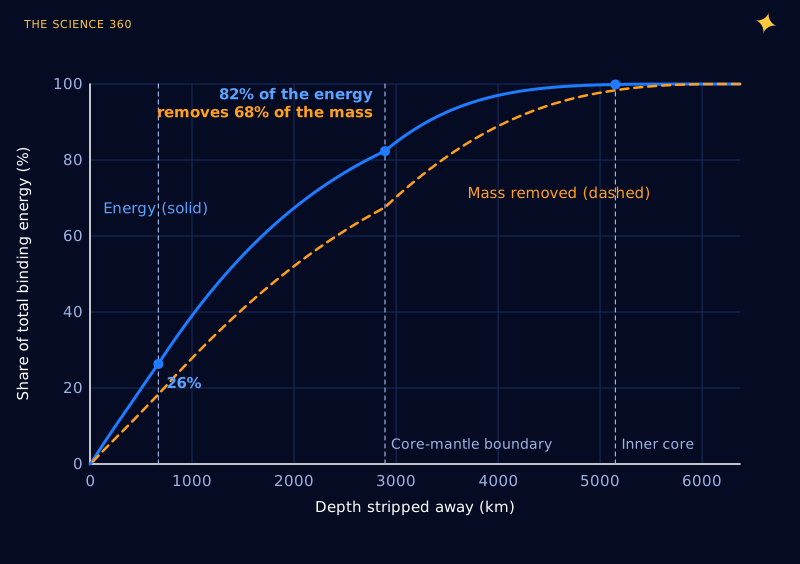
Blasting away the mantle down to the core is 82% of the job. The bare iron core that remains, about 1.9 × 1024 kg, needs only the last 18%. A superlaser engineer would care: the first shots do most of the work.
How big is 2.5 × 1032 joules?
Big numbers stop meaning anything after the first dozen zeros, so here is a ladder. All the bars in Figure 3 are on a logarithmic scale, so each gridline is a factor of a thousand.
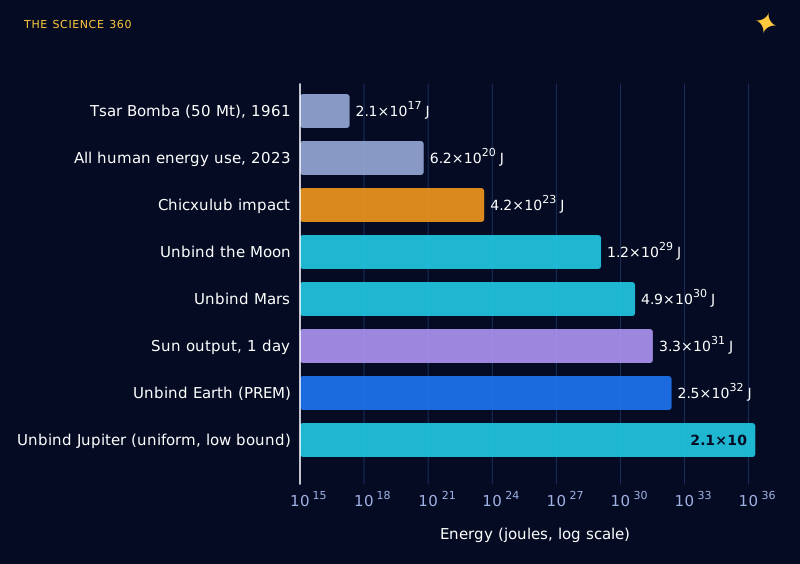
Comparisons for
Sun:
Tsar Bomba (50 Mt, about ): bombs
Chicxulub impact (about ): about 600 million dinosaur-killers
World primary energy use, 620 EJ in 2023: 400 billion years of it
Two things jump out. The asteroid that ended the dinosaurs, the most violent event in the recent history of Earth, barely registers on this scale. And the planets differ wildly: unbinding the Moon is 2,000 times cheaper than Earth, because binding energy scales as , which at fixed density goes as . Double a planet's size and it becomes 32 times harder to destroy.
Is vaporizing a planet the same as destroying it?
No, and this is the most common mistake in fan calculations. Heating rock until it boils costs very roughly 107 J per kilogram (my order-of-magnitude figure for silicate, covering heating, melting and vaporizing). Multiply by Earth's mass and you get something like 6 × 1031 J, maybe a quarter of the binding energy.
Spend that and you have a glowing ball of rock vapor, thousands of kilometres across, still bound by its own gravity. It radiates, cools, rains magma and reforms a planet. Something like this probably happened after the Moon-forming impact 4.5 billion years ago. A planet that has been vaporized is badly damaged. It is not gone.
How much power would the Death Star need?
Energy is not the whole story. The superlaser fires for a second or two, and power is energy divided by time. If we generously call it one second:
In Suns:
Fuel by :
Matter plus antimatter, 100% efficient: of each. As water, that total mass would be a sphere 17 km across.
That 2.77 × 10¹⁵ kg is also the mass Earth "lost" when it formed, carried away as heat. Perfect annihilation is the best case nature allows. Hydrogen fusion converts only about 0.7% of its fuel mass to energy, so a fusion-powered Death Star would need about 4 × 10¹⁷ kg of hydrogen per shot, and somewhere to dump the waste heat while still standing next to the target.
The Alderaan debris says it was far more than the minimum
Binding energy is the cost of debris that just barely escapes and drifts away. If you hand out exactly U and share it evenly, the pieces start with an average speed of:
That would look like a slow swelling, the planet puffing up over many minutes. The film shows nothing of the kind. By my reading of the 1977 shot, the debris front is out to several planet widths within a second or two, which is thousands of kilometres per second. Figure 4 shows what that does to the bill.
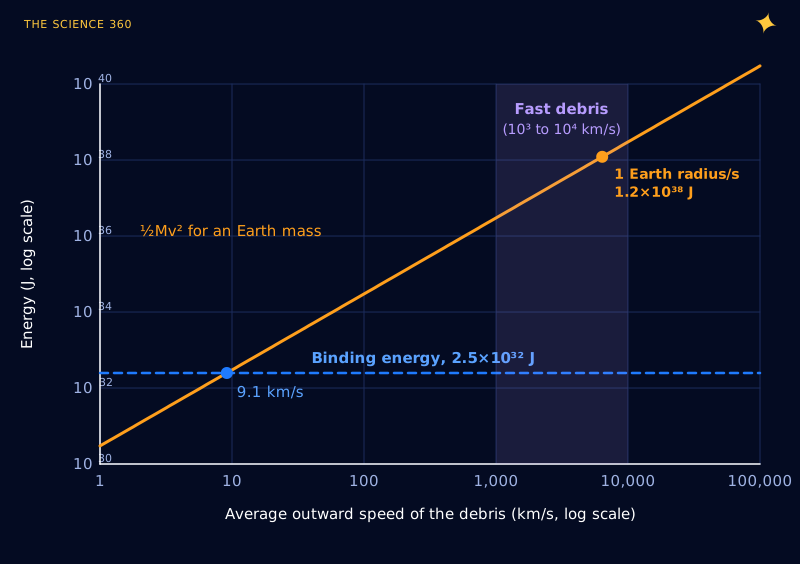
Kinetic energy grows as , so a debris cloud expanding at 6,371 km/s (one Earth radius per second) carries 1.2 × 1038 J. That is half a million times the minimum, and about 10,000 years of the Sun's output. The cheapest way to destroy a planet is slow, patient and boring to watch. What the film shows is the expensive way. Either the Death Star's reactor is absurdly overpowered or, as the later films suggest, the beam triggers something inside the planet that releases energy of its own. Physics cannot tell you which, but it can tell you the debris speed alone costs more than five orders of magnitude over the theoretical floor.
Could anything real destroy a planet?
Not on purpose. The most energetic routine collisions in the Solar System are tiny compared with Earth's binding energy. A body colliding with Earth at 30 km/s would need several Moon masses just to deliver U as kinetic energy, and in practice much of a giant impact's energy goes into heat that stays bound, which is how Earth survived the collision that made the Moon.
Impactor mass to deliver at 30 km/s
That is 7.5 Moon masses, or nearly one Mars.
Stars can do it. A planet that strays inside its star's Roche limit gets torn apart by tides, and some white dwarfs show metal-polluted atmospheres that astronomers attribute to shredded asteroids and planetary debris. Nature's planet-killer is not a beam. It is a slow, tidal grind.
FAQ
How much energy would it take to destroy the Earth?
To scatter Earth so that its pieces never fall back together you must supply its gravitational binding energy. Treating Earth as a uniform ball gives 2.24 × 1032 J. Using the real layered density profile (the PREM seismic model) gives 2.49 × 1032 J, about 11% more, because Earth's dense iron core sits deep in its own gravity well.
Could the Death Star really destroy a planet?
Physics does not forbid it, but the numbers are extreme. Delivering 2.5 × 1032 J in about one second is a power of 2.5 × 1032 W, roughly 650,000 times the Sun's total output. Even matter and antimatter annihilation would need about 1.4 trillion tonnes of each. And the fast-moving debris seen on screen implies far more energy than the bare minimum.
How long would the Sun take to produce enough energy to destroy Earth?
The Sun radiates 3.828 × 1026 W. Dividing Earth's binding energy of 2.49 × 1032 J by that power gives about 650,000 seconds, or 7.5 days. So you would need to capture every photon the Sun emits, in all directions, for a week and a half and deliver it to Earth.
Would vaporizing a planet destroy it?
No. Boiling a rocky planet takes very roughly 107 joules per kilogram, which for Earth is of order 6 × 1031 J, a fraction of the binding energy. The resulting ball of rock vapor would still be held together by its own gravity and would eventually cool and settle back into a planet.
How much energy would it take to destroy Jupiter?
The uniform-sphere formula gives about 2 × 1036 J for Jupiter, roughly 8,000 times Earth's figure. That is a lower bound, because Jupiter is strongly concentrated toward its centre, which raises the real value.
Related on The Science 360
Sources
- Gravitational binding energy, including the uniform-sphere formula and the PREM-based value of 2.49 × 1032 J for Earth: en.wikipedia.org/wiki/Gravitational_binding_energy
- Dziewonski, A. M. and Anderson, D. L. (1981), Preliminary Reference Earth Model, Physics of the Earth and Planetary Interiors 25, 297 to 356 (density polynomials used for the numerical integral): doi.org/10.1016/0031-9201(81)90046-7
- Boulderstone, Meredith and Clapton, "That's No Moon", Journal of Physics Special Topics, University of Leicester (2011): journals.le.ac.uk PST A2_8
- NASA Goddard, Sun Fact Sheet (luminosity 382.8 × 1024 W): nssdc.gsfc.nasa.gov/planetary/factsheet/sunfact.html
- NASA Goddard, Earth Fact Sheet (mass, mean radius, escape velocity 11.19 km/s): nssdc.gsfc.nasa.gov/planetary/factsheet/earthfact.html
- Energy Institute, Statistical Review of World Energy 2024 (620 EJ primary energy in 2023): energyinst.org media release
- Chicxulub crater, impact energy estimates (about 4 × 10²³ J, 100 teratonnes TNT): en.wikipedia.org/wiki/Chicxulub_crater
- Scientific American, "How Much Energy Would It Take to Blow Earth to Smithereens?" (for comparison with the uniform estimate): scientificamerican.com
Method note: the PREM integral, the layer-stripping curve and the debris energies are my own calculations from the cited inputs. The vaporization energy (about 107 J/kg) is an order-of-magnitude figure, and the debris speed in the film is my reading of the shot, not a measured value.
Header image: NASA/JPL-Caltech/Space Science Institute (image PIA12570), regraded for this article.