Could a Lightsaber Exist? The Physics, With Numbers
In The Phantom Menace, Qui-Gon Jinn pushes his blade into a blast door and the metal around it goes from grey to orange to dripping yellow in about 11 seconds. Physicists have been timing that shot ever since. A WIRED analysis by Rhett Allain got around 230 kilowatts. A University of Leicester student paper got 6.96 megawatts. That factor of 30 between two careful estimates of one scene comes almost entirely from what each assumed the door was made of.
Below we treat the two serious candidates (a beam of light and a column of plasma) as engineering proposals and find exactly where each fails. One of them fails because of a quantum effect so weak that a laser pointer's photons would have to cross a distance about 1026 times the size of the observable universe to bump into each other once. The other fails because of a cube law.
Is a lightsaber a laser or plasma?
Plenty of people still call it a "laser sword" and picture a laser. Later Star Wars reference books moved to the idea of a plasma blade held in shape by a field. For physics purposes the distinction matters enormously, because the two fail for different reasons.
A laser blade is pure electromagnetic radiation. It carries energy and momentum but no mass, travels at the speed of light, and goes wherever its optics send it. A plasma blade is gas hot enough that electrons are stripped from atoms. It has mass, pressure and temperature, and it glows because it is hot. Plasma is how real people cut real steel today: an industrial plasma torch drives an electric arc through a gas jet, and the arc runs at roughly 20,000 °C.
Neither version gives you what the films show: a blade of fixed length that hums, cuts almost anything, and stops dead against another blade.
Why do laser beams pass through each other?
Shine two flashlights so their beams cross. Nothing happens at the crossing point. Each beam continues as if the other were not there. This is the first big misconception to clear up, and it cuts in two directions.
The classical reason is that Maxwell's equations are linear in empty space. If one wave is a solution and another wave is a solution, their sum is also a solution, so the fields simply add where they overlap and carry on afterwards. Light waves interfere, but they do not scatter off each other. A laser blade parried by another laser blade would pass right through, and both duelists would lose a hand.
The common correction ("light never interacts with light") is also wrong, though. Quantum electrodynamics says the vacuum is not quite empty. A photon can briefly fluctuate into a virtual electron and positron, and a second photon can interact with that pair. The net effect is that light can scatter off light. Euler and Heisenberg worked out the theory in the 1930s, and in 2017 the ATLAS experiment at CERN reported direct evidence: 13 candidate light-by-light scattering events against an expected background of 2.6, a 4.4 sigma result, using the intense fields around lead nuclei passing each other at nearly the speed of light.
The catch is the size of the effect. At low photon energies the total cross-section (the effective target area one photon presents to another) scales as the sixth power of photon energy.
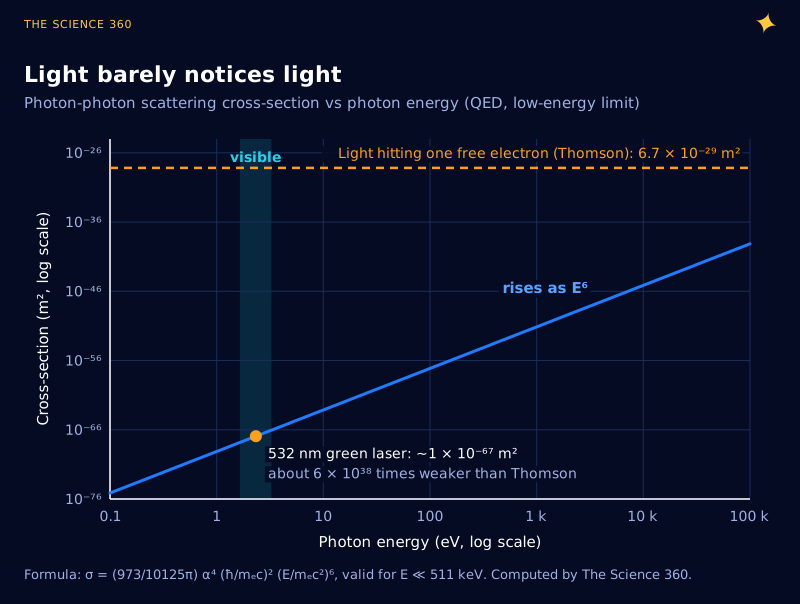
Worked example: how far before two laser pointers collide?
Let's put a green laser pointer through another one and ask how far a photon would travel, on average, before scattering off a photon from the other beam. That distance is the mean free path, 1/(nσ), where n is the photon density of the other beam and σ is the cross-section.
Cross-section, low-energy QED limit
, , (532 nm), .
Photon density in a 5 mW beam spread over 1 mm²
Mean free path:
Observable universe diameter ≈ 8.8 × 1026 m, so about 1026 universe widths.
That is an order-of-magnitude answer (head-on geometry adds a factor of about 2, and real beams are not uniform), but no correction is going to rescue it. For ordinary light, beams pass through each other. Full stop.
Could a laser lightsaber clash? The 2019 calculation
In 2019, François Fillion-Gourdeau and Jean-Sébastien Gagnon published "On the physical (im)possibility of lightsabers" in the European Journal of Physics. They took the clash problem seriously. Instead of relying on rare single-photon collisions, they used the Euler-Heisenberg effective theory, which treats the quantum vacuum as a weakly nonlinear medium once fields get strong enough. Two very intense beams overlapping in vacuum then generate a reflected wave, and the reflected light pushes back on the hilt.
Their numbers are worth quoting exactly because they are so extreme:
- To feel a force of about 10 N on the hilt (roughly a 1 kg mass dropped on your foot), each blade needs an electric field around 1015 V/m. The Schwinger limit, where the vacuum itself starts producing electron-positron pairs, is about 1.3 × 10¹⁸ V/m.
- That field corresponds to an intensity of about 1.3 × 10²³ W/cm2, at the edge of what today's petawatt lasers reach for femtoseconds in a focal spot a few wavelengths wide.
- Over a blade 2 cm wide, each saber emits about 4 × 10²³ W, roughly a thousandth of the Sun's luminosity (3.8 × 1026 W). One minute of dueling uses 2.4 × 1025 J.
- Even perfect matter-antimatter annihilation would need about 2.7 × 10⁸ kg of fuel per minute. The radiation recoil of the blade would be about 1.4 × 10¹⁵ N, against 3.5 × 10⁷ N for a Saturn V at liftoff.
They also point out that the clash would feel wrong. The push comes from reflected light hitting the hilt, so as blades start to overlap you get a torque in one direction, then a straight push, then a torque in the opposite direction as they separate. A real sword clash twists your wrist the other way.
Their conclusion is careful and fair: a clashing light blade is not forbidden by physics, only absurdly implausible. The other problem, a beam that stops at one meter, they leave unsolved, noting that "needles of light" made by tightly focused radially polarized beams have reached lengths of only about a millimeter.
A lab-scale cousin exists: in 2013, Harvard and MIT groups led by Mikhail Lukin and Vladan Vuletić bound photons into "photonic molecules" inside an ultracold rubidium cloud, and Lukin compared them to lightsabers. The interaction lives in the atom cloud, not in open air.
Could a plasma lightsaber cut through a blast door?
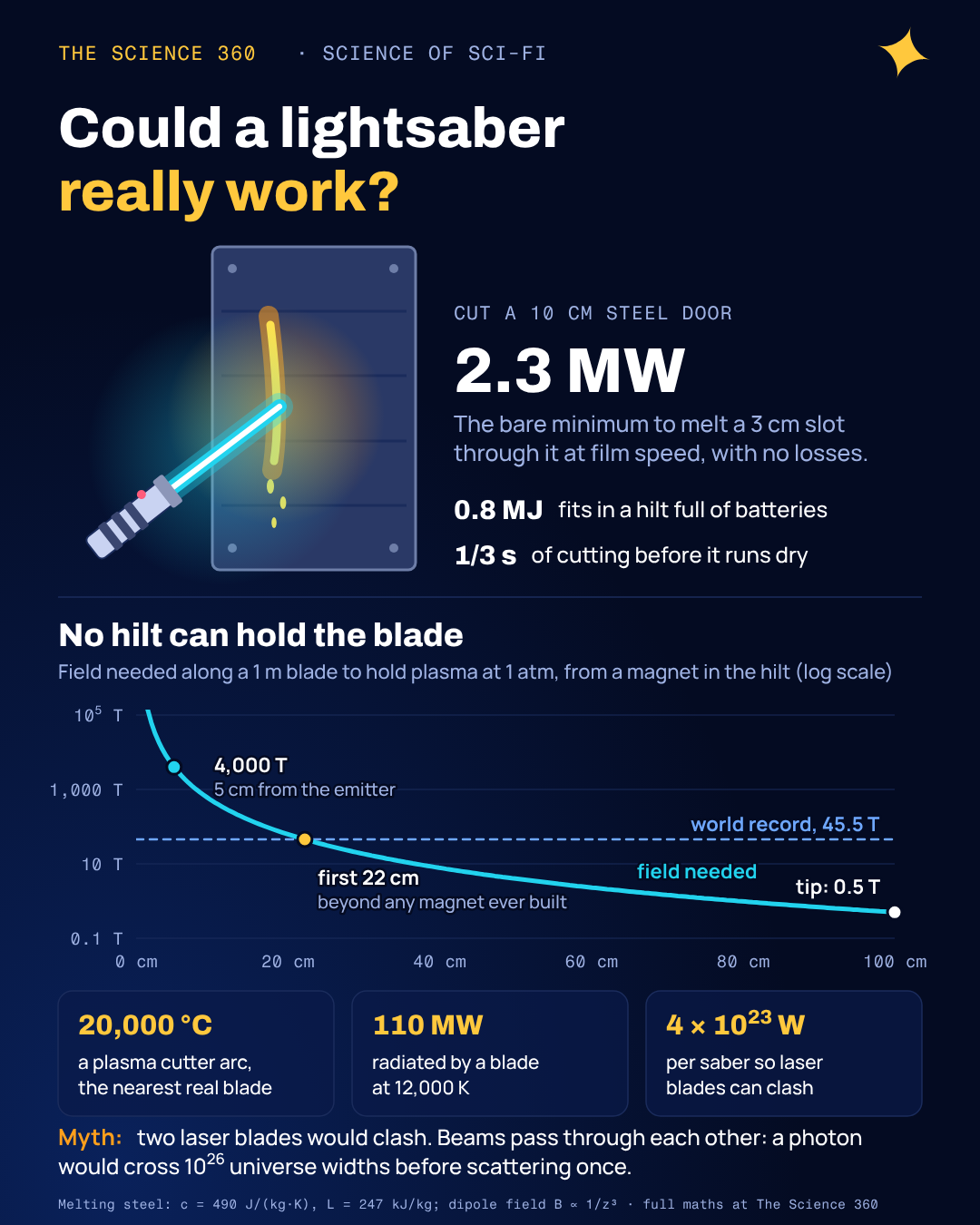
Here the plasma version wins easily. Plasma torches already cut steel, and nothing in physics stops a hotter, wider one from cutting a thicker door. The question is power. Melting metal is a straightforward energy budget: heat it to its melting point, then pay the latent heat to turn solid into liquid.
Worked example: power to cut a steel blast door
Assumptions: a carbon steel door 10 cm thick, a blade 3 cm wide that melts a slot of its own width, and a cutting speed of 10 cm per second, which is about what the film shows once Qui-Gon starts dragging the blade. We ignore every loss (heat conducted into the door, radiation, molten metal that drips away), so this is a floor.
Steel: density , specific heat . Melting point ≈ 1,500 °C (carbon steels range from about 1,370 to 1,530 °C). Latent heat of fusion of iron:
Energy per kilogram:
Mass melted per second, density × width × thickness × speed:
That is about the rated output of a typical onshore wind turbine, delivered into a stick you hold in one hand.
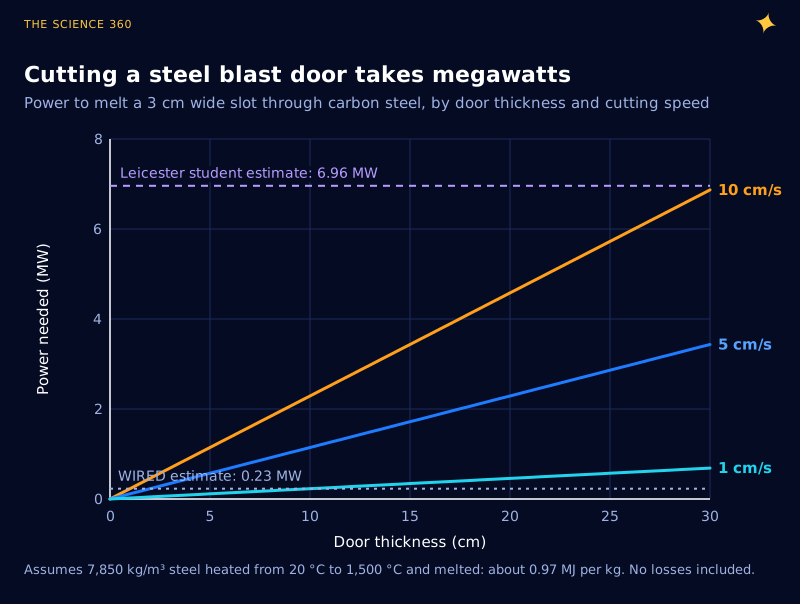
Now the battery. A generous hilt is about 25 cm long and 4 cm across, around 314 cm3. Fill all of it with lithium-ion cells at about 2.5 × 10⁹ J/m3 (the volumetric figure Allain used, about 700 Wh per liter) and you store roughly 0.8 MJ. At 2.3 MW that lasts about a third of a second. Allain reached a similar verdict in his own analysis: chemistry cannot do it, and you are into nuclear or antimatter territory.
How hot would a lightsaber be, and who gets burned?
To cut steel in seconds, the blade has to be much hotter than 1,500 °C. A blade barely above the melting point would cut at a crawl. Real plasma cutters run at around 20,000 °C. A plasma "window" built at Brookhaven National Laboratory, which uses an arc to hold atmospheric air away from a vacuum, runs at about 12,000 K at the edges and 15,000 K in the center.
Anything that hot radiates. The Stefan-Boltzmann law sets the maximum: power per unit area equals , with . A blade 1 m long and 3 cm wide has a surface of about 0.094 m2.
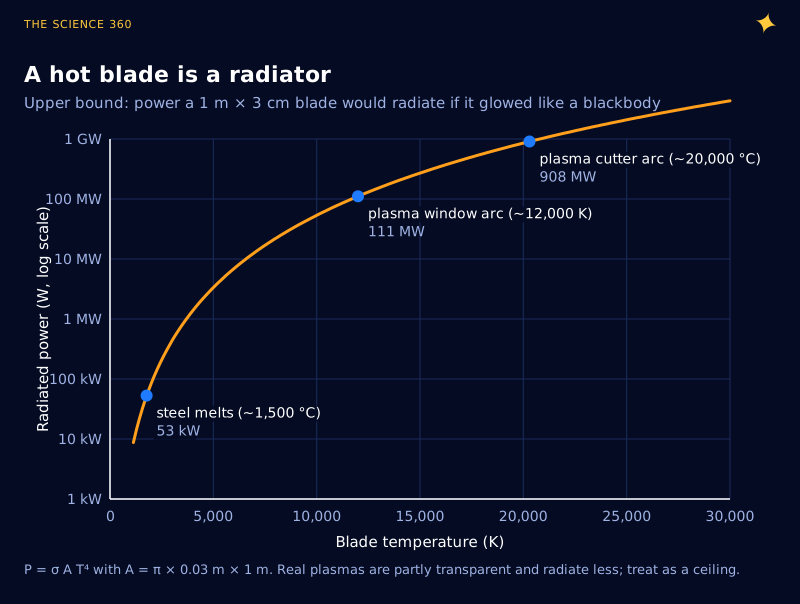
At 12,000 K the blackbody ceiling is about 110 MW. Spread that over a cylinder 0.5 m from the blade (where your face is) and the light intensity reaches tens of megawatts per square meter, about 25,000 times the intensity of sunlight above the atmosphere (1,361 W/m2). A real plasma column is optically thin, so it radiates a fraction of the blackbody value. Even if the true figure were 100 times lower, you would be holding a 1 MW heat lamp at arm's length. A real lightsaber would blind and burn everyone nearby.
Why can’t a magnetic field hold a plasma blade?
This is the confinement problem, and it is the one that kills the plasma lightsaber outright. Plasma is a hot gas. Left alone it expands, mixes with air, and cools in milliseconds. The fan explanation is that a magnetic field from the hilt holds it in a blade shape. Fusion reactors do hold plasma with magnets, so this sounds reasonable. It is not, and the reason is geometry.
A magnetic field can push on plasma with a pressure . To hold plasma at just one atmosphere (a very modest plasma), the field has to match 101,325 Pa:
Half a tesla is about a third of the field inside a typical 1.5 T hospital MRI scanner. Easy, if your magnet coils surround the plasma, which is exactly what a tokamak does. A lightsaber has nothing around the blade. All the field has to come from the hilt, and far from its source a magnet's field falls off as the cube of distance. If the field is 0.5 T at the tip, 1 m away, it must be 4,000 T at 5 cm from the emitter and 63,000 T at 2 cm.
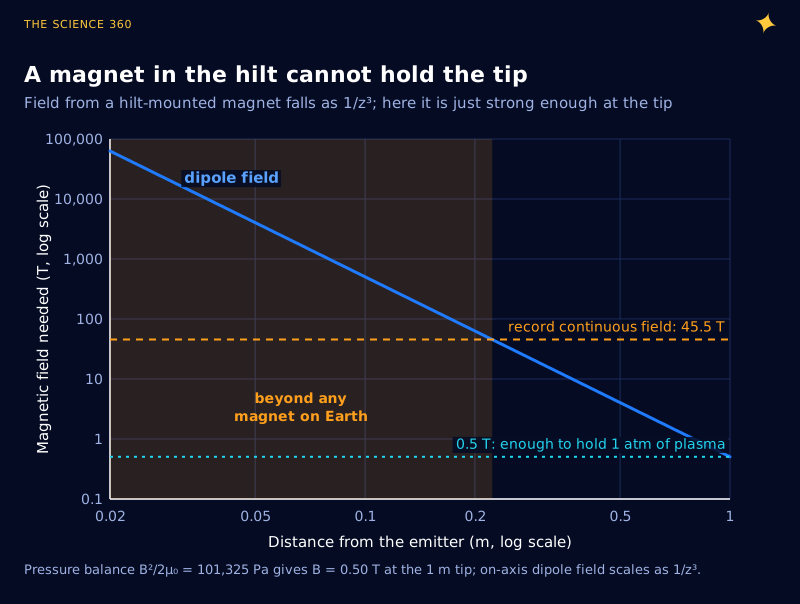
The strongest continuous magnetic field humans have ever produced is 45.5 T, from a small test coil at the National High Magnetic Field Laboratory in Florida. To hold a one-meter blade with a field from the hilt, the first fifth of the blade needs fields above that record, and near the emitter the requirement is over a thousand times higher. A dipole field also does not run parallel along a blade: its lines curve back around to the opposite pole, so instead of a straight column you get a doughnut-shaped bottle. There is no arrangement of magnets in a handle that makes a straight, self-terminating, one-meter cylinder of field in open air.
The Brookhaven plasma window is a nice reality check here. It does hold back the atmosphere with plasma, but the arc lives inside a water-cooled channel a few millimeters wide, with electrodes and walls all around it. That is what real plasma confinement looks like: structure on every side.
What a buildable “lightsaber” looks like
Relax the requirements and real technology covers pieces of the idea.
| Feature from the films | Closest real thing | Main gap |
|---|---|---|
| Glowing cutting blade | Plasma cutting torch (arc near 20,000 °C) | Cuts only a few cm from the nozzle, needs a cable and gas supply |
| Self-contained power | Lithium-ion pack, about 700 Wh/L | Lasts under a second at megawatt power |
| Fixed blade length | Needle of light from a focused annular beam | About 1 mm long, not 1 m |
| Blades that clash | Light-by-light scattering (ATLAS, 2017) | Needs fields near 1015 V/m held for minutes |
| Field-held plasma | Brookhaven plasma window | Plasma is inside a cooled channel, not free in air |
So, could a lightsaber exist?
Cutting is the easy part: plasma does it today, and the power needed for a film-style cut is a few megawatts, enormous for a handle but ordinary for a power plant. Clashing is allowed by quantum electrodynamics but needs a Sun's worth of laser power, give or take three orders of magnitude. A fixed-length blade has no known physical mechanism at all, and magnetically holding a plasma blade from a hilt fails by a factor of thousands because of a simple falloff.
The deepest problem is the one people mention least. A lightsaber needs something to define where the blade ends. Light does not stop on its own, plasma does not stay put on its own, and fields from a handle spread out. Every real device that shapes beams or plasma does it with matter on the outside. Lose the hilt-only constraint and you can build a plasma cutter. Keep it and you cannot build a lightsaber.
Frequently asked questions
Is a real lightsaber possible?
Not as shown in Star Wars. A laser blade would not stop at a fixed length and two laser beams pass through each other. A plasma blade could cut metal, but nothing can hold a meter of plasma in shape in open air from a handle.
How hot would a lightsaber be?
Far above steel's 1,500 °C melting point; plasma cutter arcs run near 20,000 °C. At that temperature even a thin plasma blade would radiate megawatts and burn its wielder.
Why don’t two laser beams bounce off each other?
Maxwell's equations are linear in vacuum, so light waves add and pass through. Quantum electrodynamics allows a tiny light-by-light scattering through virtual electron-positron pairs, but for visible light the cross-section is about 10-67 m2, so ordinary beams never noticeably collide.
How much power would a lightsaber need?
Melting a 3 cm slot through a 10 cm steel door at 10 cm/s takes about 2.3 MW with zero losses. A laser blade solid enough to clash would need around 4 × 10²³ W, according to the 2019 Fillion-Gourdeau and Gagnon paper.
Related on The Science 360
More science of sci-fi:
Related engineering:
Sources
- F. Fillion-Gourdeau and J.-S. Gagnon, "On the physical (im)possibility of lightsabers", European Journal of Physics (2019), doi:10.1088/1361-6404/ab274a. Preprint: arxiv.org/abs/1906.02575
- ATLAS Collaboration, "Evidence for light-by-light scattering in heavy-ion collisions with the ATLAS detector at the LHC", Nature Physics 13, 852 (2017). CERN summary: home.cern
- Physics World, "Light is seen to scatter off light": physicsworld.com
- Low-energy photon-photon cross-section (Euler-Heisenberg limit), e.g. arXiv:2406.10342: arxiv.org/abs/2406.10342
- R. Allain, "What Kind of Battery Would You Need to Power a Lightsaber?", WIRED, May 4, 2024: wired.com
- L. Willcocks, "Calculating the Power Output of Qui-Gon Jinn's Lightsaber", Journal of Interdisciplinary Science Topics, University of Leicester: journals.le.ac.uk
- Harvard Gazette, "Seeing light in a new way" (photonic molecules, 2013): news.harvard.edu
- Plasma window (A. Hershcovitch, Brookhaven National Laboratory): Wikipedia overview and AVS 2018 abstract: avs.org
- S. Hahn et al., "45.5-tesla direct-current magnetic field generated with a high-temperature superconducting magnet", Nature 570, 496 (2019); summary: physicsworld.com
- Specific heat of carbon steel, Engineering Toolbox: engineeringtoolbox.com; iron enthalpy of fusion 13.81 kJ/mol: Wikipedia, Iron
Header image: NASA/GSFC/Solar Dynamics Observatory (image PIA20882), regraded for this article.