Could an Iron Man Arc Reactor Work? The Fusion Numbers
In a cave in Afghanistan, Tony Stark builds a glowing disc about the size of a hockey puck and tells Yinsen that, if his math is right, it puts out three gigajoules per second. That is 3 gigawatts. Three large nuclear reactors' worth of electricity, sitting in a hole in a man's sternum, built from scrap.
Could anything like it work? The useful way to answer is not "fusion is hard" (it is) but to ask what the number itself demands. Put 3 GW in a volume of about 126 cm³ and you can work out, with real fusion data, how dense and hot the fuel must be, how strong the magnets must be, how many neutrons come out and how much heat has to go somewhere. Each answer is wrong by a factor between ten and a quarter of a million. The interesting part is which problem is the real killer, because it is not the one most people guess.
What does 3 gigawatts in your chest actually mean?
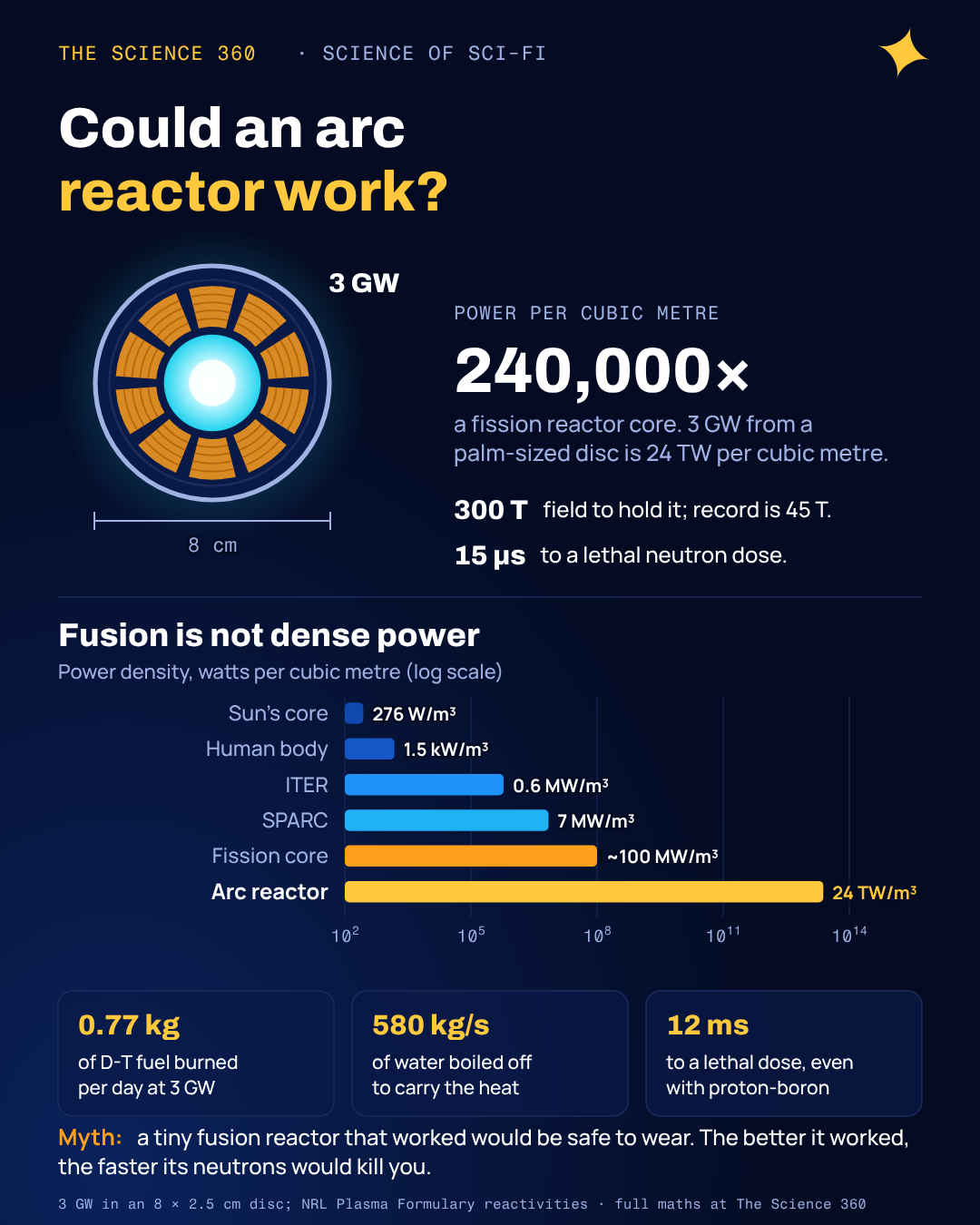
Start with the most basic number in reactor engineering: power density, the watts produced per cubic metre. I will treat the movie reactor as a disc 8 cm across and 2.5 cm thick, which matches the prop's proportions reasonably well. It is an assumption, but changing it by a factor of two changes nothing that follows.
Power density of the arc reactor
For comparison: a large pressurised water reactor core runs at about 100 MW/m³ (100 kW per litre), and the SPARC compact tokamak design at about 7 MW/m³.
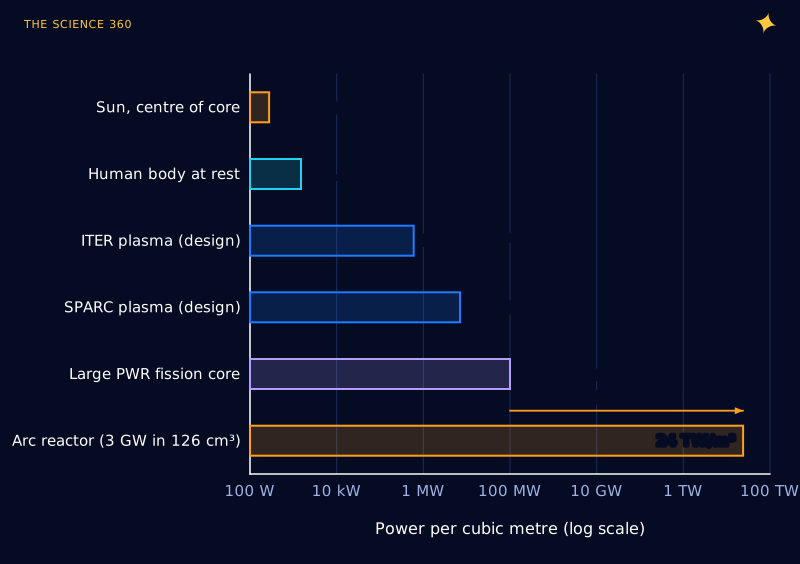
Figure 1 holds the first surprise. Fusion is not a high power density process in the places where it happens. The centre of the Sun produces about 276 watts per cubic metre, less than your body does sitting still. The Sun is bright because it is enormous. Magnetic fusion devices on Earth do far better than the Sun, but even the most aggressive compact design, SPARC, aims for about 7 MW/m³, roughly fourteen times less than an ordinary fission core.
So the common framing, "the arc reactor is a miniaturised fusion reactor", misses the scale of the ask. Miniaturising a fusion reactor is not like miniaturising a computer. The arc reactor needs a power density three to four million times SPARC's, from a technology whose plasma is, by design, thinner than air.
How dense and hot would the plasma have to be?
Fusion power density in a 50:50 deuterium-tritium (D-T) plasma has a tidy formula. If n is the total ion density, each cubic metre has n/2 deuterons and n/2 tritons, and the reaction rate depends on how often they collide at high speed, captured in the reactivity ⟨σv⟩:
The reactivity depends steeply on temperature. Figure 2 plots it from the tabulated values in the NRL Plasma Formulary for three fuels.
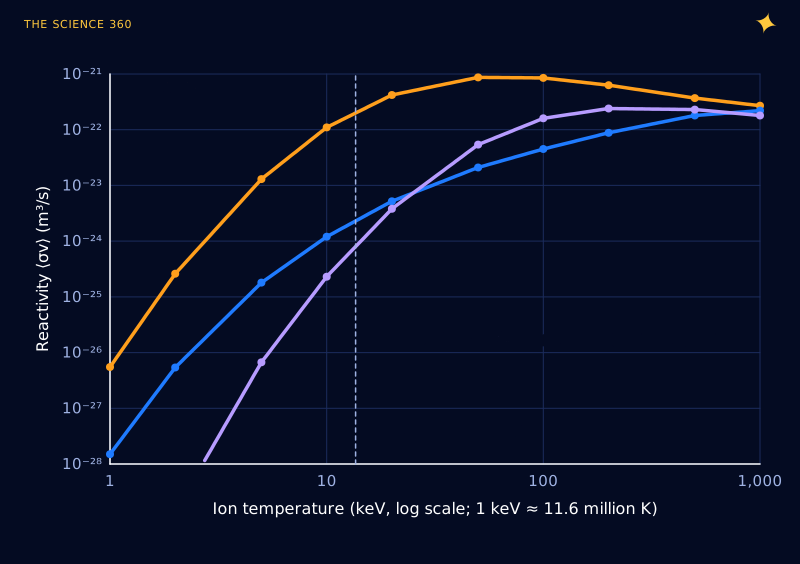
Now solve for the density the arc reactor needs, at about the temperature where D-T is easiest to confine (around 14 keV, or 160 million K):
Step 1. Density needed for 24 TW/m³
at 14 keV ≈ 2.1 × 10⁻²² m³/s (interpolated from the table).
SPARC's design density is about 3 × 10²⁰ m−3, so this is about 1,300 times denser.
Step 2. Plasma pressure (ions plus an equal number of electrons)
That is about 18,000 atmospheres.
Eighteen thousand atmospheres of gas at 160 million kelvin. No material wall can touch that, which is why tokamaks hold plasma with magnetic fields. The field's ability to push is its magnetic pressure, , and the ratio of plasma pressure to magnetic pressure is called beta (). Tokamaks run at of a few percent. So:
Step 3. Field needed to hold it
The first line is the ideal limit; the second is a realistic tokamak. Strongest continuous lab magnet: about 45 T. ITER's peak coil field: 11.8 T.
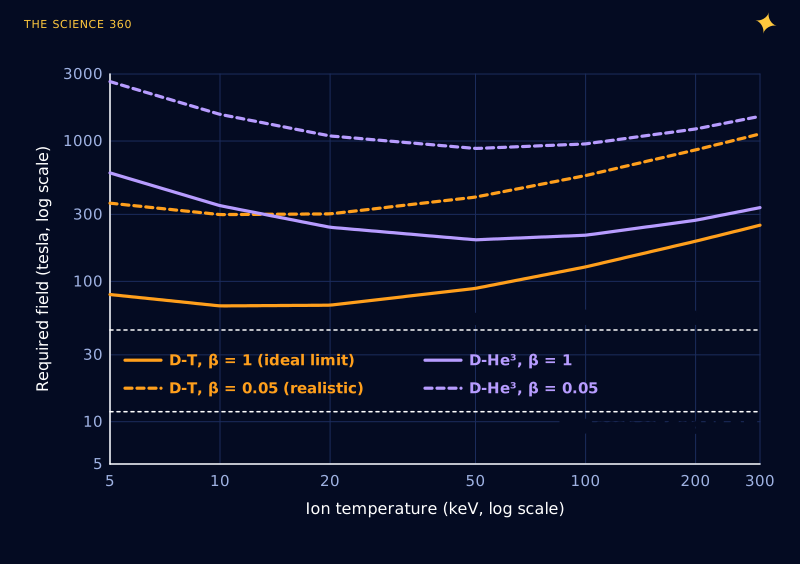
There is a shortcut that gives the same answer and shows why bigger magnets are the whole game in fusion. At fixed β and temperature, fusion power density scales as B4. That is why SPARC and MIT's ARC power plant design use high-temperature superconducting magnets: doubling the field buys sixteen times the power density. Run it backwards from SPARC:
That is at SPARC's .
Two different routes, a few hundred tesla either way. Magnets of that strength would tear themselves apart: magnetic pressure at 300 T is Pa, about 350,000 atmospheres, beyond what any known conductor and support structure can hold for long. Fields of hundreds of tesla do exist briefly in labs, in explosively driven or single-turn coils that destroy themselves in microseconds.
The real killer: neutrons
Suppose Stark solved confinement. In D-T fusion, each reaction makes a 3.5 MeV helium nucleus and a 14.1 MeV neutron. The neutron carries 80% of the energy and, having no charge, ignores every magnetic field you could build.
Neutron output at 3 GW
That is 1021 neutrons per second, about 150 GW/m² through the reactor's surface (about 0.016 m²).
Power plant designs worry about neutron wall loads of a few megawatts per square metre. This is tens of thousands of times more, and the wall in question is Tony Stark.
Here is a deliberately generous estimate. Assume only 1% of the neutron energy is absorbed by his body (most of the rest flies off in other directions or passes through), take a body mass of 70 kg, and use 5 gray (joules per kilogram) as a lethal whole-body dose.
Time to a lethal dose, D-T
This is the misconception most "is the arc reactor real?" articles skip. They focus on whether fusion can be miniaturised, as though a tiny reactor that worked would be fine to wear. The opposite is true: the better it worked, the faster it would kill you. Shielding does not save it either. Fast neutrons are typically attenuated by about a factor of e for every 10 cm or so of water or concrete (a rough figure that depends on material and energy), so cutting 1021 neutrons per second to a tolerable level takes metres of shielding, which is exactly what surrounds every real reactor.
Would aneutronic fusion fix it?
This is the best real-physics defence of the arc reactor, and it deserves a fair hearing. Some fusion reactions release their energy mostly as charged particles, which a magnetic field can steer and which could in principle be converted directly to electricity without a steam turbine. The two usual candidates:
- Deuterium-helium-3: D + ³He → ⁴He (3.6 MeV) + p (14.7 MeV). The main reaction makes no neutrons, but D-D side reactions in the same plasma do, leaving roughly 5% of the energy in neutrons. Helium-3 is also extremely scarce on Earth.
- Proton-boron-11: p + ¹¹B → 3 ⁴He + 8.7 MeV. Side reactions put roughly 0.1% of the energy into neutrons. The catch is that its Lawson requirement (the density, temperature and confinement time product needed for net energy) is about 500 times harder than D-T's.
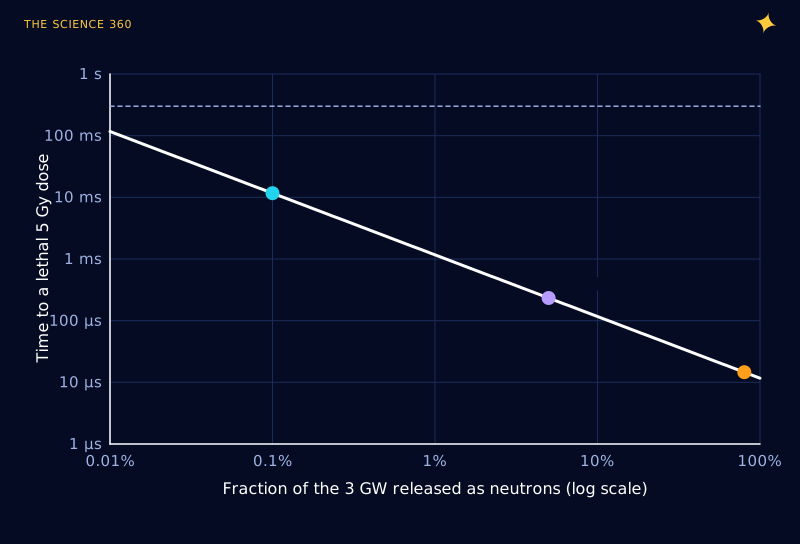
Figure 4 is the honest outcome. Aneutronic fuel moves the time to a lethal dose from 15 microseconds to about 12 milliseconds. That is a factor of 800 improvement and still less than the time it takes to blink. There is also a second radiation problem the neutron fraction hides: a plasma hot enough to burn boron (hundreds of keV) radiates intense X-rays as electrons swerve past nuclei, and at those temperatures that X-ray loss is comparable to the fusion power itself. That is the main reason p-¹¹B is so hard, and every one of those X-rays would also be heading into Stark's chest.
Where would 3 gigawatts of heat go?
Even a perfect reactor turns its output into heat somewhere. Assume a heroic 50% conversion to electricity inside the reactor, leaving 1.5 GW to remove from the device itself. Two ways to get rid of it:
Option A: radiate it away (Stefan-Boltzmann law, emissivity 1)
For the reactor face alone, :
Spread over the whole suit, , it is still 10,700 K, nearly twice the surface of the Sun.
Option B: boil water
That covers heating from 25 °C plus boiling.
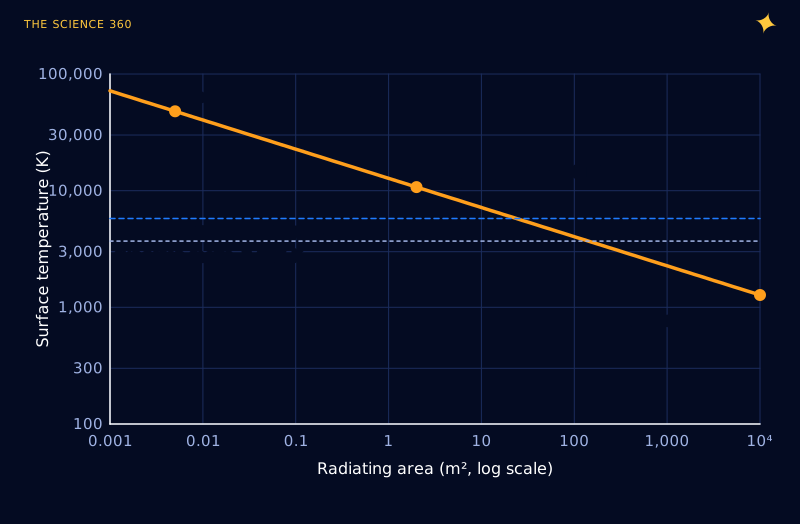
Your body, for scale, sheds about 100 W at rest and perhaps a kilowatt or so in hard exercise. Real power plants dump gigawatts into rivers, seas or cooling towers the size of cathedrals for this reason.
Is it a power problem or an energy problem?
Yinsen also says the reactor could run Stark's heart "for fifty lifetimes". That claim can only be true if the reactor almost never runs at 3 GW. Fifty 80-year lifetimes at full power is 3.8 × 10²⁰ J. D-T fusion converts about 0.38% of the fuel's mass into energy, so that output would burn about 1.1 million kilograms of fuel. The device must hold a tiny load (the chest electromagnet, watts at most) almost all the time and only surge to gigawatts for flight and fighting. That is a battery's job description, not a power plant's, and it is a fair reading of how the films use it.
So what would a physicist's arc reactor look like? Fusion fuel is wonderfully compact: at 3 GW you burn under a kilogram a day. The bulk lives in everything else: magnets to confine the plasma, metres of shielding against neutrons, and radiators or cooling water to carry away the heat. That is why the most compact real fusion power plant concept, MIT's ARC, has a major radius of 3.3 m and a 9.2 T superconducting field to produce 200 to 250 MW of electricity. Compact for a power station is the size of a building.
FAQ
Is the arc reactor possible in real life?
Not as shown. Producing 3 gigawatts in a palm-sized volume means a power density about 240,000 times that of a commercial fission core and millions of times that of any fusion plasma design. Confining such a plasma would need a magnetic field of several hundred tesla, and the neutrons and waste heat would kill the wearer almost instantly.
How much power does Iron Man’s arc reactor produce?
In Iron Man (2008) Tony Stark says it produces three gigajoules per second, which is 3 gigawatts. That is about the electrical output of three large nuclear power reactors.
Is the arc reactor based on real fusion?
Loosely. Its ring shape echoes a tokamak, the doughnut-shaped magnetic fusion device used by ITER and the compact SPARC design. Real tokamaks are building-sized because confining a fusion plasma takes a large volume and strong magnets, and their power density is a few megawatts per cubic metre.
Would aneutronic fusion make an arc reactor safe?
Safer, not safe. Proton-boron fusion releases only about 0.1 percent of its energy as neutrons through side reactions, but 0.1 percent of 3 gigawatts is still 3 megawatts of neutrons. On a rough estimate that delivers a lethal dose to a person wearing it in about a hundredth of a second, and the fuel needs conditions roughly 500 times harder to reach than deuterium-tritium.
What is MIT’s ARC reactor?
ARC is a 2015 design study for a compact, high-field tokamak power plant: a major radius of 3.3 metres, a 9.2 tesla field from high-temperature superconducting magnets, and about 200 to 250 megawatts of net electricity. Compact for a power station, it is still the size of a building.
Related on The Science 360
Sources
- Iron Man Wiki, Arc Reactor (3 GJ/s, "fifty lifetimes" line attributed to Yinsen): ironman.fandom.com/wiki/Arc_Reactor
- Inverse, "The MCU's first smash hit gets one thing right about nuclear fusion" (tokamak inspiration): inverse.com
- Wikipedia, "Nuclear fusion" (NRL Plasma Formulary reactivity table, reaction energies, neutronicity, relative Lawson criteria): en.wikipedia.org/wiki/Nuclear_fusion
- Wikipedia, "ITER" (500 MW fusion power, 840 m³ plasma volume, 11.8 T peak coil field): en.wikipedia.org/wiki/ITER
- A. J. Creely et al., "Overview of the SPARC tokamak", Journal of Plasma Physics 86 (2020) (12.2 T, R = 1.85 m, Pfusion ≈ 140 MW, ⟨ne⟩ ≈ 3 × 10²⁰ m−3, P/V ≈ 7 MW/m³): impact.ornl.gov
- B. N. Sorbom et al., "ARC: A compact, high-field, fusion nuclear science facility and demonstration power plant with demountable magnets" (2015): arxiv.org/abs/1409.3540
- Pressurised water reactor core power density (about 100 kW per litre), Taylor and Francis topic summary: taylorandfrancis.com
- Wikipedia, "Sun" (core power density 276.5 W/m³): en.wikipedia.org/wiki/Sun
- National MagLab, hybrid magnet and 45 T continuous field record: nationalmaglab.org and nationalmaglab.org (45.5 T test coil)
Method note: the reactor volume (8 cm by 2.5 cm), the 50% conversion efficiency, the 1% body absorption and the 10 cm neutron attenuation length are my assumptions, chosen to be generous to the reactor. Reactivities are interpolated from the NRL Plasma Formulary table.
Header image: NASA/JPL-Caltech (image PIA23879), regraded for this article.