Electronics 01
Charging a Capacitor: Where Half the Energy Goes
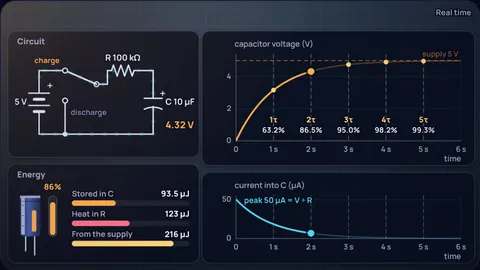
Charging a capacitor through a resistor always turns half the supply's energy into heat, whatever the resistance. The maths, the current and the timing.
Charging a capacitor through a resistor always turns half the supply's energy into heat, whatever the resistance. The maths, the current and the timing.
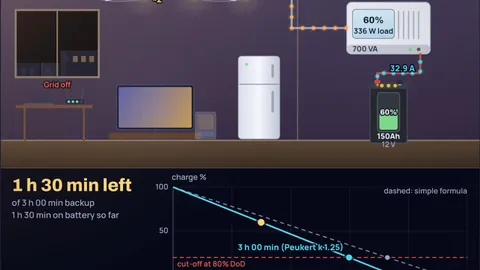
Two fans, four bulbs, a TV and a fridge get about 3 hours from a 150Ah tubular battery, not the 3.6 the brochure formula says. Here is the maths and the fixes.
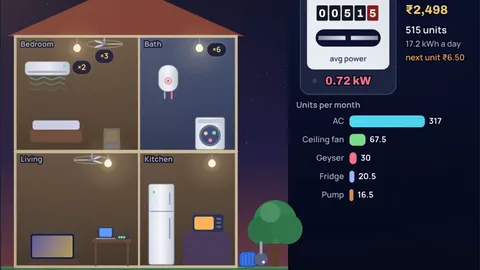
A 1.5 ton AC uses about 4.2 units in 8 hours, a 240 L fridge 0.7 a day, a 2 kW geyser 2 an hour. The maths, a real Delhi slab bill and what to change.
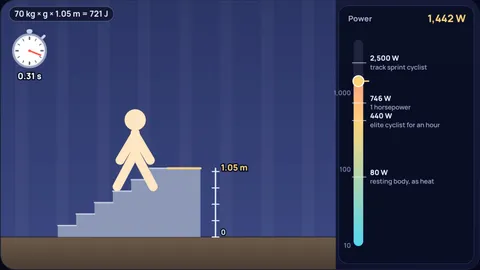
A sprint up six steps can top one horsepower. How the stair test turns mass, height and time into watts, and how much power people can keep up.
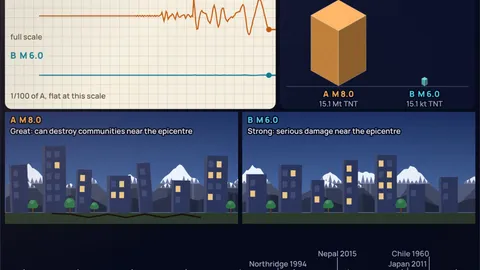
A magnitude 8 earthquake releases 1,000 times the energy of a magnitude 6 but shakes the seismogram only 100 times harder. The maths, with real quakes.
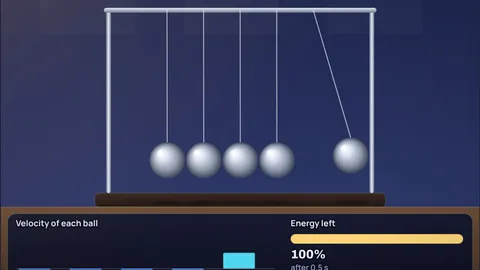
Lift one ball and exactly one flies out. Two balls at half speed would carry the same momentum but only half the energy. The physics, with numbers.
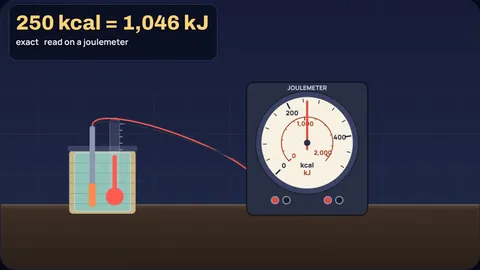
What a joule, a calorie, a food Calorie, a kilowatt hour, an electronvolt and a Btu are, the exact factors between them, and worked conversions.
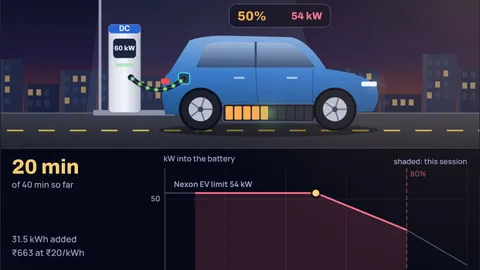
A Nexon.ev goes from 10 to 80 percent in 40 minutes on a 60 kW charger, then needs about 35 more for the last 20. Here is the charging curve, the chemistry behind it, and what it means for time and cost.
Three-phase power delivers constant power and a rotating field for motors. The copper saving is real but depends on what you compare. Worked numbers here.
Why is electricity transmitted at high voltage? We work the I²R loss for a real 345 kV line, show why 1,100 kV is about the ceiling, and when HVDC wins.
A 100 W panel on PWM gives 82 W at 25 °C. MPPT recovers the rest by running a DC-DC converter at the panel's best voltage. When it helps and when not.
Could an Iron Man arc reactor work? 3 GW in a palm-sized core is 240,000 times a fission core's power density. The fusion, neutron and heat math.
One gram of mass is 9 × 10¹³ J, about 21 kilotons of TNT. Why bombs convert under 0.1% of their fuel, plotted from a fitted binding-energy curve.
We run the numbers on Astrophage: E=mc² energy, the 1.5 g trip to Tau Ceti, the 25.984 µm Petrova line, and why the Hail Mary's fuel load falls short.
Blowing Earth apart takes 2.49×10³² J, 11% more than the textbook figure, or 7.5 days of the Sun's whole output. The Death Star math, layer by layer.
Lightning peaks at tens of gigawatts to terawatts but lasts microseconds, so a flash holds about 1 GJ. Doc Brown's 1.21 GW, checked.
A reproducible Python model separates water volume, kettle power and assumed efficiency to show what changes the energy used for a cup of hot water.