How Many Watts Can a Human Produce? The Stair Test
When James Watt was selling steam engines in the late 18th century, he needed a way to tell customers what an engine could replace. He compared it with the draft horses that turned mills and pumped mines, and the horsepower was born. Two and a half centuries later the unit is still on every car brochure, and it invites an obvious question: how close can a person get to one horse?
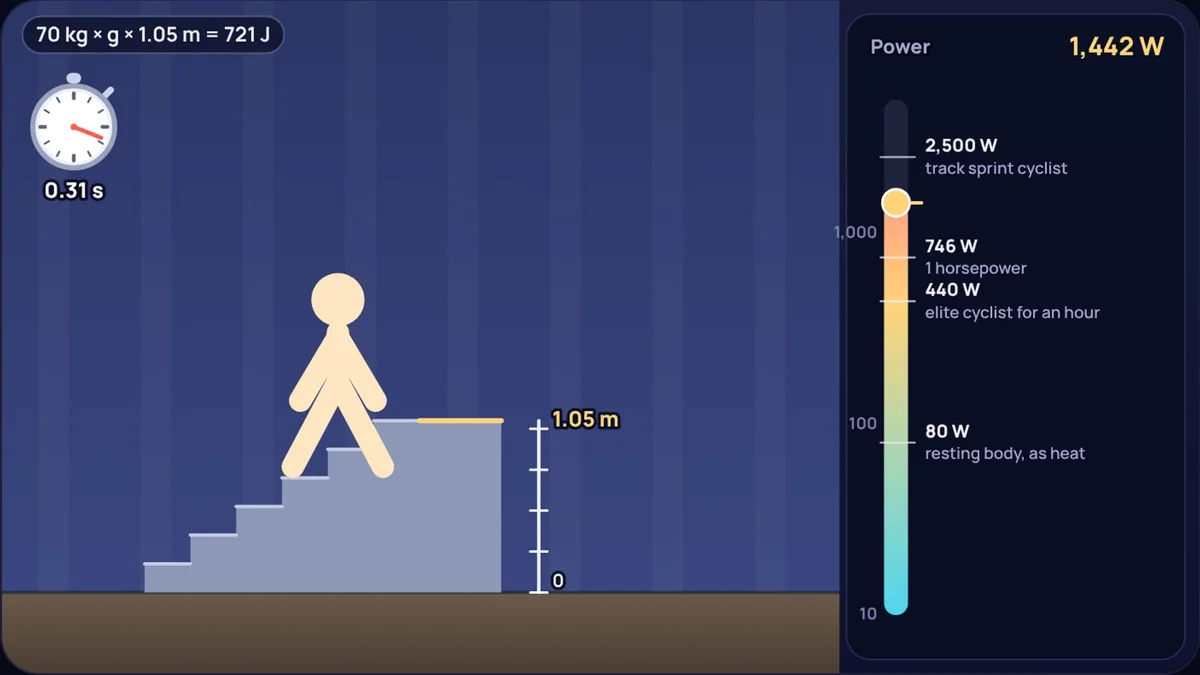
Closer than you might guess, but only for a moment. A short sprint up a flight of stairs is enough to beat one horsepower, and a simple stair test measures it with a stopwatch, a tape measure and a bathroom scale. The work and power calculator runs the test for you and puts the answer on a gauge next to a horse and a racing cyclist.
What is the difference between work and power?
In physics, work is energy transferred by a force moving something. Push with a force through a distance , at an angle between the force and the motion, and the work is:
Work is measured in joules: one joule is one newton pushing through one metre. Power is how fast that work is done, the work divided by the time, measured in watts, where one watt is one joule per second.
The difference matters. Carry a box up a flight of stairs slowly or quickly and the work is the same, because the box ends up at the same height. What changes is the power. A small motor and a big motor can both lift a lift car to the top floor; the big one just gets there sooner.
Example 1: pushing a crate, then pulling at an angle
Pull a sled with 150 N on a rope at 30° for 50 m instead, and only 150 × cos 30° = 130 N acts along the ground. The work is 130 × 50 = 6,495 J; over a minute that is 108 W. These are example forces, not measurements.
How does the stair test work?
Climbing is the cleanest way to measure human power, because gravity sets the force for you. Lifting a mass through a height takes work equal to the weight times the height, with standard gravity = 9.80665 m/s²:
The Margaria-Kalamen power test builds a short, sharp version of this. As fitness testing guides describe it, you start 6 m in front of a staircase, sprint at it, and run up three steps at a time. The steps are about 17.5 cm high, and the timing runs from the moment your foot touches step 3 to the moment it touches step 9. Six steps make about 1.05 m of height, and the best of three tries counts. The run-up means you are already moving when the clock starts, so the timed part is mostly lifting, not getting going.
Example 2: a 70 kg person, 1.05 m, 0.5 s
721 J is not much energy, about what a 60 W bulb uses in 12 seconds. The power is high because it is delivered in half a second. The mass and time here are an example; measure the vertical height of your own steps, since they vary.
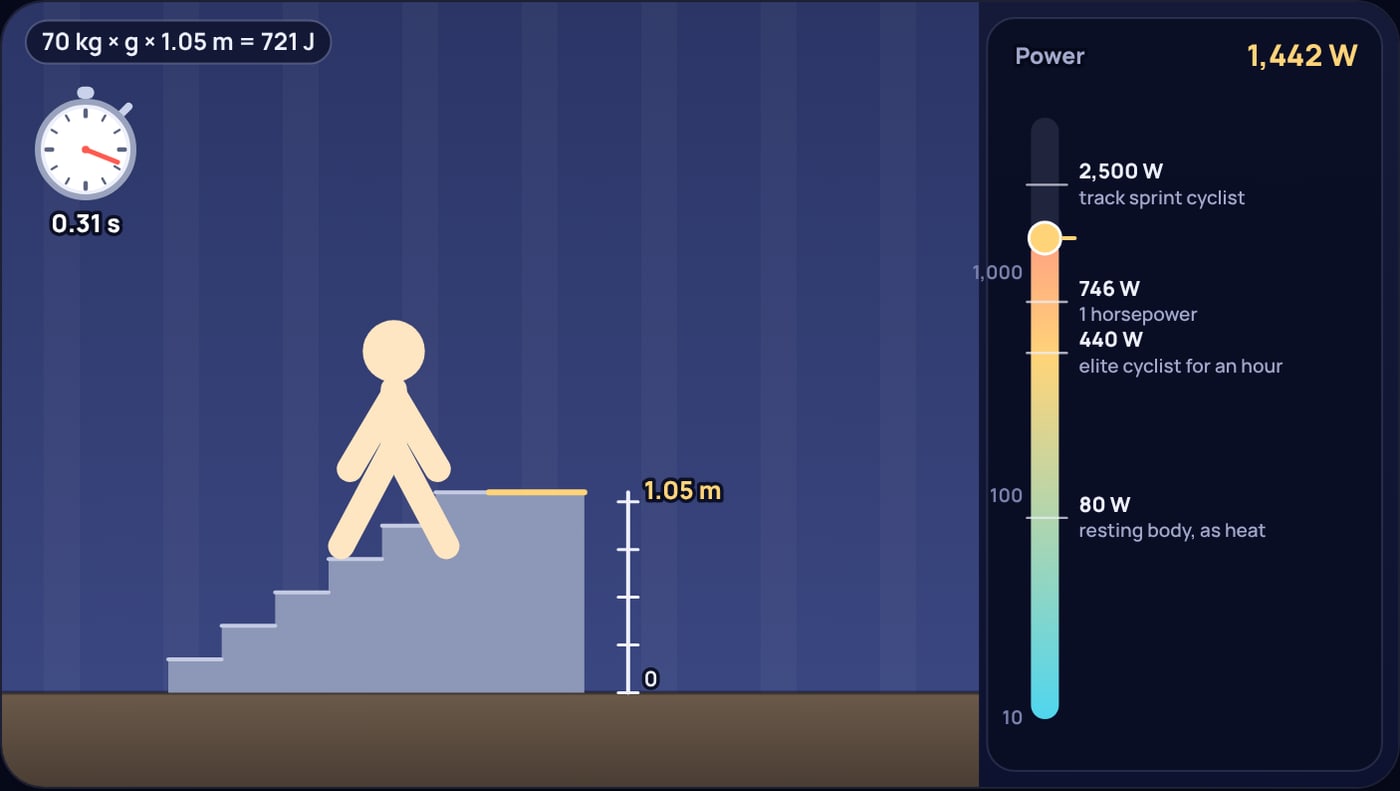
Timing is the weak point. Half a second is short enough that a hand on a stopwatch adds real error, so an electronic timer is better for anything serious. A tenth of a second either way moves the answer by roughly 20%.
How many watts is one horsepower?
There is more than one horsepower. Watt and his partner Matthew Boulton fixed the mechanical horsepower at 33,000 foot-pounds per minute, which is 550 foot-pounds per second. The metric horsepower, often written PS, is the power to lift 75 kg by 1 metre every second. The electric horsepower is exactly 746 W.
Example 3: turning 550 foot-pounds per second into watts
A foot is exactly 0.3048 m and a pound exactly 0.45359237 kg, so the horsepower comes out at 745.7 W. The metric one is about 1.4% smaller.
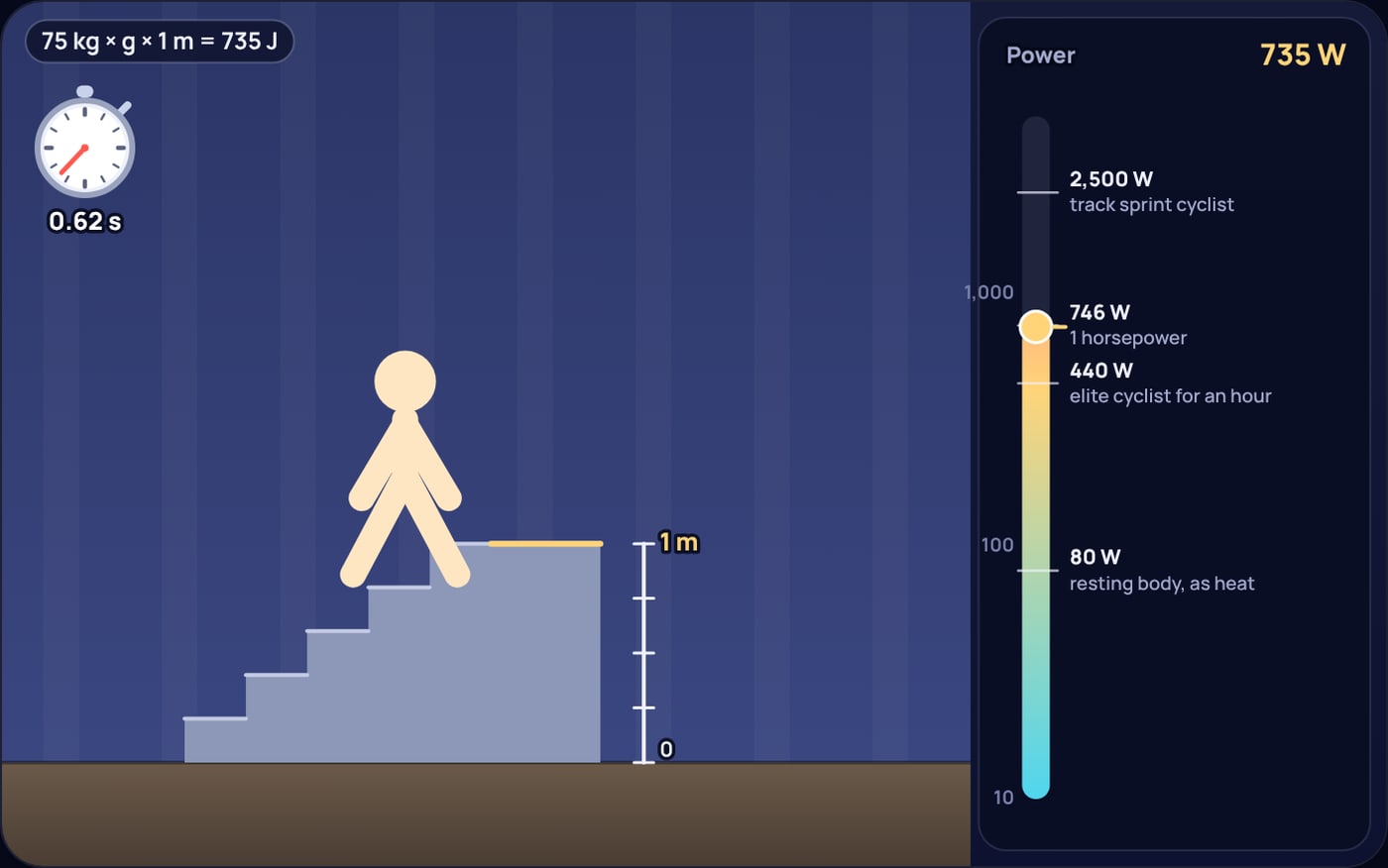
The metric definition is a stair test in disguise. A 75 kg person who climbs 1 metre of stairs every second, about six ordinary steps a second, is producing exactly one metric horsepower. The sprint in Example 2 climbs twice as fast as that, which is why a fit person can beat one horsepower on the stairs, but only for a second or two.
How much power can people keep up?
Short bursts and long efforts are very different. The usual figures quoted for human power are about 1.2 horsepower, around 900 W, for a healthy person briefly, and about 0.1 horsepower, around 75 W, indefinitely. Trained athletes can reach about 2.5 horsepower for a moment and around 0.35 horsepower, 260 W, for several hours.
Cycling gives the best measured numbers, because a power meter on a bike reads watts directly. An elite cyclist can hold around 440 W for an hour, and track sprinters top 2,500 W in short bursts. A fit adult doing steady physical work is more likely to average 50 to 150 W, and a manual labourer over a full shift around 75 W. Even sitting still, your body gives off heat at a resting rate of around 80 W.
Example 4: three floors, walking and running
The same 7,208 J of work either way, because the height and the mass do not change. Running does it three times as fast, so the power is three times higher. Again, the times are an example.
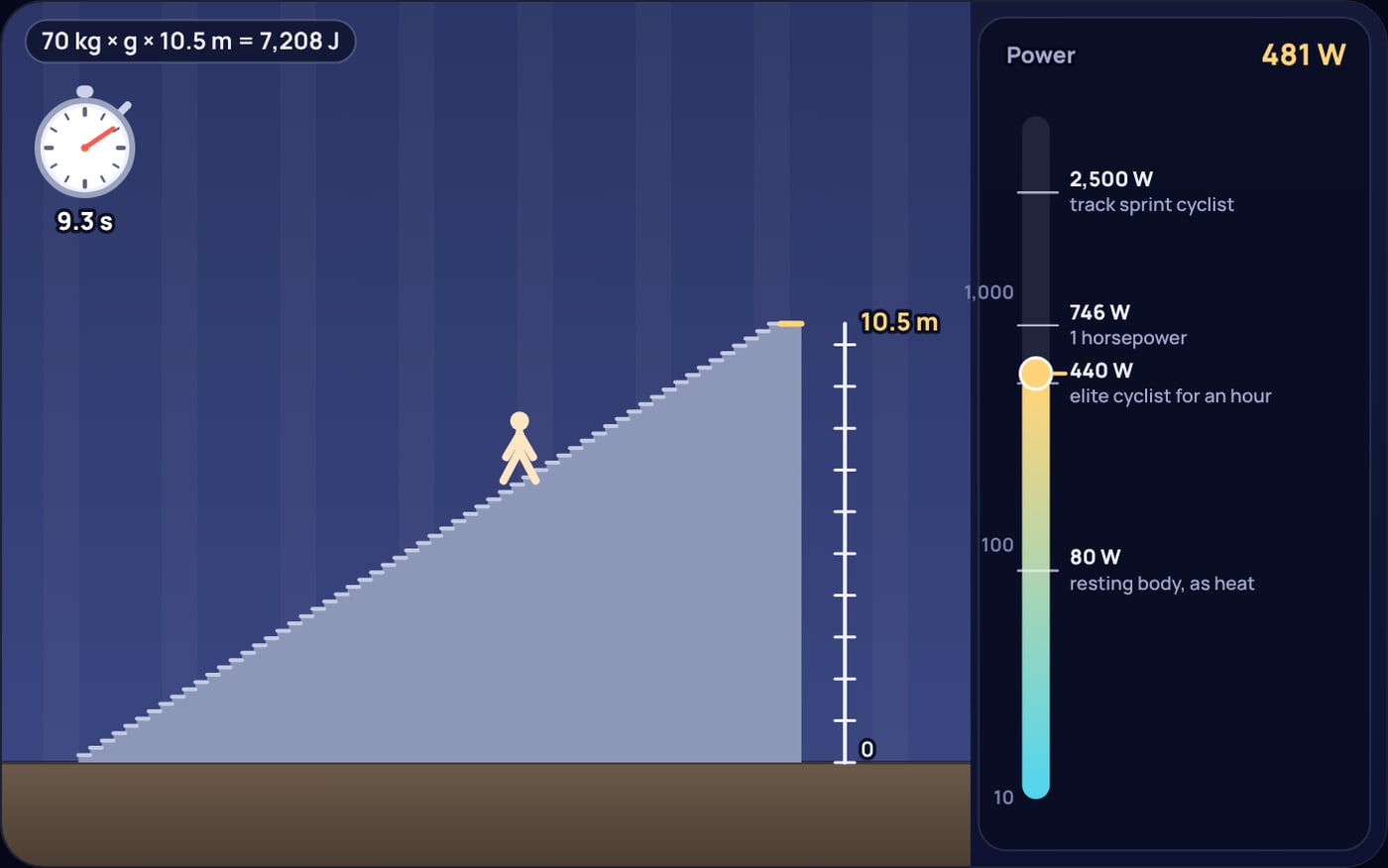
Put those numbers on the gauge and the pattern is clear. A walk up the stairs sits near the resting body. A run up the stairs reaches an elite cyclist's hour, but only for 15 seconds. The stair sprint goes past one horsepower, for half a second. The shorter the effort, the more power a person can put out.
Why does your body burn more than the work you do?
The calculator's kilocalorie figure is the mechanical work only. Your muscles are not that efficient. Over several minutes of effort they turn on average around 25% of the food energy they use into work, and the body gives off about 3 W of waste heat for every watt of mechanical output. That is why you get hot climbing stairs.
Example 5: the food energy for three floors
About 7 kilocalories to lift 70 kg three floors, on top of what the body uses anyway. That is a small amount of food energy, which is why climbing stairs works the heart and legs hard but is a slow way to burn off a snack.
There is a similar gap between a person and a machine. A car engine rated at 100 kW is 134 hp, the output of more than a thousand people working at a steady 75 W. In terms of power, a horse was always a generous comparison for a human; a car engine is in a different class.
Does the stair formula miss anything?
It counts only the lift against gravity. A real climb also costs energy swinging the arms and legs, and speeding up at the start. The run-up in the Margaria-Kalamen test keeps the speeding-up part out of the timed section, so for that test m g h ÷ t is a fair measure of the power going into lifting.
The push and pull formula has its own catch. Only the part of the force along the motion does work. Hold a heavy bag still and you tire, but nothing moves, so in physics no work is done on the bag. Carry it along level ground at a steady speed and, in the same strict sense, your upward force on it is at 90° to the motion and does no work either. Your muscles still burn energy, because they keep contracting to hold the load up; that energy goes into heat.
Try it yourself
Find a staircase, count the steps, measure one step's height and time yourself, then put the numbers in the work and power calculator to see where you sit on the gauge. For the energy side of the same story, see kinetic and potential energy with examples and joules, calories and kWh explained, and for a different kind of average, why average speed is not the average of the speeds.
Sources
- NIST, Guide to the SI, Appendix B.8: standard gravity 9.80665 m/s², the horsepower (550 ft·lbf/s), metric and electric horsepower, and the thermochemical kilocalorie, 4,184 J.
- Wikipedia, Horsepower: Watt’s adoption of the unit, 33,000 ft·lbf per minute, 745.7 W, the metric horsepower as 75 kg lifted 1 m per second, and human output of about 1.2 hp briefly and 0.1 hp indefinitely.
- Wikipedia, Human power: resting heat of about 80 W, 50 to 150 W for a fit adult, 75 W for a labourer’s shift, 440 W for an elite cyclist over an hour, over 2,500 W for track cyclists in bursts, and muscle efficiency of about 25% over many minutes.
- Wikipedia, Work (physics): W = F s cos θ and work against gravity.
- Wikipedia, Pound (mass): 1 lb = 0.45359237 kg exactly since 1959.
- Topend Sports, Margaria-Kalamen power test: the 6 m run-up, 17.5 cm steps, timing from step 3 to step 9, and P = M × D × 9.8 ÷ t.
Frequently asked questions
How many watts can a human produce?
A healthy person can produce about 1.2 horsepower, roughly 900 W, for a few seconds, and about 0.1 horsepower, around 75 W, indefinitely. An elite cyclist can hold around 440 W for an hour, and track sprinters exceed 2,500 W in short bursts.
How do you calculate power from climbing stairs?
Multiply your mass in kilograms by 9.81 and by the height climbed in metres to get the work in joules, then divide by the time in seconds. 70 kg up 1.05 m in 0.5 s is about 1,442 W.
Can a human produce one horsepower?
Yes, briefly. One horsepower is 745.7 W, and a fit person sprinting up stairs can exceed it for a second or two. Nobody can keep it up for long; sustained human output is closer to a tenth of a horsepower.
Is running up stairs more work than walking up?
No. The work against gravity is your weight times the height, which is the same either way. Running up faster only raises the power, because the same work is done in less time.
Why do you burn more calories than the work you do?
Muscles turn only part of the food energy they use into mechanical work, roughly a quarter over several minutes of effort. The rest becomes heat, so the food energy burned is about four times the work done.