Why Average Speed Is Not the Average of the Speeds
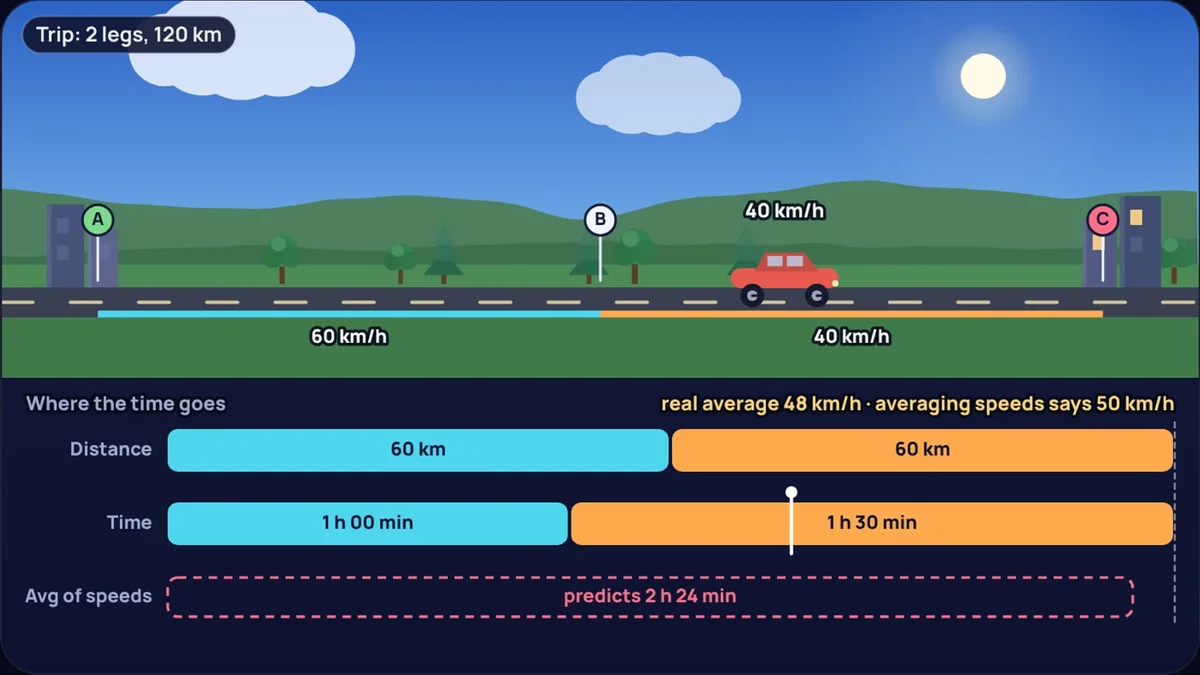
Here is a question that catches out most people the first time. You drive 60 km to a friend's house at 60 km/h. On the way home the traffic is heavier and you average 40 km/h. What was your average speed for the whole trip? Nearly everyone says 50 km/h. The answer is 48.
The gap looks small, but the reasoning behind it matters every time you plan a trip, read a running split or check a homework answer. This post works through why the two numbers differ, the formula that gets it right, and how runners use the same idea as pace. The speed, distance and time calculator does every example here and shows where the time goes on a timeline.
What is average speed?
Speed is distance divided by time. For a single steady leg there is nothing to argue about: 150 km in 2 hours is 75 km/h. The same formula turns round to give the other two quantities, distance = speed × time and time = distance ÷ speed.
When the speed changes along the way, the average speed is still defined the same way, over the whole trip: add up all the distance, add up all the time, and divide. That definition is the one that answers practical questions. If your average speed is 48 km/h, then 120 km takes 2.5 hours, which is how long you were actually on the road.
Example 1: 60 km/h out, 40 km/h back
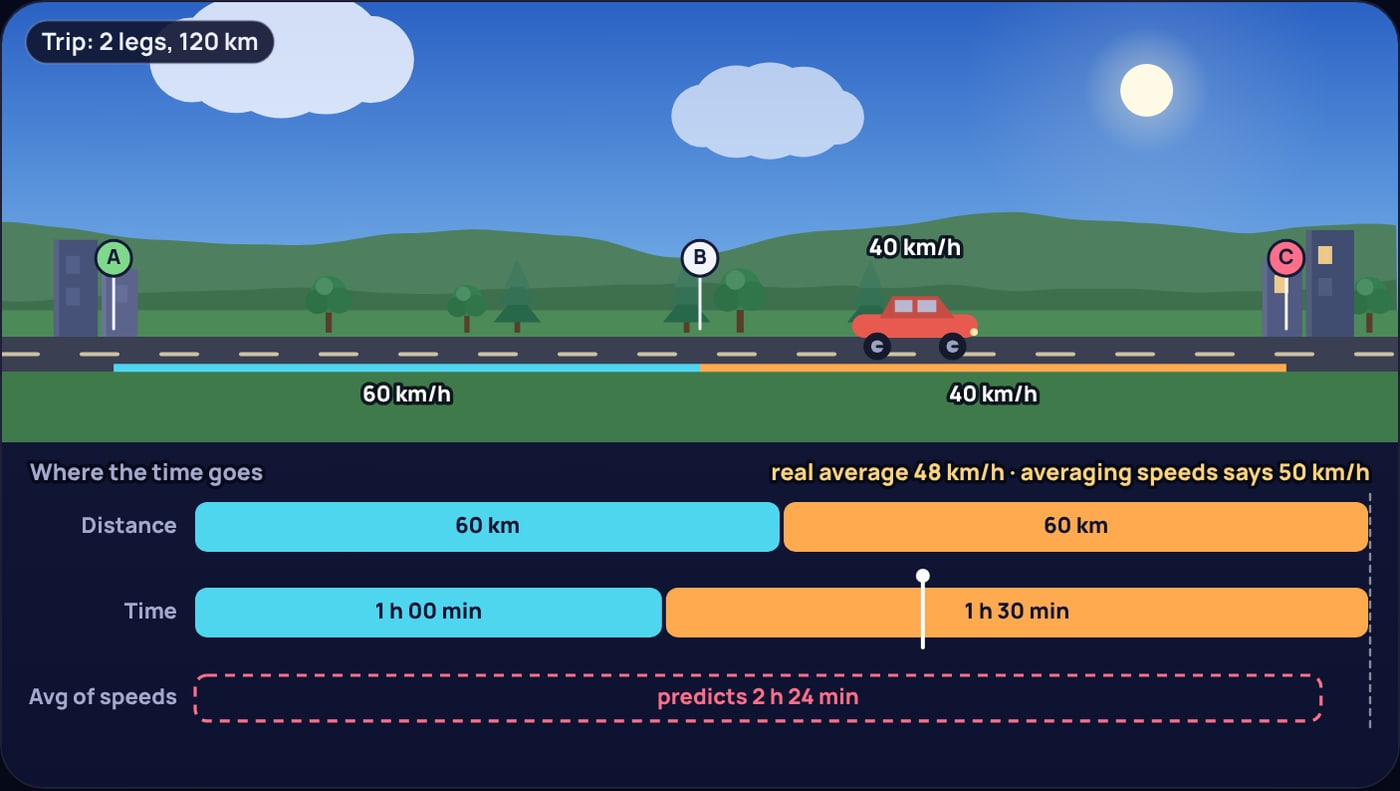
If the average really were 50 km/h, the 120 km trip would take 2.4 hours, or 2 h 24 min. It took 2 h 30 min. The 6 minute gap is exactly the error you make by averaging the speeds.
Why do the slow legs count for more?
An average of anything is only fair if each item is counted in proportion to how much of the whole it makes up. Speed is a rate per unit of time, so each speed should be weighted by how long you spent at it. Look at the timeline in Figure 1: the distance bar splits half and half, but the time bar splits 40% and 60%. The car spends more of the trip at 40 km/h than at 60 km/h, so the true average sits closer to 40.
Averaging 60 and 40 to get 50 quietly assumes the two speeds lasted equally long. That is a different trip. If you drive for one hour at 60 km/h and then one hour at 40 km/h, the plain average is exactly right.
Example 2: equal times instead of equal distances
Same two speeds, different average. The speeds alone never tell you the average speed; you also need either how long or how far each one lasted.
So the rule is simple to state. When each speed lasts the same time, average the speeds. When each speed lasts the same distance, the slow ones dominate and the plain average is too high. When the legs differ in both, work out each leg's time and divide total distance by total time, which always works.
What is the formula for two equal distances?
For two legs of the same length at speeds and , the times are and . Dividing the total distance by the total time, the cancels:
This is the harmonic mean of the two speeds. It is always less than or equal to the ordinary average, and the further apart the speeds, the bigger the gap. For 60 and 40 it gives 2 × 60 × 40 ÷ 100 = 48. For 60 and 20 it gives 30, not 40, the same example the Wikipedia article on the harmonic mean uses. With more legs of equal length the rule extends: the average is the number of legs divided by the sum of 1 ÷ speed for each.
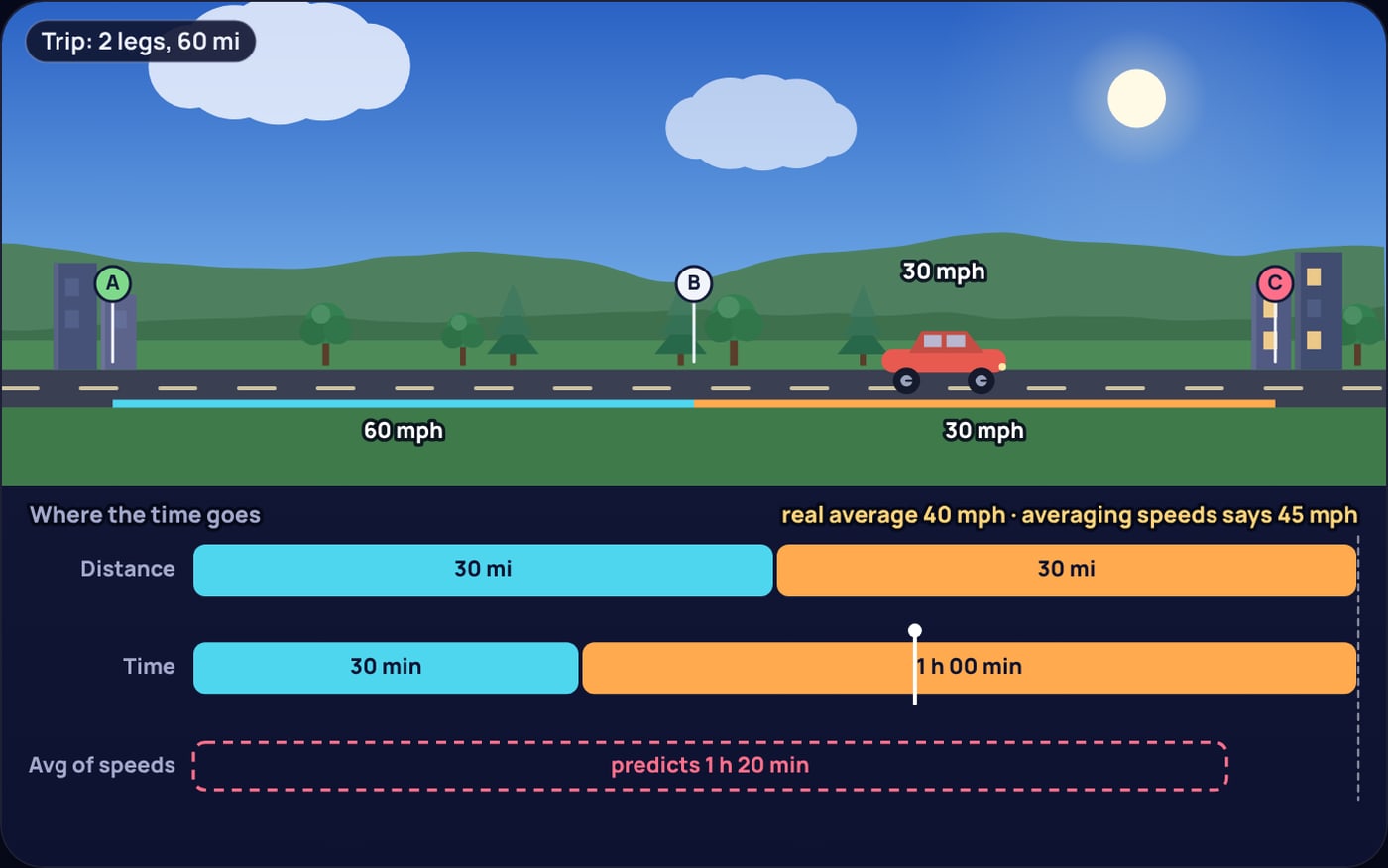
Example 3: 30 miles at 60 mph, then 30 miles at 30 mph
The plain average says 45 mph. The second half at 30 mph takes twice as long as the first, so it gets twice the weight: (60 × 0.5 + 30 × 1) ÷ 1.5 = 40 mph. The units do not change anything.
Can you make up for a slow start?
A classic puzzle shows how strongly slow speeds pull the average down. You drive to a town 30 km away at 30 km/h. How fast must you drive back to average 60 km/h for the round trip?
Example 4: the return trip that cannot be fast enough
The trip out has already used the whole hour. To average 60 km/h you would have to get back in no time at all, which no speed allows. Aim for 45 km/h instead and the formula 2ab ÷ (a + b) = 45 with a = 30 gives b = 90 km/h: three times the speed out to lift the average by half.
This is the general lesson. Time lost at a low speed can be reduced but never fully recovered by going faster later, because each extra km/h saves less and less time. The same arithmetic explains why a short stop on a long drive drags the average down more than people expect, and why running a race at an even pace usually beats a fast start and a slow finish.
What about legs of different lengths?
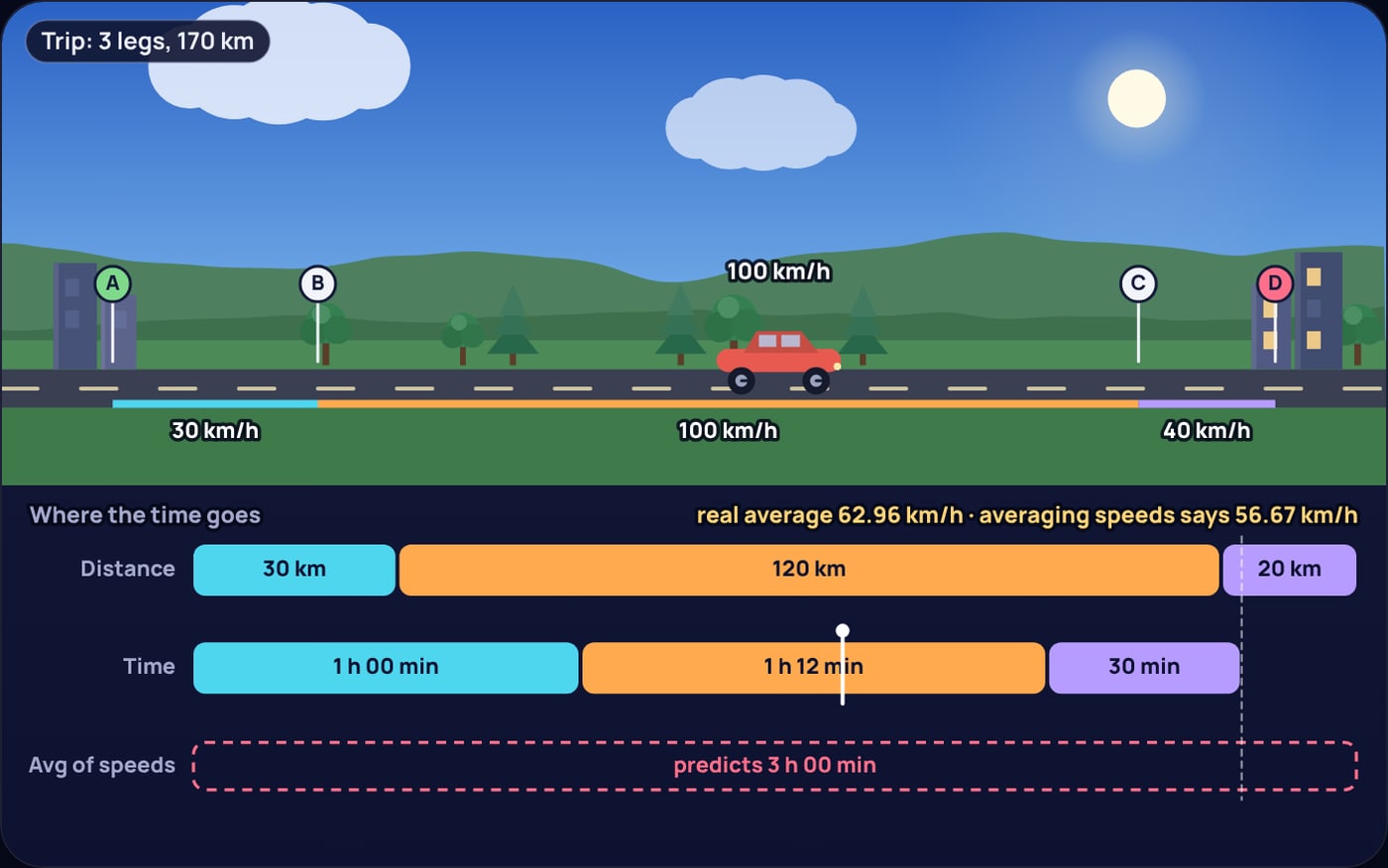
Real trips are rarely two equal halves. Say you crawl 30 km through town at 30 km/h, cruise 120 km on a highway at 100 km/h, then do the last 20 km at 40 km/h. These are example numbers, but the method is the one you would use for any trip: time each leg, then divide.
Example 5: town, highway, town
The plain average of the three speeds is (30 + 100 + 40) ÷ 3 = 56.67 km/h, which this time is too low. Most of the distance, and nearly half the time, is on the fast highway, and the plain average gives the short town legs as much say as the long highway one.
So averaging the speeds is not wrong in one direction only. It can come out too high or too low depending on how the time is shared out. The only safe method is total distance over total time.
How do runners use pace?
Runners usually turn speed upside down. Pace is time divided by distance, in minutes per kilometre or per mile. It is handy because it adds up directly: if each kilometre takes 5 minutes, ten of them take 50 minutes.
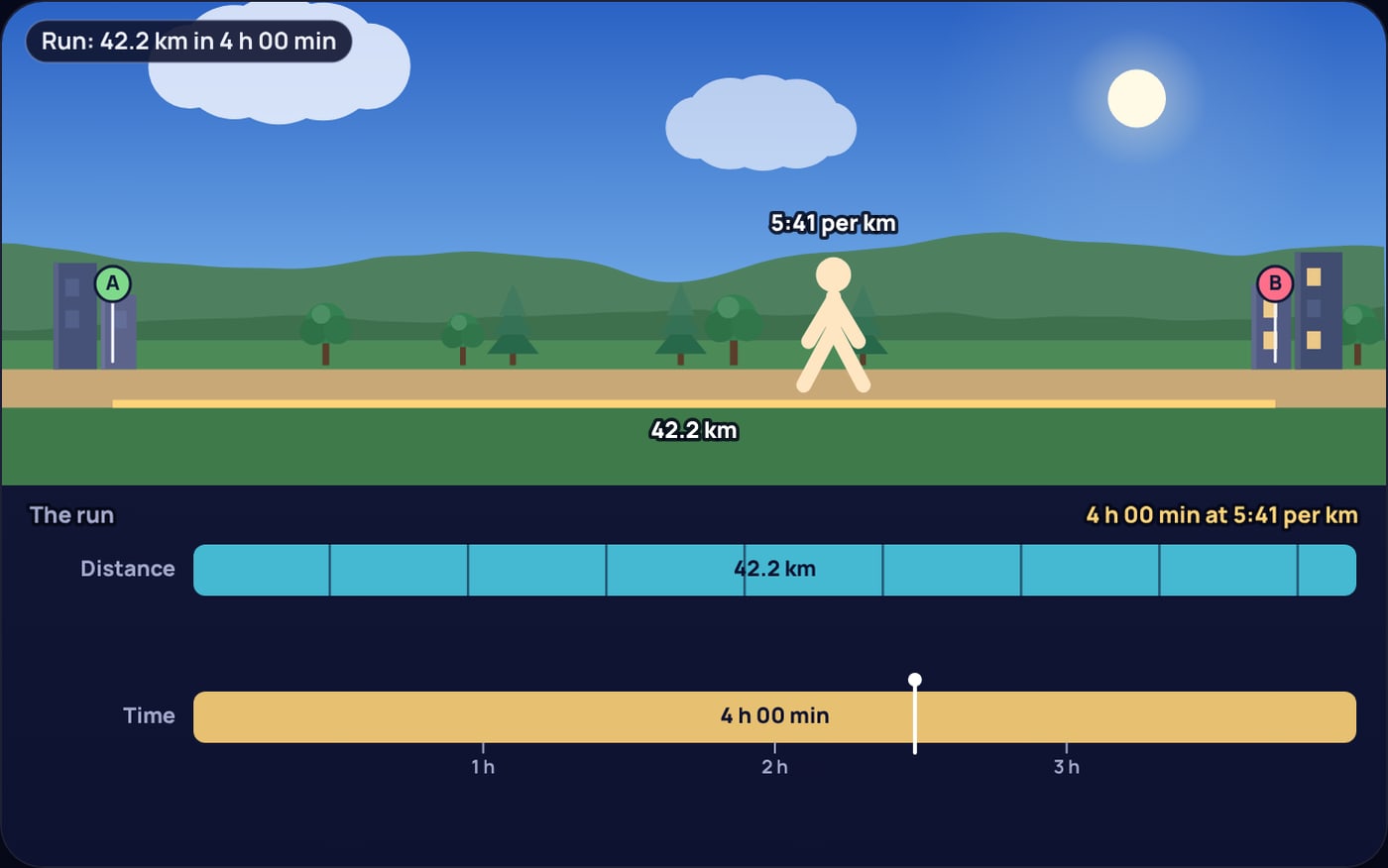
Example 6: a 4 hour marathon
The marathon has been 42.195 km since it was standardised in 1921. As a pace per mile, 4 hours is 9:09. A 25 minute 5K is an easier sum: 25 ÷ 5 = 5:00 per km, or 12 km/h.
Pace also flips the averaging rule round. Because pace is time per unit of distance, the plain average of paces is correct for equal distances. If you run one kilometre at 5:00 and the next at 6:00, your average pace is 5:30 per km. Turn those into speeds, 12 and 10 km/h, and the plain average would say 11 km/h, but the true speed is 2 km ÷ 11 min = 10.9 km/h. Whichever quantity has distance in the bottom averages correctly over equal distances, and whichever has time in the bottom averages correctly over equal times.
How do you convert between speed units?
The conversions are exact by definition. A kilometre per hour is 1,000 metres in 3,600 seconds, so divide km/h by 3.6 to get m/s. The international mile is exactly 1,609.344 m, which makes 1 mph exactly 0.44704 m/s, and a knot is one nautical mile, 1,852 m, per hour. So 90 km/h is 25 m/s, and 100 km/h is about 62.14 mph.
The most common slip in speed sums is not the units but the clock. Hours have 60 minutes, so 2.5 hours is 2 h 30 min, and 2 h 30 min typed as 2.3 hours gives the wrong answer. The calculator takes hours, minutes and seconds in separate boxes to avoid that.
Try it yourself
Open the speed, distance and time calculator with three legs and change one leg's speed to see how much the trip average moves, or switch to Pace and enter your own race time. The same distance over time reasoning works at much larger scales in how long sunlight takes to reach Earth and how many miles you have travelled around the Sun, and with the speed of sound in how far away lightning is.
Sources
- NIST, Guide to the SI, Appendix B.8: factors for units listed alphabetically: the foot (0.3048 m), mile (1,609.344 m), nautical mile (1,852 m) and mile per hour (0.44704 m/s) as exact factors.
- Wikipedia, Harmonic mean: average speed over equal distances as the harmonic mean, with the 60 and 20 km/h example, and the arithmetic mean for equal times.
- Wikipedia, Marathon: the 42.195 km distance, standardised in 1921.
Frequently asked questions
How do you calculate average speed?
Divide the total distance by the total time. A trip of 60 km at 60 km/h and 60 km back at 40 km/h covers 120 km in 2.5 hours, so the average speed is 48 km/h.
Why is average speed not the average of the speeds?
Because you spend more time at the lower speed. Over equal distances the slow leg lasts longer, so it counts for more in the average. Averaging the speeds only works when each speed lasts the same length of time.
What is the formula for average speed over two equal distances?
It is the harmonic mean of the two speeds: 2ab ÷ (a + b). For 60 and 40 km/h that is 2 × 60 × 40 ÷ 100 = 48 km/h.
How do you work out running pace?
Divide the time by the distance. 25 minutes for 5 km is 5 minutes per km. A 4 hour marathon of 42.195 km works out at 5 minutes 41 seconds per km.
Can you drive faster on the way back to make up for a slow trip out?
Only partly. If you go out at 30 km/h, you have already used all the time a 60 km/h round trip allows, so no return speed can bring the average up to 60. Time spent going slowly can never be won back in full.