How Far Away Is Lightning? The Counting Rule Explained
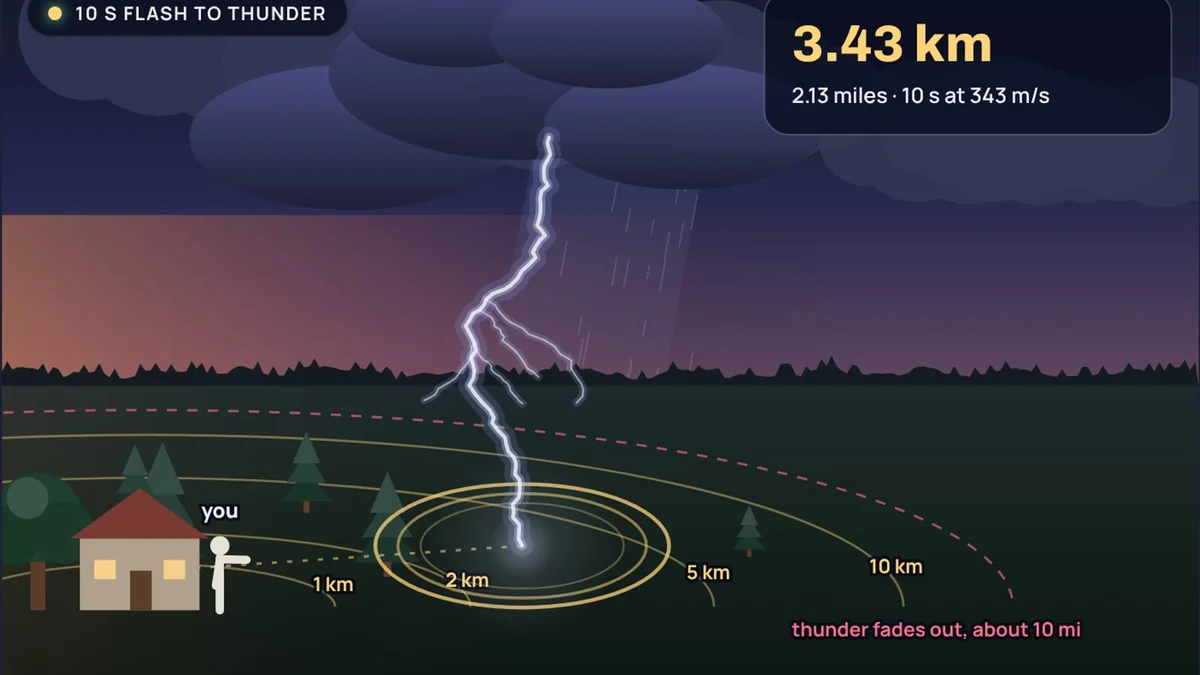
Ten seconds. That is what most people count when a storm feels like it is "still a way off", somewhere between the flash lighting up the window and the rumble rattling it. Ten seconds puts the strike 3.4 km away, about 2.1 miles. People are hit by lightning at that distance every summer, often while they are still deciding whether the storm is close enough to worry about.
The counting rule is the best free instrument anyone has for storms: divide the seconds by 3 for kilometres or by 5 for miles. This post explains why it works, how much the weather changes it, and what the count should and should not tell you to do. If you want the number for your own count, the lightning distance calculator has a tap timer: tap at the flash, tap at the thunder, and it drops the bolt on a map around your house.
Why does counting seconds tell you the distance?
A lightning flash makes light and sound at the same moment. The return stroke heats a channel of air a few centimetres wide to as much as 50,000 °F (about 28,000 °C) in a few millionths of a second, according to the National Weather Service. The air cannot expand fast enough to keep up, so it bursts outward as a shock wave that decays into the sound we call thunder.
The light then reaches you almost instantly. At m/s it covers 10 km in about 33 microseconds, far too short to notice. Sound is nearly a million times slower. So the gap you hear is, to within millionths of a second, the time the sound spent travelling. Distance is speed times time:
Everything else in the counting rule is the speed of sound written in a form you can do in your head.
How fast does thunder travel?
Sound in air travels at about 343 m/s at 20 °C. The speed depends on temperature, because sound is carried by air molecules bumping into each other and warmer molecules move faster. The US National Weather Service uses this formula in its weather calculators, with the temperature in kelvin:
This is the ideal gas result for dry air, with the constants folded into the 0 °C value. It gives these speeds:
| Air temperature | Speed of sound | Seconds per km | Seconds per mile |
|---|---|---|---|
| −10 °C (14 °F) | 325 m/s | 3.08 | 4.95 |
| 0 °C (32 °F) | 331 m/s | 3.02 | 4.86 |
| 15 °C (59 °F) | 340 m/s | 2.94 | 4.73 |
| 20 °C (68 °F) | 343 m/s | 2.91 | 4.69 |
| 30 °C (86 °F) | 349 m/s | 2.87 | 4.61 |
| 35 °C (95 °F) | 352 m/s | 2.84 | 4.57 |
You can see where the rules come from. Sound needs about 3 seconds per kilometre and about 5 seconds per mile at any temperature you are likely to meet in a thunderstorm. NASA's Glenn Research Center gives the standard sea level figure as about 761 mph, which is the 15 °C row.
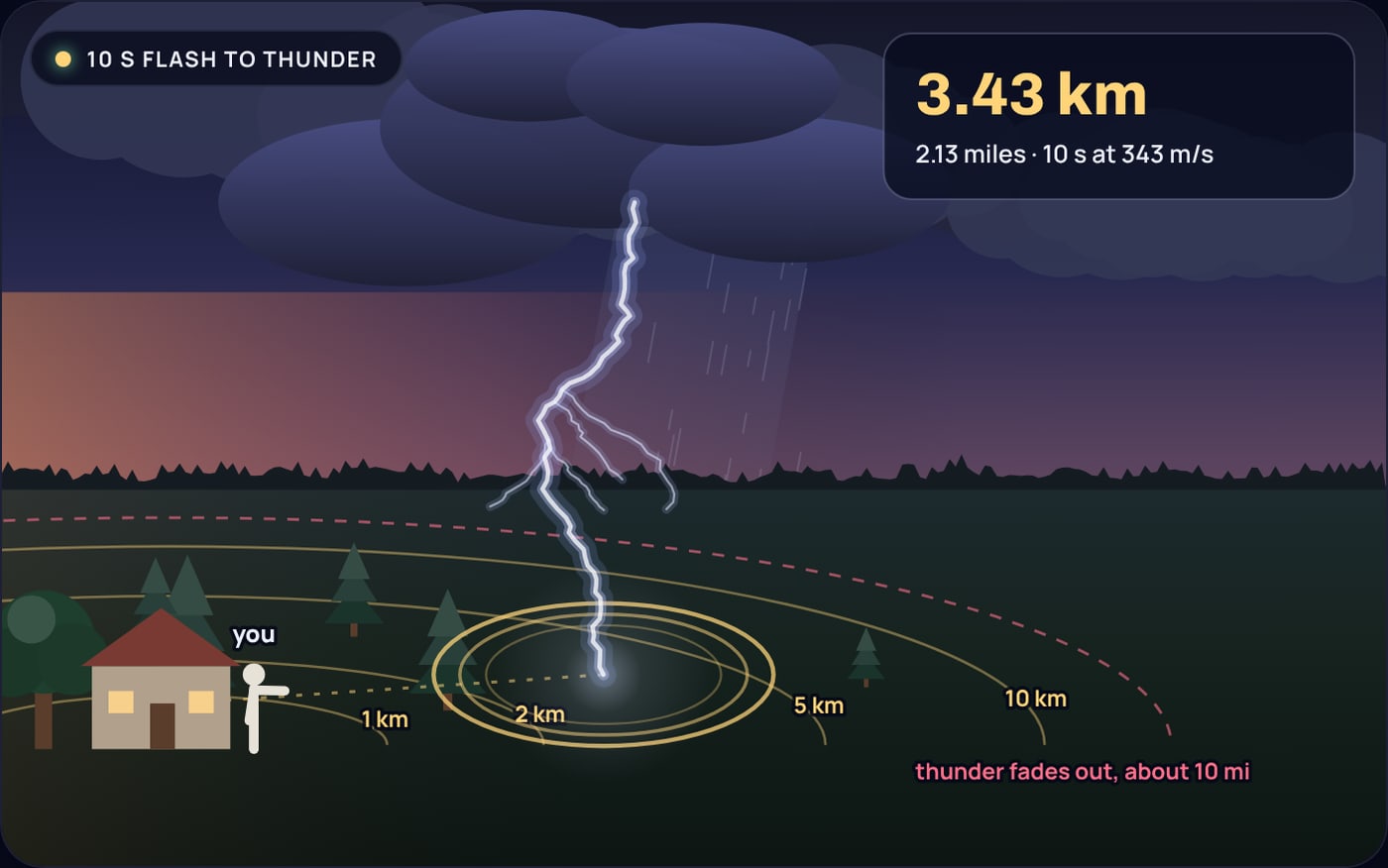
Worked example: a 10 second count
You see a flash and count ten seconds to the first sound of thunder. The air is a mild 20 °C.
Example 1: 10 seconds at 20 °C
The rules of thumb give 10 ÷ 3 = 3.3 km and 10 ÷ 5 = 2.0 miles. Both are within about 6% of the exact answer, which is better than anyone can count by ear.
That 6% is worth a moment. The kilometre rule says 3.3 km where the truth is 3.4 km, so it slightly underestimates, which is the safe direction. The mile rule says 2.0 miles where the truth is 2.13, also slightly short. Neither error matters next to your own timing, which is easily half a second either way, or about 170 m.
Does temperature change the answer much?
A little. Between a freezing winter storm and a hot monsoon evening, the speed of sound changes by about 5%. Here is the same kind of count on a hot evening, the sort of pre-monsoon storm that rolls over Kolkata or Mumbai in May.
Example 2: 12 seconds at 30 °C
At 20 °C the same 12 seconds would be 4.12 km. The heat adds about 70 m. The rule of thumb, 12 ÷ 3 = 4 km, is still within 5%.
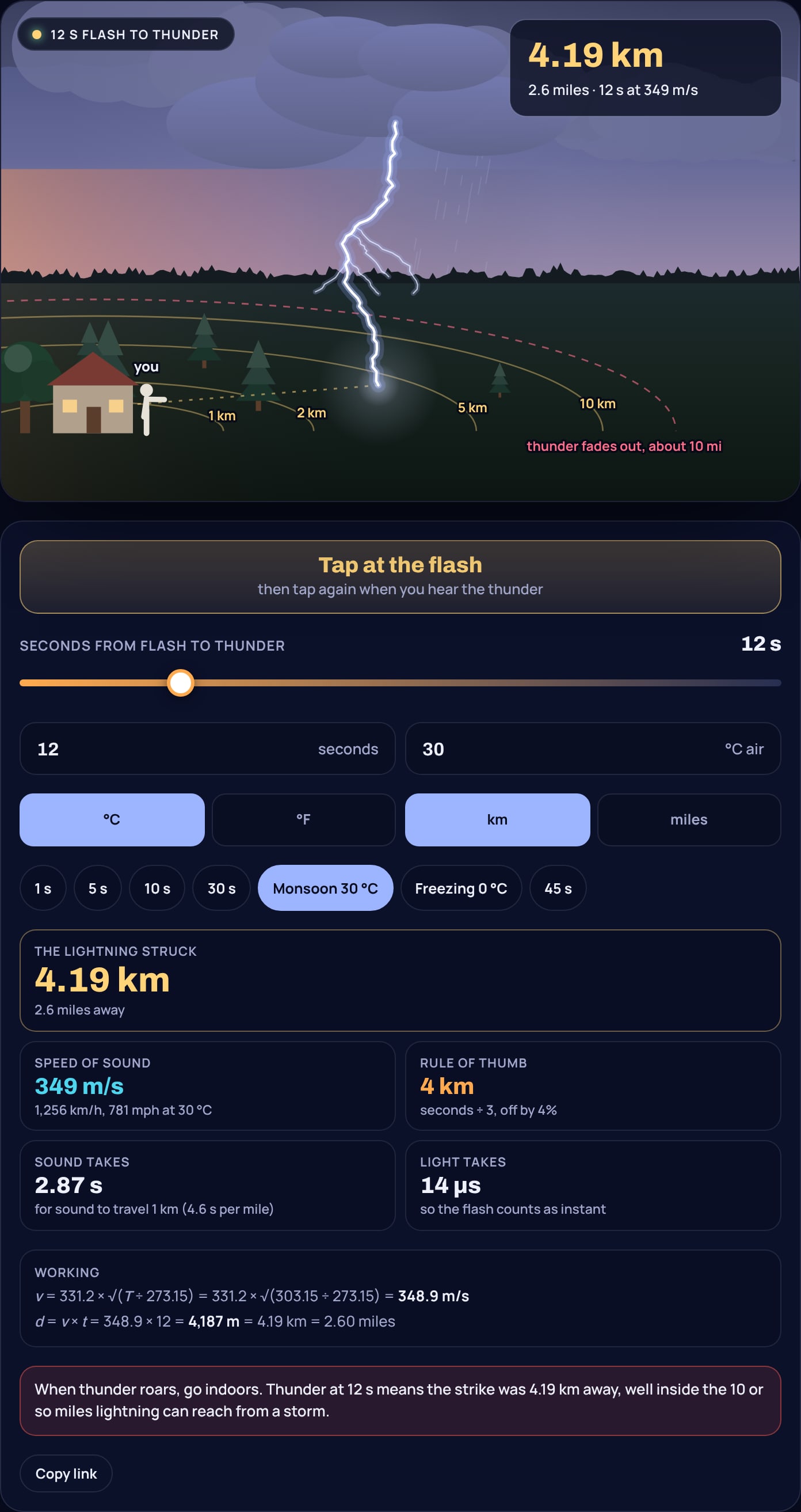
So temperature is a correction, not a different answer. The calculator includes it because it costs nothing, and because "3.43 km" and "3.32 km" are both easy to show. For a decision about whether to go inside, the rule of thumb is all you need.
How do you count accurately?
Most counting errors come from three habits, and all three are easy to fix.
Stop on the first sound, not the loudest. Thunder from a single flash can rumble for many seconds, because the channel is kilometres long and its different parts are at different distances from you. The first sound comes from the nearest part. The loud crash that follows can come from further up the channel or from the part that touched the ground.
Use a clock, not "one thousand, two thousand". Spoken counts drift, usually fast when people are anxious. A phone stopwatch, or the tap timer on the calculator, is better.
Match the flash to its thunder. In an active storm, flashes can come several times a minute. With long counts, the rumble you hear may belong to an earlier flash. This is why counts above 30 seconds are less reliable than short ones.
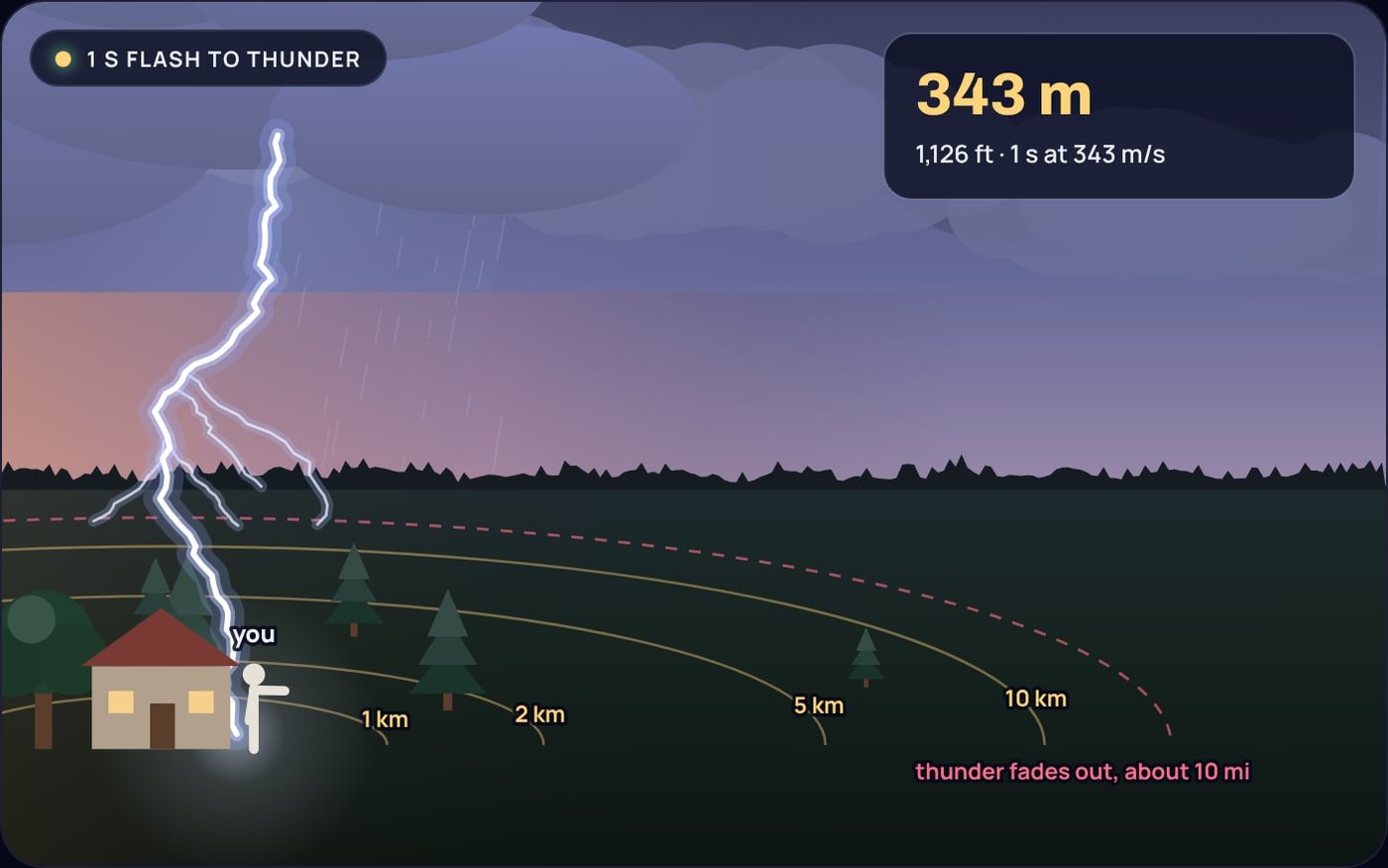
Is 30 seconds still the safe number?
No, and this is the most common mistake people make with the count. For years, safety advice used the 30-30 rule: if the flash-to-thunder count is 30 seconds or less, be in a safe place; then wait 30 minutes after the last thunder before going back out. A National Weather Service training sheet still describes it that way. Thirty seconds is about 10 km, or 6.4 miles.
The first half of that rule has been replaced. In a paper on lightning safety for the public, meteorologist William Roeder explains that many people read the 30-30 rule as "start heading for shelter at 30 seconds", when it meant "already be inside by then". He also points out that fast moving storms can leave barely enough time to reach shelter even after the first thunder, so waiting for a 30 second count wastes the warning you have. The lightning safety community replaced it with a simpler slogan, the one the National Weather Service now leads with:
When thunder roars, go indoors. If you can hear thunder, you are close enough to be struck. Stay inside until 30 minutes after the last thunder.
The reasoning is in the distances. NWS says thunder can usually be heard only about 10 miles from the strike. NWS also says lightning often strikes more than three miles from the centre of a storm, and that "bolts from the blue" can land 10 to 15 miles away. The range of hearing and the range of striking are about the same. So the count is useful for watching whether a storm is approaching or leaving, but there is no count at which it becomes safe to stay outside while you can still hear it.
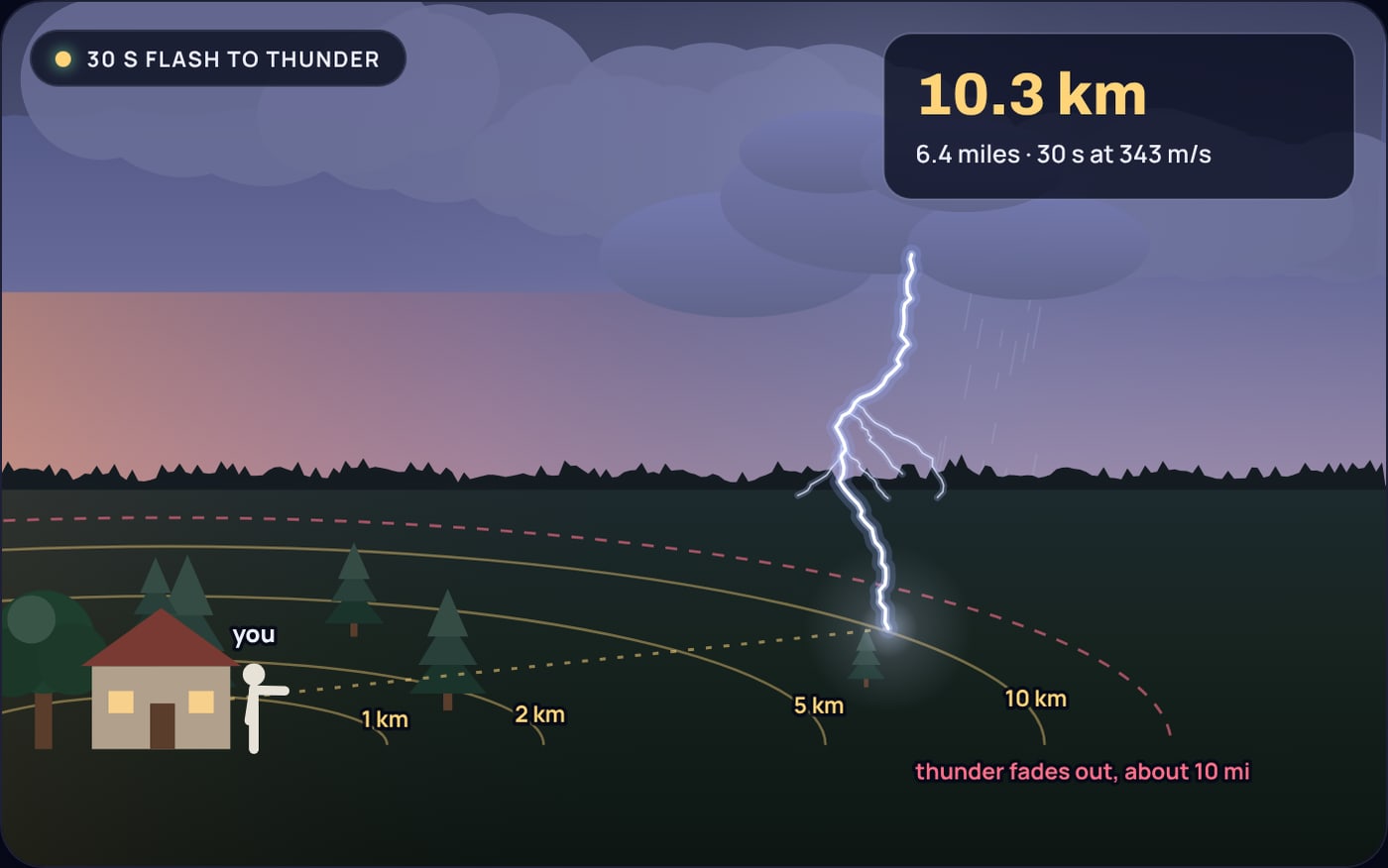
How far away can you hear thunder?
About 10 miles, or 16 km, according to the National Weather Service. At 20 °C that is a count of about 47 seconds. Part of the reason is that air usually gets colder with height, and sound bends towards colder, slower air, so the thunder from a distant strike curves up over your head. Hills, buildings, wind and the noise around you cut the range further.
This explains "heat lightning", the silent flickering on the horizon on a summer night. It is ordinary lightning from a storm too far away for its thunder to reach you. Nothing about the flashes is different; you are just outside the sound's range.
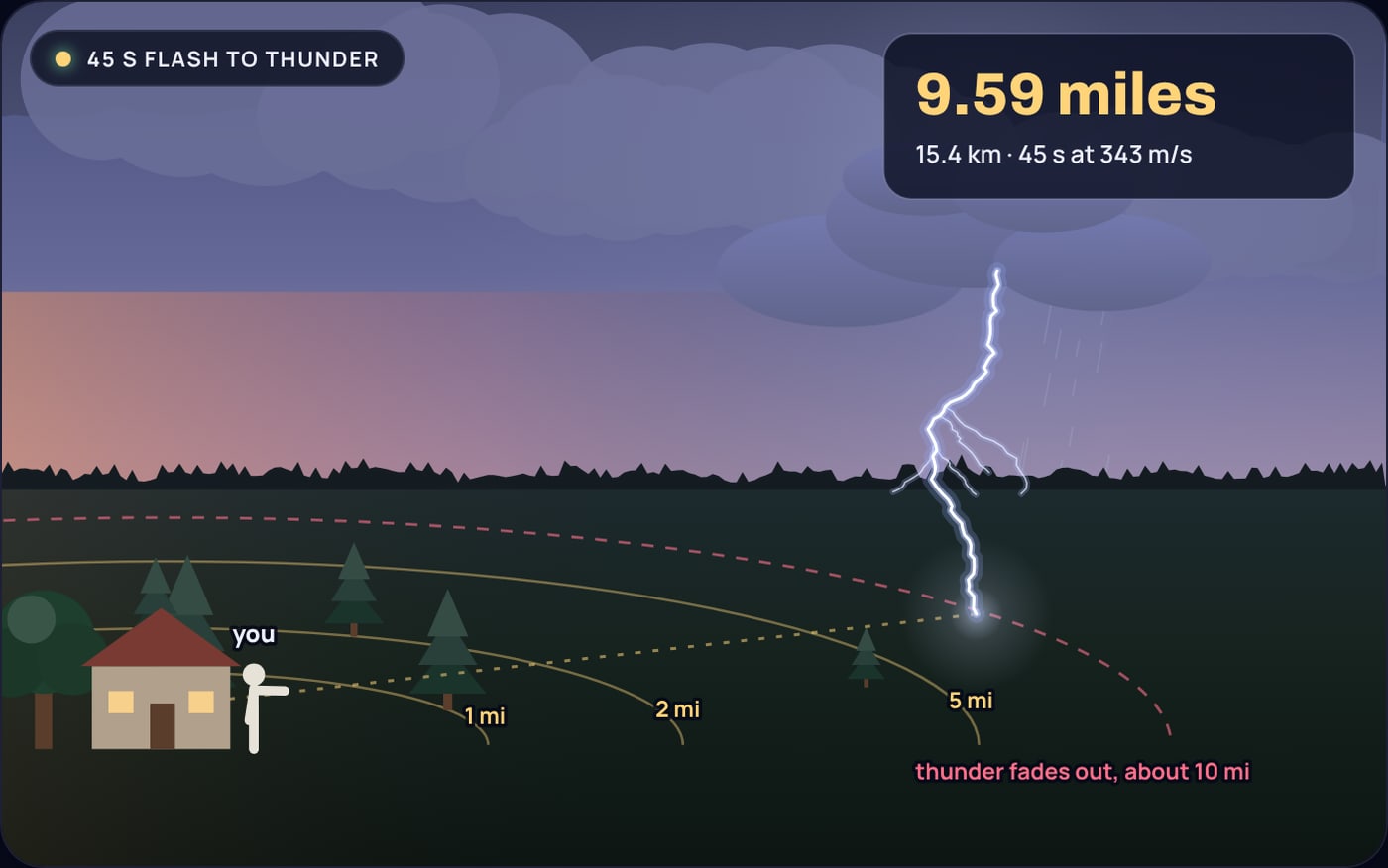
Is the storm coming towards you?
One count gives a distance. Several counts give a direction of travel, which is more useful. If the counts go 30, 22, 15 seconds over ten minutes, the storm is closing at roughly 15 seconds, or 5 km, in ten minutes, about 30 km/h. If the counts are growing, it is moving away, but the NWS 30 minute wait still applies: the trailing edge of a storm can produce strikes after the rain has stopped.
For a sense of scale, a typical flash carries roughly a gigajoule of energy, released in a fraction of a second. The 1.21 gigawatts post works through the power and energy in a bolt. And if you have wondered why birds sit on power lines unharmed while a strike nearby is deadly, why birds don't get electrocuted explains the difference between touching one wire and being part of the path.
What the rule leaves out
The count assumes still, dry air at one temperature. Wind changes the speed a little: a 10 m/s wind blowing from the storm towards you shortens the delay by about 3%. Humidity speeds sound up by well under 1%. The air between you and the cloud is colder than the air where you stand, which slows the sound slightly on its way down. And the delay gives the distance to the nearest part of the channel, which for a slanting bolt may be part way up rather than where it hit the ground. All of these are small next to a half second of human reaction time.
Try it at the next storm: open the lightning distance calculator indoors, tap at a flash and again at the first thunder, and switch to freezing 0 °C or a 30 °C monsoon evening to see how little the temperature moves the bolt.
Sources
- National Weather Service: Understanding Lightning: Thunder (5 seconds per mile, thunder heard to about 10 miles, 50,000 °F)
- National Weather Service: Lightning Safety Tips and Resources (When Thunder Roars, Go Indoors; wait 30 minutes)
- National Weather Service: Lightning Myths (strikes more than three miles from the storm centre; 10 to 15 miles for bolts from the blue)
- National Weather Service El Paso: Speed of Sound formula
- National Weather Service Houston: lightning facts training sheet (the 30-30 rule)
- W. P. Roeder, Lightning Safety Procedures for the Public (why the 30-30 rule was replaced)
- NASA Glenn Research Center: Speed of Sound
Frequently asked questions
How do you tell how far away lightning is?
Count the seconds from the flash to the first sound of thunder. Divide by 3 for kilometres or by 5 for miles. A 10 second count means the strike was about 3.4 km, or 2.1 miles, away in 20 °C air.
Is it 3 seconds or 5 seconds per mile?
5 seconds per mile and 3 seconds per kilometre. At 20 °C sound covers a mile in about 4.7 seconds and a kilometre in about 2.9 seconds, so both rules slightly underestimate the distance, which is the safe direction to be wrong in.
Is lightning 30 seconds away dangerous?
Yes. A 30 second count is about 10 km, or 6.4 miles, and lightning can strike 10 miles or more from a storm. The old 30-30 rule has been replaced by the simpler advice: when thunder roars, go indoors.
How far away can you hear thunder?
Usually about 10 miles (16 km), according to the US National Weather Service. That is a count of about 47 seconds. Flashes from further away are seen without any thunder.
How long should you wait after the last thunder?
30 minutes after the last thunder or lightning, according to the National Weather Service. The trailing edge of a storm can still produce strikes after the rain has stopped.