Why Don't Birds Get Electrocuted on Power Lines?
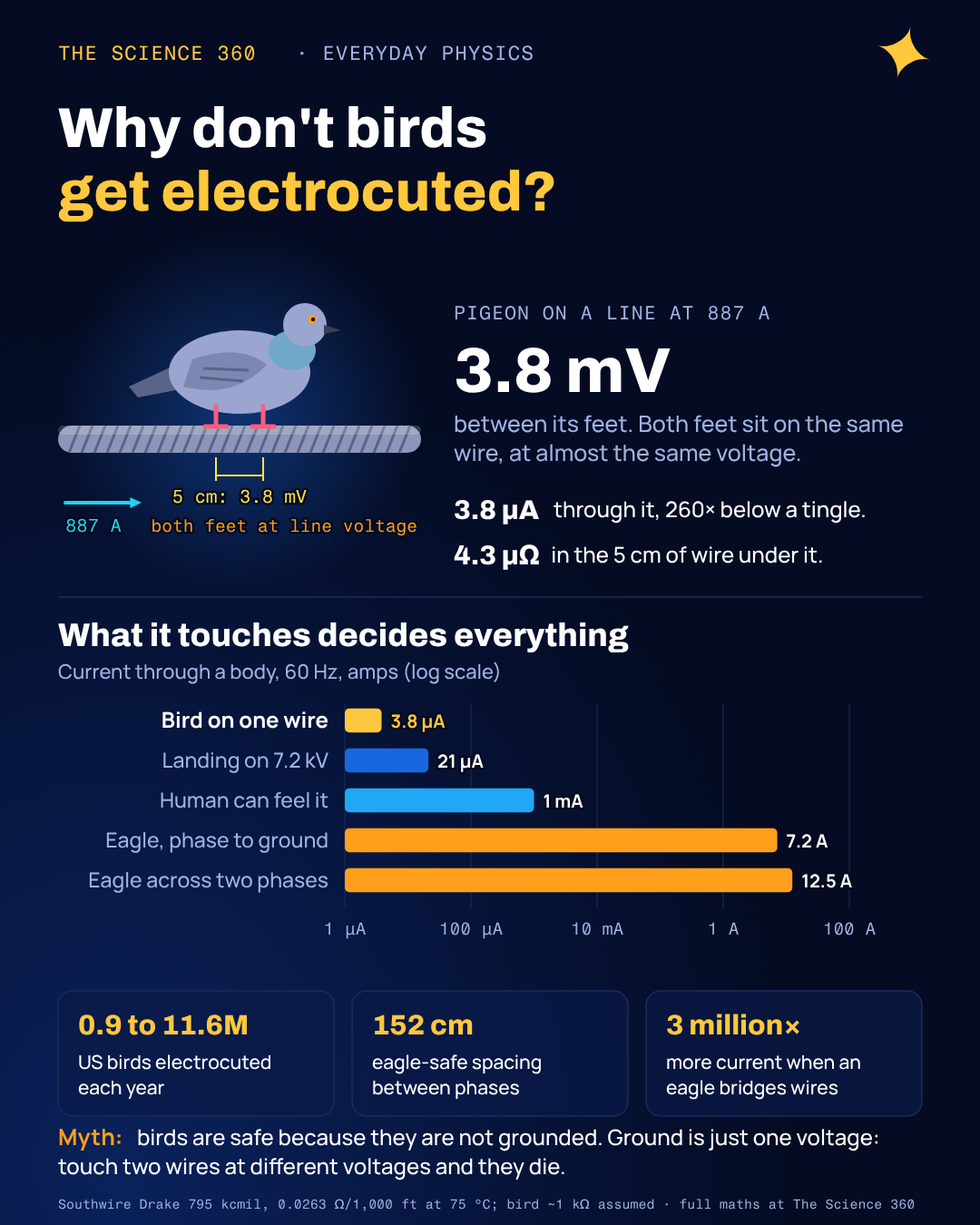
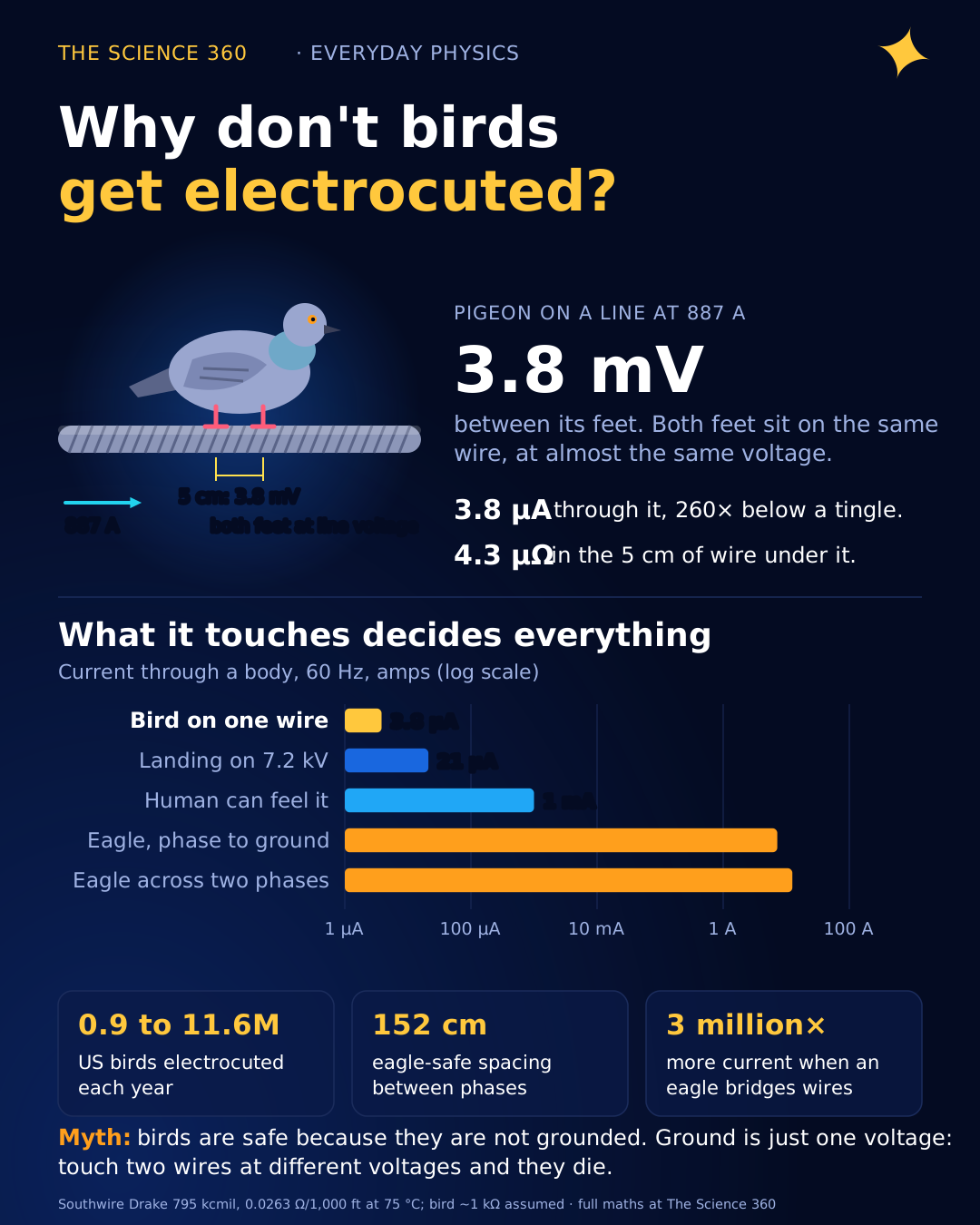
Here is a number most explanations skip: a pigeon standing on a 795 kcmil transmission conductor carrying 887 amps has 3.8 millivolts between its feet. That is about four thousandths of a volt, roughly what a type K thermocouple produces with one end in boiling water. Meanwhile the wire it stands on may sit 7,200 volts or 289,000 volts away from the ground below.
The usual explanation, "the bird isn't grounded," is half right and leaves out the interesting part. Being ungrounded is necessary, but it is not the reason nothing happens. The reason is that the wire itself is a far better conductor than the bird, and electricity does not care about "ground" at all. It cares about voltage differences between two points of contact. Let's put real numbers on it, then look at the cases where birds do die, which is millions of times a year in the US alone.
Why don’t birds get shocked on power lines?
Current flows through something only when there is a voltage difference across it. A bird perched on a single conductor touches that conductor at two points, its left foot and its right foot. Whatever the voltage of the line is relative to the earth (7.2 kV on a typical North American distribution feeder, hundreds of kilovolts on a transmission line), both feet share it almost exactly. The bird rises and falls with the line, 60 times a second in North America, like a passenger on an elevator who does not feel the building's height.
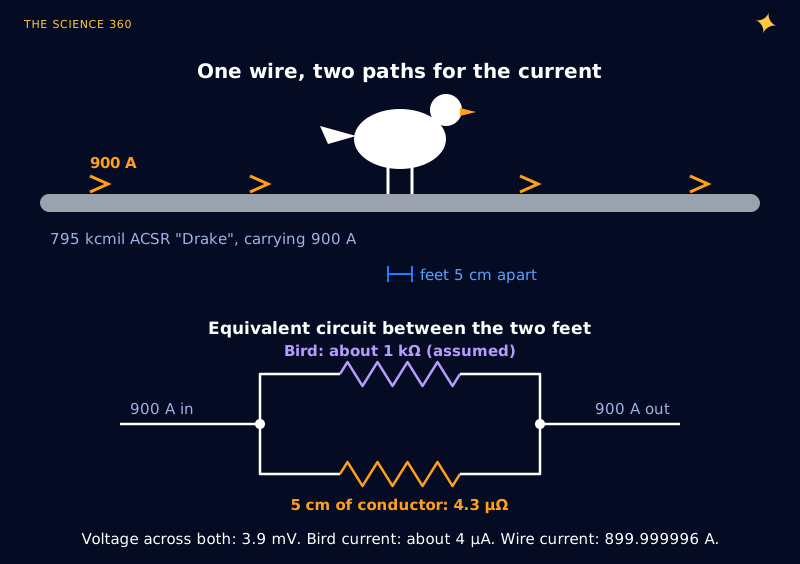
"Almost exactly" is the part worth quantifying. A real wire has some resistance, and the line current flowing through it produces a small voltage drop along its length. The bird's two feet are a few centimeters apart along that length, so there is a small voltage between them. The bird and that short piece of wire form two resistors in parallel, and the current splits between them in inverse proportion to their resistances.
How many volts does a bird on a power line actually feel?
We need three numbers: the conductor's resistance per meter, the current it carries, and the spacing of the bird's feet.
For the conductor, take Drake, a 795 kcmil aluminum conductor steel reinforced (ACSR) cable that is one of the most common transmission and large feeder conductors in North America. Southwire's catalog lists the trapezoidal-strand version at 0.0263 Ω per 1,000 feet AC resistance at 75 °C, with an allowable ampacity of 887 A (25 °C ambient, 2 ft/s wind, full sun). For the bird, take a pigeon or crow with feet about 5 cm apart. For the bird's own resistance, nobody seems to have published a measured figure, so I will assume 1 kΩ, which is in the same range as the internal resistance of a human body. As you will see, this assumption barely matters.
Worked calculation: voltage and current through a perched bird
1. Resistance per metre, then across the 5 cm between the feet:
2. Voltage between the feet (Ohm's law), and current through the bird:
3. Compare with the human perception threshold of about 1 mA at 60 Hz (NIOSH), and the share of line current the bird carries:
Four parts per billion.
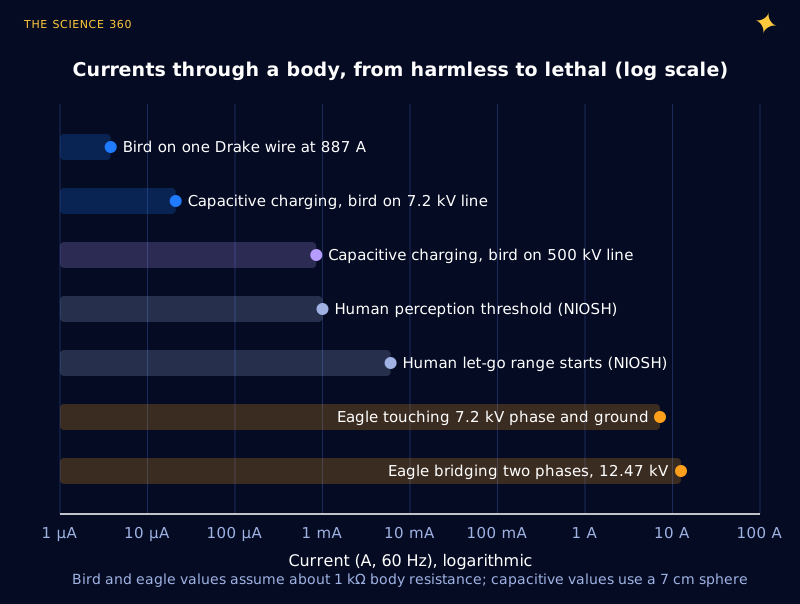
So the bird carries a current about 260 times smaller than the faintest tingle a person can detect. If the bird's real resistance is 10 kΩ instead of 1 kΩ (dry, scaly feet are poor contacts), the current drops to 0.4 µA. If it is 100 Ω, the current rises to 38 µA, still well below perception. That is why I said the assumption barely matters: the wire's resistance is so tiny that the bird could be off by a factor of a hundred either way and still be fine.
Thinner wires carry less current, but they also have more resistance per meter, so it is fair to check them too. Distribution lines on wooden poles often use smaller conductors such as Raven (1/0 AWG ACSR, 0.84 Ω per mile) and Sparrow (2 AWG ACSR, 1.34 Ω per mile). Figure 2 runs each one up to its rated current.
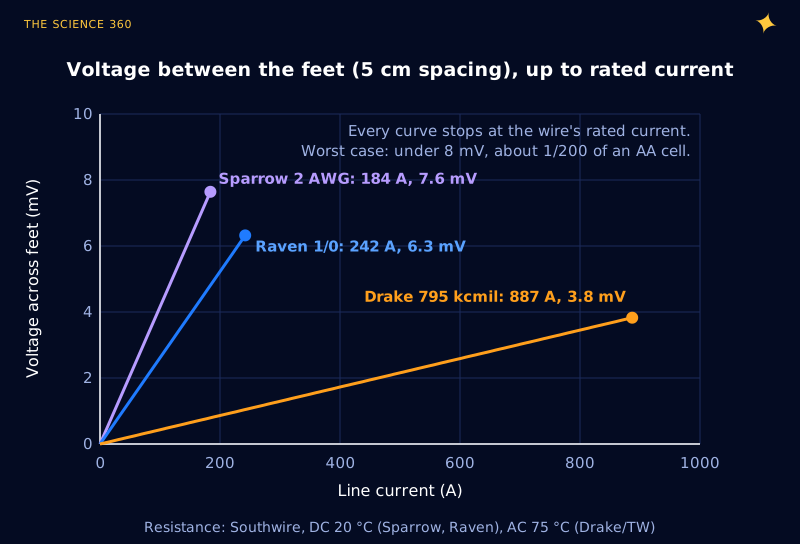
There is a neat engineering reason the curves end so close together. A conductor's ampacity is set by how hot it gets, and the heat per meter is I2R per meter. The voltage drop per meter is IR. For conductors running at their thermal limit in similar weather, a bigger cable can shed a bit more heat, but not proportionally more, so the voltage drop per meter at rated current only varies by a factor of two across this whole range. The bird's worst case is a few millivolts on essentially any overhead line.
The “birds aren’t grounded” explanation is incomplete
Most top search results stop at "the bird doesn't touch the ground, so no current flows." Two things are wrong with stopping there.
First, current does flow. It is not zero, it is a few microamps. Some explanations online claim the voltage between the feet is in the nanovolt range; the calculation above shows that is off by about a factor of a million for a loaded line. The honest answer is not "nothing happens" but "something happens that is far too small to matter."
Second, "ground" is just one particular voltage. You could hang a bird between two wires that are both thousands of volts away from the earth and it would die, because those two wires are at different voltages from each other. Conversely, you can be thousands of volts away from the earth and perfectly safe, as long as everything you touch is at that same voltage. Line workers use exactly this fact, which we will come back to.
A related myth: "electricity takes the path of least resistance." It doesn't. It takes every available path, splitting in inverse proportion to resistance. The bird is a real path. It just carries about four billionths of the current. This matters for people, because a high-resistance path through your body in parallel with a low-resistance path elsewhere can still carry a lethal current if the voltage across it is high.
When do birds get electrocuted?
They do, in large numbers. A 2014 analysis in PLOS ONE by Loss, Will and Marra pooled the available studies and estimated that power lines in the United States kill 0.9 to 11.6 million birds per year by electrocution, on top of 8 to 57 million by collision. The wide range reflects how few rigorous surveys exist, but even the low end is a lot of birds.
The Avian Power Line Interaction Committee (APLIC), the joint utility and wildlife group whose guidance US utilities follow, describes the mechanism plainly: a bird is electrocuted when it simultaneously touches two energized parts at different voltages, or an energized part and a grounded part. Its guidance also notes that dry feathers insulate well, so a fatal contact usually goes through fleshy parts such as the feet, skin or bill. Wet feathers conduct far better, so wet weather raises the risk.
The deadly spot is rarely the middle of a span. It is the pole top, where conductors converge, insulators are short, and grounded hardware (ground wires, steel brackets, transformer tanks) sits close to live parts. A starling on a crossarm cannot reach from one phase to another. A golden eagle, with a wingspan of 185 to 220 cm according to the Cornell Lab of Ornithology, can, and raptors love poles because they are the tallest perch in open country.
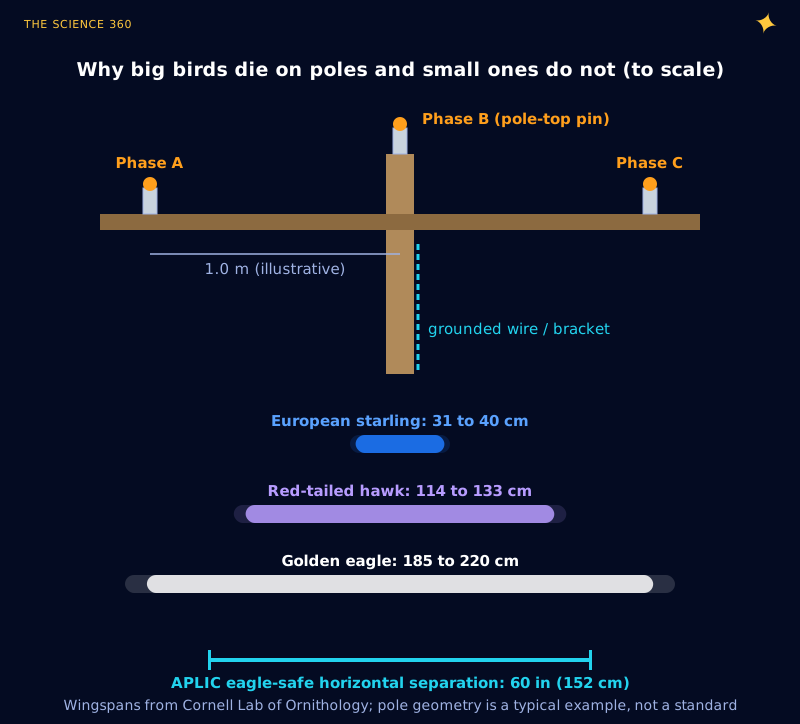
The numbers for a bridging eagle are brutal. On a 12.47 kV feeder (one of the most common North American distribution voltages, 7.2 kV from each phase to ground), an eagle touching phase and ground sees 7,200 V, and one bridging two phases sees 12,470 V. With the same 1 kΩ body estimate, that is roughly 7 to 12 amps. Compare that with the 3.8 µA of the perched pigeon: the difference is a factor of about three million, and it comes entirely from what the bird touches, not from how high the voltage of the line is.
This is why APLIC's fix is geometric rather than electrical. Utilities make poles "avian-safe" by spreading conductors to at least 60 inches apart horizontally and 40 inches vertically where eagles live, by mounting perch guards, and by fitting plastic covers over bushings, jumpers and conductors near the pole. The US Fish and Wildlife Service refers to those same spacing numbers when describing raptor-safe construction.
Does a bird get a shock when it lands on a wire?
There is one effect the parallel-resistor model ignores. Before landing, a bird is near earth potential (it has been sitting in a tree). The instant it touches a 7.2 kV line, its body must charge to the line's voltage. Treating a pigeon as a conducting sphere about 7 cm in radius, its self-capacitance is . At the 10.2 kV peak of a 7.2 kV RMS line, the charge transferred is about 80 nanocoulombs and the energy about 0.4 mJ, comparable to or smaller than the static spark you get from a doorknob on a dry day.
Because the line is AC, that charge sloshes in and out 120 times a second as the voltage swings. The RMS charging current is 2πfCV, about 21 µA on a 7.2 kV line. On a 500 kV transmission line (289 kV phase to ground) the same bird would carry around 0.85 mA, close to the human perception level. These are crude estimates (the real capacitance depends on the geometry of the nearby wires and towers), but they suggest something plausible: very high voltage lines may not be completely unnoticeable to a perched bird, even though they are not dangerous to it. Strong fields around such lines also produce corona, the hissing and crackling you can hear near transmission lines in wet weather.
How can linemen touch live wires bare-handed?
The bird principle scales up to people. In bare-hand live-line work, a lineman is lifted to a transmission line on an insulated boom or by helicopter, wearing a conductive suit woven with stainless steel fibers (one common type is about 75% Nomex and 25% stainless steel). Before touching the line, he connects the suit to the conductor with a bonding lead. From that moment, his body is at line potential, hundreds of kilovolts above the earth, and nothing flows through him because his hands, feet and suit are all at the same voltage.
The suit is a wearable Faraday cage. It solves the landing problem we just calculated: a human has far more capacitance than a pigeon, so the charging current is bigger, and you want it to flow through the suit's metal fibers rather than through skin. It also keeps the strong electric field near the conductor off the body. What makes the job dangerous is everything else: the insulated boom or helicopter must hold off the full line voltage, and the worker must never get close to a second phase or a grounded tower member. That is the eagle problem, at human scale.
What is step potential, and why is a downed line deadly?
Ground is not an equipotential either. When a live wire falls and touches the earth, current pours into the soil and spreads out. The soil has resistance, so the voltage falls off with distance from the contact point. For a simple model (a hemispherical contact in uniform soil), the voltage at distance is , where is the soil resistivity.
Take a modest case: 100 A flowing into soil of 100 Ω·m (a typical moist loam). At 1 m from the contact point the ground is at about 1,590 V; at 1.8 m it is about 880 V. A person taking a normal stride at that spot puts roughly 700 V across their legs. That is the "step potential" utilities warn about, and why their advice is to shuffle away with your feet together, never stride.
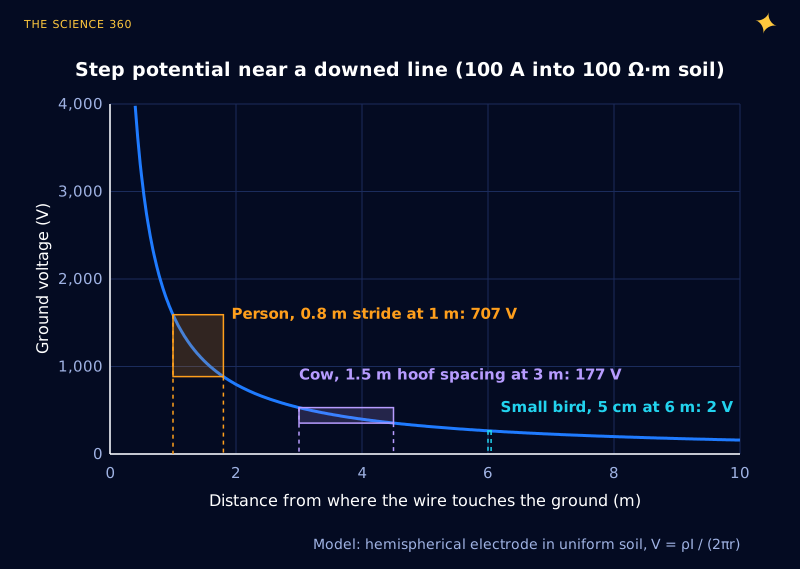
Notice the same logic as the perched bird. The danger scales with the distance between your contact points along a voltage gradient. Cattle, with front and rear hooves 1.5 m apart, span much more voltage than a person, and they are known to be killed by ground currents from lightning and faults for that reason. A sparrow hopping 6 m from the contact point spans about 2 V.
One more thing makes downed lines treacherous: they do not always trip the breaker. Dry soil or pavement can limit the fault current to tens of amps, below the protection settings designed for short circuits, so the wire can lie on the ground live and silent. Treat every downed line as energized.
What this teaches about electrical safety in general
The perched bird is the cleanest demonstration of a rule that every electrician and circuit designer uses daily: voltage is always measured between two points. A component, a lineman, or a pigeon only cares about the difference between where current can enter and where it can leave. It also explains why a relay coil needs a flyback diode (the inductor creates a large voltage between two points that used to be close). It is also the logic behind why LEDs need a resistor: a small change in voltage across a low-resistance path drives a big change in current.
Frequently asked questions
Why don’t birds get electrocuted on power lines?
Both feet sit on the same conductor, so they are at almost the same voltage. A few centimeters of thick aluminum wire has only microohms of resistance, so the voltage between the feet is a few millivolts and the current through the bird is a few microamps, far below anything it can feel.
Can birds get electrocuted on power lines?
Yes. A bird dies when its body bridges two points at different voltages: two phase conductors, or a live conductor and a grounded part of a pole. Large raptors such as eagles and hawks are most at risk because their wingspans can reach across the gaps on distribution poles. A 2014 study estimated 0.9 to 11.6 million electrocutions per year in the United States.
Would a person hanging from a power line get shocked?
Hanging by both hands from a single conductor and touching nothing else, a person would have only millivolts across their body, like a bird. The danger is that people are big: any contact with the ground, a pole, a ladder or a second wire completes a circuit at thousands of volts. Line workers who do bare-hand live work wear conductive suits and bond to the line on purpose.
Why do squirrels get electrocuted but birds don’t?
Squirrels climb on poles and transformers, where live terminals sit centimeters away from grounded metal tanks and brackets. A squirrel stretched between a transformer bushing and the grounded tank completes a circuit to ground. A bird perched on a span of wire away from the pole has nothing at a different voltage within reach.
Do birds feel electricity on power lines?
Almost certainly not through their feet: the current is microamps. On very high voltage lines a perched bird is charged and discharged by the alternating electric field 50 or 60 times a second, which on a 500 kV line works out to the order of a milliamp, and birds may sense the field on their feathers. The landing itself can produce a tiny spark.
Related on The Science 360
Sources
- Southwire, ACSR bare overhead conductor specification 80100 (DC resistance of Drake, Linnet, Raven, Sparrow): cabletechsupport.southwire.com/tile/23/spec/80100
- Southwire, ACSR and ACSR/TW catalog (Drake/TW 0.0263 Ω/kft at 75 °C, 887 A): Southwire ACSR cable catalog (PDF)
- APLIC, Electrocutions (mechanism, fleshy-part contact, 60 in and 40 in separation): aplic.org/Electrocutions
- APLIC, Suggested Practices for Avian Protection on Power Lines: The State of the Art in 2006 (CEC-500-2006-022): APLIC 2006 Suggested Practices (PDF)
- Loss, Will and Marra (2014), Refining Estimates of Bird Collision and Electrocution Mortality at Power Lines in the United States, PLOS ONE 9(7): e101565: PMC4081594
- Cornell Lab of Ornithology, All About Birds: Golden Eagle and Red-tailed Hawk identification and measurements
- NIOSH 60 Hz current effects table, reproduced by the University of Alabama in Huntsville: How electrical current affects the human body (PDF)
- Snohomish County PUD, distribution structures and equipment (7.2 kV and 12.47 kV systems): Structures and Equipment (PDF)
- Hubbell Power Systems, Dressing for live-line barehand success (conductive suit construction): blog.hubbell.com
- Live-line working (bare-hand method, bonding, helicopter access): Wikipedia
- Duke Energy, Step Potential (first responder guidance): safety.duke-energy.com
Header image: NASA/Ben Smegelsky (image KSC-20240918-PH-JBS02_0012), regraded for this article.