Do Microwaves Resonate With Water? No, and Here's Why
If microwave ovens were tuned to water's resonant frequency, they would be terrible ovens. Run the numbers for room-temperature water at 19 GHz, where its absorption really does peak, and half the energy is gone within about 0.3 mm of the surface. You'd get a scorched skin on cold soup. At the 2.45 GHz your oven actually uses, the same water's loss factor is four times smaller, and that weakness is the whole point.
The "resonance" explanation is printed in textbooks, repeated on cooking sites and still sits on page one of search results. It is wrong in two ways: water doesn't have a resonance near 2.45 GHz, and if it did, an oven wouldn't want to use it. Let's look at what water actually does to microwaves, with the curves plotted from a standard physical model, and then use the same physics to explain why ice barely heats, why there are hot spots, how to measure the speed of light with a chocolate bar, and why your 2.4 GHz WiFi router is harmless.
Is 2.45 GHz the resonant frequency of water?
A resonance is a sharp response at one particular frequency, like a wine glass ringing at its natural pitch. Isolated water molecules in a gas do have sharp rotational resonances, because a free molecule can only spin at certain quantized rates. The lowest-energy one of ortho-water sits at 556.936 GHz. There are also lines at 183.31 GHz and at 22.235 GHz (the 22 GHz line connects two excited rotational levels and is used by radio astronomers and weather satellites). None of these is anywhere near 2.45 GHz.
More importantly, those lines belong to water vapor. In liquid water each molecule is hydrogen-bonded to its neighbors, so it cannot spin freely at all. What it can do is reorient: when an electric field is applied, the molecules' dipoles gradually swing to line up with it, a process that takes a few picoseconds because each molecule has to break and remake hydrogen bonds. This is called Debye relaxation, after Peter Debye, who worked out the theory of polar molecules in the early twentieth century. It doesn't produce a sharp line. It produces a broad hump in the absorption that spans more than two decades of frequency.
Physicists describe this with the complex relative permittivity, . The real part measures how much the material polarizes and stores field energy. The imaginary part , the loss factor, measures how much of the field energy is turned into heat each cycle. Heating power per unit volume is
where E is the RMS field strength. So the question "how well does water absorb microwaves?" is really "what is ε″ at 2.45 GHz?"
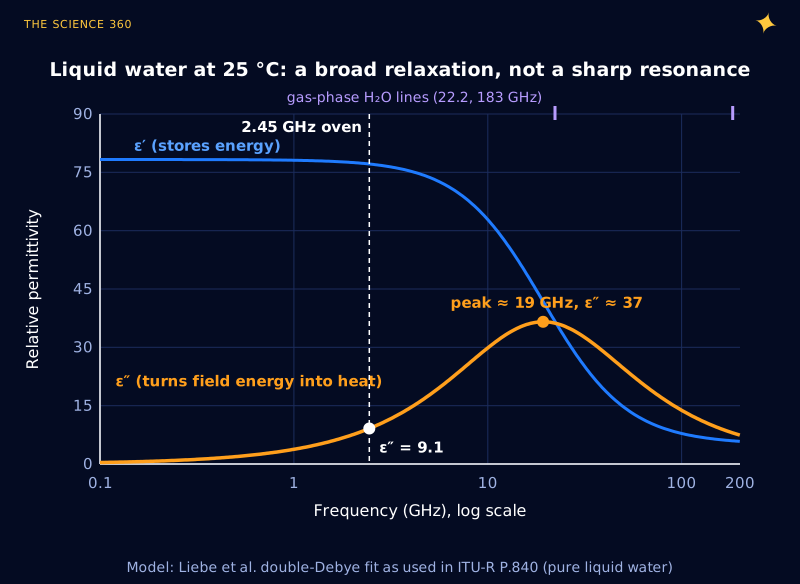
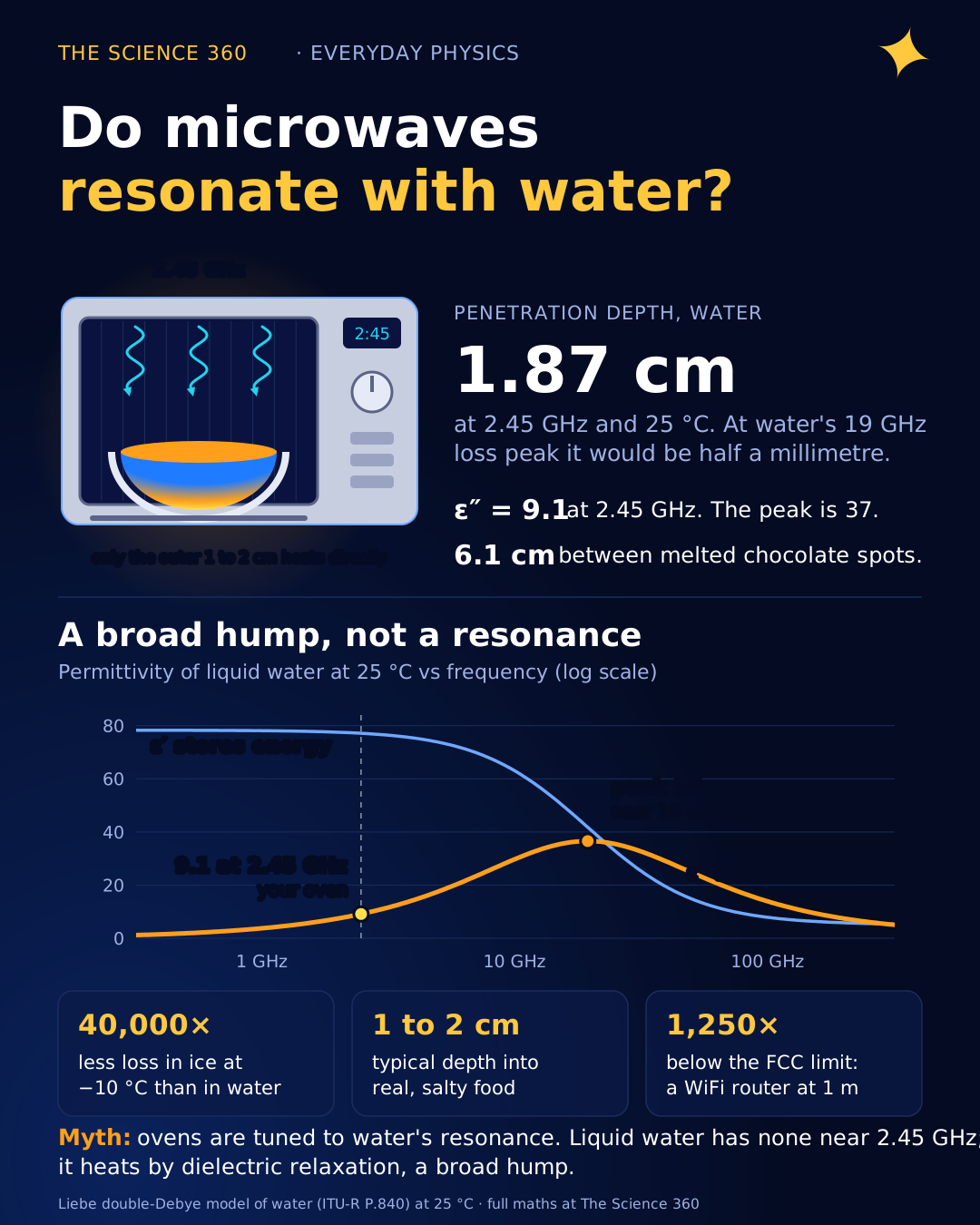
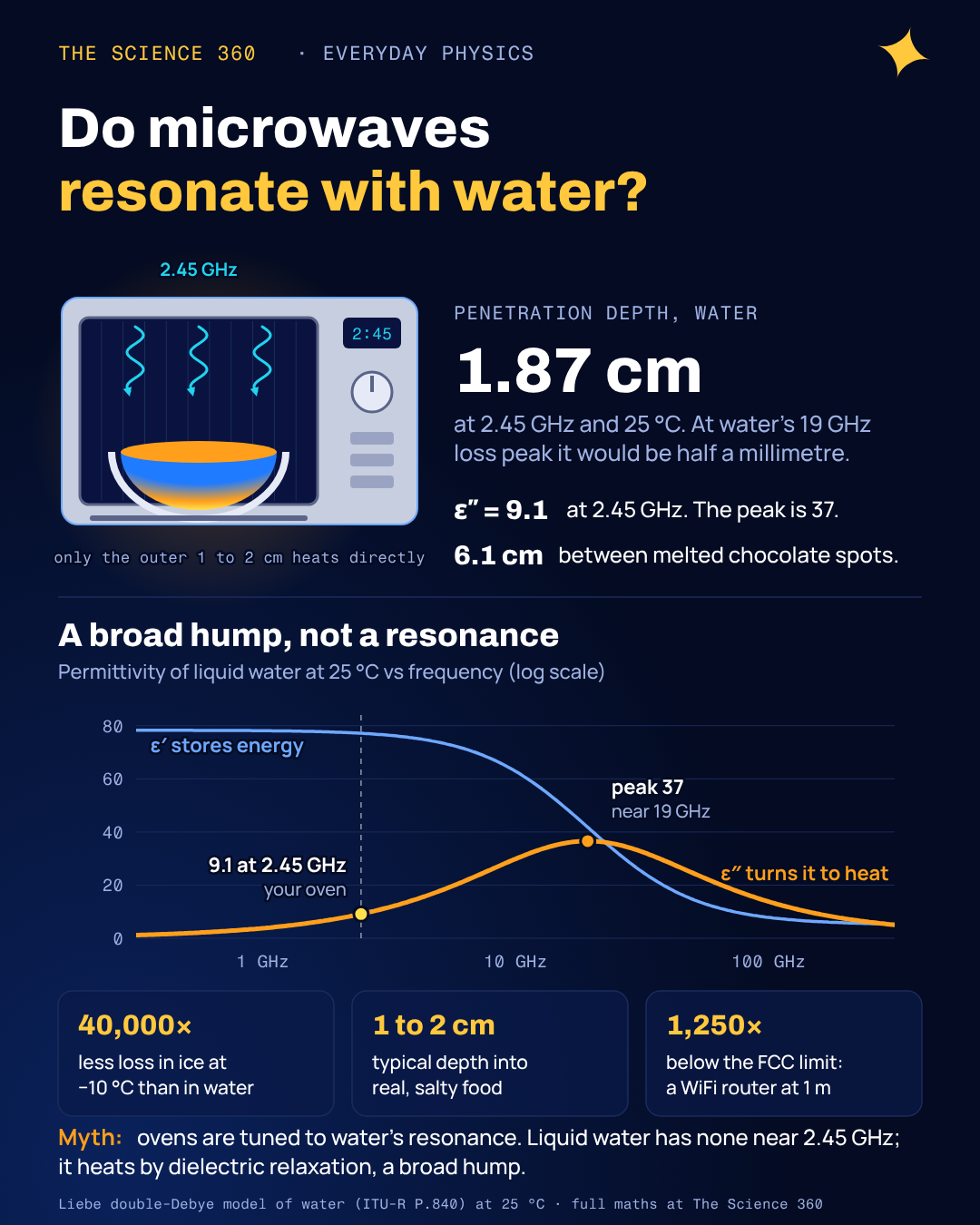
At 25 °C, the model gives ε′ = 77.1 and ε″ = 9.1 at 2.45 GHz. The peak of ε″ is about 37, at 19.3 GHz. If the "resonance" story were true, ovens would run near 19 GHz. They don't, and the reason is penetration depth.
Why do microwave ovens use 2.45 GHz?
A wave traveling into a lossy material loses power exponentially. The power penetration depth is the distance over which the absorbed power falls to , about 37%, of its value at the surface. A strongly absorbing material has a short penetration depth, which is great for heating a thin surface and useless for warming a bowl of stew.
Worked calculation 1: penetration depth in water at 2.45 GHz
Inputs (water, 25 °C, from Figure 1): , .
The loss tangent is small, so the low-loss formula is accurate:
At the 19.3 GHz loss peak (, , cm) the exact expression gives about 0.05 cm, half a millimeter.
Real food is not pure water. Dissolved salts add ionic conduction, which raises ε″ (for a salt solution with conductivity of 1.5 S/m, roughly physiological saline, the extra term at 2.45 GHz is about 11), so the penetration depth in a salty soup drops to roughly 1 cm. That is why the usual engineering figure for food at 2.45 GHz is 1 to 2 cm, and why microwaves do not cook "from the inside out." The outer centimeter or two is heated directly; the center of anything thicker warms by ordinary conduction.
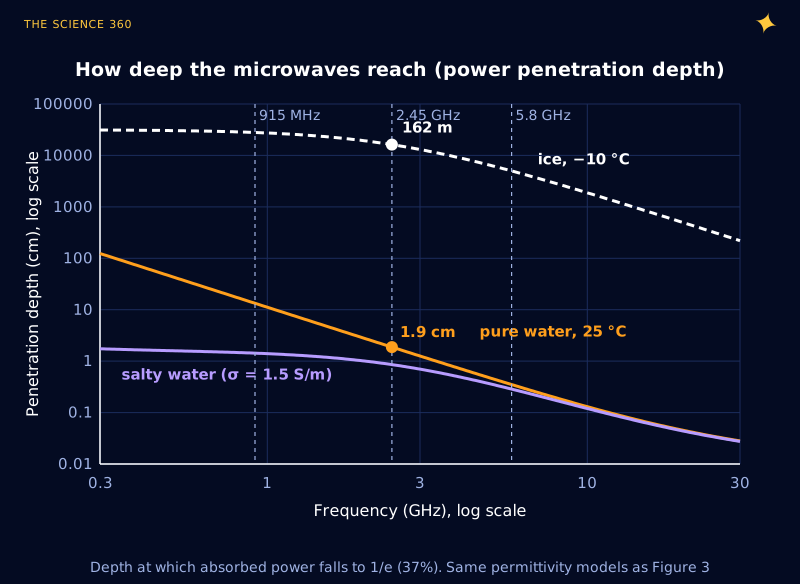
So 2.45 GHz is a compromise: high enough that a compact magnetron and a kitchen-sized metal box work well, low enough that energy reaches a useful depth into a typical portion. Industrial systems that thaw whole blocks of frozen meat often use 915 MHz precisely to reach deeper. There is also a regulatory reason. The band 2,450 MHz ± 50 MHz is designated by the ITU for industrial, scientific and medical (ISM) equipment, a designation going back to the 1947 international radio conference in Atlantic City; accounts of the conference minutes say the US delegation noted that a diathermy machine and an "electronic cooker" were already operating near that frequency. Once ovens were built for that band, the frequency stuck. Water was never consulted.
Why doesn’t ice heat in a microwave?
Freeze the water and its molecules are locked into a crystal lattice. They can still reorient, but slowly: the relaxation in ice happens on timescales of tens of microseconds, so its loss peak sits in the kilohertz range, a factor of about a million below liquid water's. At 2.45 GHz the molecules simply can't follow the field.
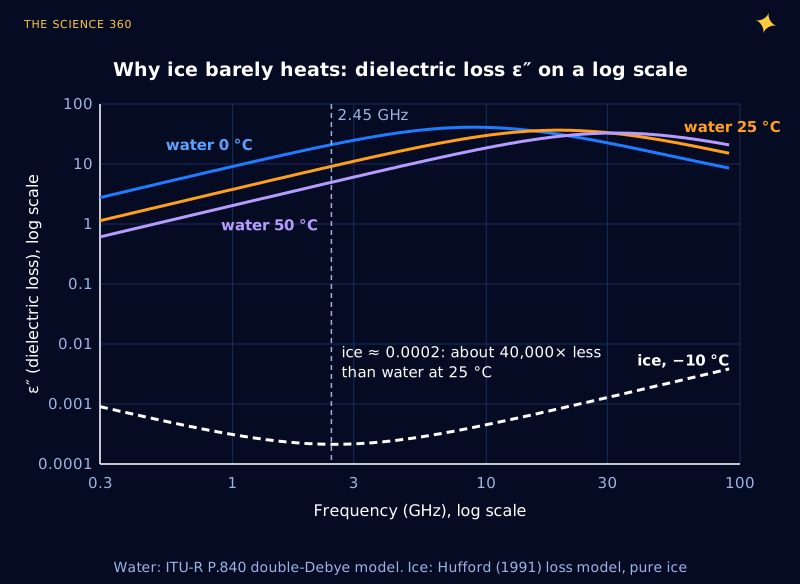
The numbers are stark. Pure ice at −10 °C has around 2 × 10⁻⁴ at 2.45 GHz, roughly 40,000 times less than room-temperature water, and its penetration depth is over 100 meters. A microwave oven passes straight through pure ice.
Real frozen food thaws anyway because it isn't pure ice. Salts and sugars depress the freezing point, leaving thin films of brine that stay liquid well below 0 °C. Those pockets absorb, warm up, melt their surroundings, and the newly melted water absorbs even better than the ice did. This is thermal runaway, and it is why a frozen burrito ends up with lava edges and an icy middle. Defrost settings fight it by cycling the magnetron on and off so heat has time to conduct from the melted spots into the frozen ones.
Figure 3 also shows something counterintuitive. As liquid water warms, its relaxation gets faster and the loss peak moves to higher frequencies, so ε″ at 2.45 GHz falls: from about 21 at 0 °C to 9 at 25 °C and 5 at 50 °C. Pure water actually becomes a poorer absorber as it heats. In real food, rising ionic conductivity with temperature partly offsets this, but it is one reason heating is uneven.
Why are there hot and cold spots in a microwave?
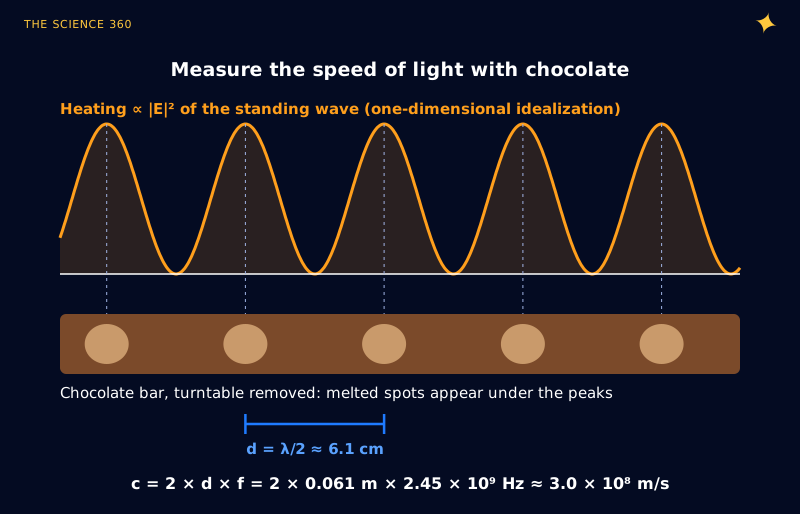
A microwave oven is a metal box, and metal reflects microwaves. Waves bouncing between the walls interfere and form standing waves: fixed patterns of strong field (antinodes) and nearly zero field (nodes). Heating goes as |E|2, so food at an antinode cooks and food at a node barely warms. In a real cavity the pattern is three-dimensional and depends on the load, but along any line the strong spots are spaced about half a wavelength apart.
That spacing is why ovens have turntables (to drag food through the pattern) or hidden metal "mode stirrers" (to keep shifting the pattern). It is also the basis of a classic kitchen experiment.
Measure the speed of light with a chocolate bar
Remove the turntable (put an upside-down plate over the drive so the chocolate does not rotate), lay a large flat bar of chocolate inside, and heat it on low power for 15 to 30 seconds until a few spots begin to melt. Measure the distance between neighboring melted spots. That distance is half the wavelength. The frequency is printed on the oven's rating label, almost always 2,450 MHz.
Worked calculation 2: the speed of light from melted chocolate
Measured spacing between melted spots: 6.1 cm (expected: λ/2 = 12.24/2 = 6.12 cm). Frequency from the oven label: 2,450 MHz.
Accepted value: 2.998 × 10⁸ m/s.
Be honest about the error bars. The magnetron frequency drifts by tens of MHz with load and temperature, the 3D mode pattern doesn't give perfectly regular spacing, and a melted spot is about 2 cm wide, so measuring its center to better than 3 or 4 mm is hard. Expect to land within about 5 to 10% of the true value, which is still remarkable for a chocolate bar.
Is WiFi at 2.4 GHz dangerous if microwave ovens use the same frequency?
Since WiFi's 2.4 GHz band overlaps the oven's 2.45 GHz band, people reasonably ask whether their router is slowly cooking them. Everything above says why it isn't: there is nothing special about 2.4 GHz for water. Heating is set by power density and ε″, and ε″ is nearly the same at 2.0, 2.4 or 3.0 GHz. So the only question is how much power reaches you.
Worked calculation 3: an oven versus a router
Router: about 0.1 W radiated (100 mW EIRP is the European limit in the 2.4 GHz band), spread over a sphere.
The FCC general-public limit for 1,500 to 100,000 MHz is 1.0 mW/cm² = 10 W/m², so the router at 1 m is 1,250 times below the limit.
Oven: about 1,000 W confined in a metal box with a cross-section of roughly 0.1 m².
About a million times the router's at 1 m.
The oven's metal walls and the perforated metal screen in the door (its holes are a few millimeters across, far smaller than the 12 cm wavelength) keep the energy inside. US federal rules (21 CFR 1030.10) limit leakage to 1 mW/cm2 at 5 cm for a new oven and 5 mW/cm2 over its lifetime, and measured leakage from a typical oven is around 0.1 mW/cm2 at that distance, falling quickly as you step back. The same physics of conductors confining a wave also governs how waveguides and coaxial cables carry microwave power, which we cover in why coax is 50 ohms.
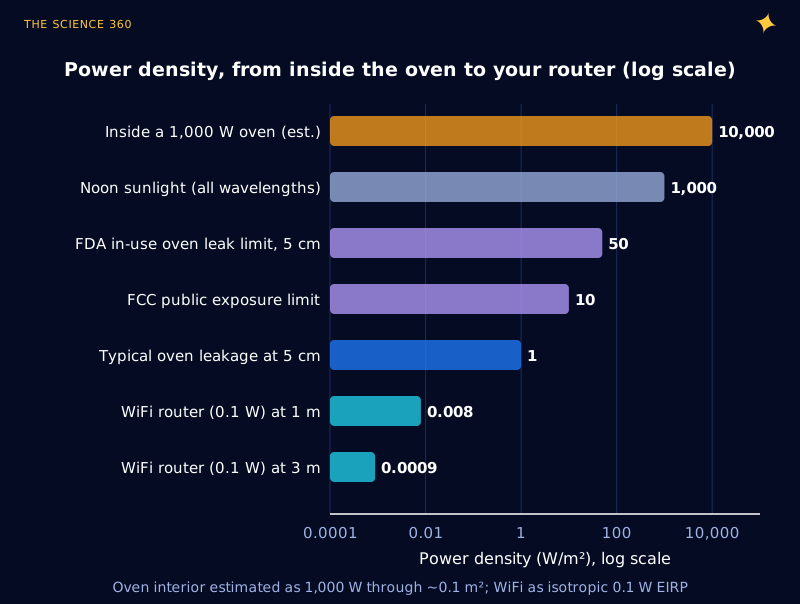
Sunlight makes a good sanity check. Standing in noon sun, your skin absorbs on the order of 1,000 W/m2, which you feel as gentle warmth. A router at 1 m delivers about 100,000 times less. Frequency matters for what a photon can do chemically, but at microwave and radio frequencies the only established biological effect is heating, and the heating from a router is too small to measure against your body's own 100 W or so of metabolic heat.
So how does a microwave oven actually heat food?
Put it all together. The magnetron produces a 2.45 GHz field in a metal box. The field tugs on water's polar molecules billions of times a second; because they are tangled in hydrogen bonds they lag behind, and that lag dissipates energy as heat, at a rate set by ε″. Dissolved ions add their own resistive heating. The frequency is deliberately on the low side of water's broad absorption peak so the energy penetrates 1 to 2 cm instead of being dumped in the first fraction of a millimeter. No resonance is involved anywhere. If you want a one-line version: a microwave oven is closer to a resistive heater spread through the food than to a tuning fork.
Frequently asked questions
Do microwaves resonate with water molecules?
No. Liquid water has no sharp resonance near 2.45 GHz. It heats by dielectric relaxation: polar water molecules try to follow the oscillating field and lose energy as friction. Water's loss is spread over a broad band and peaks near 19 GHz at room temperature. Sharp rotational lines exist only for water vapor, at 22 GHz, 183 GHz and higher.
Why do microwave ovens use 2.45 GHz?
It is a compromise. At 2.45 GHz microwaves penetrate a centimeter or two into food, so a whole portion warms rather than just the surface, magnetrons at that frequency are compact and cheap, and the 2,450 MHz band was set aside for industrial, scientific and medical equipment in 1947. Industrial ovens often use 915 MHz for deeper penetration.
Why does ice not heat well in a microwave?
In ice the water molecules are locked in a crystal and cannot rotate at gigahertz frequencies, so its dielectric loss at 2.45 GHz is tens of thousands of times smaller than liquid water's. Frozen food heats mainly where small pockets have already melted, which is why defrost settings pulse the power and let heat spread.
Is WiFi at 2.4 GHz dangerous if microwave ovens use the same frequency?
No. Frequency is not what cooks food; power is. An oven puts about 1,000 W into a closed metal box. A router radiates roughly 0.1 W in all directions, which is about 0.008 W per square meter at 1 m, more than a thousand times below the FCC public exposure limit and about a million times below the power density inside an oven.
Do microwaves cook food from the inside out?
No. At 2.45 GHz the absorbed power falls to about 37 percent within roughly 1 to 2 cm in watery food, so the outer layers are heated directly and the center is heated mostly by conduction. In a large roast the inside heats last, as in a conventional oven.
Related on The Science 360
Sources
- ITU-R Recommendation P.840, Attenuation due to clouds and fog (double-Debye model of liquid water permittivity, after Liebe, Hufford and Manabe 1991): ITU-R P.840-9 (PDF)
- Liebe, H. J., Hufford, G. A. and Manabe, T. (1991), A model for the complex permittivity of water at frequencies below 1 THz, Int. J. Infrared and Millimeter Waves 12, 659: NTIA copy (PDF)
- Hufford, G. (1991), A model for the complex permittivity of ice at frequencies below 1 THz, Int. J. Infrared and Millimeter Waves 12, 677; summarized with the Liebe-Hufford ice formula in Jiang, J. H. and Wu, D. L. (2004), Ice and water permittivities for millimeter and sub-millimeter remote sensing, Atmos. Sci. Lett.: JPL MLS library copy (PDF)
- Water vapor rotational transitions (22.235 GHz 616−523, 183.31 GHz, 556.936 GHz 110−101): Bergin et al., A survey of 557 GHz water vapor emission (arXiv) and Search for 183 GHz water maser emission (arXiv)
- Vollmer, M. (2004), Physics of the microwave oven, Physics Education 39, 74 (penetration depth and frequency choice)
- Health Physics Society, Microwave oven Q&A (2,450 MHz, FDA leakage limits): hps.org
- 47 CFR 1.1310, Radiofrequency radiation exposure limits (general population, 1,500 to 100,000 MHz: 1.0 mW/cm2): law.cornell.edu
- Microwave Journal, Question of the month answers, May 2006 (typical leakage about 0.1 mW/cm2 at 5 cm): microwavejournal.com
- ISM band history and the 1947 Atlantic City conference, as quoted from the conference minutes: ISM band review of essentials; Gigazine, why 2.4 GHz
- University of Kiel, Cooking with microwaves (frequency choice below the loss maximum): tf.uni-kiel.de
Header image: NASA (image iss036e018295), regraded for this article.