Why Does Metal Spark in the Microwave? Points and Gaps
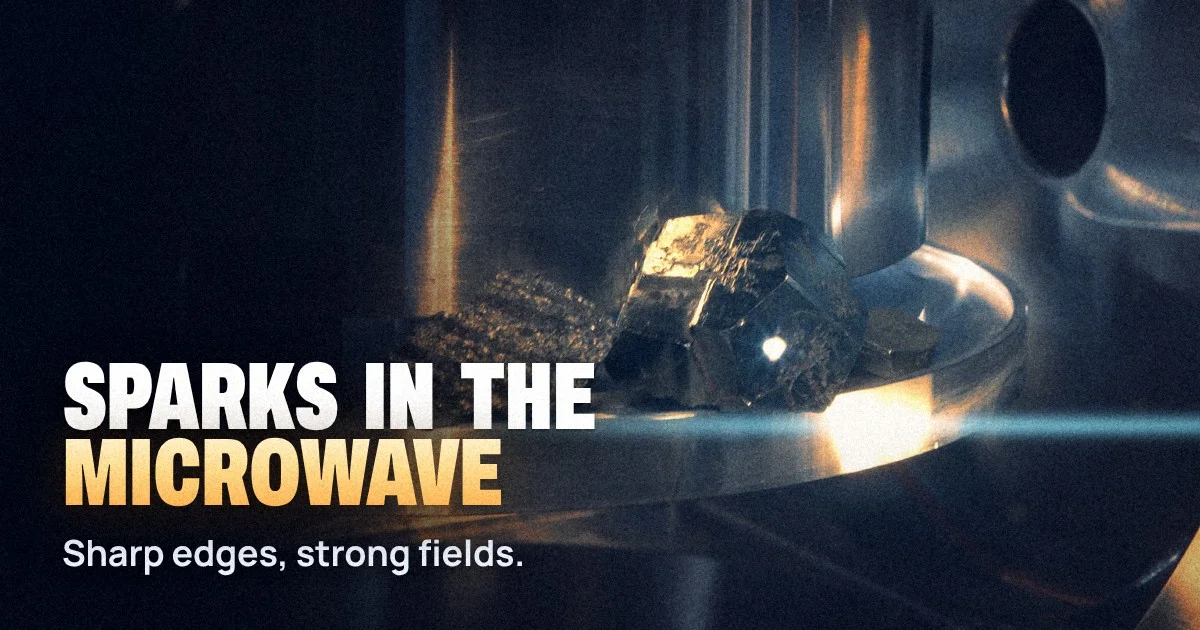
Your microwave oven is a metal box. The walls are steel, the door has a metal mesh, and plenty of ovens ship with a metal rack. None of it sparks. Yet a fork left in a bowl of leftovers can crackle with blue light, and a crumpled ball of aluminium foil can look like a small fireworks show. Same metal, same oven, same 2.45 GHz.
Most explanations stop at "electrons collect at sharp points and the voltage gets high enough to ionize the air." That is half right, and it skips the numbers that tell you which objects spark. Put numbers on it and you find that sharp points alone are often not quite enough. The other half of the story, the one almost nobody mentions, is gaps.
How strong is the field inside a microwave oven?
There is no headline number for this, because it depends heavily on what you put inside. But we can estimate it. A magnetron pumps power P into the cavity. The energy stored in the cavity's standing waves is , where Q is the quality factor: roughly, how many radians of oscillation the energy survives before it is absorbed. A cavity full of soup absorbs quickly (low Q). An empty one absorbs almost nothing (high Q), and the field builds up much further.
Estimating the oven field (my own estimate)
Stored energy W, where the second line holds for a cavity mode:
Well loaded (Q = 10), light load (Q = 100) and nearly empty (Q = 1,000). The peak at the strongest antinodes is about 4 times the rms field:
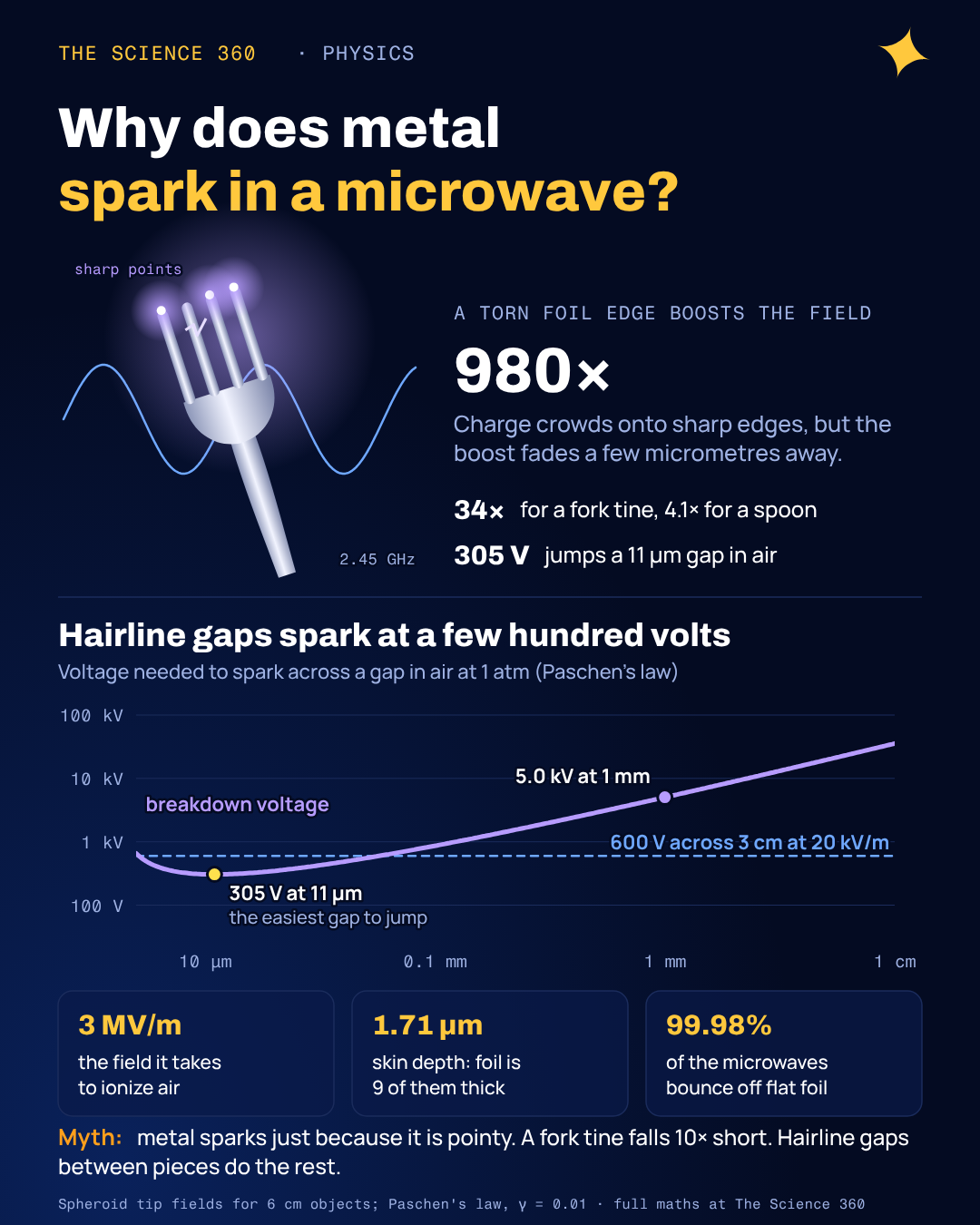
Compare that with what air can take. Wikipedia's dielectric strength table gives about 3 MV/m (3,000 kV/m) for air, and Peek's classic power-line formula uses a "disruptive field" of 30 to 32 kV/cm, the same thing. Even in an empty oven, the bulk field is 50 times too weak to spark. Something has to multiply it.
Why do sharp points concentrate the field?
Inside a good conductor the field is zero, so the surface charges arrange themselves to cancel the oven's field everywhere inside the metal. On a smooth, flat sheet that takes only a thin, even layer of charge. On a sphere it takes more charge at the two poles facing the field, and the field just outside the poles is exactly 3 times the applied field. Stretch the sphere into a needle and the charge at the ends has to do the work for a long object, so the field at the tip climbs roughly as the object's half-length divided by its tip radius.
Field enhancement at the tip of a conducting spheroid (exact electrostatics)
Here n is the depolarisation factor of the spheroid. For a long, thin spheroid of half-length a and tip radius ρ:
All objects 6 cm long (a = 3 cm):
The foil edge radius is half the 16 µm foil thickness.
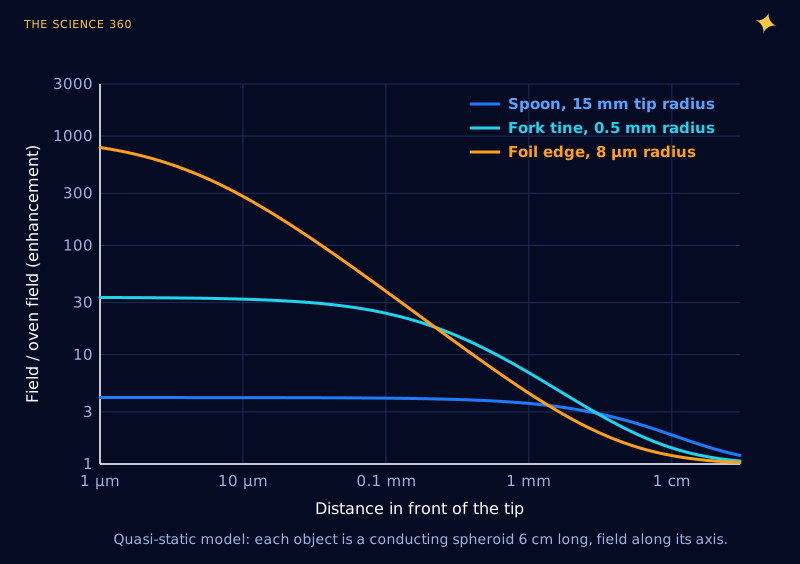
Figure 1 shows the catch. The foil edge multiplies the field nearly a thousand times, but only within a few micrometres of the metal. A spark needs room to grow: an electron has to gain enough energy between collisions to knock loose another electron, again and again, over some distance. If the strong field only extends 8 µm, the avalanche runs out of road. Power-line engineers have handled this for a century with Peek's law, which says the surface field needed to start a corona discharge rises for thin conductors: , with r in centimetres.
Does the tip spark? Field needed versus field available (oven antinode at 20 kV/m)
Fork tine, r = 0.05 cm:
Short by 10 times.
Foil edge, r = 0.0008 cm:
Close.
Foil edge in a nearly empty oven (60 kV/m): available = 59 MV/m. Sparks.
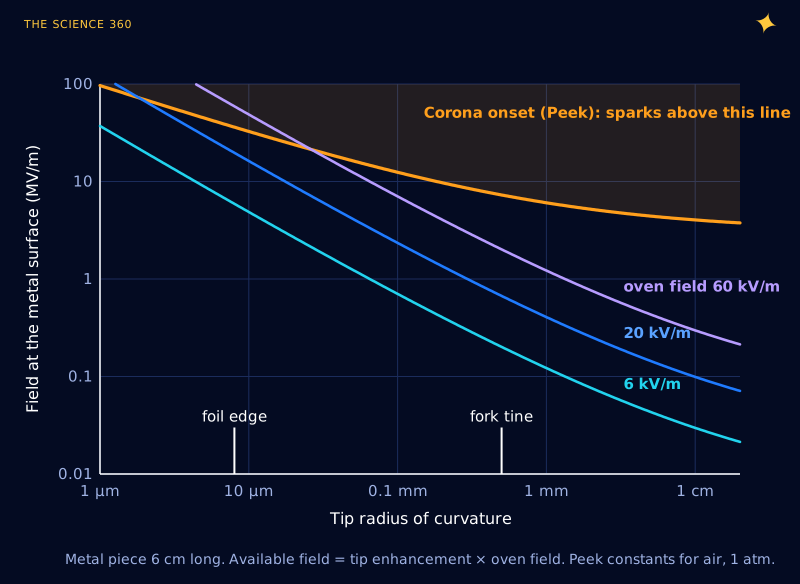
Peek's formula was fitted to long wires, not to points, so treat Figure 2 as a guide to scale. The conclusion is still useful: sharpness alone is marginal. Microscopically jagged foil edges can do it in a lightly loaded oven. A fork tine cannot, at least not by being pointy. So why do forks spark?
The part most explanations miss: gaps
A piece of metal in a field is an equipotential, but two separate pieces are not at the same potential. Put two 3 cm pieces end to end with a hairline gap between them, and the potential difference across the gap is roughly the oven field times the distance between their centres. In a 20 kV/m antinode that is , squeezed into whatever the gap is.
How many volts does it take to jump a tiny gap? That is Paschen's law, the same physics that sets the spark gap in a car's ignition. Using the constants for air given in Wikipedia's article (A = 112.5 per kPa·cm, B = 2,737.5 V per kPa·cm, and an assumed secondary emission coefficient of 0.01):
Paschen breakdown voltage in air at 1 atm (101.3 kPa)
d = 1 cm, so pd = 101.3 kPa·cm:
The last is near the minimum of about 305 V at 11 µm.
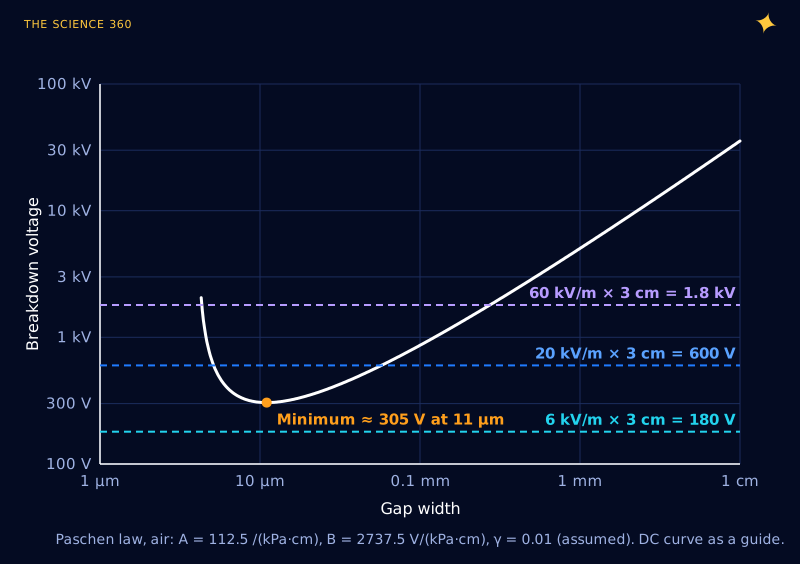
This is the real reason the dangerous objects are dangerous. Crumpled foil is full of folds that almost touch, separated by its natural oxide layer or by air. A fork's tines sit a few millimetres apart, and if it leans near the oven wall or another piece of metal the gap can be much smaller. The gold or silver trim on a plate is a film thin enough to crack into islands with microscopic gaps. Twist ties hide a wire inside paper and the wire ends near each other. In every case the oven puts hundreds of volts across a space a few tens of micrometres wide, and Figure 3 says that is plenty.
The length of the metal matters too. The free-space wavelength at 2.45 GHz is , so a straight piece around half that, 6 cm, is a resonant antenna, like the rods on an old TV aerial. Fork tines and foil strips in that size range can ring up currents and voltages above the quasi-static estimate. That is one more reason sparking is erratic: move the fork 3 cm and it may sit at a node of the standing wave where nothing happens, or at an antinode where it crackles. Our post on the water resonance myth shows how that standing-wave pattern makes hot and cold spots.
Why doesn’t the microwave itself spark?
The walls are large and flat, and flat metal does not concentrate the field at all: just outside a flat conductor the field is simply whatever the standing wave is at that spot. Concave inside corners actually weaken it. The panels are welded or tightly seamed, so there are no hairline gaps for Paschen to exploit. The racks supplied with some ovens are thick, rounded rods held clear of the walls, which avoids both problems.
The other reason is that thick metal barely notices the microwaves. At 2.45 GHz the current flows only in a thin skin at the surface.
Skin depth and absorption in kitchen foil
Aluminium resistivity
Standard foil is 16 µm, about 9 skin depths: effectively a solid mirror.
Smooth foil reflects 99.98% of the power that hits it, so flat foil heats very little. That is why aluminium packaging designed for microwave heating can exist at all: the foil is not the problem, its edges and gaps are.
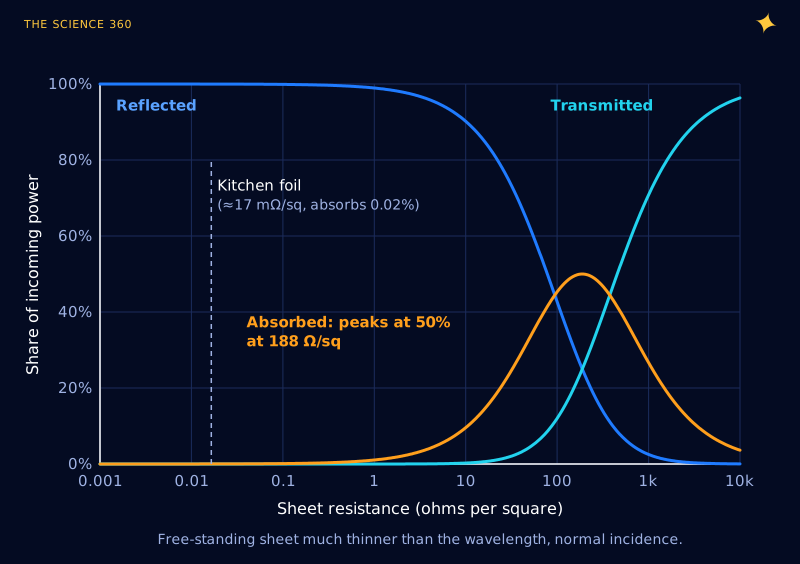
Figure 4 also explains microwave susceptors, the grey metallised patches in popcorn bags and crisping sleeves. They are deliberately made of metallised film so thin that, instead of reflecting the waves, they absorb a large share and get hot enough to brown food. Thin decorative trim on china lands in the same regime, which is why it can scorch even before it sparks.
Why do grapes make plasma in the microwave?
Grapes contain no metal at all, and yet cut a grape almost in half, leave the halves joined by a strip of skin, and microwave it, and you get a ball of glowing plasma. For years the explanation was that the skin bridge acted like a wire antenna. In 2019 Hamza Khattak, Pablo Bianucci and Aaron Slepkov showed in PNAS that the bridge is not needed: two whole grapes, or two skinless beads of water gel, placed close together do the same thing.
The trick is water's huge permittivity. The paper gives water's refractive index at 2.45 GHz and 20 °C as n = 8.9, so inside a grape the wavelength shrinks from 12.24 cm to , about the size of a grape. Each grape becomes a resonant cavity, and when two sit next to each other their resonances combine and squeeze the field into a hotspot where they meet. The authors report focusing to around to , a millimetre or so, and note that 9.5 mm radius beads produced an intense hotspot that 10 mm beads did not. The field there is strong enough to ionize the sodium and potassium in the skin. It is the gap story again, built from water instead of metal.
So what is safe to put in a microwave?
The physics gives a simple ranking. Large, smooth, rounded metal with nothing nearby is low risk: a spoon in a full mug sees an enhancement of about 4 and nothing to arc to. Anything with micrometre edges, folds or hairline gaps is high risk: crumpled foil, gold or silver trim, twist ties, forks near the wall. And the emptier the oven, the higher its Q and the stronger the field, which is why running a microwave with only a metal object inside is the worst case. The US FDA's own advice is blunter: metal pans or aluminium foil "should also not be used," and some ovens should not be run empty at all. Your oven's manual is the final word on your oven.
The sparks themselves do more than look alarming. They can pit the walls, burn the waveguide cover (the small panel on the side wall) and set paper or food alight, and metal that reflects most of the power sends more of it back toward the magnetron, although Wikipedia's foil article notes that modern ovens are designed to protect it. If you see sparks, stop the oven.
FAQ
Why does metal spark in the microwave?
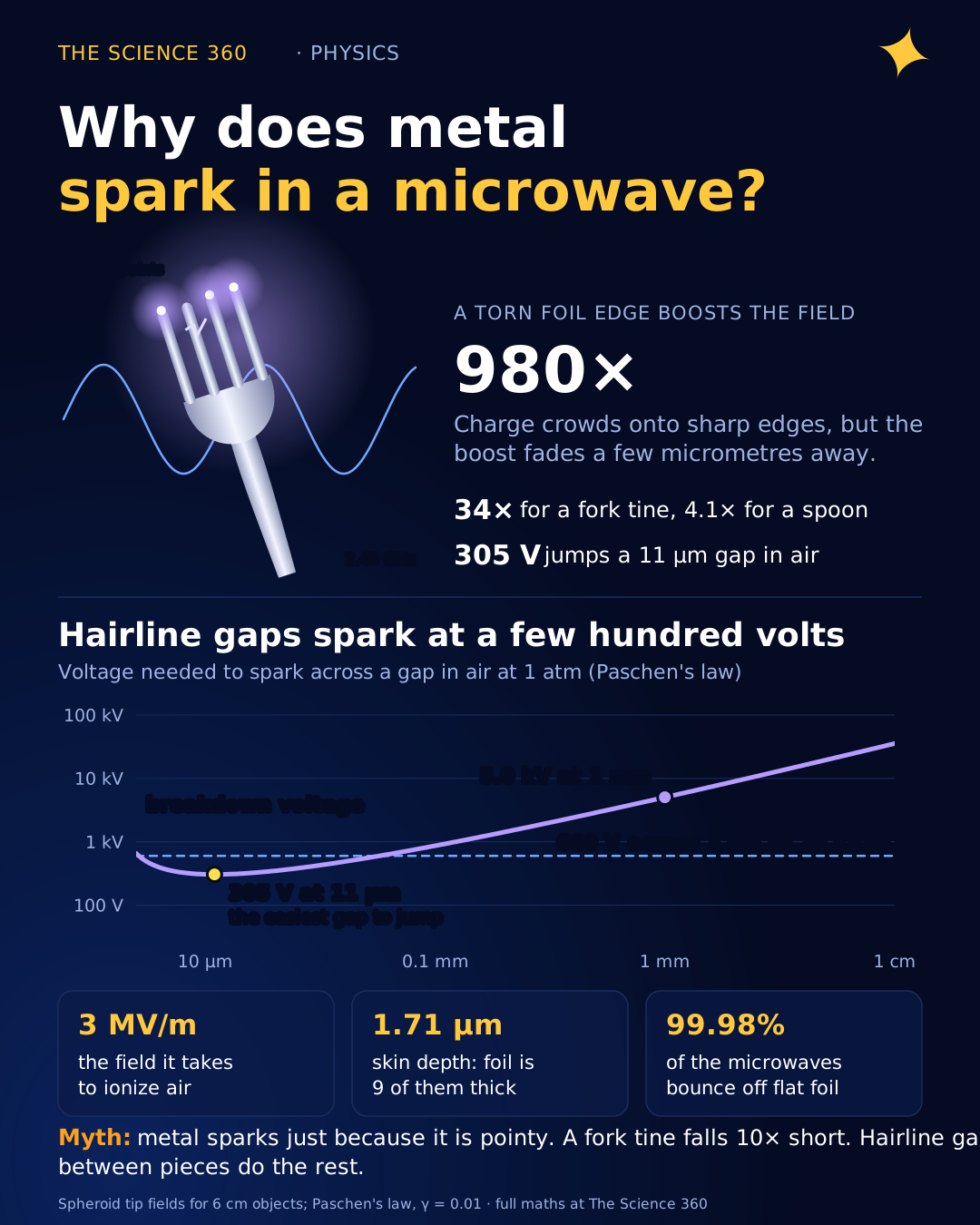
The oven's field drives currents and charges in metal. Charge crowds onto sharp points and edges, multiplying the local field by tens to hundreds of times, and pieces separated by hairline gaps can end up a few hundred volts apart. Either effect can push the air past its breakdown field of about 3 million volts per metre, which makes a spark.
Is it safe to put a spoon in the microwave?
A smooth spoon in a mug of liquid is usually fine, because its rounded edges only raise the field a few times and the liquid absorbs most of the energy. Keep it away from the oven walls, never run the oven with the spoon alone and nothing to heat, and stop if you see sparks. Follow your oven's manual, since the FDA advises against metal in general.
Why doesn’t the metal inside the microwave spark?
The walls are large, flat, smoothly joined sheets with no sharp points and no gaps, so there is nowhere for the field to concentrate. The field right at a flat metal wall is no stronger than in the middle of the oven. Inside corners actually weaken the field. Metal racks supplied with some ovens are designed with rounded ends and set clear of the walls.
Why does aluminum foil spark in the microwave but not when flat?
Foil is only about 16 micrometres thick, so its torn and crinkled edges have tiny radii that concentrate the field hundreds of times. Crumpling also creates hairline gaps between folds. A smooth, flat piece wrapped closely around food has few sharp edges and gaps, so it is far less likely to arc, especially if it is kept away from the walls.
Why do grapes make plasma in the microwave?
A 2019 PNAS study showed that grape-sized spheres of water trap microwaves as resonances, because water's refractive index of about 9 shrinks the wavelength inside them to about 1.4 cm. Two touching or nearly touching grapes concentrate the field into a millimetre-scale hotspot where they meet, which ionizes sodium and potassium from the skin into a glowing plasma.
Related on The Science 360
Sources
- H. K. Khattak, P. Bianucci and A. D. Slepkov, "Linking plasma formation in grapes to microwave resonances of aqueous dimers", PNAS 116 (10), 4000 to 4005 (2019): pmc.ncbi.nlm.nih.gov/articles/PMC6410810
- US Food and Drug Administration, "Microwave Ovens" (metal and foil advice, running empty, 5 mW/cm² leakage limit): fda.gov
- Wikipedia, "Paschen's law" (air constants A and B, minimum near 327 V at 7.5 µm at 1 atm): en.wikipedia.org/wiki/Paschen's_law
- Wikipedia, "Peek's law" (visual critical field, g0 about 30 to 32 kV/cm, c = 0.301 cm1/2): en.wikipedia.org/wiki/Peek's_law
- Wikipedia, "Dielectric strength" (air about 3 MV/m): en.wikipedia.org/wiki/Dielectric_strength
- Wikipedia, "Aluminium foil" (household foil 0.016 mm thick) and "Electrical resistivity and conductivity" (aluminium 2.82 × 10⁻⁸ Ω·m at 20 °C): en.wikipedia.org/wiki/Aluminium_foil, en.wikipedia.org/wiki/Electrical_resistivity_and_conductivity
- Wikipedia, "Susceptor" (metallised film in popcorn bags and crisping sleeves): en.wikipedia.org/wiki/Susceptor
Method note: field enhancements use the exact electrostatic solution for an isolated conducting prolate spheroid, which ignores resonance (objects here are a sizeable fraction of the 12.24 cm wavelength) and the shape of real forks. Peek's and Paschen's laws are steady-field results applied as a guide. The oven field range is my own estimate from stored energy.
Header image: NASA/JPL-Caltech/LANL (image PIA13399), regraded for this article.