How far away is lightning?
Count the seconds between the flash and the thunder, then divide by 3 for kilometres or by 5 for miles. At 20 °C sound travels 343 m/s, so a 10 second count puts the strike 3.43 km (2.13 miles) away, and every 3 seconds is about one kilometre. The flash reaches you in microseconds, so the whole delay is the thunder's travel time.
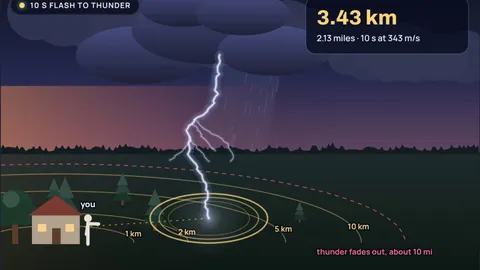
The calculator does the exact version: it works out the speed of sound for your air temperature and multiplies by your count. Use the big button to time it, tapping once at the flash and once when the thunder starts. The scene drops the bolt at that distance from your house. For the safety side, the National Weather Service rule is short: if you can hear thunder, you are close enough to be struck. The companion guide to the counting rule goes through the physics and the common mistakes.
Key results from the calculator
- 3 seconds is about 1 km: 1.03 km at 20 °C. 5 seconds is about 1 mile: 1.07 miles.
- 10 seconds: 3.43 km, or 2.13 miles. 30 seconds: 10.3 km, or 6.40 miles, the old "30 second" threshold.
- Temperature matters a little: sound runs at 331 m/s at 0 °C and 349 m/s at 30 °C, a 5% difference. A 12 second count is 4.19 km on a 30 °C monsoon evening and 4.12 km at 20 °C.
- Thunder fades out at about 10 miles (16 km), roughly a 47 second count. Lightning can strike that far from a storm, which is why hearing thunder at all means go indoors.
Six counts people actually make
Each section gives the numbers the calculator shows for that count and what to do about it. All use 20 °C air unless stated.
Flash and crack almost together (1 second)
1 s, 20 °CA count of one means the strike was about 343 m away, a few streets. NWS describes close strikes as a sharp crack or click, while a long rumble means the lightning was at least several miles away.
There is no counting to be done here. Get inside a building with wiring and plumbing or a hard-topped car, and stay off corded phones and away from taps until 30 minutes after the last thunder.
The 5 second count: one mile
5 s, 20 °CThe National Weather Service gives the rule as 5 seconds per mile. At 20 °C the exact figure is 1.07 miles, so the rule is about 6% short, which is fine for a count you make by ear. In kilometres, 5 seconds is 1.72 km.
A mile is well inside striking distance. At a 5 second count the storm is effectively on top of you.
A 10 second count: 3.4 km
10 s, 20 °CTen seconds is the count most people get when a storm feels "a bit away". It is 3.43 km, or 2.13 miles. Divide by 3 and you get 3.3 km, divide by 5 and you get 2 miles: both rules are within 3% to 7% of the exact answer.
The common mistake is to treat this as a safe margin. NWS notes lightning often strikes more than three miles from the centre of a storm, so 2 miles away is inside the zone where people are hit.
The 30 second figure: about 6 miles
30 s, 20 °CThirty seconds gives 10.3 km, or 6.40 miles. That is the first "30" of the old 30-30 rule, which said to be in a safe place once the count dropped to 30 seconds or less. NWS material still quotes it, but the lightning safety community replaced it with "When thunder roars, go indoors" because people read it as "start moving at 30 seconds" rather than "already be inside".
So a 30 second count is not a deadline. If you can hear the thunder at all, the storm is close enough. The second "30" still stands: wait 30 minutes after the last thunder before going back out.
A hot monsoon evening (30 °C, 12 seconds)
12 s, 30 °CWarm air carries sound faster: 349 m/s at 30 °C against 343 m/s at 20 °C. A 12 second count on a hot pre-monsoon evening in India is 4.19 km, about 70 m further than the same count in 20 °C air.
That is a small correction next to the error in your own count, which is easily half a second either way. The calculator includes it so the number you see is right, not because it changes what you should do.
A long count: 45 seconds
45 s, 20 °CForty-five seconds is 15.4 km, or 9.59 miles, right at the edge of where thunder is normally heard. NWS gives about 10 miles as the range of thunder, in part because air usually cools with height, which bends the sound upward and away from the ground.
Long counts are the least reliable. With several flashes a minute, the rumble you hear may belong to a different strike. Lightning that strikes from a storm this distant is called a bolt from the blue, and NWS says those can land 10 to 15 miles from the storm.
Lightning distance for every count from 1 to 45 seconds
| Seconds | Kilometres | Miles | ÷ 3 rule (km) | ÷ 5 rule (miles) |
|---|---|---|---|---|
| 1 | 0.34 | 0.21 | 0.3 | 0.2 |
| 2 | 0.69 | 0.43 | 0.7 | 0.4 |
| 3 | 1.03 | 0.64 | 1.0 | 0.6 |
| 5 | 1.72 | 1.07 | 1.7 | 1.0 |
| 8 | 2.75 | 1.71 | 2.7 | 1.6 |
| 10 | 3.43 | 2.13 | 3.3 | 2.0 |
| 15 | 5.15 | 3.20 | 5.0 | 3.0 |
| 20 | 6.86 | 4.26 | 6.7 | 4.0 |
| 30 | 10.29 | 6.40 | 10.0 | 6.0 |
| 40 | 13.73 | 8.53 | 13.3 | 8.0 |
| 45 | 15.44 | 9.59 | 15.0 | 9.0 |
Air at 20 °C, where sound travels 343 m/s. At 0 °C every distance is 3.5% shorter; at 30 °C it is 1.7% longer.
How the calculator works
Light from the flash covers a kilometre in about 3.3 millionths of a second, so for any storm you can hear, it arrives instantly. The thunder is made at the same moment, when the channel heats the air to as much as 50,000 °F (about 28,000 °C, NWS figure) and it expands with a bang. The delay you count is therefore the time sound takes to reach you, and distance = speed of sound × delay.
The speed of sound comes from the formula the National Weather Service uses in its weather calculators: v = 643.855 knots × √(T ÷ 273.15), with T in kelvin. In metres per second that is 331.2 × √(T ÷ 273.15). It is the ideal gas result a = √(γRT) for dry air with γ = 1.4, and it gives 325 m/s at −10 °C, 331 m/s at 0 °C and 343 m/s at 20 °C.
The tap timer measures the time between your two taps to a tenth of a second. Start on the flash and stop on the first sound of thunder, not the loudest part of the rumble: the first sound comes from the nearest point of the channel.
The rings around the house are at 1, 2, 5 and 10 km (or 1, 2 and 5 miles), drawn on the ground in perspective, so distant rings crowd towards the horizon. The dashed ring marks the roughly 10 miles beyond which thunder is rarely heard.
What the model leaves out
- Humidity: moist air carries sound slightly faster, by well under 1% in normal weather. The calculator ignores it.
- Wind: sound moving with the wind arrives a little sooner. A 10 m/s wind changes the speed by about 3%.
- Temperature with height: the formula uses the air temperature where you stand. The thunder path from a cloud passes through colder air, which slows it slightly, so the real horizontal distance can be a touch shorter.
- Your reaction time: a human count is good to about half a second, which is about 170 m. That is far bigger than any of the effects above.
- Where the strike landed: the delay gives the distance to the nearest part of the channel, which may be part way up a slanting bolt, not the ground point.
Common misconceptions
"Each second is a mile." It is about 340 m, a fifth of a mile. Counting seconds as miles makes a storm look five times further away than it is.
"If it is more than 6 miles away, I am safe." That came from the old 30 second rule, which has been replaced. Lightning can strike 10 miles or more from a storm, so any audible thunder means go indoors.
"Heat lightning is a separate kind of lightning." It is ordinary lightning from a storm too far away for its thunder to reach you.
Frequently asked questions
How do you calculate how far away lightning is?
Count the seconds from the flash to the thunder and multiply by the speed of sound, about 343 m/s at 20 °C. In practice, divide the count by 3 for kilometres or by 5 for miles. A 10 second count is 3.43 km, or 2.13 miles.
Is it 3 seconds or 5 seconds per mile?
5 seconds per mile, and 3 seconds per kilometre. Sound covers a mile in about 4.7 seconds and a kilometre in about 2.9 seconds at 20 °C.
How far away is lightning if the thunder comes after 30 seconds?
About 10.3 km, or 6.40 miles, at 20 °C. That is still within striking distance. The National Weather Service advice is to go indoors whenever you can hear thunder.
How far away can you hear thunder?
Usually up to about 10 miles (16 km), according to the National Weather Service. That is a count of about 47 seconds. Beyond that the sound bends upward and fades, which is why distant storms flicker silently.
Does temperature change the lightning distance?
Slightly. Sound travels 331 m/s at 0 °C and 349 m/s at 30 °C, so the same count gives a distance about 5% longer on a hot evening. Your counting error is usually larger than this.
Keep learning
How Far Away Is Lightning? The Counting Rule Explained
Count from flash to thunder and divide by 3 for km or 5 for miles. Why it works, how temperature changes it, and why any thunder means go indoors.

How Much Power Is in a Lightning Bolt? 1.21 GW Checked
Lightning peaks at tens of gigawatts to terawatts but lasts microseconds, so a flash holds about 1 GJ. Doc Brown's 1.21 GW, checked.

Why Don't Birds Get Electrocuted on Power Lines?
A bird on a live wire feels about 4 millivolts and 4 microamps. We work the numbers, bust the 'not grounded' myth, and show when birds really do die.

How Far Is the Horizon? Formula, Refraction, Examples
At 1.7 m eye height the sea horizon is 4.7 km away, about 5 km with refraction. The formula, how far you can see tall objects, and the 8 inches per mile error.