How much would you weigh on other planets?
You would weigh about 37.8% of your Earth weight on Mars, about 16.5% on the Moon and about 2.53 times as much at Jupiter's cloud tops. Weight is your mass times the local gravity, so a 70 kg person would read 26.5 kg on a Mars scale, 11.6 kg on the Moon and 177 kg at Jupiter's 1-bar level. The gravity on Mars is 3.71 m/s² against 9.81 m/s² on Earth. Your mass, the amount of matter in you, stays the same everywhere.
Type your weight above in kilograms or pounds, or drag the slider, then tap a body or sweep across the row. The person on each body is drawn taller where the pull is stronger, and the selected one hops in real time, so a jump on the Moon visibly hangs in the air. For more on the Solar System, see Top 20 Interesting Facts About Our Solar System.
Key results for a 70 kg person
- Moon: 11.6 kg (25.5 lb). The 2 m drop takes 1.57 s and a 50 cm Earth jump rises 3.03 m.
- Mars: 26.5 kg (58.4 lb), with gravity of 3.71 m/s² and an escape speed of 5.01 km/s.
- Jupiter: 177 kg (390 lb) at the 1-bar level, the strongest pull of any planet at 24.8 m/s².
- Sun: 1,960 kg at the visible surface. Neutron star: about 9.2 trillion kg, from an assumed 1.4 solar masses and a 12 km radius.
Six worlds, from the Moon to a neutron star
Each section gives the numbers the simulation shows for that body and has a button that selects it. They use a 70 kg person, and every figure scales in proportion if you change the weight.
The Moon
16.5% of Earth's gravityThe Moon's gravity is 1.62 m/s², so a 70 kg person weighs as much as 11.6 kg would on Earth. The same take-off that lifts you 50 cm on Earth carries you 3.03 m up, and the jump lasts 3.9 s instead of 0.64 s. A ball dropped from 2 m takes 1.57 s to land, against 0.639 s on Earth.
The Moon is small as well as light, so its escape speed is only 2.37 km/s, about a fifth of Earth's 11.2 km/s. That is why it holds no real atmosphere. Spinning a ship to imitate weight is the topic of Could We Create Artificial Gravity in Space? and the artificial gravity simulation.
Related reading: Could We Create Artificial Gravity in Space?
Mars
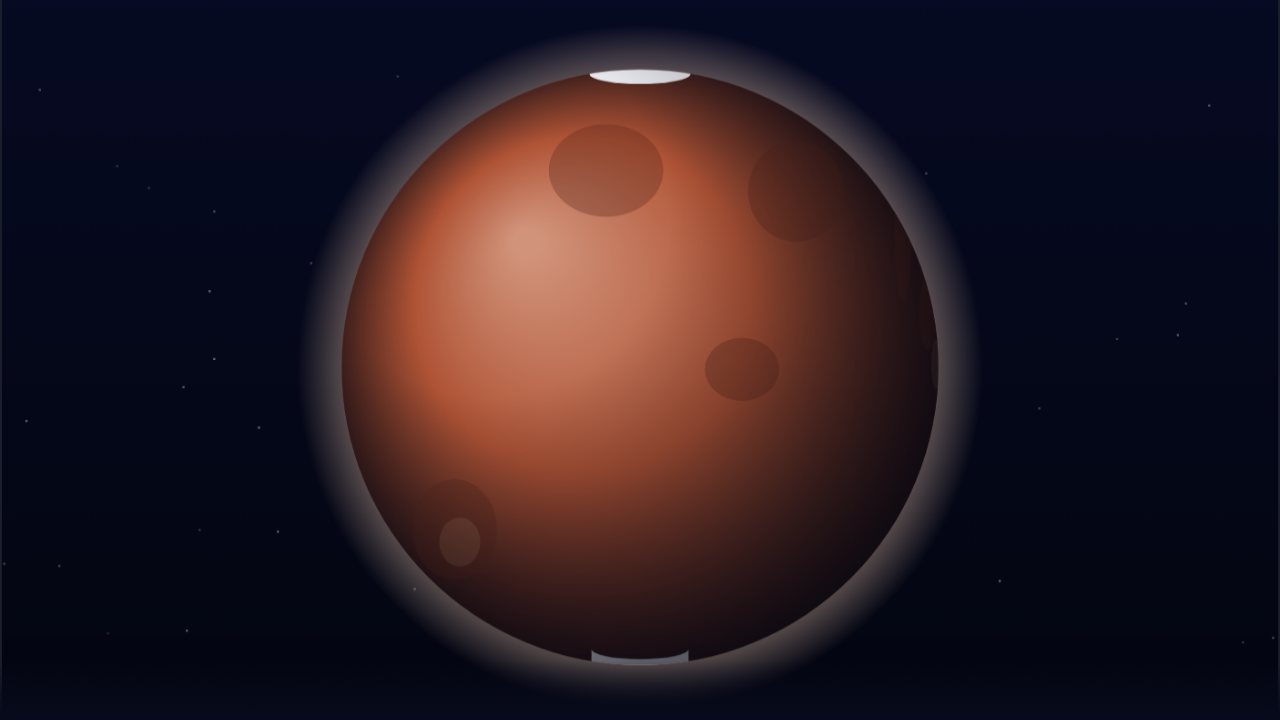
37.8% of Earth's gravityThe gravity on Mars is 3.71 m/s², nearly the same as Mercury's 3.7, because Mars is both smaller and less dense than Earth. A 70 kg person would read 26.5 kg (58.4 lb) and could jump 1.32 m with an Earth-sized effort. A ball dropped from 2 m lands in 1.04 s.
Mars is the only world on this page where people have seriously planned to live, so the low pull matters: nobody knows whether bones and muscles can stay healthy at 37.8% of Earth weight for years. Try the Mars terraforming simulation to see what else would have to change.
Jupiter
2.53 times Earth's gravityJupiter's 24.8 m/s² is the strongest pull of any planet, and it is measured at the 1-bar cloud level because there is no surface. A 70 kg person would read 177 kg (390 lb), the 0.5 m jump shrinks to 19.8 cm, and a ball dropped from 2 m lands in 0.402 s.
Jupiter is about 318 times as massive as Earth but pulls only about 2.5 times as hard at its cloud tops, because those tops lie 11 times further from the centre. Gravity falls with the square of distance. Its escape speed of 59.5 km/s is why it keeps every gas it has ever collected.
Neptune
1.14 times Earth's gravityNeptune is 3.9 times Earth's radius but pulls only 14% harder at its 1-bar level: 11.2 m/s². A 70 kg person would read 79.6 kg there, and a ball dropped from 2 m lands in 0.599 s.
Uranus is a near twin in pull at 8.87 m/s², slightly weaker than Earth's. Neptune's gravity is ordinary, which makes its winds all the more striking, and you can read why in Why Neptune's Winds are the Fastest. The escape speed of 23.5 km/s is about twice Earth's.
Related reading: Why Neptune's Winds are the Fastest?
The Sun
27.9 times Earth's gravityAt the Sun's visible surface the gravity is 274 m/s², so a 70 kg person would read 1,960 kg. The jump shrinks to 1.79 cm, it lasts 23 ms, and a ball dropped from 2 m lands in 0.121 s. Escape speed is 617 km/s, about 0.21% of the speed of light.
This is a thought experiment: the surface is gas at about 5,800 K, so nobody could stand there. The Sun is 109 times Earth's radius and about 333,000 times its mass, and the extra distance from the centre softens the pull by the square of the radius ratio. To see what a different star would do to the Solar System, try Replace the Sun.
A neutron star
130 billion times Earth's gravityA neutron star packs about 1.4 solar masses into a ball 12 km in radius, so its gravity is about 1.3×10¹² m/s². A 70 kg person would weigh 9×10¹³ N, which a scale calibrated on Earth would show as 9.2 trillion kg. A 50 cm Earth jump rises 3.8 pm, and a ball dropped from 2 m lands in 1.76 µs.
The escape speed is 176,000 km/s, about 0.59 times the speed of light. Those numbers use Newtonian gravity, which is only a rough guide that close to a star this dense, and nothing you know could survive the tides. The figure in the simulation is flattened as a symbol, not a prediction. Compare it with the squeeze a star simulation.
Weight on every body, for a 70 kg person
| Body | Gravity (m/s²) | Scale reads | Jump | Ball falls 2 m in | Escape speed |
|---|---|---|---|---|---|
| Mercury | 3.7 | 26.4 kg | 1.33 m | 1.04 s | 4.25 km/s |
| Venus | 8.87 | 63.3 kg | 55.3 cm | 0.672 s | 10.4 km/s |
| Earth | 9.81 | 70 kg | 50 cm | 0.639 s | 11.2 km/s |
| Moon | 1.62 | 11.6 kg | 3.03 m | 1.57 s | 2.37 km/s |
| Mars | 3.71 | 26.5 kg | 1.32 m | 1.04 s | 5.01 km/s |
| Jupiter | 24.8 | 177 kg | 19.8 cm | 0.402 s | 59.5 km/s |
| Saturn | 10.4 | 74.5 kg | 47 cm | 0.619 s | 35.5 km/s |
| Uranus | 8.87 | 63.3 kg | 55.3 cm | 0.672 s | 21.3 km/s |
| Neptune | 11.2 | 79.6 kg | 44 cm | 0.599 s | 23.5 km/s |
| Pluto | 0.62 | 4.42 kg | 7.91 m | 2.54 s | 1.21 km/s |
| Sun | 274 | 1,960 kg | 1.79 cm | 0.121 s | 617 km/s |
| Neutron star | 1.3×10¹² | 9.2 trillion kg | 3.8 pm | 1.76 µs | 176,000 km/s (0.59 c) |
Gravity is the value at the surface, at the 1-bar level for Jupiter, Saturn, Uranus and Neptune, and at the visible surface for the Sun. The neutron star row uses an assumed 1.4 solar masses and a 12 km radius. "Scale reads" is what a bathroom scale calibrated on Earth would show. Jump height assumes the same take-off speed as a 0.5 m jump on Earth.
How the simulation works
Each body has a surface gravity g in metres per second squared and a radius R in metres, taken from standard planetary data. Your weight as a force is W = m × g in newtons. The scale reading is that force divided by Earth's 9.81 m/s², so it shows in kilograms or pounds what a bathroom scale on Earth would say if it were carried there. The kg and lb switch only changes the unit, using 2.2046 lb per kilogram, and the slider always holds your mass.
The jump uses one take-off speed, 3.13 m/s, which is what lifts you 50 cm on Earth since v² = 2 g h. On another body the same speed gives h = v² ÷ 2g, which is 50 cm × 9.81 ÷ g. The hop on the stage keeps the true time in the air, 0.64 s on Earth, but draws the height on a compressed scale so every body fits. The ball drop uses t = √(2d ÷ g) for d = 2 m, and the escape speed is √(2gR), which equals √(2GM ÷ R). The neutron star's g comes from GM ÷ R² with G = 6.6743×10⁻¹¹ N m² kg⁻².
The person on each body is drawn at a height of 1 + 0.5 × log₁₀ of the weight ratio, limited to the space available, so the Sun's figure is taller than Earth's but not 28 times taller. The planets are stylised pictures at one size and are not drawn to scale with each other. For that, see the planet size comparison.
What the model leaves out
- Surfaces: Jupiter, Saturn, Uranus, Neptune and the Sun have no solid surface. Their gravity is quoted at a chosen level, and you could not stand on them.
- Spin: a spinning world is slightly lighter at the equator than at the poles. On Earth the difference is about 0.3%, and on fast rotators such as Jupiter and Saturn it is larger.
- Constant gravity: the pull falls with height, but over a jump or a 2 m drop the change is far too small to matter. Air drag is also ignored, which matters on Venus and Earth but not on the Moon.
- The body doing the jump: real jumps depend on a spacesuit, on footing and on training. The numbers show only what the same take-off speed would give.
- Relativity: the neutron star row uses Newtonian gravity. General relativity makes the real pull and the escape speed there different, and the star would crush anyone near it.
Common misconceptions
"My mass changes on other planets." Mass is the amount of matter and stays the same. Only the weight, the pull on that mass, changes, so you would still be 70 kg on Mars while the scale reads 26.5 kg.
"A bigger planet always pulls harder." Saturn is about 9.5 times Earth's radius yet pulls only 6.4% harder at its cloud tops, and Uranus pulls 9.6% less than Earth does. Gravity depends on mass and on how far you are from the centre.
"There is no gravity on the space station." At 400 km up, gravity is still about 89% of its value on the ground, around 8.69 m/s². Astronauts float because they and the station are falling around Earth together.
Frequently asked questions
How much would I weigh on Mars?
About 37.8% of your Earth weight. A 70 kg person would read 26.5 kg (58.4 lb) on a scale calibrated on Earth. Enter your own weight above to see yours.
What is the gravity on Mars?
The gravity on Mars is 3.71 m/s² at the surface, which is 0.378 times Earth's 9.81 m/s². A ball dropped from 2 m takes 1.04 s to land there, against 0.639 s on Earth.
How much would I weigh on the Moon?
About 16.5% of your Earth weight, or roughly a sixth. A 70 kg person would read 11.6 kg (25.5 lb). The Moon's gravity is 1.62 m/s².
Which planet has the strongest gravity?
Jupiter, at 24.8 m/s² at the 1-bar level, about 2.53 times Earth's. Neptune is next at 11.2 m/s², then Saturn at 10.4. Outside the planets, the Sun's surface is 274 m/s² and a neutron star's is about 1.3×10¹² m/s².
What is the difference between mass and weight?
Mass is how much matter you contain, measured in kilograms, and it is the same everywhere. Weight is the force gravity puts on that mass, W = m × g, measured in newtons. A 70 kg person weighs 687 N on Earth and 260 N on Mars. Bathroom scales show kilograms because they are calibrated for Earth's gravity.
How high could you jump on the Moon?
If you leave the ground as fast as you would for a 50 cm jump on Earth, you would rise about 3.03 m on the Moon and stay in the air for 3.9 s. A spacesuit and the awkward balance of a heavy backpack reduce that in practice. See also Kepler orbits for how the same gravity holds the Moon in its orbit.
Keep learning
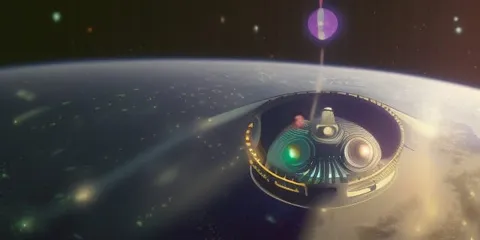
Could We Create Artificial Gravity in Space?
Can humans ever experience gravity-like forces in space? we delve into the science and engineering of artificial gravity, from rotating habitats to electromagnetic fields
Top 20 Interesting Facts About Our Solar System
Here, we'll delve into the top 10 interesting facts about our solar system that will leave you in awe of the cosmos
Why Neptune's Winds are the Fastest?
Neptune, is known for its striking blue color and its supercharged winds that outpace those of any other planet in our solar system but why?