What launch angle gives a projectile its maximum range?
In a vacuum, on level ground, 45° gives the longest range. Range is proportional to sin(2θ), and that is largest when 2θ = 90°. With air drag the best angle is lower: for the ball in the simulation thrown at 40 m/s on Earth it is about 40.9°, and at 100 m/s it is about 34.3°. The simulation above lets you check this yourself, because it plots range against angle for whatever speed, world and drag setting you choose.
A projectile is anything that is thrown or fired and then moves under gravity alone (plus air drag, if you switch it on). Its horizontal and vertical motions are independent, which is why the path is a parabola in a vacuum. At 30 m/s on Earth a 45° shot lands 91.8 m away after 4.33 s and climbs 22.9 m. The same shot on the Moon goes 556 m. For hands-on versions of ideas like this, see 5 amazing physics experiments for your kids.
Key results from the simulation
- Vacuum: R = v² sin(2θ) ÷ g. At 30 m/s on Earth, 45° gives 91.8 m and nothing else does better.
- Twin angles: θ and 90° − θ land in the same place in a vacuum. 15° and 75° both go 45.9 m, but 75° flies 42.8 m high and stays up 5.91 s, against 3.07 m and 1.58 s.
- Gravity scales everything: the same 30 m/s, 45° shot goes 556 m on the Moon, 243 m on Mars, 91.8 m on Earth and 36.3 m on Jupiter.
- Drag lowers the best angle: at 100 m/s the ball's best angle is 34.3° and the range is 230 m, against 1.02 km in a vacuum.
Six shots to try
Each section gives the numbers the simulation shows for that setting and has a button that loads it, including the speed, world and air drag. The dotted blue arc in the simulation is always the 45° shot for the same settings, so you can see how far your angle is from it.
The classic: 45° at 30 m/s with no air
Exact formulasWith drag off, every number is exact. R = v² sin(2θ) ÷ g gives 91.8 m, T = 2v sin θ ÷ g gives 4.33 s and H = (v sin θ)² ÷ 2g gives 22.9 m. The ball lands at the speed it left at, 30 m/s, and at the same angle below the horizontal.
The graph on the right is a hump with its top at 45°. It is flat near the top, so 40° or 50° still reach 98% of the best range. That is why a 45° rule of thumb works so well in a vacuum, and why small errors near it cost very little.
A high lob at 75°
Same range as 15°, much more timeAt 75° and 30 m/s the ball climbs 42.8 m and is airborne for 5.91 s, yet lands only 45.9 m away. That is exactly the range of the 15° shot (45.9 m), because sin(2 × 75°) = sin(150°) = sin(30°) = sin(2 × 15°).
This is the "twin angle" rule: θ and 90° − θ share a range in a vacuum. The steeper twin spends its speed going up, the flatter one going along. Artillery firing tables list a low and a high angle for the same range for this reason: a flat shot arrives sooner, a high one clears obstacles. With drag switched on the twins stop matching, so try it.
The same throw on the Moon
Gravity 1.62 m/s², no airLunar gravity is about 17% of Earth's, so the same 30 m/s, 45° shot goes 556 m, about 6.1 times as far, and hangs for 26.2 s instead of 4.33 s. It climbs 139 m.
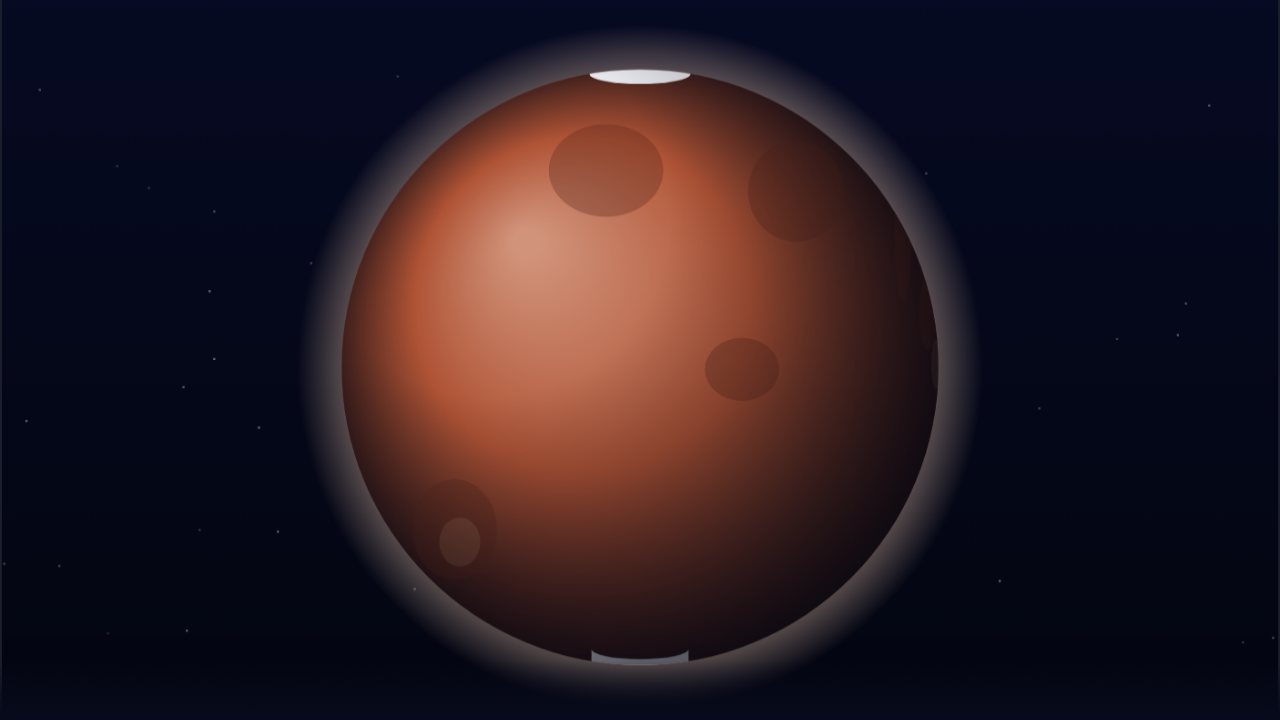
Range scales as 1 ÷ g, so the ratio of ranges is just the ratio of the two gravities. The Moon has no atmosphere, so the vacuum formulas are the real thing there, not an approximation, and the drag toggle changes nothing. Mars sits between: the same shot goes 243 m, and Mars gravity is about 38% of Earth's (see Could Mars be the first terraformed planet?).
The same throw on Jupiter
Gravity 24.79 m/s² at the 1-bar levelJupiter has no solid surface, so the simulation uses the height where the pressure is 1 bar, where gravity is about 24.79 m/s². The 30 m/s, 45° shot goes only 36.3 m and is back after 1.71 s, with a peak of 9.08 m.
Everything shrinks by the same factor, about 2.5, so the arc has the same shape as on Earth but is drawn smaller and the view zooms to keep it in frame. The shape does not depend on gravity. Only the size and the clock do.
Turn on air drag at 40 m/s
The best angle falls below 45°The ball in the simulation is baseball-sized (0.145 kg, 43 cm² cross-section, drag coefficient 0.35), which gives k = 0.00636 per metre and a speed limit of about 39 m/s when falling. At 40 m/s the best angle drops to 40.9°, and the range at that angle is 95.5 m, against 163 m in a vacuum.
Why lower? Drag always opposes the motion and grows with speed squared, so a high arc loses a lot during the long climb and the ball comes down steeply and slowly. A flatter shot spends less time high up. The simulation lands steeper too: the shot here comes down at 54° against its launch angle of 41°.
A fast shot at 100 m/s
Drag takes most of the rangeAt 100 m/s in a vacuum the 45° range would be 1.02 km. With drag, the best angle is 34.3° and the range is only 230 m, a loss of 77%. The ball lands at 32 m/s, far below its launch speed.
That gap between the vacuum parabola and the real arc is why ball sports and artillery tables are not simple parabolas. The faster the shot, the lower the best angle and the less the vacuum formula tells you. For gliding animals that produce lift, such as the flying snake, a pure projectile model misses the point entirely.
Five angles side by side
| Angle | Range (vacuum) | Max height | Flight time | Range with drag |
|---|---|---|---|---|
| 15° | 45.9 m | 3.07 m | 1.58 s | 38.6 m |
| 30° | 79.5 m | 11.5 m | 3.06 s | 59.6 m |
| 45° | 91.8 m | 22.9 m | 4.33 s | 64.5 m |
| 60° | 79.5 m | 34.4 m | 5.30 s | 54.6 m |
| 75° | 45.9 m | 42.8 m | 5.91 s | 31.9 m |
All rows are for a 30 m/s throw on Earth from the ground, in a vacuum (exact formulas) and with air drag on the baseball-sized ball (numerical). In a vacuum the 30° and 60° rows share a range, as do 15° and 75°; with drag they do not.
How the simulation works
Split the launch velocity into v cos θ along the ground and v sin θ upward. With no air, nothing slows the horizontal part, so x = v cos θ · t. Gravity pulls the vertical part down at g, so y = v sin θ · t − ½ g t². Setting y = 0 gives the flight time T = 2 v sin θ ÷ g. Multiply by the horizontal speed and you get the range R = v² sin(2θ) ÷ g. The top is reached at T ÷ 2, where H = (v sin θ)² ÷ 2g.
With drag on, the acceleration is a = −g ŷ − k |v| v, where k = ρ Cd A ÷ (2m). It depends on the air density ρ of the world: 1.225 kg/m³ on Earth, about 0.02 on Mars, about 0.166 at Jupiter's 1-bar level, and zero on the Moon. There is no closed-form answer, so the simulation steps the equations forward with fourth-order Runge-Kutta (RK4) using 400 steps per vacuum flight time, and finds where the path crosses the ground. The best angle comes from scanning range against angle and narrowing in on the peak. On Mars at 40 m/s it is 44.7°, almost 45°, because the air is thin.
The playback is not always real time. A flight is shown in between 2.2 and 4.5 seconds, so a 26.2 s Moon flight is time-lapsed and a very short flight is slowed down. The badge on the stage says which and by how much. The velocity arrow on the ball is drawn to scale: its length is proportional to the ball's speed at that instant.
What the model leaves out
- Launch height: every shot starts and ends at ground level. Launched from a height h, the best angle in a vacuum is atan(v ÷ √(v² + 2gh)), which is 43.7° for 20 m/s from 2 m up.
- Spin and lift: a spinning ball feels a sideways force (the Magnus effect), and a glider or a javelin gets lift. The simulation has none.
- A changing drag coefficient: the drag coefficient of a ball changes with speed and surface. Here it is a constant 0.35.
- The wind and the shape of the Earth: there is no wind, gravity is the same at every height, and the ground is flat. Over thousands of kilometres none of that holds.
- Thin atmospheres: for Mars and Jupiter only the density at the surface is used, not how it falls with height.
Common misconceptions
“45° is always the best angle.” It is the best angle only for a launch from level ground with no air. Air drag lowers it, and launching from a height lowers it too.
“Heavier things go farther.” In a vacuum mass does not matter at all. In air it does, but only because drag becomes a smaller fraction of the weight for a heavier object of the same size and shape. Switch to the Moon to see mass-free motion.
“The ball keeps being pushed forward.” After release the only forces are gravity and drag. In a vacuum the horizontal speed never changes. Nothing in the arc needs a forward force.
Frequently asked questions
What angle gives the maximum range for a projectile?
In a vacuum, launched from level ground, 45°. With air drag it is lower: 43.6° at 20 m/s, 40.9° at 40 m/s and 34.3° at 100 m/s for the baseball-sized ball in the simulation. If you launch from a height it is lower again.
Why is 45 degrees the best angle for range?
Range is R = v² sin(2θ) ÷ g. The speed and gravity are fixed, so only sin(2θ) matters, and its maximum value of 1 occurs when 2θ = 90°, which is θ = 45°. Lower angles waste speed on going along, steeper ones on going up.
What is the formula for the range of a projectile?
R = v² sin(2θ) ÷ g for a vacuum and level ground, where v is the launch speed, θ the launch angle and g the gravity. The flight time is T = 2 v sin θ ÷ g and the maximum height is H = (v sin θ)² ÷ 2g.
Does mass affect projectile motion?
Not in a vacuum: mass cancels out of every equation, which is why a hammer and a feather fall together on the Moon. In air it matters, since the deceleration from drag is a force divided by mass, so a heavier object of the same shape slows less.
Why does air resistance lower the best launch angle?
Drag grows with speed squared and always opposes the motion. A steep shot spends a long time high up and loses speed on the way, and it comes down slowly. A flatter shot keeps more of its speed over the ground, so the best compromise moves below 45°. The faster the throw, the bigger the effect.
How much farther does a throw go on the Moon?
In a vacuum, range is inversely proportional to g, so the same throw goes about 6.1 times farther on the Moon, because Earth's gravity is that many times larger. At 30 m/s and 45° that is 556 m against 91.8 m.
Keep learning

5 amazing physics experiment for your kids
Physics is a fascinating subject that explores the fundamental laws governing the universe. Teaching physics to kids can be a challenging task
Amazing Science behind Flying Snake
Have you ever heard of a flying snake? In this blog post, we'll delve into the science behind its unique ability and

Could Mars Be the First Terraformed Planet?
Mars: Could it be the first terraformed planet? Explore the challenges, potential solutions, and ethical considerations.