How can muons reach the ground if they decay in 2.2 microseconds?
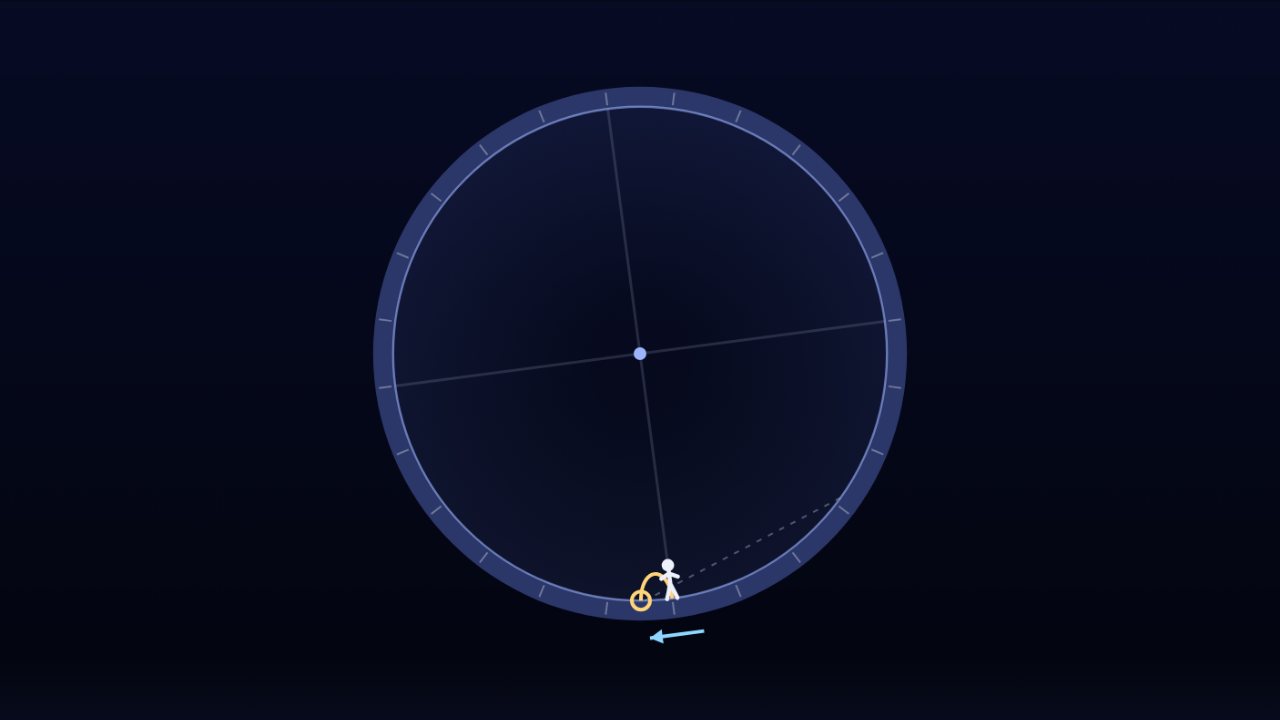
A muon at rest lasts 2.197 µs on average. Even at nearly the speed of light that is only about 0.66 km of travel, yet muons made in the upper atmosphere reach the ground in large numbers. They survive because a fast-moving clock runs slow: in our frame the muon's lifetime is stretched to γ × 2.197 µs. In the muon's own frame the explanation is different but gives the same answer: the 15 km of air is squeezed to 15 km ÷ γ, so the trip is short. The simulation above lets you set the speed and watch both descriptions at once.
This page assumes the muons are made 15 km above the ground, which is a convenient round number (real production heights vary, see below). With that choice, a muon at 0.994c has γ = 9.14, a dilated lifetime of 20.1 µs and a mean decay length of 5.99 km. About 8.2% of them survive the fall. Without relativity, essentially none would. Read more about the history in The Muon Paradox: Cosmic Rays and Relativity.
Key results from the simulation
- Time dilation: the lifetime seen from Earth is γ × 2.197 µs. At 0.9999c that is 155 µs, about 71 times longer.
- Length contraction: in the muon's frame the air is only 15 km ÷ γ thick. At 0.9999c it is 0.21 km, so the trip takes 0.71 µs of the muon's own time.
- Same survival, two explanations: both frames give N/N₀ = exp(−15 km ÷ (βγcτ)). At 0.9999c that is 72%.
- Without relativity: the survival fraction falls to about 1.3e−8% at any speed close to c. The difference is not subtle, it is about ten orders of magnitude.
Six muon speeds, one 15 km fall
Each section gives the numbers the simulation shows for that speed, explains what they mean, and has a button that loads the speed into the simulation above. The slider uses a logarithmic scale of γ so that 0.99c, 0.999c and 0.9999c each get a comparable stretch of track.
Half the speed of light
Relativity is too weak to helpAt 0.5c, γ is only 1.15, so the lifetime grows from 2.197 µs to 2.54 µs. The muon needs 100 µs to cover 15 km, which is about 39 lifetimes. The survival fraction is 7.4e−16%, effectively zero.
This is the case where the paradox does not appear: time dilation exists, but it is too small to rescue the muon. The air is contracted to 13.0 km, yet the muon still needs 86.7 µs of its own time to cross it. Both frames agree that nothing arrives.
Ninety percent of the speed of light
Relativity helps, but not enoughAt 0.9c, γ = 2.29. The muon lives 5.04 µs in our frame and typically travels 1.36 km before decaying. The fall takes 55.6 µs, so about 1.6e−3% survive.
That is about 1.6 million times better than the classical figure of 1.0e−9%, but it is still too small to see at the ground. Relativity is a large correction here and still not enough.
98 percent of the speed of light
The first muons arriveAt 0.98c, γ = 5.03. The dilated lifetime is 11.0 µs and the mean decay length is 3.24 km. The trip takes 51.1 µs on Earth's clock, so 0.98% get through.
In the muon frame the atmosphere is 2.98 km thick and the muon crosses it in 10.2 µs, a little under five of its lifetimes. About one in a hundred survives. Muons are produced in huge numbers, so one in a hundred is still a measurable flux.
0.994c: the speed of the classic measurements
About 1 GeV muonsAt 0.994c, γ = 9.14, which corresponds to a muon energy near 1 GeV. The dilated lifetime is 20.1 µs, the decay length is 5.99 km, and 8.2% survive the 15 km. The classical prediction is 1.1e−8%.
Speeds like this are what the early experiments of Rossi and Hall (1941) and Frisch and Smith (1963) dealt with. Frisch and Smith counted muons on a 1.9 km mountain and again at sea level. About 70% made it down, where a non-relativistic lifetime would have allowed only about 5%.
Related reading: The Physics of Time Dilation: A Closer Look
0.9999c: a muon from a high-energy cosmic ray
γ of about 71At 0.9999c, γ = 70.7. The lifetime is stretched to 155 µs and the decay length is 46.6 km, three times the height of the atmosphere. About 72% survive.
From the muon's side, the air is 0.21 km thick, about as long as two city blocks, and it passes in 0.71 µs. Its own clock barely ticks, so the muon is very unlikely to decay. These muons carry about 7.5 GeV and come from cosmic rays that were far more energetic.
Related reading: Cosmic Rays: A Mysterious and Powerful Force
The classical prediction at a typical sea-level speed
0.9996c, γ about 35Muons that reach sea level average around 4 GeV, which means γ near 38 and speeds near 0.9996c. In the simulation this is the red curve against the green one. A Newtonian muon would travel 0.66 km on average, so its chance of living through 15 km is 1.3e−8%. With time dilation the same muon survives with probability 53%.
The classical curve is not a competing theory that merely loses by a little. At this speed the two predictions differ by a factor of about 4.1 billion. That is why muon detection is a clean test: no adjustment of the lifetime or the height rescues the Newtonian answer.
Related reading: Top 6 things that can travel faster than light
All six speeds side by side
| Speed | γ | Lifetime | Decay length | Air in muon frame | Survive | No relativity |
|---|---|---|---|---|---|---|
| 0.5c | 1.15 | 2.54 µs | 0.38 km | 13.0 km | 7.4e−16% | 1.7e−18% |
| 0.9c | 2.29 | 5.04 µs | 1.36 km | 6.54 km | 1.6e−3% | 1.0e−9% |
| 0.98c | 5.03 | 11.0 µs | 3.24 km | 2.98 km | 0.98% | 8.1e−9% |
| 0.994c | 9.14 | 20.1 µs | 5.99 km | 1.64 km | 8.2% | 1.1e−8% |
| 0.9996c | 35.4 | 77.7 µs | 23.3 km | 0.42 km | 53% | 1.3e−8% |
| 0.9999c | 70.7 | 155 µs | 46.6 km | 0.21 km | 72% | 1.3e−8% |
Values come from the formulas the simulation uses, for muons created 15 km above the ground and falling straight down at a constant speed. They are estimates for a simplified case, not measured fluxes. See time dilation in more detail.
How the simulation works
The muon's mean lifetime at rest is τ = 2.197 µs. Its speed is v = βc, and the Lorentz factor is γ = 1 ÷ √(1 − β²). In the Earth frame the muon covers d = 15 km in t = d ÷ v. Its decay is a random process, so the fraction of a large group still alive after time t is N/N₀ = exp(−t ÷ τ′), where τ′ = γτ is the lifetime measured by Earth's clocks. The "no relativity" curve uses τ′ = τ.
In the muon frame, the muon is at rest and the ground rises toward it at v. The air is length-contracted to L = 15 km ÷ γ, so the trip takes L ÷ v = t ÷ γ of the muon's own time. That is the same elapsed time the muon's clock records in the Earth-frame picture. Putting it into exp(−t′ ÷ τ) gives exactly the same survival fraction, so the frames never disagree about whether the muon arrives.
The speed slider is the base-10 logarithm of γ, running from γ = 1.15 (0.5c) to γ = 100 (0.99995c). The toggle switches the left panel and the time axis between the two frames. The dots dim in proportion to the chance that a muon is still alive at that moment.
What the model leaves out
- Production height: muons are made by decaying pions at heights from about 10 to 20 km, not at one fixed height. 15 km is a typical value, so the survival numbers are only as good as that choice.
- A spread of speeds: real cosmic-ray muons come with energies from below 1 GeV to many TeV. The simulation follows one speed at a time, not the mix.
- Energy loss: muons lose about 2 GeV to ionisation crossing the atmosphere. Their speed is slightly lower at the ground than at birth, and the model holds it constant.
- Direction: only vertical paths are shown. Slanted muons cross more air and are less likely to arrive.
- Measured flux: the simulation gives a survival probability, not a count. The actual flux at sea level, about one muon per square centimetre per minute, depends on the primary cosmic-ray flux and the shower physics.
Common misconceptions
“Each frame sees something different happen.” No. Both frames agree that a given muon arrives or decays. They disagree only about which effect gets the credit: Earth says the clock is slow, the muon says the air is short.
“Relativity is a small correction to the muon story.” For fast muons it is the whole story. Without it the predicted flux at the ground is off by about ten orders of magnitude, as the red and green curves show.
Frequently asked questions
What is the muon paradox?
A muon lives about 2.197 µs, so at nearly light speed it should travel only a few hundred metres, yet muons made 15 km up reach the ground. The paradox goes away once you include time dilation (in Earth's frame) or length contraction (in the muon's frame).
Is it time dilation or length contraction?
Both are correct, each in its own frame. Earth observers say the muon’s clock runs slow, so it lives γ times longer. The muon says the atmosphere is γ times shorter. Neither is more real, and they give the same survival fraction. For a longer discussion see The Muon Paradox: Cosmic Rays and Relativity.
Why use 15 km?
Muons come from pions made when cosmic rays hit air molecules, and this typically happens at heights of around 15 km. It is a representative figure rather than an exact one, so treat the outputs as illustrations.
Does the muon feel its own time slowing down?
No. In its own frame it lives 2.197 µs on average, like any muon at rest. The slowing only appears when comparing the muon’s clock to ours. For the frame-dependence of time, see The Arrow of Time Paradox.
Has this been measured?
Yes. Rossi and Hall measured it in 1941 by comparing cosmic-ray muon counts at different altitudes in Colorado and finding more muons at low altitude than a non-relativistic lifetime allowed. Frisch and Smith in 1963 made a cleaner test on Mount Washington, and storage-ring experiments at CERN have since confirmed the dilation of muon lifetimes at γ ≈ 29 to about one part in a thousand.
Can muons travel faster than light?
No. Their speed is always below c, even at γ = 100. The slider stops at 0.99995c because the numbers, not the physics, get hard to read after that. Some things that appear faster than light are covered in Top 6 things that can travel faster than light.
Keep learning

The Muon Paradox: Cosmic Rays and Relativity
The muon paradox—a captivating phenomenon where cosmic ray-generated muons defy expected decay rates, showcasing relativity in action.

The Physics of Time Dilation: A Closer Look
Header 1: The Physics of Time Dilation: A Closer Look Introduction (Approximately 100 words): Time dilation, a concept in physics, challenges our unde

Cosmic Rays: A Mysterious and Powerful Force in the Universe
The universe is full of mysteries, some of which are much closer to us than we might imagine. One of these mysteries is cosmic rays,

Top 6 things that can travel faster than light
The speed of light is the ultimate sped barrier of the Universe or is it? Here are 6 ways that you can break the speed of light and can FTL

The Arrow of Time Paradox
The Arrow of Time Paradox: Exploring the Mysteries of Time's One-Way Flow. Learn about this fascinating topic and its implications for the universe.