Can Mars be terraformed, and how much CO₂ would it take?
Probably not with the resources we know about. To make liquid water stable on Mars you need two things at once: air pressure above 6.11 millibar and a surface warmer than 273 K (0 °C). Mars has the first barely and the second not at all. In this simple model, even a full Earth-like 1000 mbar of CO₂ only warms the planet to about 259 K, still about 15 K too cold, and most estimates say Mars holds only tens of millibar of CO₂ that could be released.
Use the simulation above to add CO₂, darken the ground or add man-made greenhouse gases, and watch the dot move across water’s phase diagram. The guide below walks through six cases. For the wider story, read Could Mars be the first terraformed planet?.
Key results from the simulation
- Today: 6 mbar of CO₂ and about 213 K. Ice is stable, liquid water is not, and the air pressure sits just under water’s triple point.
- CO₂ alone is not enough: raising pressure from 6 to 1000 mbar warms the surface by about 46 K in this model, to 259 K. That is still below freezing.
- Extra levers matter: adding strong man-made greenhouse gases (about +22 K more at 1000 mbar) or darkening the surface (about +12 K) pushes the surface past 273 K.
- The supply problem: estimates differ, but the CO₂ in the polar caps and soil is probably only about 10 to 50 mbar, a few percent of the 1000 mbar the sliders go up to.
Six ways to change Mars
Each section gives the numbers the simulation shows, says why they come out that way, and has a button that loads the setting. Temperatures are global averages in kelvin, with °C in brackets. The pressure axis is logarithmic, so equal steps on the slider multiply the pressure.
Mars today: thin, cold and just short of liquid water
6 mbar · albedo 0.25Mars gets about 590 W/m² of sunlight, 43 percent of what Earth receives, and reflects a quarter of it. That leaves an equilibrium temperature of 210 K. The thin CO₂ air adds only about 3 K of greenhouse warming in this model, giving 213 K (−60 °C), close to the real planet’s mean.
The pressure of about 6 mbar is almost exactly water’s triple point of 6.11 mbar, the lowest pressure at which liquid can exist. Together with the cold, that means ice sits there as frost or buried ice and any warm patch of ground dries it straight into vapour.
Related reading: Top 20 interesting facts about our solar system
100 mbar: ten percent of Earth’s air, still frozen
About 17 times today’s pressureMultiply today’s CO₂ by 17 and the greenhouse effect grows from 3 K to 15 K. The surface reaches 225 K (−48 °C). The pressure is now well above the triple point, so water would no longer boil off the moment it thawed, but the ground is 48 K too cold for that to matter.
That is already about twice the top of the 10 to 50 mbar range that some studies allow for CO₂ that could be freed from the caps and soil, so it is a generous case for CO₂ alone.
500 mbar: half an Earth atmosphere of CO₂
Needs far more CO₂ than Mars holdsAt 500 mbar the pressure matches the top of a 5 km mountain on Earth and the greenhouse adds 35 K, bringing the surface to 245 K (−28 °C). This is where CO₂ starts to pay off, because in this model the warming grows roughly as the pressure to the power 0.6, not in a straight line.
The catch is the supply. Reaching 500 mbar means finding more than ten times the CO₂ that the best estimates put in reachable form on the planet.
Earth-like pressure from CO₂ alone: still below freezing
1000 mbar · albedo 0.25Give Mars a full 1000 mbar of CO₂, about Earth’s sea-level pressure, and the model reaches 259 K (−15 °C) with a greenhouse effect of 48 K. Liquid water needs about 15 K more. In this model plain CO₂ would need roughly 2000 mbar to cross 273 K.
The air would also be nearly pure CO₂, which is poisonous. Ordinary breathing needs about 210 mbar of oxygen and CO₂ below a fraction of a percent, so oxygen is a separate project that this simulation does not model.
Add man-made greenhouse gases: the first liquid water
1000 mbar · fluorinated gases onGases such as perfluorocarbons absorb heat in the wavelengths where CO₂ is nearly transparent, so they close a gap that CO₂ leaves open. The model adds a fixed extra opacity (a choice for illustration, not a measured value). The surface jumps to 281 K (+8 °C), with a total greenhouse effect of 71 K.
At that temperature and 1000 mbar, liquid water is stable and would only boil above 373 K. Published studies suggest such gases could add tens of kelvin, but they would need to be manufactured on Mars in huge quantities.
Darken the surface: more sunlight absorbed
1000 mbar · albedo 0.10Dark dust or soot spread over Mars would lower its albedo from 0.25 to 0.10, so it absorbs 20 percent more sunlight. Equilibrium temperature rises from 210 K to 220 K, and with 1000 mbar of CO₂ the surface reaches 271 K (−2 °C), almost at melting.
Combine this with added gases and you reach 294 K (+21 °C). But coating a planet with 145 million square kilometres of dark material is a huge task, and real dust storms tend to cool the surface rather than warm it.
All the scenarios side by side
| Scenario | CO₂ (mbar) | Albedo | Added gases | Surface temp. | Water |
|---|---|---|---|---|---|
| Mars today | 6 | 0.25 | None | 213 K (−60 °C) | Ice |
| Thin | 100 | 0.25 | None | 225 K (−48 °C) | Ice |
| Dense | 500 | 0.25 | None | 245 K (−28 °C) | Ice |
| Earth-like CO₂ | 1000 | 0.25 | None | 259 K (−15 °C) | Ice |
| With added gases | 1000 | 0.25 | PFCs | 281 K (+8 °C) | Liquid |
| Dark surface | 1000 | 0.10 | None | 271 K (−2 °C) | Ice, nearly |
| Everything at once | 1000 | 0.10 | PFCs | 294 K (+21 °C) | Liquid |
Values come from the formulas the simulation uses. Treat them as a way to compare options, not as a forecast: a real climate model would shift every temperature by tens of kelvin.
How the simulation works
Step 1, no air: a planet balances sunlight in against heat out, so T_eq = [S(1 − A) / 4σ]^¼. With S = 590 W/m², albedo A = 0.25 and σ = 5.67 × 10⁻⁸, that gives 210 K.
Step 2, the greenhouse: the air is treated as one grey layer with an opacity τ that grows with pressure: τ = 0.08 × (p / 6 mbar)^0.6, with p in mbar. The surface temperature is then T = T_eq × (1 + 0.75 τ)^¼. The 0.08 matches Mars today, and the exponent below 1 reflects that CO₂ absorption saturates. Both are tuned to be reasonable, not fitted to data. Switching on the added gases adds 1.2 to τ.
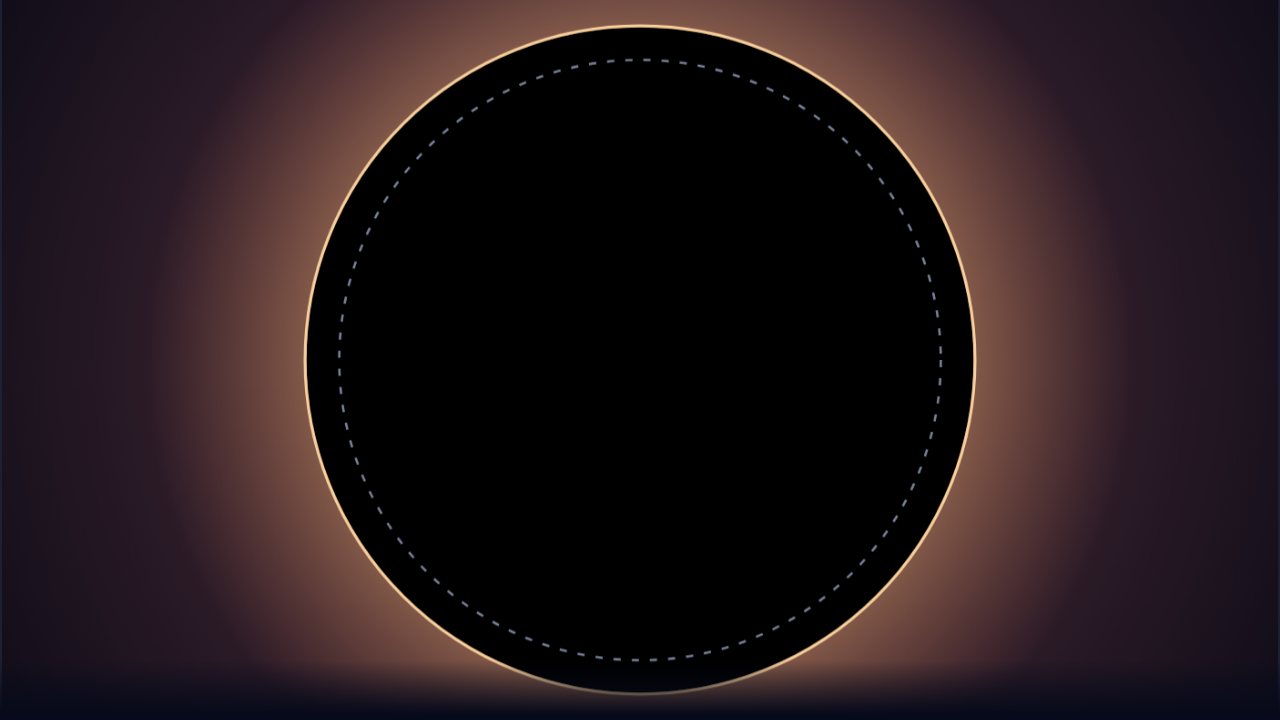
Step 3, water: ice turns to vapour below the line p = 6.11 × exp(6140 × (1/273.16 − 1/T)) mbar. Liquid is stable when T is at least 273.16 K and p is above 6.11 × exp(5200 × (1/273.16 − 1/T)). The dot on the phase diagram is your current temperature and pressure, and the disc shifts from rust toward blue-green as liquid becomes stable.
What the model leaves out
- Real climate physics: no clouds, no day and night, no seasons, no winds, no latitude. A proper climate model would move every temperature by tens of kelvin.
- Feedbacks: more warming would release more CO₂ from the caps and soil, and water vapour is itself a strong greenhouse gas. Both would help, and neither is included. Ice reflects light, which works the other way.
- The CO₂ budget: the sliders go to 1000 mbar, but estimates differ on how much CO₂ exists in reachable form. A common figure is only 10 to 50 mbar, and some could be locked in minerals.
- Losing the air: Mars has no global magnetic field and low gravity, so the solar wind slowly strips its atmosphere. This is slow on human timescales, but it is part of why Mars is thin today.
- Oxygen: nothing here makes air you can breathe. Making around 200 mbar of oxygen from CO₂ is a separate, much slower problem.
Common misconceptions
“Just release the CO₂ in the ice caps and Mars warms up.” The caps and soil hold roughly 10 to 50 mbar by most estimates, which in this model lifts the surface to about 220 K at best, far below freezing.
“Warm Mars means breathable Mars.” Temperature and breathability are different problems. A 1000 mbar CO₂ atmosphere would be toxic, and the oxygen would need to come from a separate process.
“Mars is too far from the Sun.” Sunlight is weaker, but the larger problem is the thin air. With a Mars-like greenhouse effect, a planet at Earth’s distance would be frozen too: Earth without its greenhouse gases would sit near 255 K.
Frequently asked questions
Can Mars be terraformed?
Not with the resources we currently know about. Warming Mars to liquid water needs both thicker air and a stronger greenhouse effect, and the CO₂ available on the planet is probably only tens of millibar. Man-made greenhouse gases and darker surfaces help on paper, but each is a project on the scale of a planet. See Could Mars be the first terraformed planet? for the ideas people have proposed.
How much CO₂ is there on Mars?
Estimates differ, but the atmosphere holds about 6 mbar and the polar caps and top layer of soil probably add roughly 10 to 50 mbar more in total. Some CO₂ may be locked in carbonate minerals, but getting it out would take enormous energy. Compare that with the 1000 mbar needed for Earth-like pressure.
Would the air be breathable once Mars is warm?
No. The air would be almost all CO₂, which is toxic at far lower levels than that. Humans need about 210 mbar of oxygen and very little CO₂. Making that oxygen is a separate, much slower task, so a warm Mars would still need pressurised suits or habitats.
Why does Mars have such thin air?
Mars is small, with 38 percent of Earth’s gravity, and it lost its global magnetic field long ago. The solar wind stripped away much of the early atmosphere, and some CO₂ also became locked in rock and ice. Today’s 6 mbar is about 0.6 percent of Earth’s sea-level pressure.
Is there liquid water on Mars today?
Not as a stable surface lake. Ice exists at the poles and underground, and very salty brines may form briefly because salt lowers the freezing point. On the simulation’s phase diagram Mars today sits in the ice region, close to the triple point where liquid becomes possible.
If not terraforming, what is the alternative?
Sealed or buried habitats on Mars, or large rotating structures in space, which need no planet-sized change. Read Exploring the Bernal Sphere and the glorious near future of space exploration. Or try changing the star instead in What if we replace the Sun?.
Keep learning

Could Mars Be the First Terraformed Planet?
Mars: Could it be the first terraformed planet? Explore the challenges, potential solutions, and ethical considerations.
Top 20 Interesting Facts About Our Solar System
Here, we'll delve into the top 10 interesting facts about our solar system that will leave you in awe of the cosmos
Glorious Near Future of Space Exploration
The Near future of space exploration is looking bright and glorious. With advances in technology and a renewed focus on reaching for the stars, we are on the cusp of a new era of discovery and excitement. Join us as we explore the possibilities that await us.
What if we Replace the SUN?
What if we dared to swap out the Sun for some of the most massive and intriguing objects in the cosmos? let's find out
Exploring the Bernal Sphere: A Revolutionary Concept for Space Colonization
Explore the concept of the Bernal Sphere, a proposed self-sustaining rotating cylinder in space, and its potential for supporting human life beyond Earth