Which gas molecules can outrun a planet’s escape speed?
Gas escapes more easily when a planet’s gravity is weak, the upper atmosphere is hot, or the molecules are light. This experiment compares a thermal speed distribution with the local escape speed.
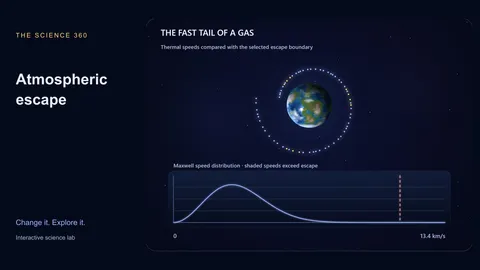
The shaded tail is the instantaneous fraction of speeds above the threshold in a three-dimensional Maxwell distribution. It is not an atmospheric loss percentage per second. Escape flux, replenishment and long-term lifetime require additional information.
Read the companion article for a worked investigation, or continue with terraform mars.
What to look for
- Earth’s surface escape speed is about 11.19 km/s in this model.
- At fixed temperature, most probable speed varies as one over the square root of molecular mass.
- At fixed mass, increasing radius lowers escape speed. Heating gas does not change the planet’s escape speed.
Experiments to try
Load a complete preset, predict what will change, then adjust one control and compare the live measurements.
Earth, hydrogen
Guided experimentThe thermal distribution has a small high-speed tail above Earth’s 11.19 km/s surface escape speed. A small fraction per instant does not mean no escape over geological time. The chosen temperature describes a toy upper atmosphere, not Earth’s ground temperature.
Earth, nitrogen
Guided experimentKeep gravity and temperature fixed but choose a heavier molecule. The speed distribution shifts far to the left and the above-threshold fraction becomes extremely small. Molecular mass matters even though the escape speed itself is unchanged.
Small hot world
Guided experimentLow gravity and a hot light gas put much more of the distribution above the threshold. The graph diagnoses easy thermal escape in this toy model. It does not say how many years the atmosphere would last.
Compare the cases
| Change one input | Escape speed | Gas speed distribution |
|---|---|---|
| Higher planet mass | Increases | Unchanged |
| Higher temperature | Unchanged | Shifts faster |
| Heavier molecule | Unchanged | Shifts slower |
Rounded values and classifications refer to the model and assumptions on this page.
How the model works
The planet controls set GM and radius in Earth units. The gas controls set the Maxwell–Boltzmann distribution, with molecular masses expressed in atomic mass units. The curve is normalized in speed space.
Integrating the curve above escape speed gives erfc(√λ) + 2√(λ/π)e^(−λ). The separate particle panel is an illustration of molecular motion, not a hydrodynamic atmosphere solver.
What the model leaves out
- No exobase density, vertical structure, collisions, upward escape flux or loss timescale.
- No stellar wind stripping, photochemistry, magnetic effects or hydrodynamic escape.
- Radius is the chosen escape boundary; it need not equal the real exobase height.
Common misconceptions
An atmosphere is not lost only when its average molecule outruns gravity. A thermal distribution has a tail. Conversely, this tail alone cannot predict whether an atmosphere survives for billions of years.
Frequently asked questions
Does this explain all of Mars’s atmospheric loss?
No. It isolates thermal speeds and gravity. Solar-driven and other nonthermal processes require additional models and measurements.
Is 1000 K Earth’s surface temperature?
No. This is a selectable upper-atmosphere temperature in a simplified distribution model. Different layers can have very different temperatures.
Keep learning
Why planets lose atmospheres: gravity, temperature and molecular speed
Compare escape velocity with a thermal gas distribution, and learn why a fast molecular tail does not directly give an atmospheric lifetime.