Why planets lose atmospheres: gravity, temperature and molecular speed
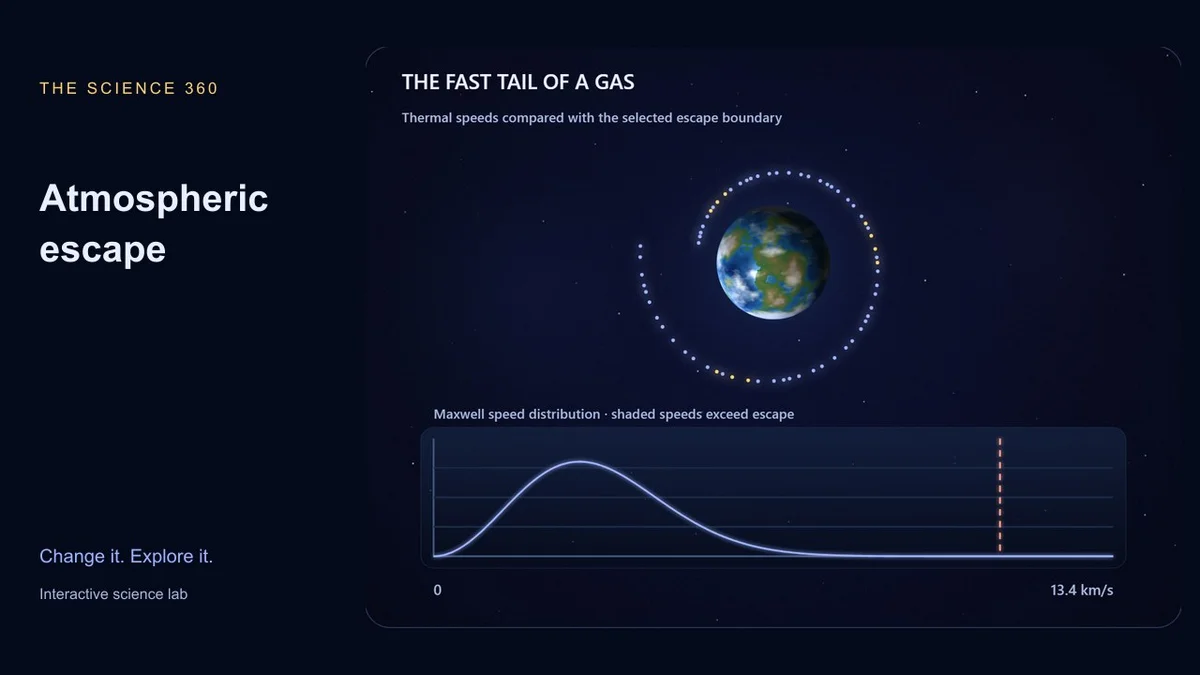
A gas has no single molecular speed. Some molecules move slowly, others quickly, and a small number occupy a high-speed tail. That distribution is essential to understanding thermal atmospheric escape: an average speed alone can hide the particles able to leave.
Use the atmospheric escape simulator to compare a Maxwell–Boltzmann speed distribution with a planet’s escape threshold. The gas curve and escape marker answer different questions, so change one group of controls at a time.
Gravity sets the threshold
For a spherical planet, the escape speed at radius R is:
vesc = √(2GM/R)
At one Earth mass and one Earth radius the model gives about 11.19 km/s. Increase mass while leaving radius fixed and the threshold rises. Increase radius while keeping mass fixed and it falls.
The selected radius is the boundary from which escape is being compared. A real atmosphere extends above the surface, so an actual upper-atmosphere calculation would use an appropriate altitude and density there.
Temperature and molecule mass set the distribution
The most probable thermal speed is:
vmp = √(2kT/m)
At fixed temperature, light molecules move faster on average than heavy molecules. Load Earth with hydrogen, then switch to nitrogen without changing gravity or temperature. The curve moves, while the escape-speed marker stays in place.
Now double temperature. The characteristic molecular speed grows by √2, not by two. The fraction beyond a distant threshold can nevertheless change by much more, because the rapidly declining tail is sensitive to where the threshold falls.
Read the tail without turning it into a clock
The lab reports the fraction of an ideal three-dimensional thermal distribution with speed above escape velocity. It also shows the Jeans parameter:
λ = (vesc/vmp)²
A large λ places escape far out in the fast tail. A smaller value makes thermal escape easier in this comparison. Neither reading says how many kilograms leave per second.
A loss rate also needs information such as the exobase density and upward particle flux. A lifetime additionally needs the atmosphere’s mass, replenishment and evolution. For this reason the tool deliberately does not report “your atmosphere disappears in X years.”
A controlled investigation
Choose the small hot world preset. Record the above-threshold fraction for hydrogen, helium, nitrogen and carbon dioxide at the same temperature. Then return to hydrogen and increase only the planet’s mass. Which input changes the distribution, and which changes the threshold?
The animated particles are a conceptual illustration. The plotted distribution and numerical readings are the quantitative part of the experiment.
Real planets also lose gas through processes this lab does not model, including interactions driven by stellar radiation and winds. Understanding Mars’s history therefore requires more than this thermal comparison. Continue with the terraforming Mars simulation to investigate a different part of the atmosphere problem.