Why the 2027 Solar Eclipse Lasts 6 Minutes 23 Seconds
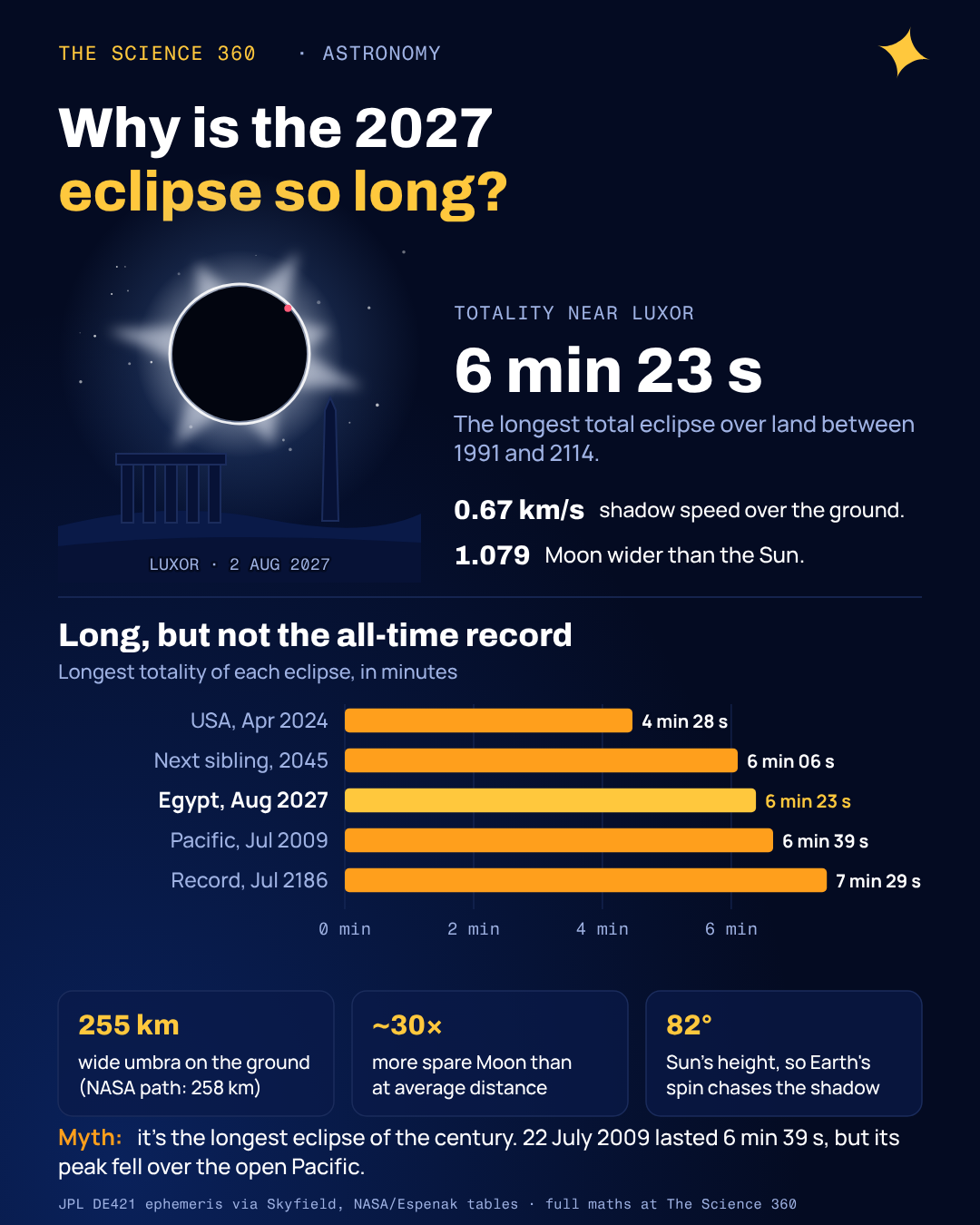
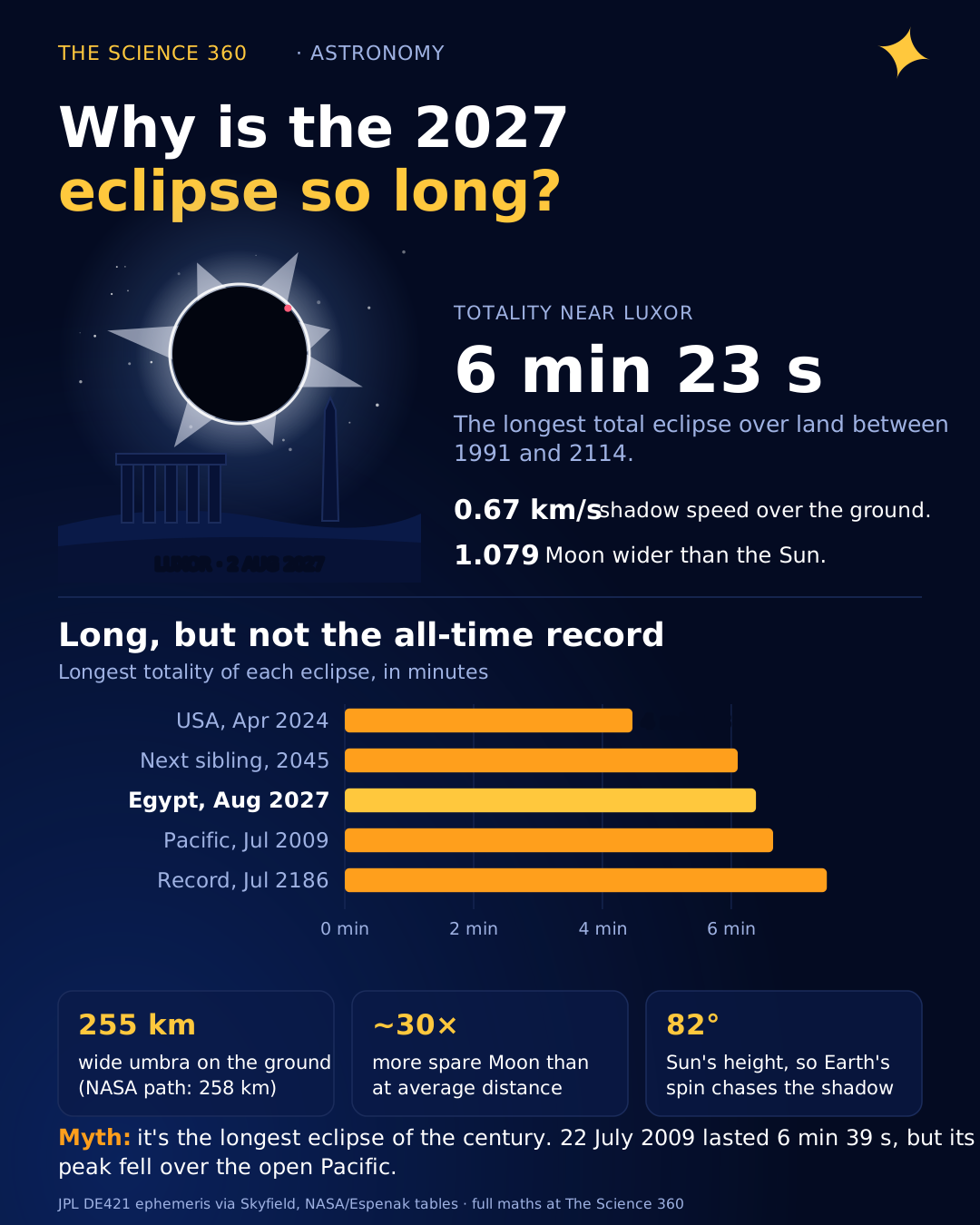
On Monday 2 August 2027, at about seven minutes past ten UTC, the Moon's shadow will touch down in the desert east of Luxor and stay there, over any one spot, for 383 seconds. The typical total eclipse gives you two or three minutes. The one that crossed the United States in April 2024 maxed out at 4 minutes 28 seconds. This one gives you enough time to look at the corona, check the horizon, take a photo, look at the corona again, and still have most of a minute left over.
Most coverage stops at "the Moon is close to Earth." That's true, but it's maybe half the story. I wanted to see if you could get from raw geometry to NASA's 6 minutes 23 seconds with a few distances and the speed of Earth's rotation. You can. Below I compute the Moon's and Sun's apparent sizes, the width of the shadow and how fast it crosses the ground, checking each step against the JPL DE421 ephemeris. My numbers land within two seconds of the official ones.
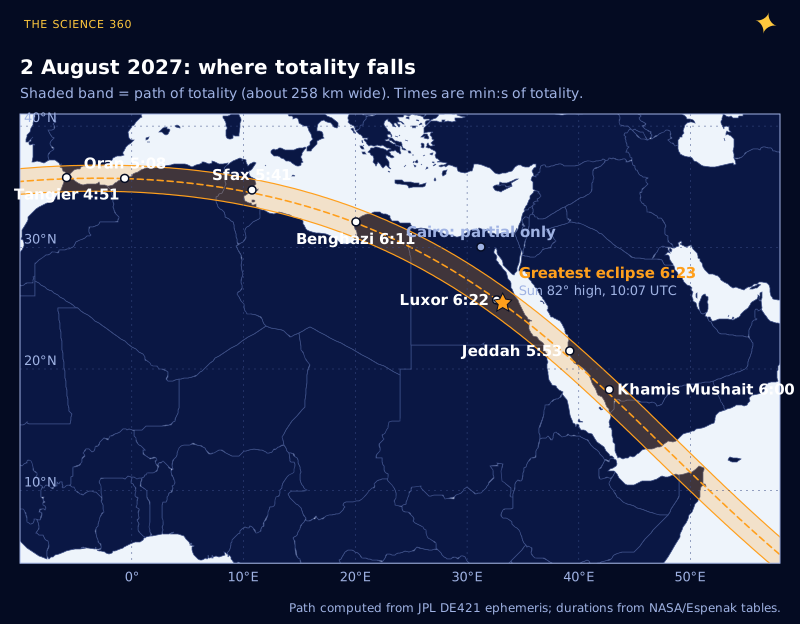
Where is the 2027 eclipse total, and when?
The shadow first touches Earth in the Atlantic, then crosses the Strait of Gibraltar a little before 09:00 UTC. It runs along the North African coast through Morocco, Algeria, Tunisia and Libya, cuts diagonally across Egypt, crosses the Red Sea to Jeddah and Mecca, passes over Yemen and the tip of Somalia, and leaves Earth in the Indian Ocean. The band is about 258 km wide at its fattest.
Greatest eclipse is at 25.5°N, 33.2°E, a stretch of desert roughly 60 km east-southeast of Luxor, at 10:07 UTC (1:07 pm local time). The Sun stands 81.7° above the horizon. Luxor itself gets 6 minutes 22 seconds. For comparison, NASA's tables give Benghazi 6:11, Jeddah 5:53, Tangier 4:51 and Cádiz 2:56.
Is the 2027 eclipse really the longest of the century?
This is the claim you'll read most often, and it's wrong as stated. The total eclipse of 22 July 2009 reached 6 minutes 39 seconds, sixteen seconds longer. Its maximum just happened to fall over open Pacific Ocean, so few people saw it at full length. The accurate version is narrower: 2027 is the longest totality over land between 1991 and 2114. That's still a once-in-a-lifetime claim for anyone alive today, so there's no need to inflate it.
Reason 1: the Moon is almost as close as it gets
A total eclipse needs the Moon's disk to look bigger than the Sun's. Both are about half a degree wide, which is a coincidence of the current era, and the margin between them is small. That smallness is the key to everything. When the margin is thin, a modest change in the Moon's distance changes it by a large factor.
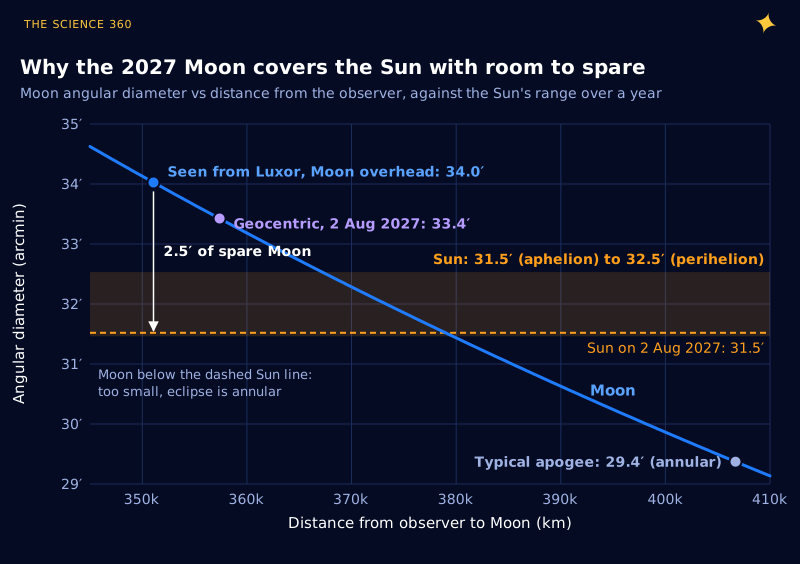
The Moon's orbit is an ellipse. Its distance from Earth's center swings between roughly 356,400 km at the closest perigees and 406,700 km at the farthest apogees. On 2 August 2027 the Moon passes perigee at 07:25 UTC, about two and a half hours before greatest eclipse. At mid-eclipse the ephemeris puts it 357,384 km from Earth's center.
There's a second, less obvious bonus. Near Luxor the Moon is almost straight overhead, so you are standing on the side of Earth facing it, about one Earth radius closer than Earth's center is. That shaves another 6,300 km off the distance.
Worked calculation 1: how big do the Moon and Sun look?
Moon radius . Angular diameter:
Moon from Earth's center, :
Moon from the ground near Luxor, :
Sun: , distance on 2 Aug 2027 = 1.01491 AU = 151.8 million km:
The spare 2.5′ is about 150 arcseconds, and 1.079 is the "magnitude" NASA lists for this eclipse.
Now run the same numbers for a Moon at its average distance of 384,400 km. Seen from overhead it would be 31.6′ wide, only 0.08′ bigger than the 2027 Sun. The spare margin would shrink from 2.5′ to under a tenth of an arcminute, about thirty times less. That is the leverage I mentioned. Moving the Moon 7% closer multiplies the margin by around 30, because the margin is the small difference between two nearly equal numbers.
Reason 2: the Sun looks small in early August
The Sun's apparent size changes too, by about 3.4% over the year. Earth is closest to the Sun (perihelion) in early January, when the Sun is 32.5′ wide, and farthest (aphelion) in early July, when it's 31.5′. Aphelion 2027 falls on 5 July. Four weeks later Earth is still 1.0149 AU out, so the Sun is within 0.06′ of its smallest. Every arcsecond the Sun loses is an arcsecond of extra totality margin.
A January eclipse has a bigger Sun to cover and starts with a handicap of about 1′, which is why the longest eclipses cluster in northern summer.
How wide is the Moon’s shadow on the ground?
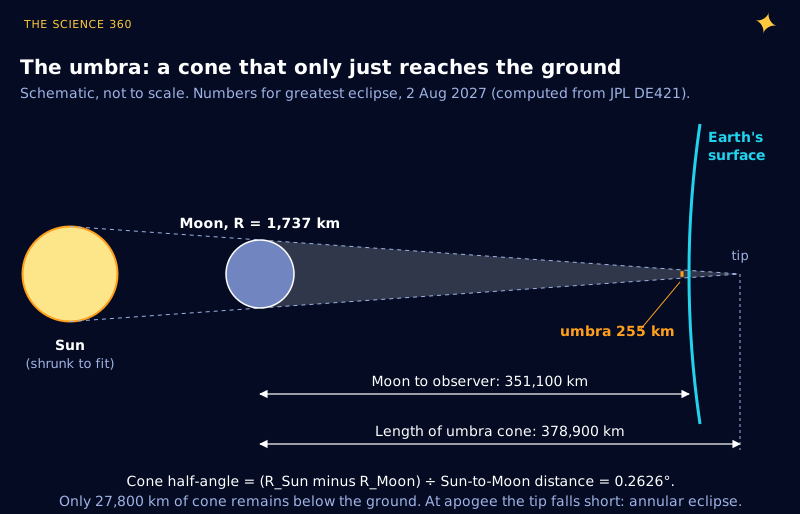
The two angular sizes have a physical counterpart, the umbra. Light from the Sun's edges converges past the Moon into a cone of total shadow. Where you stand inside that cone, the whole solar disk is hidden. The question is how much of the cone is left when it reaches the ground.
Worked calculation 2: the umbra width
Sun-to-Moon distance:
Cone taper:
Length of the umbra cone:
Distance from Moon to observer . Umbra radius at the ground:
Umbra diameter ≈ 255 km (NASA's path width: 258 km).
The cone is 378,900 km long, and the ground is 351,100 km from the Moon. Only the last 7% of the cone sticks below Earth's surface. The cone's length barely depends on where the Moon is; it is set by the Sun's distance and runs from about 367,000 km in January to 379,000 km in July. Put the Moon at apogee, 400,000 km from an observer underneath it, and the cone would end in mid-air some 21,000 km above your head. No umbra reaches the ground, and you see an annular eclipse.
Reason 3: Egypt is running alongside the shadow
A wide shadow is half of a long eclipse. The other half is how fast the shadow slides over you. Here we hit the most misunderstood part of the whole story.
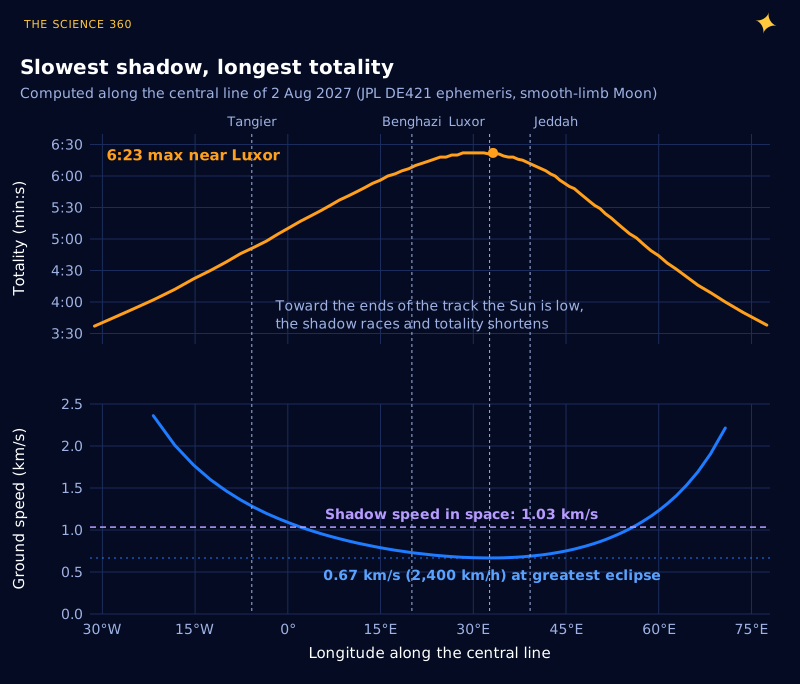
The Moon orbits Earth eastward at around 1 km/s. In the plane perpendicular to the sunlight, the shadow moves at almost the same speed. At greatest eclipse in 2027 the ephemeris gives 1.035 km/s. That's in space, though. You're not standing still in space: Earth's rotation is carrying you east too, at 465 m/s at the equator, times the cosine of your latitude.
At 25.5°N that's 420 m/s. Near local noon, with the Sun close to overhead, nearly all of that velocity lies in the same plane as the shadow's motion, so it subtracts directly. You're running after the shadow at 40% of its speed.
Worked calculation 3: from shadow speed to 6 minutes 23 seconds
Shadow speed in space (fundamental plane), 10:07 UTC: 1.035 km/s. Earth's surface speed at 25.5°N:
The component of that speed along the shadow's direction is 0.388 km/s (the shadow's track is tilted against the equator, so the subtraction is done as vectors). Relative speed of the shadow over the ground: 0.666 km/s ≈ 2,400 km/h.
Same result from angles: the spare Moon is 150″ in diameter, divided by the Moon's apparent drift relative to the Sun as seen from Luxor:
Two different routes, one in kilometers and one in arcseconds, land on the same 383 seconds, matching NASA's 6m23s. A full calculation that steps through time (Figure 4) gives 382 s with a smooth-edged Moon; the official tables also include the bumpy lunar limb profile and refined constants, which accounts for the last second or two.
The perigee paradox
A Moon near perigee moves faster, not slower. Kepler's second law says so, and the ephemeris agrees: 1.10 km/s on 2 August 2027 versus about 0.97 km/s near apogee. A faster Moon means a faster shadow, which should shorten totality by roughly 8%. So perigee works against you on speed. It wins anyway, because it multiplies the size margin by about 30. Size beats speed by a mile.
Why it matters that the Sun is overhead
The location of greatest eclipse is set by geometry, not luck. On 2 August the Sun is directly over latitude 17.8°N. The shadow axis on this date passes 904 km north of Earth's center (that offset, divided by Earth's radius, is the 0.142 "gamma" value in NASA's catalog), so it lands at 25.5°N where the Sun is 82° high. That gets you three benefits at once. You're closest to the Moon, adding 1.8% to its apparent size. The shadow hits the ground head-on, so its footprint isn't smeared. And your rotational velocity is aimed almost entirely along the shadow's path.
Away from that sweet spot, all three fade. Over Morocco the Sun is only 40° high and the shadow crosses the ground at 1.2 km/s. Out in the Atlantic at sunrise it streaks along at over 4 km/s. Totality there still lasts about 3.5 minutes, because a low Sun stretches the footprint into a long ellipse, but the gain doesn't make up for the speed.
Could an eclipse be even longer than 2027?
Yes, a little. The Belgian astronomer Jean Meeus put the theoretical ceiling at about 7 minutes 31 seconds (Journal of the British Astronomical Association, 2003): an early-July eclipse near the equator, where Earth's surface moves fastest (465 m/s versus 420 m/s at Luxor), with the Moon at a close perigee.
The 2027 eclipse misses that ceiling because it falls four weeks after aphelion and its shadow lands at 25.5°N, not in the deep tropics. The record holder among the 6,326 total eclipses computed for 4000 BCE to 6000 CE is 16 July 2186, at 7 minutes 29 seconds over the Atlantic, which hits nearly every condition.
What is Saros 136, and how is 2027 linked to 1991 and 2009?
Eclipses repeat in families called Saros series. After 6,585.3 days (18 years, 11 days and 8 hours) the Sun, Moon and lunar node return to almost the same configuration, and the Moon returns to nearly the same point in its elliptical orbit. That last part is why Saros siblings have similar durations. The extra 8 hours means Earth has turned another third of a rotation, so each eclipse lands about 120° of longitude further west.
The 2027 eclipse is member 38 of 71 in Saros 136. Its older siblings include some famous ones. The 29 May 1919 eclipse is the one Arthur Eddington's expedition photographed from the island of Príncipe to test Einstein's prediction that the Sun bends starlight, the first major confirmation of general relativity. The 11 July 1991 eclipse gave Hawaii and Mexico 6 minutes 53 seconds. The 22 July 2009 eclipse crossed India and China.
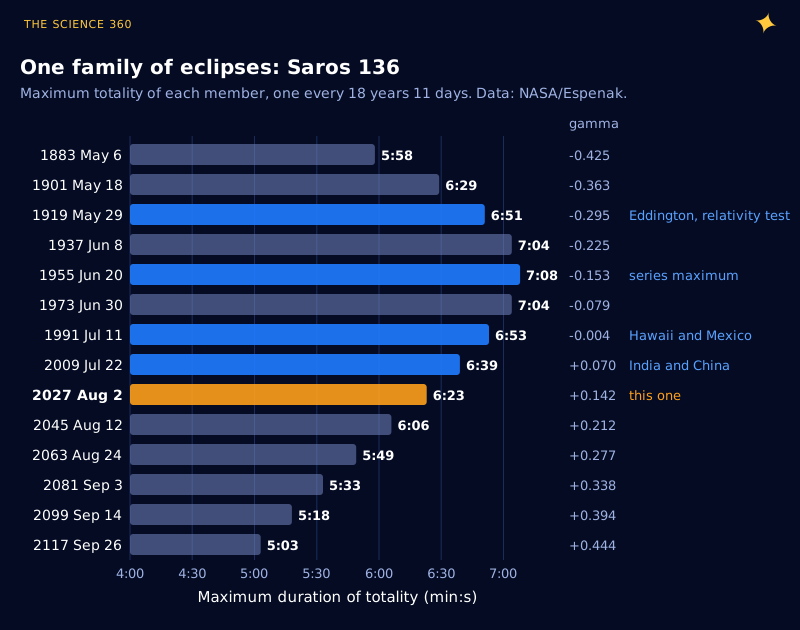
Saros 136 peaked on 20 June 1955 at 7 minutes 8 seconds, when its eclipse fell two weeks before aphelion with the shadow axis close to Earth's center. Since then each member arrives 11 days later in the calendar, drifting past aphelion into a slightly bigger Sun, and its gamma creeps from negative toward positive, so the shadow lands further from the subsolar point. Each one loses 11 to 17 seconds. The next sibling, on 12 August 2045, gets 6 minutes 6 seconds.
Common misconceptions about the 2027 eclipse
"The whole world will go dark." Totality covers a strip about 258 km wide. Outside it, partial means daylight. London sees about half the Sun's diameter covered and would barely notice the dimming.
"Cairo and Aswan are in the path." Neither is. Cairo is about 220 km north of the northern limit and gets roughly 95% of the Sun's diameter covered. Aswan sits just outside the southern edge with about 99.6% covered, per timeanddate's data cited by trip planners. That sounds close, but 99.6% is still bright daylight with a dangerous sliver of Sun. A Nile cruise moored in Aswan on 2 August misses the show.
How to watch the 2027 eclipse safely
The physics of totality is the physics of eye safety too. During the partial phases even 1% of the Sun's disk is about as bright as a few thousand full Moons, enough to burn the retina without pain. NASA's rules are short:
- Use eclipse glasses or a handheld viewer that meets the ISO 12312-2 standard, and discard any that are scratched or torn. Normal sunglasses, even very dark ones, are not filters.
- Take them off only when you can't see any part of the Sun through them. That's totality. Put them back on the moment a bright bead of light reappears on the Moon's western edge.
- Never look through binoculars, a camera or a telescope with eclipse glasses on. Optics need their own solar filter mounted on the front, the Sun-facing end, or the concentrated light can burn through.
- Outside the path of totality, including Cairo and Aswan, the glasses stay on the whole time.
A pinhole in a card, with the Sun behind you, projects a safe image; under a tree, the gaps between leaves throw hundreds of tiny crescents on the ground. If you can get to Upper Egypt, plan for heat above 40 °C and pick a site near the central line between Sohag and Luxor. You'll have six minutes. Spend the first one just looking.
FAQ
Why is the 2027 solar eclipse so long?
A near-perigee Moon looks big, a near-aphelion Sun looks small, and the shadow lands where the Sun is 82° high, so Earth's rotation slows it to about 0.67 km/s over the ground.
Is the 2027 eclipse the longest of the century?
No. The 22 July 2009 eclipse reached 6 minutes 39 seconds over the Pacific. The 2027 eclipse is the longest totality over land between 1991 and 2114.
Where is the best place to see the 2 August 2027 eclipse?
Upper Egypt: Luxor gets about 6 minutes 22 seconds with very low odds of cloud. Benghazi, Jeddah and the Strait of Gibraltar are also in the path. Cairo and Aswan are not.
Will the 2027 solar eclipse be visible in the UK, US or India?
The UK sees a partial eclipse, about half the Sun's diameter covered from London. Western India sees a small partial eclipse in the late afternoon. The United States sees nothing, since it happens before sunrise there.
When is the next total solar eclipse as long as 2027?
Nothing longer crosses land until 16 July 2114. The next member of the same Saros family, on 12 August 2045, peaks at 6 minutes 6 seconds.
Related on The Science 360
Sources
- NASA Eclipse Web Site (F. Espenak), Total Solar Eclipse of 2027 Aug 02, Besselian data and greatest eclipse: eclipse.gsfc.nasa.gov/SEsearch/SEdata.php?Ecl=+20270802
- NASA Eclipse Web Site, Catalog of Saros 136: eclipse.gsfc.nasa.gov/SEsaros/SEsaros136.html
- Wikipedia, Solar eclipse of August 2, 2027 (perigee time, city durations from Espenak's tables): en.wikipedia.org/wiki/Solar_eclipse_of_August_2,_2027
- Space.com, Total solar eclipse 2027 complete guide (longest over land 1991 to 2114): space.com/total-solar-eclipse-2027-complete-guide-where-when-how-to-see-it
- Meeus, J. (2003), The maximum possible duration of a total solar eclipse, JBAA 113, 343: articles.adsabs.harvard.edu/pdf/2003JBAA..113..343M
- Wikipedia, Solar eclipse of May 29, 1919 (Saros 136, Eddington expedition): en.wikipedia.org/wiki/Solar_eclipse_of_May_29,_1919
- NASA Science, Eclipse safety: science.nasa.gov/eclipses/safety/
- JPL planetary ephemeris DE421 (used for all computed positions, distances, path and durations, via the Skyfield library): ssd.jpl.nasa.gov/planets/eph_export.html
- Tripprof, Egypt 2027 eclipse guide (timeanddate data for Aswan, 99.6% partial): tripprof.com/en/blog/solar-eclipse-egypt-2027-budget-guide/
- Wikipedia, Solar eclipse of July 16, 2186 (longest of 6,326 total eclipses, 4000 BCE to 6000 CE): en.wikipedia.org/wiki/Solar_eclipse_of_July_16,_2186
Header image: NASA/GRC/Jordan Salkin (image GRC-2024-C-02645), regraded for this article.