What Color Is the Sun Really? White, and Here's Why
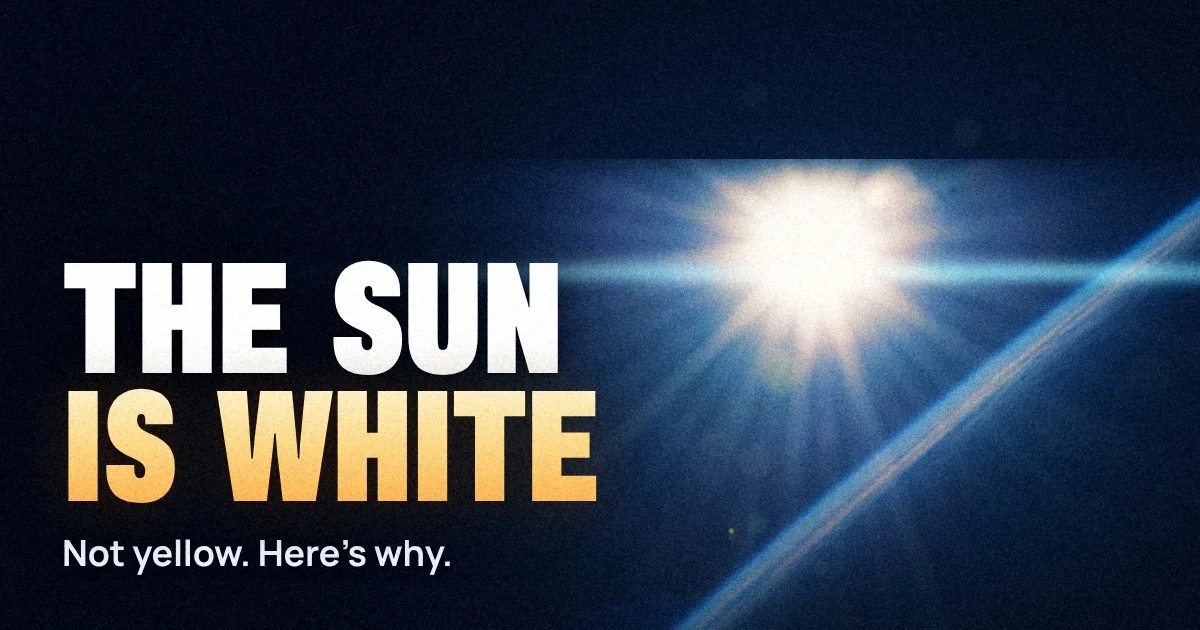
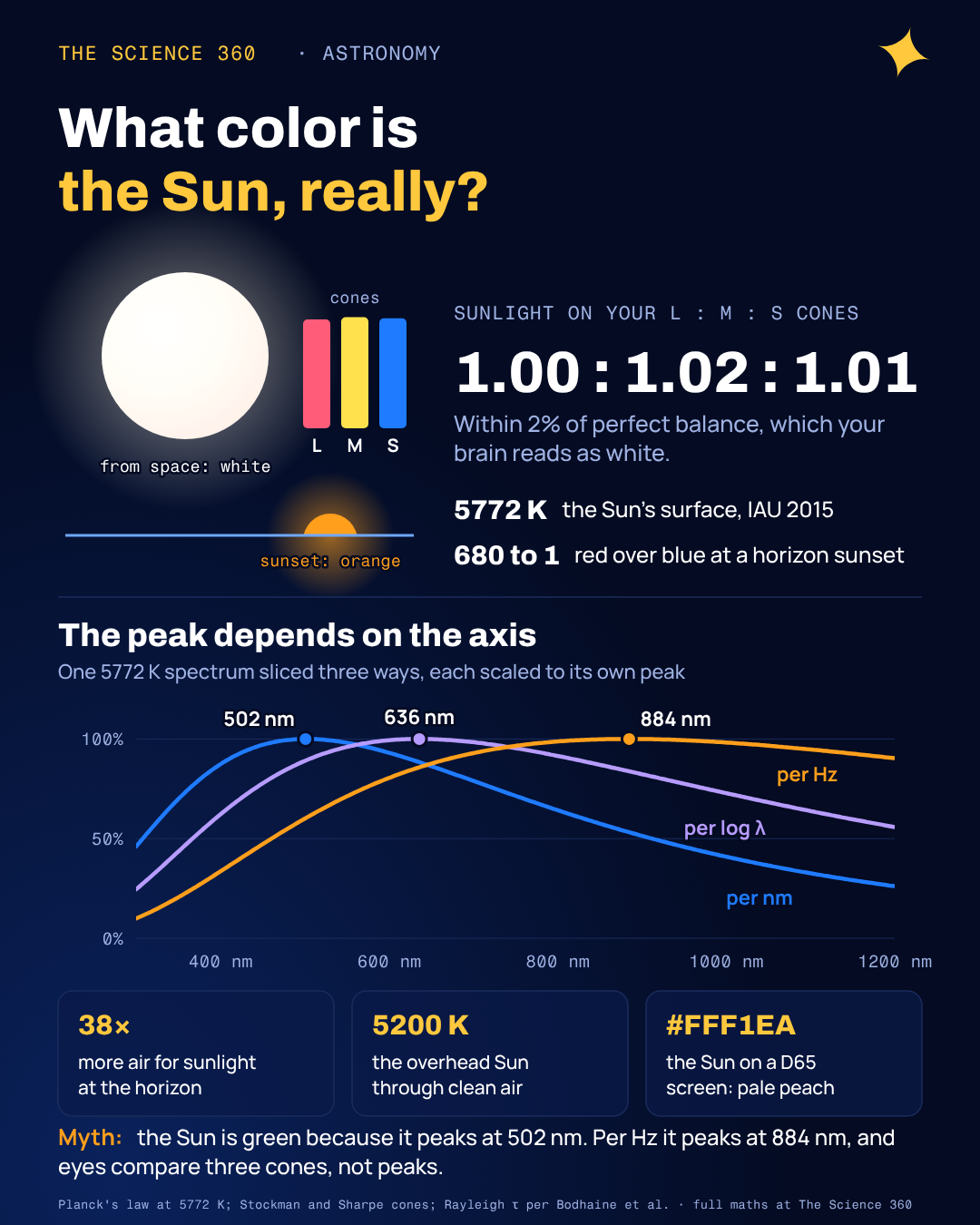
Ask a room of children to draw the Sun and you get yellow crayons. Ask a room of physics students and someone will tell you, with great confidence, that the Sun is actually green because its spectrum peaks at 500 nm. Both answers are wrong, and the second one is wrong in a more interesting way. The Sun's surface radiates like a body at 5772 kelvin, and when you push that spectrum through the actual machinery of human color vision, the answer comes out as white. Not "sort of white". Measurably, calculably white.
What does the Sun’s spectrum actually look like?
The Sun is not a perfect blackbody (its spectrum is notched by thousands of absorption lines from elements in its atmosphere) but across the visible band a blackbody is a very good stand-in. The International Astronomical Union fixed the nominal solar effective temperature at 5772 K in 2015. Plug that into Planck's law and you get Figure 1.
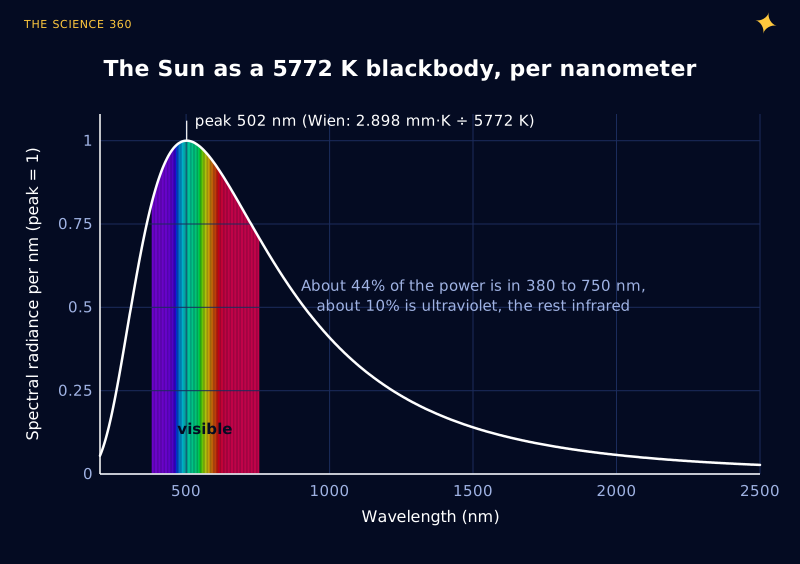
Two things stand out. First, the peak sits almost in the middle of what we can see, which is not a coincidence: our eyes evolved under this light. Second, the curve is remarkably flat across the visible band. Integrating it shows that about 44% of the Sun's blackbody power falls between 380 and 750 nm, about 10% is ultraviolet, and the rest is infrared.
Wien's displacement law, per unit wavelength
The constant is from CODATA. Ratio of radiance at 700 nm and at 420 nm to the peak, from Planck's law:
502 nm is a blue-green, close to the color of a swimming pool under a white tile. That is where the "the Sun is green" idea comes from.
Is the Sun green because it peaks at 500 nm?
No, and there are two independent reasons. Either one alone kills the claim.
Reason 1: the peak moves when you change the axis
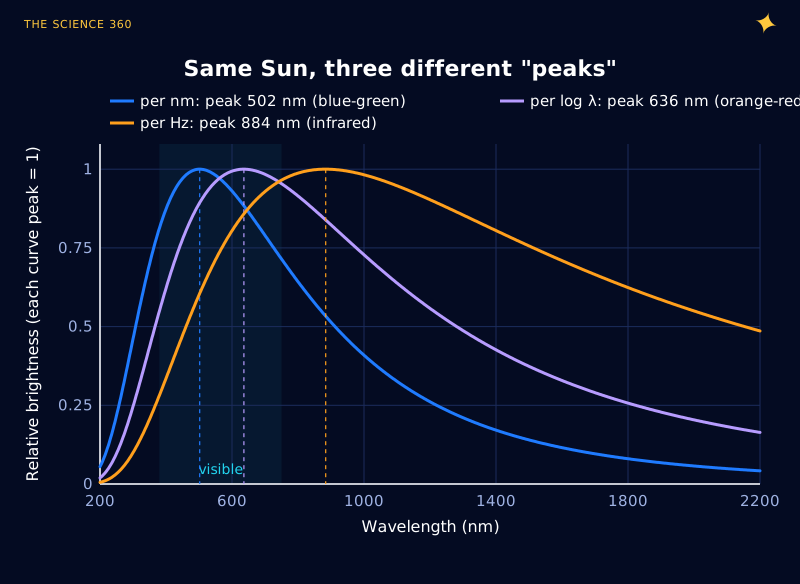
A spectrum is a density: power per little slice of something. The "peak" is the slice with the most power, and its location depends on how you cut the slices. If you slice by equal steps of wavelength (per nm), you get 502 nm. If you slice by equal steps of frequency (per Hz), the slices are narrower in wavelength at the blue end and wider at the red end, so the peak shifts, a lot.
Per unit frequency, Wien's law has a different constant
Convert to a wavelength:
Per log wavelength (equal ratios, like octaves), the peak is at .
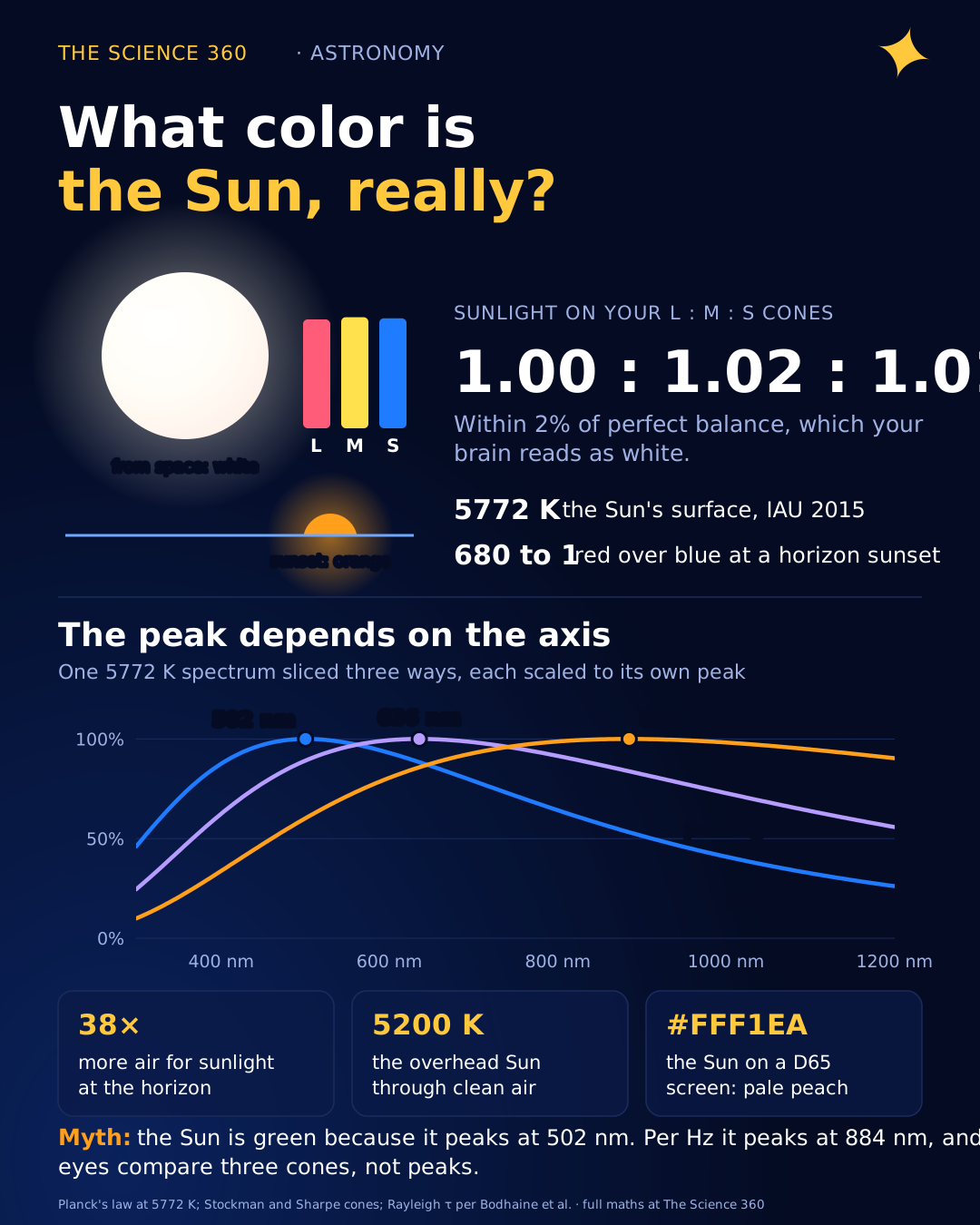
So the very same sunlight "peaks" at 502 nm (blue-green), 636 nm (orange-red) or 884 nm (infrared, invisible), depending only on bookkeeping. Physicists Jonathan Marr and Francis Wilkin made exactly this point in a 2012 paper in the American Journal of Physics, arguing that the per-wavelength peak is routinely over-interpreted. A quantity that changes color when you change units cannot be "the color of the Sun".
Reason 2: your eye does not look for a peak
Even if the peak were unambiguous, color vision does not work by finding it. You have three types of cone: short (S), medium (M) and long (L) wavelength cones. Each responds to a broad range of wavelengths, and they overlap heavily. Your brain only ever gets three numbers, the total excitation of each cone type, and color is the ratio between them. A spectrum that excites all three in balance looks white, wherever its peak is.
So the question "what color is the Sun" has a precise version: multiply the solar spectrum by each cone's sensitivity curve, add up, and compare. I did that with the Stockman and Sharpe cone fundamentals, the modern standard for the average human eye (peaks at about 442, 543 and 570 nm in this data set), and compared the result with a perfectly flat "equal energy" spectrum that colour scientists use as a reference white.
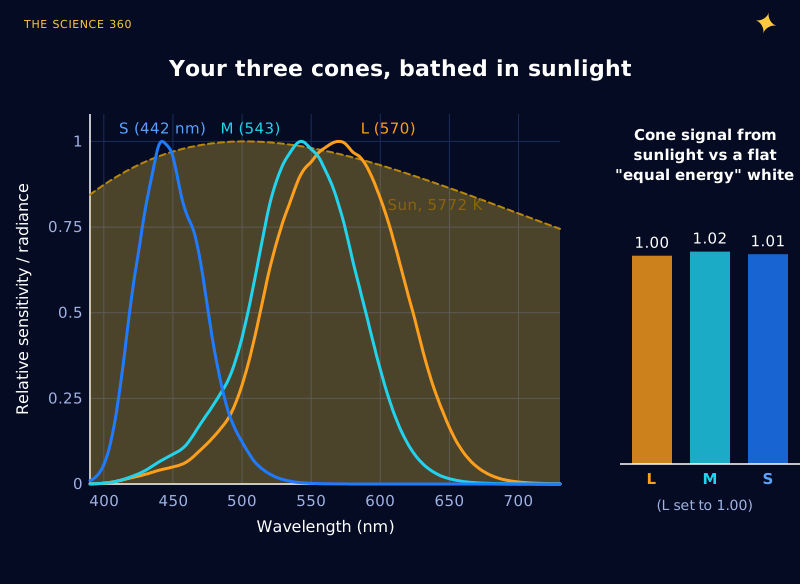
Within two percent of perfect balance. The slight surplus of green is far too small to tint anything; a green that you can actually see needs the M signal to beat its neighbors by much more than that. And notice the overlap in Figure 3: 502 nm light is not "only for" one cone type. It drives the M cones hard, but also the L cones and a fair bit of the S cones. The "green" of a green laser comes from narrow light that excites M and L unevenly. Sunlight is the opposite of narrow.
Where does the Sun sit on a color chart?
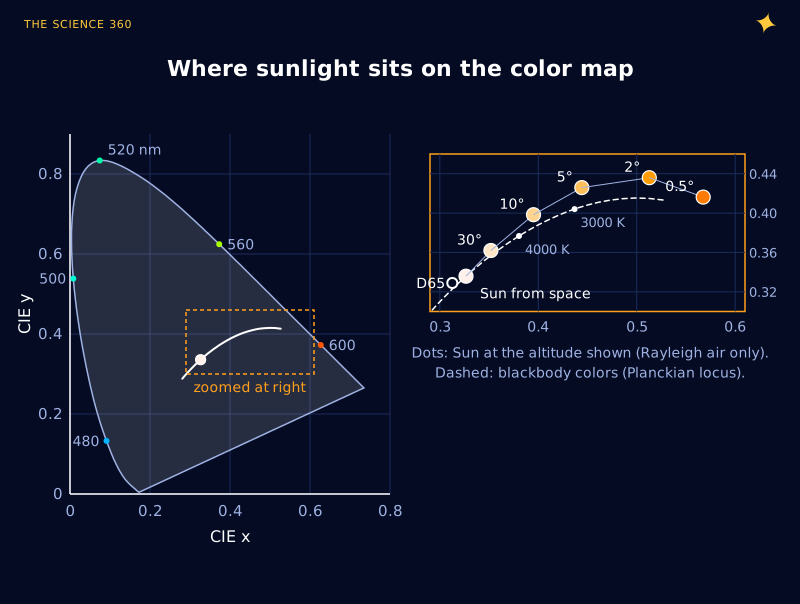
Colour scientists summarize those three cone numbers into a 2D map, the CIE 1931 chromaticity diagram. Pure spectral colors run around the curved edge; whites live near the middle. The line through the middle is the Planckian locus, the colors of blackbodies from candle-orange to sky-blue.
The computed chromaticity of a 5772 K blackbody is . For comparison, the D65 standard daylight white that your phone and monitor are calibrated to is , and the theoretical equal-energy white is . The Sun sits between them. If you rendered the Sun's light on a screen calibrated to D65, it would show as an extremely pale peach (sRGB about #FFF1EA) because the screen's "white" is a slightly bluer 6500 K. Stand in the light itself and your visual system adapts to it within seconds and calls it white.
Why does the Sun look yellow, then orange, from the ground?
Air molecules are far smaller than the wavelength of light, so they scatter in the Rayleigh regime, where the amount scattered rises steeply as the wavelength falls, close to . Every bit of blue scattered out of the direct beam lights up the rest of the sky (which is why the sky is blue) and is missing from the disk you look at.
The strength of this filtering depends on how much air the light crosses, the airmass. Overhead it is 1 by definition. At the horizon it is about 38, using the Kasten and Young formula that accounts for Earth's curvature and refraction.
Rayleigh optical depth of the whole atmosphere at sea level (Bodhaine et al. 1999 method)
Check against : ; the actual ratio 0.221/0.049 = 4.50, because air's refractive index also rises toward blue.
Transmission through air mass :
Sun overhead, X = 1
Blue loses 20%, red 5%: the direct beam's color temperature is about 5200 K, a faintly warm white.
Sun on the horizon, X ≈ 38
Red now outnumbers blue by 0.155 / 0.00023 ≈ 680 to 1 relative to the original sunlight.
That last line is the whole sunset in one number. Blue light from the setting Sun is down to two parts in ten thousand; red still has one part in seven. Figure 5 shows the full transmission curves and the resulting color of the solar disk, computed from the same equations.
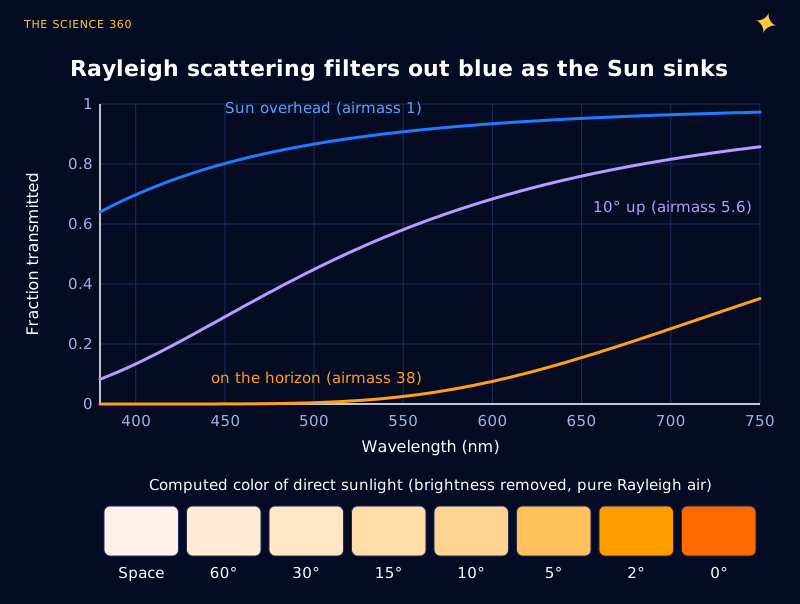
In clean air the model puts the overhead Sun at about 5200 K, the Sun at 30° near 4800 K, 10° near 3800 K, and 2° near 2300 K, close to candlelight. Real air is dirtier than pure Rayleigh (aerosols add scattering that is less steep with wavelength, and ozone absorbs in the orange), so actual sunsets are usually redder and dimmer than these numbers. The physics points the same way; only the strength differs.
So why do we draw the Sun yellow?
Partly physics, partly culture. From the ground at midday the direct beam really is a little warmer than white, and against a deep blue sky it looks warmer still by contrast. The Sun is also far too bright to look at (please do not try: staring at it can cause permanent retinal damage), so our mental picture comes from glances, hazy days, and the low Sun near sunrise and sunset, when it is dim enough to look at and genuinely yellow or orange. Astronomers add to the confusion by calling it a "yellow dwarf", which is a classification label for a G-type star, not a color measurement.
Snow is a good everyday check. Fresh snow reflects all visible wavelengths almost equally, so it takes on the color of whatever lights it. In direct midday sun, snow looks white, not yellow. That is your eye's verdict on sunlight.
From orbit the atmosphere drops out entirely, and astronauts consistently describe the Sun as brilliant white. Former NASA astronaut Scott Kelly put it bluntly in 2022 when asked about a post saying the Sun is white: he confirmed it.
Why are NASA photos of the Sun orange or gold?
Because most of them are not visible-light pictures. The Solar Dynamics Observatory and similar missions image the Sun in ultraviolet and extreme ultraviolet bands that reveal the corona and flares. Those wavelengths have no visible color, so each channel is given a false color by convention, and the 171 Å channel, the most widely shared, happens to be rendered in gold. Visible-light "white light" images of the Sun, when not color-adjusted, are white or gray.
The same atmosphere that tints the Sun also makes the stars twinkle, which we covered in why stars twinkle but planets don't. And if the Sun is a white light filling the day sky with scattered blue, you might reasonably ask why the night sky, with billions of suns in it, is not bright too; that is why the sky is dark at night (Olbers' paradox).
FAQ
Is the Sun white or yellow?
White. Above the atmosphere the Sun's light stimulates all three types of cone in your eye almost equally, which is what white means. From the ground the atmosphere removes some blue, pulling the direct beam to about 5200 K overhead, a faint warm white, and much further toward orange near the horizon.
If the Sun peaks in green light, why isn’t it green?
The peak is very broad and its position depends on how you plot the spectrum: 502 nm per unit wavelength, 636 nm per log wavelength, 884 nm per unit frequency. Your eye does not detect a peak; it compares how strongly three overlapping cone types are excited, and sunlight excites them almost equally.
What color is the Sun from space?
White, with at most a barely warm tint compared with a computer screen's white point. Astronauts describe it as brilliant white, and the computed chromaticity of a 5772 K blackbody sits right next to standard daylight white.
Why is the Sun orange or red at sunset?
Near the horizon sunlight passes through about 38 times as much air as at the zenith. Rayleigh scattering removes blue far more strongly than red, so only about 0.02% of 450 nm blue survives compared with about 15% of 650 nm red. Dust, smoke and aerosols make it stronger.
Why do NASA pictures show the Sun as orange or gold?
Most dramatic solar images are taken in ultraviolet or extreme ultraviolet light that our eyes cannot see, then given false colors to tell the channels apart. The gold is a labeling choice, not the Sun's visible color.
Related on The Science 360
Sources
- IAU 2015 Resolution B3, nominal solar effective temperature 5772 K: resolution text (PDF); text and discussion in Mamajek et al., arxiv.org/abs/1510.07674
- NIST CODATA, Wien wavelength displacement law constant (2.897771955×10⁻³ m·K): physics.nist.gov
- Marr, J. M. and Wilkin, F. P. (2012), "A better presentation of Planck's radiation law", American Journal of Physics 80, 399: arxiv.org/abs/1109.3822
- Stockman, A. and Sharpe, L. T. (2000), 2° cone fundamentals, Colour and Vision Research Laboratory database: cvrl.org
- Cone cell peak sensitivities and individual variation: en.wikipedia.org/wiki/Cone_cell
- Bodhaine, B. A. et al. (1999), "On Rayleigh optical depth calculations", J. Atmos. Oceanic Technol. 16, 1854: doi.org/10.1175/1520-0426(1999)016<1854:ORODC>2.0.CO;2
- Kasten, F. and Young, A. T. (1989), "Revised optical air mass tables and approximation formula", Applied Optics 28, 4735: doi.org/10.1364/AO.28.004735
- CIE 1931 colour matching functions and Planckian locus computations: Colour Science for Python (colour-science), colour-science.org
- Report on Scott Kelly confirming the Sun is white (2022): geo.tv
- NASA Scientific Visualization Studio, SDO/AIA 171 Å shown with a gold color table because the wavelengths are invisible to the eye: svs.gsfc.nasa.gov/3999
Header image: NASA (image iss066e152099), regraded for this article.